Crib Mattress Certifications Explained
Crib mattress certifications help parents understand which safety and emissions standards a mattress has actually been tested to meet. Some labels represent real third-party certifications such as GREENGUARD Gold, while others are simply marketing terms that sound reassuring but are not verified by independent testing organizations.
Trying to understand which crib mattress certifications actually matter? Start here:
What makes a crib mattress safe?
Are breathable crib mattresses really safer?
Are organic crib mattresses worth the extra expense?
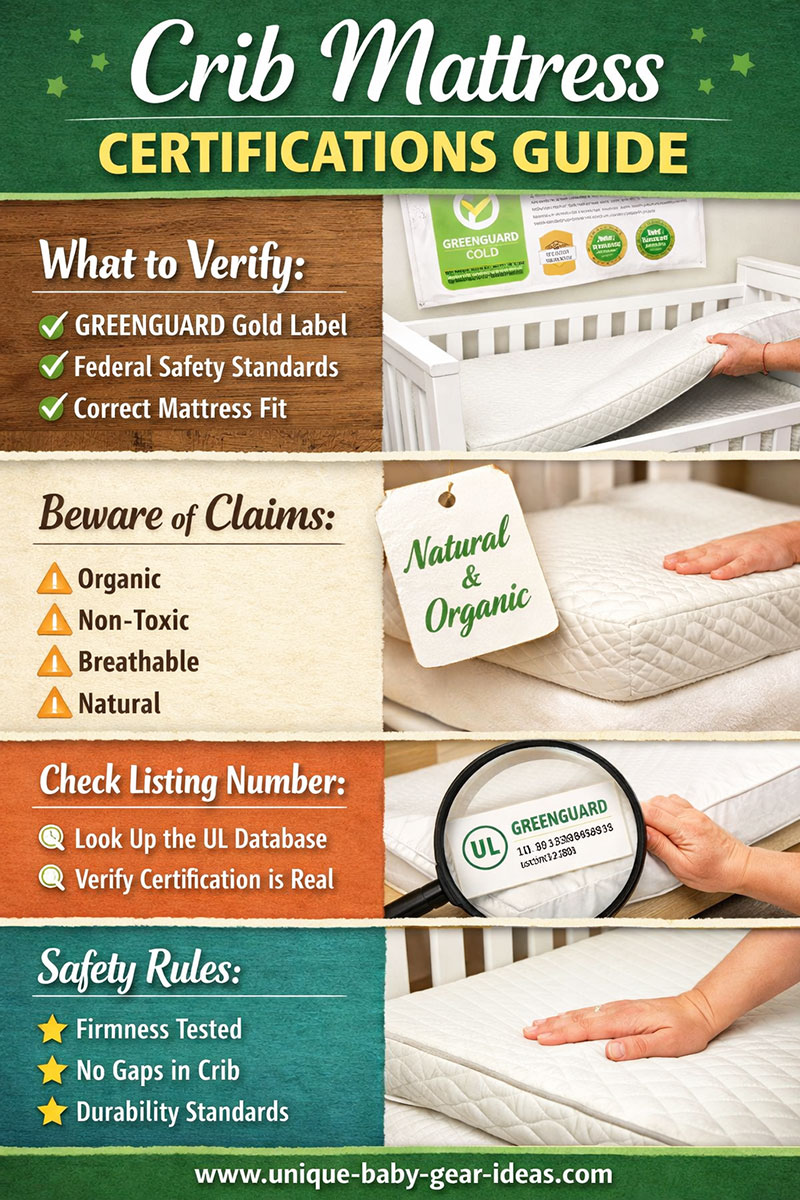
Understanding crib mattress certifications can make it much easier to compare safety claims, emissions labels, and quality standards before you buy.
The buying process becomes a lot clearer when you see how everything fits together as my crib mattress guide lays out very clearly.
Jump to a Section
What Crib Mattress Certifications Mean
Which Labels Are Real Certifications
Crib Mattress Certifications ComparisonFederal Safety Rules Parents Should Know
Marketing Claims That Are Not Certifications
What Crib Mattress Certifications Mean
Crib mattress certifications are independent testing programs that confirm a mattress meets specific safety or emissions standards. The certification parents see most often is GREENGUARD Gold, which measures indoor air emissions, while all crib mattresses sold in the United States must also meet safety rules enforced by the Consumer Product Safety Commission.
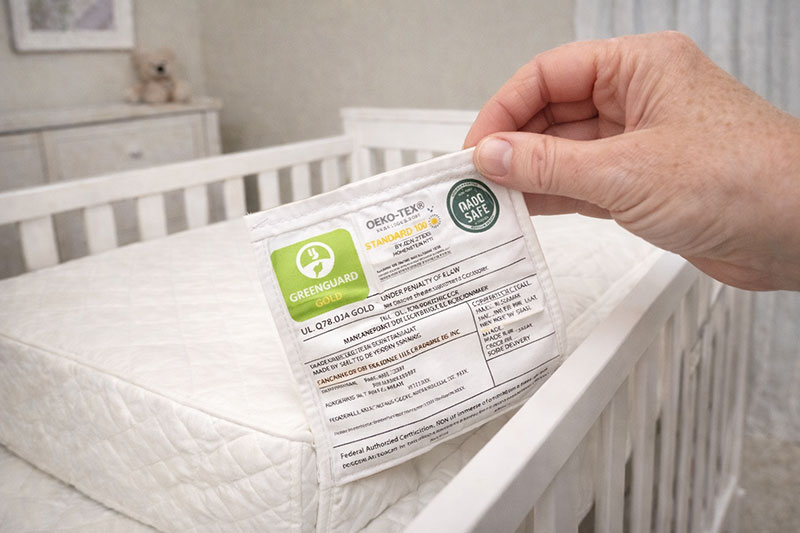
This becomes easier to understand once you see it in real life. A parent might unbox a new mattress and notice several badges printed across the cover. At first glance, every label looks official, but a closer look often shows that only one represents a verified third-party certification. This situation happens frequently when families compare mattresses during nursery setup, which is why my best breathable crib mattress guide compares how airflow-focused designs perform once they are actually in use, including whether they stay firm, fit correctly, and maintain a stable sleep surface.
Crib mattress certifications are meant to confirm three key things: that the materials release measured levels of indoor emissions, that the mattress meets required structural safety standards, and that the manufacturer followed documented testing procedures. Not every mattress label is a certification, which is why understanding the difference matters when comparing products.
For a more complete view of how mattress construction, materials, and design choices come together, see my Newton vs Naturepedic crib mattress comparison, which looks at how breathable design and organic materials differ in real-world use. You can also review my guide to crib mattresses for a full overview of types and construction, and check these crib mattress fit rules to understand why proper sizing and tight fit are critical for crib safety.
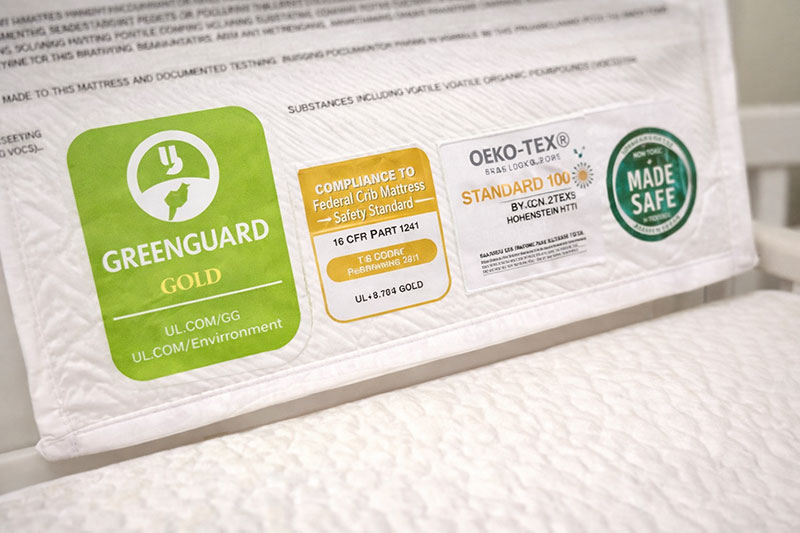
Which Crib Mattress Labels Represent Real Certification Programs
The certification parents encounter most often is GREENGUARD Gold.
This certification is issued by UL Solutions.
It verifies that a product meets strict indoor air emission limits.
Products tested under the GREENGUARD Gold standard are intended for spaces where children spend extended periods of time.
These spaces include schools and childcare environments.
The testing measures volatile organic compounds released from mattress materials.
Parents usually notice this label when comparing two mattresses that appear similar but carry different certification badges.
Another required verification involves compliance with the federal crib mattress rule.
In the United States, crib mattresses must comply with the safety regulation known as 16 CFR Part 1241.
The rule is enforced by the Consumer Product Safety Commission.
This regulation requires firmness testing.
It also requires durability testing.
The rule includes dimensional fit testing so that a mattress fits properly inside a standard crib.
These tests exist because gaps between the mattress and crib frame can create a sleep hazard.
An official explanation of these requirements is available through the Consumer Product Safety Commission.
Get crib safety guidance from the U.S. Consumer Product Safety Commission.
GREENGUARD vs GREENGUARD Gold Certification Differences
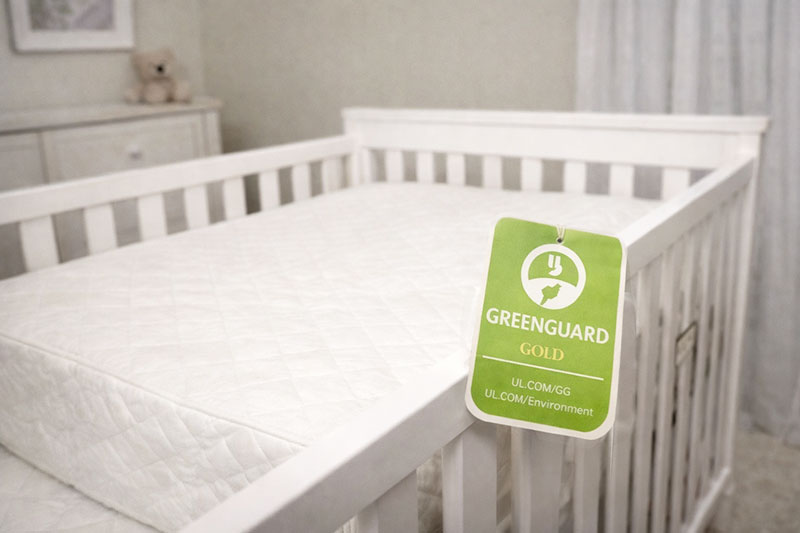
GREENGUARD and GREENGUARD Gold both measure indoor air emissions.
The difference is the emission limit used during laboratory testing.
GREENGUARD Gold uses stricter limits because it is designed for environments where children spend extended time.
When a crib mattress carries the GREENGUARD Gold label it means the mattress materials released lower measured levels of emissions during controlled testing.
Parents often notice this difference when comparing entry level mattresses with models that cost more.
The price difference sometimes reflects certification testing rather than visible construction differences.
A practical verification step that many buying guides fail to mention involves checking the certification listing number.
Every GREENGUARD certified product receives a listing number.
This number can be searched in the UL public database.
If the number cannot be located in that database, the certification claim should be treated cautiously.
This simple step allows parents to confirm certification claims before buying.
How the Most Common Crib Mattress Certifications Compare
Crib mattress certifications are often listed together, but each one focuses on a different part of safety. No single label covers everything, which is why it helps to understand what each certification actually tests and what it leaves out.
GREENGUARD Gold focuses on indoor air quality and low chemical emissions. It helps confirm that a mattress releases fewer volatile organic compounds (VOCs), but it does not verify whether the materials are organic or how the mattress is constructed.
GOTS (Global Organic Textile Standard) applies to textiles such as cotton fabrics used in mattress covers. It verifies organic sourcing and processing standards for those fibers, but it does not evaluate foam cores or overall mattress emissions.
GOLS (Global Organic Latex Standard) applies specifically to latex. It confirms that the latex content meets organic criteria and follows certain processing standards, but it does not cover other mattress components like covers, adhesives, or overall emissions.
OEKO-TEX Standard 100 tests finished materials for harmful substances. It helps confirm that specific components are free from certain chemicals at tested levels, but it does not guarantee low emissions or organic sourcing.
CertiPUR-US applies to polyurethane foam. It verifies that the foam is made without certain chemicals and meets emissions limits, but it only covers the foam layer, not the entire mattress.
These certifications fall into three different categories: emissions (like GREENGUARD Gold), organic material standards (like GOTS and GOLS), and foam or chemical content testing (like CertiPUR-US and OEKO-TEX). Each one answers a different question rather than providing a complete safety picture on its own.
For parents comparing certification labels alongside mattress construction, this dual-sided crib mattress vs single-sided crib mattress guide explains how two-stage designs and single-surface mattresses differ in firmness, materials, and long-term use.
The key takeaway is simple: certifications help verify specific claims, but they do not replace checking overall mattress fit, firmness, and construction as part of a complete crib sleep setup.
Parents comparing certified mattresses that offer separate infant and toddler sleep surfaces can also review dual sided crib mattresses to see how two-stage designs balance firmness, materials, and long-term use.
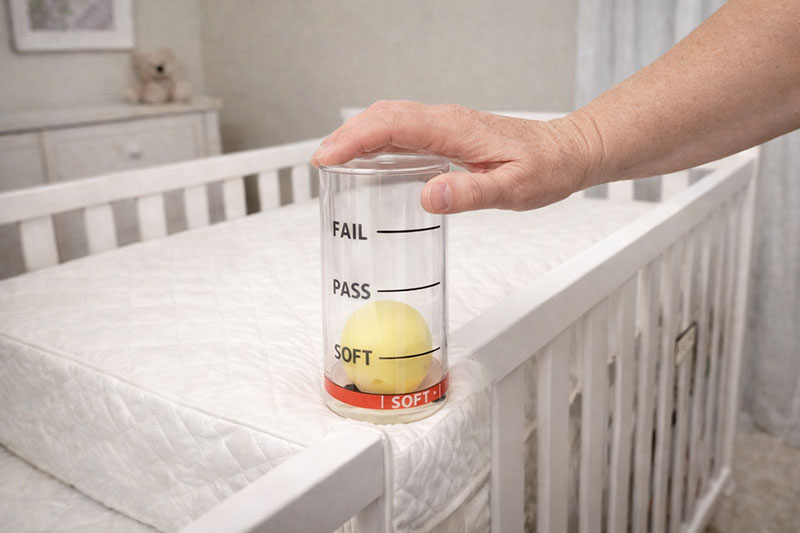
Federal Crib Mattress Safety Rules Parents Should Know
Beyond certification programs, crib mattresses must follow mandatory safety rules in the United States.
These rules apply to every crib mattress sold through retailers.
The federal standard requires firmness testing designed to reduce suffocation risk.
It also requires durability testing that simulates repeated compression.
The mattress must fit securely inside a crib built to standard crib dimensions.
If the mattress is too small, gaps can form along the sides of the crib.
To understand the mattress size used in these safety tests, see the measurement guide here.
To see the measurements used in federal safety testing, review the standard crib mattress size guide.
Many parents become aware of this requirement when assembling a crib and realizing that mattress fit matters more than brand name.
Firmness and correct fit remain the most important safety factors in an infant sleep space.
Mattress Claims That Are Not Certification Programs
Many mattress descriptions include words that appear official but do not represent independent certification programs.
Examples include:
Organic
Natural
Breathable
Non toxic
These terms may describe product characteristics.
Families who want to compare organic materials, verified labels, and overall crib mattress tradeoffs in one place can use my best organic crib mattress comparison.
To become more familiar with certification labels, material claims, and how parents can effectively sort through this category, see my organic crib mattresses guide.
They do not necessarily mean the mattress has been tested by an independent laboratory.
Parents often encounter these phrases when browsing mattress listings online.
A mattress may still meet safety standards.
However the words themselves are not proof of certification testing.
Recognizing the difference between marketing language and certification programs helps parents compare mattresses more accurately. For parents trying to sort out what “non-toxic” really means in crib mattress shopping, this non-toxic crib mattress guide explains which claims are meaningful and which ones are mostly marketing language.
How to Read a Crib Mattress Label Before Buying
A crib mattress label usually contains several key pieces of information.
The certification logo typically appears first.
The manufacturer identification number appears next.
This number allows regulators to trace the mattress to its testing documentation.
Material descriptions also appear on the label.
These descriptions identify foam type, fiber fill, or layered construction.
Parents often notice this label when removing a mattress from packaging during crib assembly.
The label allows retailers and regulators to trace the mattress back to its production batch if safety issues arise.
Crib Mattress Certification Checklist Parents Can Use
This checklist helps confirm the most meaningful mattress standards before purchasing.
Look for GREENGUARD Gold certification.
Confirm the mattress meets the federal crib mattress rule.
Check that the mattress size matches standard crib dimensions.
Verify the certification listing number when possible.
These steps take only a few minutes.
They provide confirmation that a mattress meets tested standards.
Many nurseries run into confusion because mattress packaging highlights marketing claims while the real certification information appears in smaller print.
Learning how to read those labels removes most of the uncertainty.
Frequently Asked Questions About Crib Mattress Certifications
Do crib mattresses have to be certified?
All crib mattresses sold in the United States must comply with safety rules enforced by the Consumer Product Safety Commission.
Some mattresses also carry voluntary certification programs such as GREENGUARD Gold.
Is GREENGUARD Gold required for crib mattresses?
No.
GREENGUARD Gold certification is voluntary.
It verifies indoor air emission testing but is not required by federal regulation.
Are organic mattress labels the same as certifications?
No.
Organic claims often describe materials used in the mattress cover or filling.
A certification indicates the product was tested and verified by an independent organization.
What matters most when choosing a crib mattress?
Firmness and correct mattress fit remain the most important safety factors for infant sleep spaces.
For a comparison of mattress sizes used in cribs and toddler beds, see this
guide.When you click on links to various merchants on this site and make a purchase, this may result in this site earning a commission. This does not affect the price you pay.
UBGI Gold Standard 2026
Reviewed under the site's
editorial checklist.
Photos, decorating ideas, party setups and reader submissions are shared for inspiration unless a page is specifically presented as a pattern, tutorial, reference guide or step-by-step project. Follow the instructions, measurements, safety guidance and manufacturer directions provided for the particular project or product.
About Jan | Contact | Baby Nursery Ideas (Blog) | Site Map | Privacy Policy | Disclosure Policy | Disclaimer | Affiliate Disclosure | Earnings Disclosure | Facebook | Pinterest
I am a participant in the Amazon Services LLC Associates Program, an affiliate advertising program designed to provide a means for us to earn fees by linking to Amazon. As an Amazon Associate I earn from qualifying purchases.
Copyright © 2006-2026. All Rights Reserved.