Standard Crib Mattress Size: Dimensions and Specifications
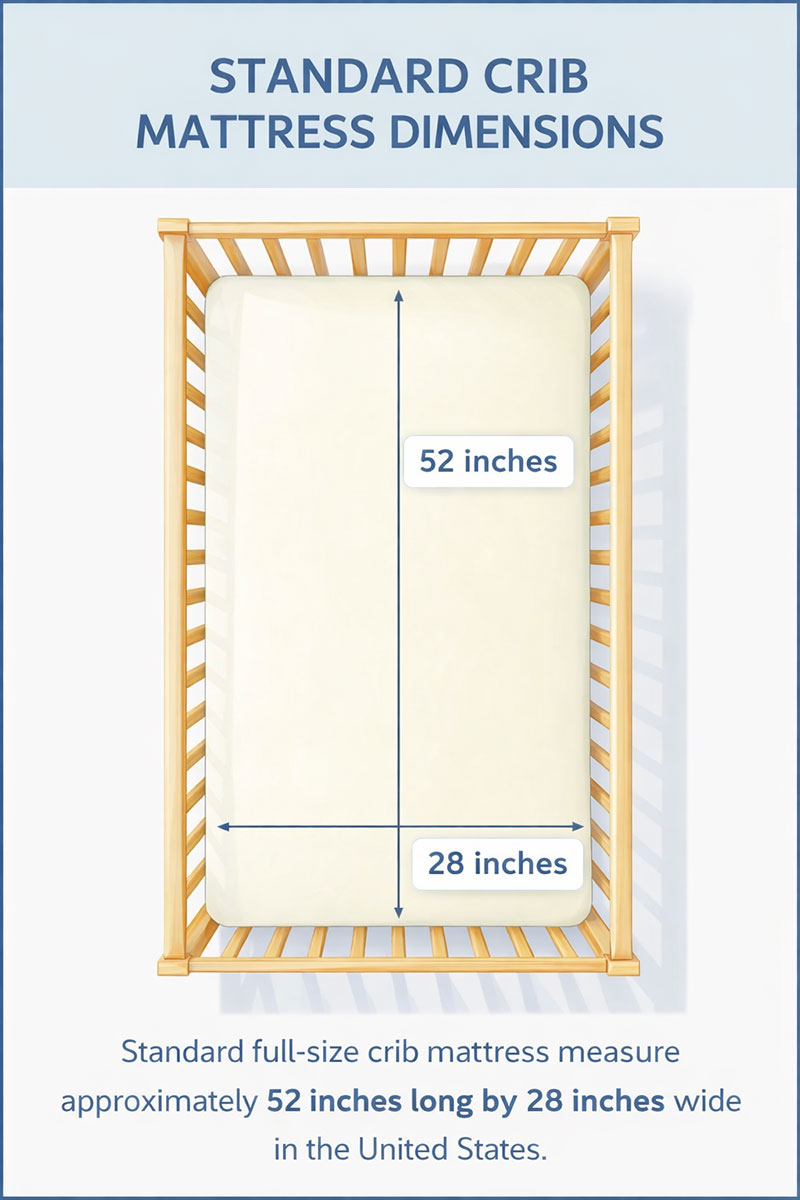
The standard crib mattress size in the United States is approximately 28 inches wide by 52 inches long. This measurement corresponds to the interior dimensions used for full-size cribs and is the mattress footprint most commonly referenced in manufacturer specifications and federal crib safety standards.Standard crib mattress dimensions and exact measurements
Trying to confirm the crib mattress size before you buy or use it? Start here:
How do you know if the mattress fits correctly?
Is that mattress gap dangerous?
Could this be a mini crib mattress instead?
Is the crib mattress I have unsafe?
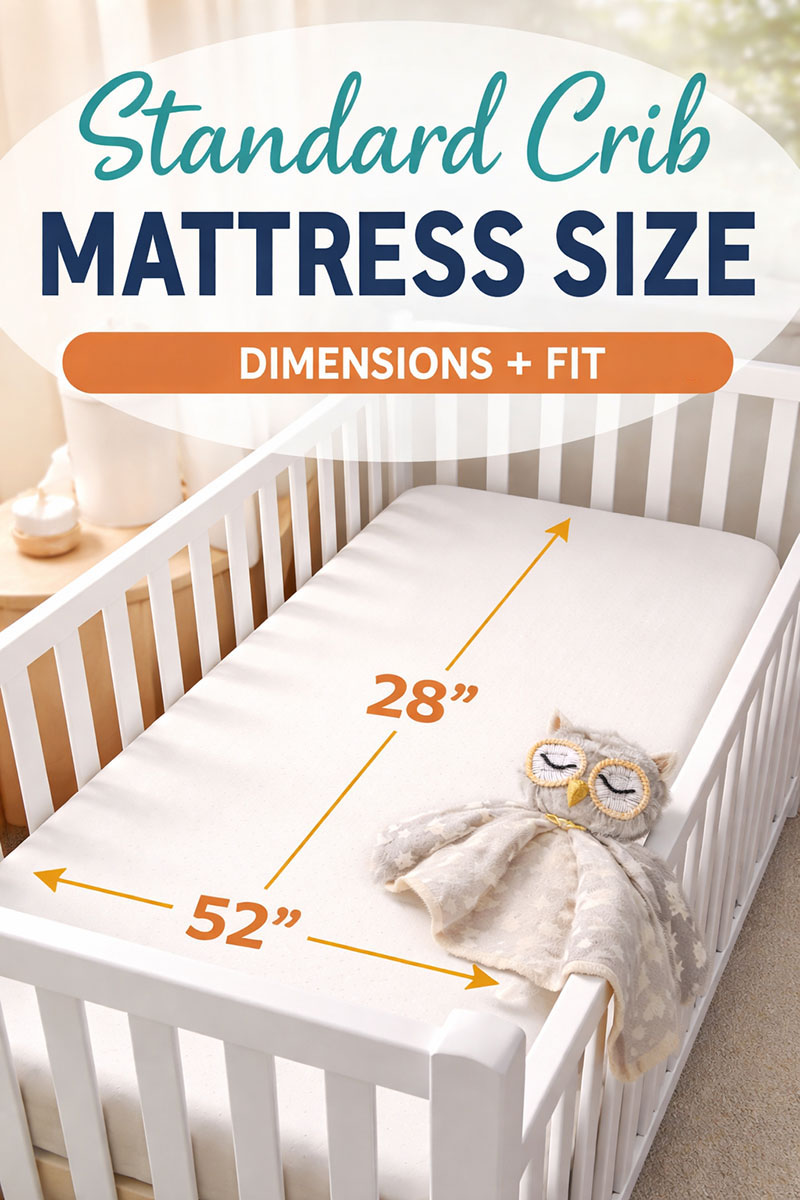
Standard crib mattress size in the United States exists within a federal regulatory framework that defines full-size crib interior dimensions, mattress tolerances, slat spacing limits, and structural performance requirements. These standards were reinforced through the 2011 federal crib safety update, which strengthened construction rules while maintaining the established full-size mattress footprint. As a result, the commonly cited 28 × 52 inch standard reflects both long-standing manufacturing conventions and legally enforceable dimensional classifications.
In metric terms, this corresponds to approximately 132 cm by 71 cm.
For a broader overview of crib types, safety topics, mattress compatibility, and common crib questions, see the baby crib guide.
For a complete overview of materials, firmness types, sizing categories, and how crib mattresses are typically classified, see this crib mattress guide that explains the major mattress types used in modern cribs.
The standard crib mattress size in the United States is 28 inches wide by 52 inches long.
- Width: about 28 inches (71 cm)
- Length: about 52 inches (132 cm)
- Category: Full-size crib mattress
Federal crib standards allow small variations, but mattresses labeled “standard” or “full-size crib mattress” are designed to fit cribs built to this 28 × 52 inch interior size classification.
Standard crib mattress dimensions and exact measurements
Federal classification defines the allowable full-size crib mattress range as approximately 51⅝–53 inches long and 27¼–28 inches wide.
In the United States, the standard full-size crib mattress measures approximately 28 inches by 52 inches (about 71 cm by 132 cm).
| Measurement | Standard crib mattress |
|---|---|
| Width | 28 inches (about 71 cm) |
| Length | 52 inches (about 132 cm) |
| Category | Full-size crib mattress |
Commonly cited measurements include:
- Standard crib mattress size: 28 inches × 52 inches (with small fractional variation related to quilting and cover construction)
This footprint corresponds to full-size crib interiors described in manufacturer materials. In standards information, a standard crib mattress is described as occupying the interior dimensions of a full-size crib frame as specified by product classifications.
The 28 × 52 footprint became consistent through manufacturing practices and federal crib safety rules. My standard crib mattress size history page explains how those dimensions evolved, while the crib safety regulation timeline shows how federal rules and enforcement milestones helped lock standard mattress dimensions into place.
Dimensional definitions used across manufacturers are outlined in the U.S. Consumer Product Safety Commission crib standards. Product labels may use terms such as “standard,” “full-size,” or “full-size crib mattress,” while packaging may also mention quilting, corner shape, edging, or thickness. My crib mattress certifications guide explains how those labels connect to testing standards and certification systems.
Length and width define the standard size category, but corner geometry, exterior edging, and thickness can still affect how a mattress looks and behaves inside a crib frame. My crib mattress guide explains how to weigh those details before choosing, my breathable vs foam crib mattress guide compares airflow, support, and construction differences, and my best breathable crib mattress guide compares which airflow-focused designs still stay firm, fit correctly, and maintain a stable sleep surface once they are used in a real crib setup.
To compare mattress measurements with crib interiors, this breakdown of baby crib dimensions and standard sizes describes full-size crib classifications and common dimensional variations.
Mattress fit notes (commonly cited terminology)
Crib frames and mattresses may appear closely sized while still showing small perimeter spacing. These observations are frequently noted in size-related descriptions associated with standard crib mattresses.
Even when mattresses share the same printed dimensions, small construction differences can influence how a mattress sits inside the crib frame. This overview of crib mattress fit explains how mattress alignment and perimeter spacing are typically evaluated inside full-size cribs.
Within standards information, full-size crib mattresses are described in relation to crib frame perimeter alignment and lateral positioning.
The phrase “two-finger” appears in general discussions as a descriptive expression referring to minimal spacing at the mattress edge, rather than a visible channel between the mattress and the crib frame.
Descriptions of edge spacing often focus on whether separation is visible along the perimeter once the mattress is positioned within the frame.
Separation that is visually apparent between the mattress and crib frame is commonly referenced in standards information as a departure from the dimensional alignment described for full-size crib mattresses.
Product-care topics are frequently mentioned alongside fit discussions because surface wear or moisture exposure may influence mattress appearance over time. Manufacturer-style care language is summarized on how to clean a crib mattress.
For background on why mattresses labeled “standard” may present differently once placed in a crib, this overview summarizes commonly cited causes: Do all crib mattresses fit all cribs?
Fit-related descriptions also arise when full-size crib interiors appear slightly narrower or wider due to rail construction, corner hardware, or mattress edging, without altering printed dimensions.
Retail listings sometimes combine size terminology across categories, particularly when brands offer both mini crib and full-size crib mattresses. This overlap is frequently noted in size classification discussions.
To understand how these categories are actually separated in real-world use, this mini crib mattress guide explains how compact crib mattresses differ in construction, compatibility, and intended setups beyond just dimensions.
For a clearer explanation of mini crib mattress size differences, this guide breaks down the common mini dimensions and how they differ from the standard full-size crib mattress footprint.
Thickness, firmness, and surface characteristics
Marketing descriptions often emphasize surface feel. In standards information, crib mattresses are characterized using stability, surface firmness, and dimensional consistency.
Common descriptive attributes include:
- Firmness: surfaces described as resisting compression under light pressure.
- Flatness: absence of sagging, dips, or raised padding.
- Fit: edge alignment relative to crib frame geometry.
Thickness is frequently listed as a feature, but thickness alone does not define standard crib mattress size. Products with different thickness values may share the same 28 × 52 footprint described in standards information.
For parents comparing mattress surface design after confirming size, this dual-sided crib mattress vs single-sided guide explains how two-stage firmness and one-surface crib mattress designs differ.
For a closer look at the two-stage mattress option itself, my dual sided crib mattress guide explains how infant and toddler sides work while the outside dimensions still stay within the standard crib mattress size category.
Construction details vary by product. Listings may reference layered foam, fiber cores, coil systems, or barrier materials, while exterior dimensions remain within the standard size category.
For an example of how organic materials, barrier design, and certification details come together in a real product line, see my Naturepedic organic crib mattress guide.
Cover materials and quilting patterns affect surface texture. Smooth and padded covers are both common, even when overall dimensions remain unchanged.
Construction details vary by product. Listings may reference layered foam, fiber cores, coil systems, or barrier materials, while exterior dimensions remain within the standard size category. Differences in mattress construction and firmness are explained in this guide to crib mattress thickness and firmness.
Protector listings frequently repeat standard dimensions to indicate compatibility. Fitted skirts or elastic edges may influence surface appearance once layered.
Sheet sizing is also associated with thickness. Many crib sheets are produced for the standard footprint and grouped by depth ranges in retail listings.
Common mix-ups: mini cribs, portable cribs, and specialty frames
Size-related questions often involve cribs that resemble full-size models but fall into different categories.
Commonly cited scenarios include:
- Mini crib vs full-size crib: mini crib mattresses use smaller footprints.
- Portable crib / travel crib: products that use model-specific pads.
- Older or specialty cribs: frames using non-rectangular mattress shapes.
Mini cribs are sometimes grouped with portable products in listings, which can blur category distinctions. Printed dimensions typically clarify the difference.
Portable cribs and play yard–style products often use thin pads designed for specific frames rather than standard crib mattresses.
Compact cribs that fall between mini and full-size categories are another source of overlap in product descriptions, as standard crib terminology may appear alongside different mattress footprints.
Mattress sizing associated with compact frames is summarized here: Mini portable crib mattress.
For travel-focused products, the BabyBjörn travel crib is frequently discussed alongside standard crib mattresses due to its firm, model-specific sleep surface.
Older cribs and specialty designs may appear in resale listings without model details, prompting mattress size discussions when frames do not align with current standards information.
Round and corner cribs occupy separate categories with distinct mattress shapes. These designs use non-rectangular sleep surfaces identified separately in manufacturer materials and are not part of the standard crib mattress size category.
For the next sleep stage after a full-size crib, this crib mattress vs toddler mattress guide explains how mattress dimensions and use shift once crib-size sleep surfaces are no longer the right category.
Frequently Asked Questions About Standard Crib Mattress Size
What is the standard crib mattress size?
In the United States, a standard full-size crib mattress measures approximately 28 inches by 52 inches.
Are all crib mattresses 28 × 52 inches?
Only full-size crib mattresses follow the standard 28 × 52 footprint. Mini and portable crib mattresses use different dimensions.
Does thickness change the standard size category?
No. Thickness varies by product, but length and width define the standard crib mattress size classification.
When you click on links to various merchants on this site and make a purchase, this may result in this site earning a commission. This does not affect the price you pay.

UBGI Gold Standard 2026
Reviewed under the site's
editorial checklist.
Photos, decorating ideas, party setups and reader submissions are shared for inspiration unless a page is specifically presented as a pattern, tutorial, reference guide or step-by-step project. Follow the instructions, measurements, safety guidance and manufacturer directions provided for the particular project or product.
About Jan | Contact | Baby Nursery Ideas (Blog) | Site Map | Privacy Policy | Disclosure Policy | Disclaimer | Affiliate Disclosure | Earnings Disclosure | Facebook | Pinterest
I am a participant in the Amazon Services LLC Associates Program, an affiliate advertising program designed to provide a means for us to earn fees by linking to Amazon. As an Amazon Associate I earn from qualifying purchases.
Copyright © 2006-2026. All Rights Reserved.