Free Crochet Duck Lovey Pattern: A Snuggler Babies Love to Hold
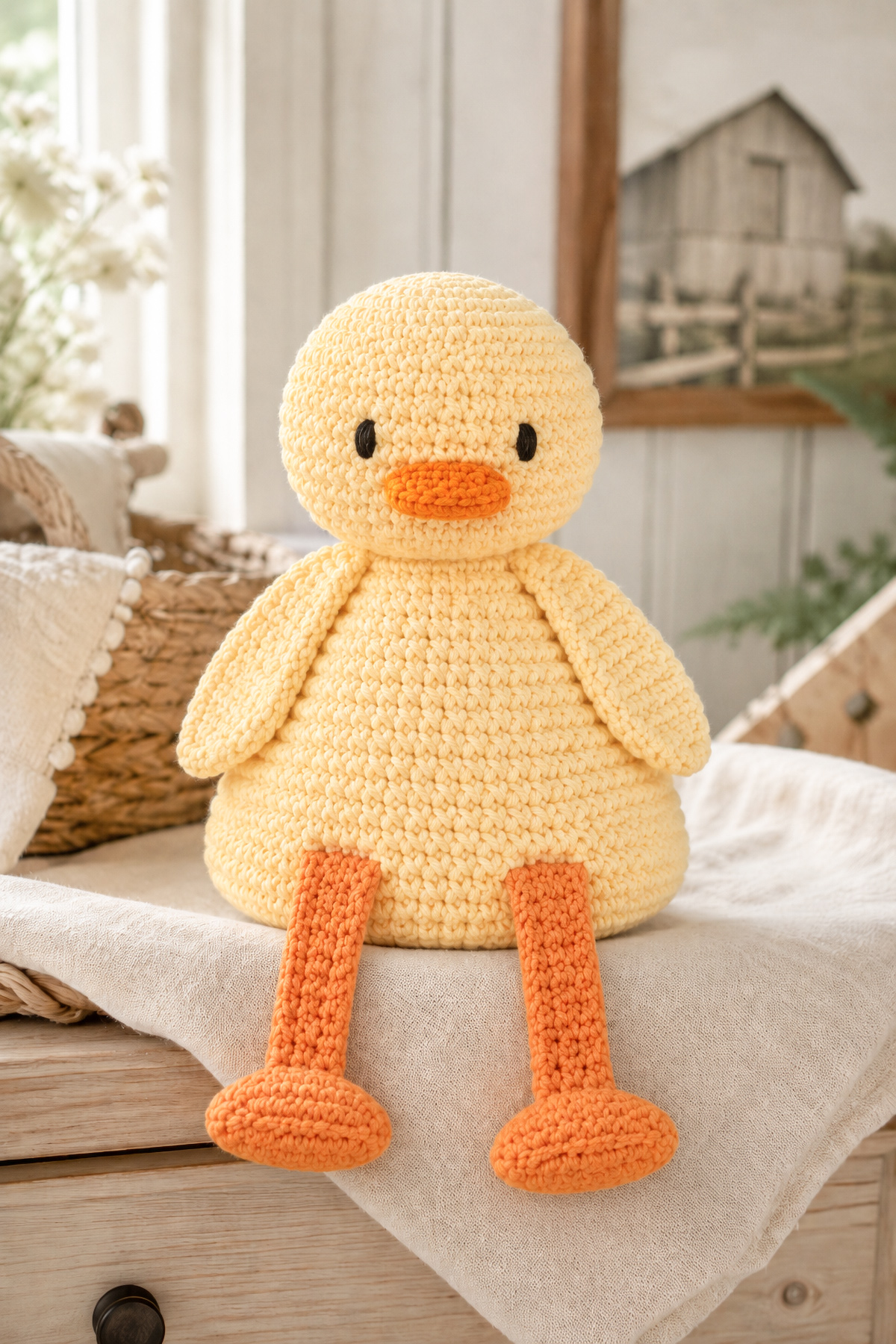
My free crochet duck lovey pattern is a sweet way to make a soft, simple baby snuggler that little hands can easily hold onto. More than just a cute toy, this snuggler is designed to be light, comforting, and easy to carry during supervised playtime, stroller rides, and quiet cuddle moments. If you have been searching for a beginner-friendly baby gift that feels both practical and heartfelt, this duck lovey is the kind of project that quickly becomes a favorite.
Explore more lovey patterns:
See the chunky plush yarn for this duck lovey
Jump to what you need:
There’s something about a soft lovey like this that babies do not just play with. They hold onto it, carry it along, and keep it close during supervised awake play, stroller rides, and quiet cuddle moments. That is exactly why this duck is designed to feel light, flexible, and easy to carry instead of being stiff or overstuffed.
This free crochet duck lovey pattern also makes a thoughtful handmade baby gift because it feels personal, useful, and easy for little hands to enjoy right away.
Materials for this free crochet duck lovey pattern
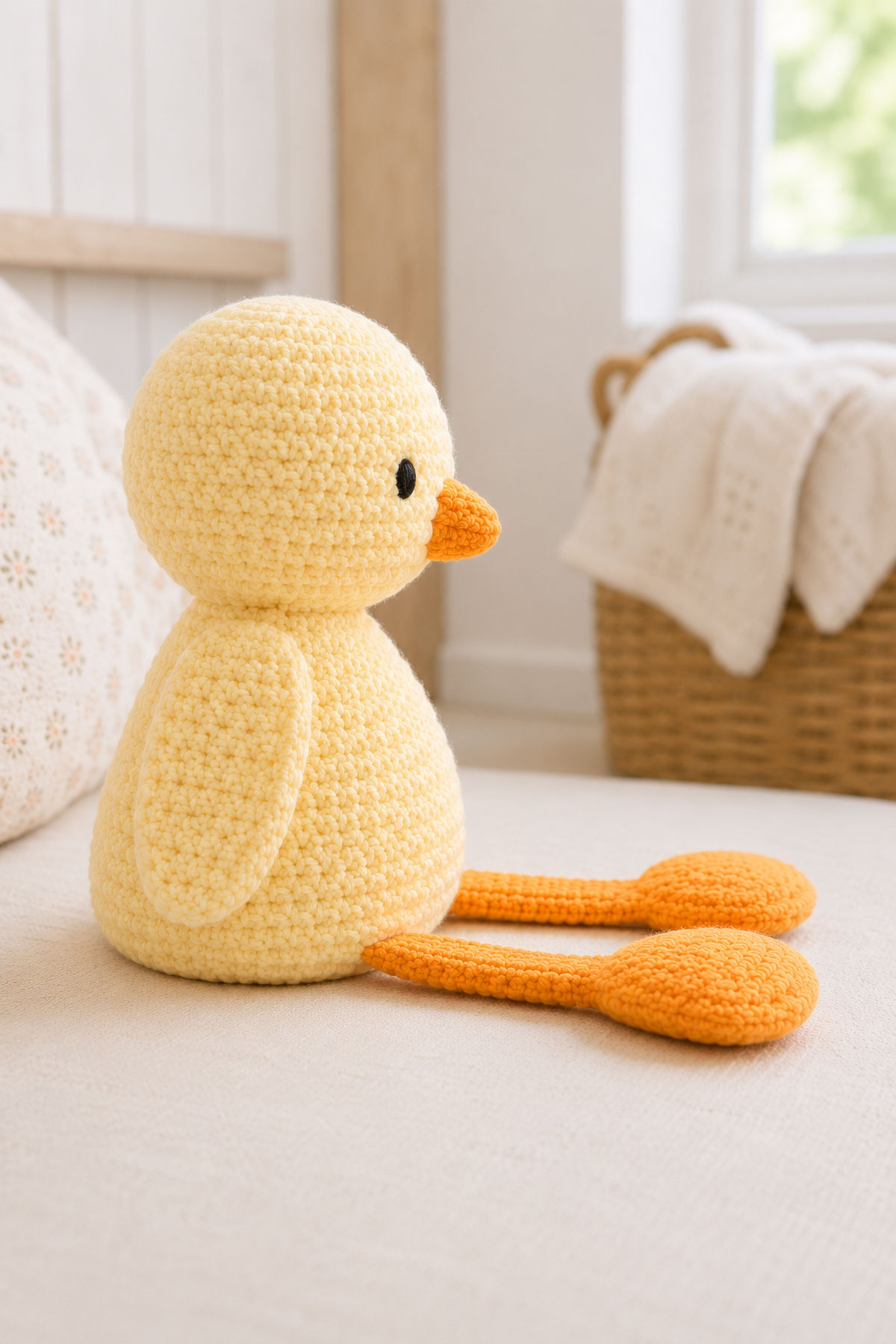
This rebuilt duck lovey uses a proportionate stuffed head, a wider softly stuffed body, flat wings, flexible legs, and modest padded feet. The body will remain soft enough to cuddle, but it will have enough shape to keep the duck from looking collapsed or top-heavy.
Skill level: Confident beginner
Finished size: Approximately 16 to 20 inches from the top of the head to the bottom of the feet. The finished size will vary with yarn brand, hook size, and tension.
You will need:
Yellow super bulky plush yarn, size 6, approximately 180 to 220 yards
Orange super bulky plush yarn, size 6, approximately 40 to 60 yards
7 mm crochet hook
Polyfill stuffing, approximately 5 to 7 ounces
Black embroidery floss for the eyes
Tapestry needle
Stitch marker
Scissors
Removable stitch markers or sewing pins for assembly
Abbreviations:
ch = chain
sc = single crochet
inc = work 2 single crochet stitches in the same stitch
dec = invisible single crochet decrease
sl st = slip stitch
mr = magic ring
fo = fasten off
Construction notes:
Work all numbered rounds in a continuous spiral unless the instructions specifically say otherwise. Do not join at the end of each round. Place a stitch marker in the first stitch of every round and move it up as you work.
Keep the stitches firm enough that the stuffing does not show through, but do not pull so tightly that the fabric becomes stiff.
The head and body are made separately. Both pieces will finish with matching 24-stitch openings so they can be joined evenly without gathering or stretching either piece.
Do not embroider the eyes until the beak has been pinned in place. The beak establishes the center of the face and makes accurate eye placement easier.
After completing Round 2 of the head and body, pull the magic ring completely closed. Thread the starting tail onto the tapestry needle, weave it around the center through the backs of several Round 1 stitches on the inside of the piece, then reverse direction through several nearby stitches before trimming. Do not rely on the tightened ring alone to keep the center closed.
Gauge: Exact gauge is not required. After Round 6 of the head, the circle should lie flat without cupping or rippling and should measure approximately 5 to 6 inches across when laid flat without stretching. Use the same yarn and hook for every yellow piece so the finished proportions remain consistent.
Step 1. Crochet the duck head
Use yellow plush yarn.
Round 1: Work 6 sc in a mr. You have 6 stitches.
Round 2: Inc in each stitch around. You have 12 stitches.
Round 3: Sc 1, inc in the next stitch. Repeat 6 times. You have 18 stitches.
Round 4: Sc 2, inc in the next stitch. Repeat 6 times. You have 24 stitches.
Round 5: Sc 3, inc in the next stitch. Repeat 6 times. You have 30 stitches.
Round 6: Sc 4, inc in the next stitch. Repeat 6 times. You have 36 stitches.
Rounds 7 through 11: Sc in each stitch around. Keep 36 stitches for 5 rounds.
Round 12: Sc 4, dec over the next 2 stitches. Repeat 6 times. You have 30 stitches.
Round 13: Sc 3, dec over the next 2 stitches. Repeat 6 times. You have 24 stitches.
Rounds 14 and 15: Sc in each stitch around. Keep 24 stitches for 2 rounds.
Begin stuffing the head. Add the stuffing gradually and distribute it evenly around the sides, crown, and back of the head. Keep the head full and rounded, but do not pack it until it feels hard.
Add slightly less stuffing directly behind the center of the face. This allows the beak and embroidered eyes to sit naturally without forcing the face outward.
Fasten off with a tail at least 36 inches long. Leave the 24-stitch opening unclosed. This opening will be joined evenly to the matching 24-stitch opening at the top of the body.
Head checkpoint: The finished head should be rounded rather than oversized, with a gently narrowed lower section and a 24-stitch opening. It should hold its shape when placed on a table, but it should still compress slightly when squeezed.
Step 2. Crochet the duck body
Use yellow plush yarn.
The body is worked from the rounded bottom upward. It is wider than the head so the finished duck has balanced proportions. The body is lightly stuffed rather than packed firmly, which allows it to remain soft and flexible without collapsing completely.
Round 1: Work 6 sc in a mr. You have 6 stitches.
Round 2: Inc in each stitch around. You have 12 stitches.
Round 3: Sc 1, inc in the next stitch. Repeat 6 times. You have 18 stitches.
Round 4: Sc 2, inc in the next stitch. Repeat 6 times. You have 24 stitches.
Round 5: Sc 3, inc in the next stitch. Repeat 6 times. You have 30 stitches.
Round 6: Sc 4, inc in the next stitch. Repeat 6 times. You have 36 stitches.
Round 7: Sc 5, inc in the next stitch. Repeat 6 times. You have 42 stitches.
Rounds 8 through 14: Sc in each stitch around. Keep 42 stitches for 7 rounds.
Round 15: Sc 5, dec over the next 2 stitches. Repeat 6 times. You have 36 stitches.
Round 16: Sc in each stitch around. Keep 36 stitches.
Round 17: Sc 4, dec over the next 2 stitches. Repeat 6 times. You have 30 stitches.
Round 18: Sc in each stitch around. Keep 30 stitches.
Begin stuffing the body. Place stuffing firmly enough in the rounded bottom to smooth the increases and help the body hold its shape.
Add less stuffing through the middle and upper body. The body should feel soft and flexible when squeezed. Do not pack the stuffing tightly or force the body into a rigid upright shape.
Round 19: Sc 3, dec over the next 2 stitches. Repeat 6 times. You have 24 stitches.
Rounds 20 and 21: Sc in each stitch around. Keep 24 stitches for 2 rounds.
Add a small amount of stuffing around the upper sides if needed, but leave the final 1 inch below the opening only lightly filled. This softer neck area allows the head to sit securely without creating a hard ridge at the seam.
Fasten off and leave a tail at least 36 inches long. Leave the 24-stitch opening unclosed.
Body checkpoint:
The body should have a rounded lower half, gently narrowing shoulders, and a 24-stitch opening that matches the head opening. It should be wider and slightly longer than the head. When laid on its side, the body should compress softly without becoming completely flat.
Step 3. Crochet the duck beak
Use orange plush yarn.
The beak is worked as a small oval in continuous rounds. It remains unstuffed so it lies close to the face without becoming heavy or oversized.
Chain 5.
Round 1: Starting in the second chain from the hook, sc in the next 3 chains. Work 3 sc in the last chain. Continue along the unused loops on the opposite side of the foundation chain. Sc in the next 2 chains, then work 2 sc in the final chain. You have 10 stitches.
Round 2: Inc in the first stitch, sc in the next 2 stitches, inc in each of the next 3 stitches, sc in the next 2 stitches, then inc in each of the final 2 stitches. You have 16 stitches.
Round 3: Sc in each stitch around. Keep 16 stitches.
Do not stuff the beak. Position the foundation chain so it runs horizontally from side to side. Bring the 2 long sides of the opening together and flatten the beak so 8 stitches lie against the remaining 8 stitches. The closed edge should run parallel to the foundation chain, creating a wide horizontal oval rather than a narrow vertical shape.
Fasten off with a tail at least 30 inches long. Whipstitch the opening closed through both layers. Keep the remaining tail for sewing around the entire outer edge of the beak and securing it to the head.
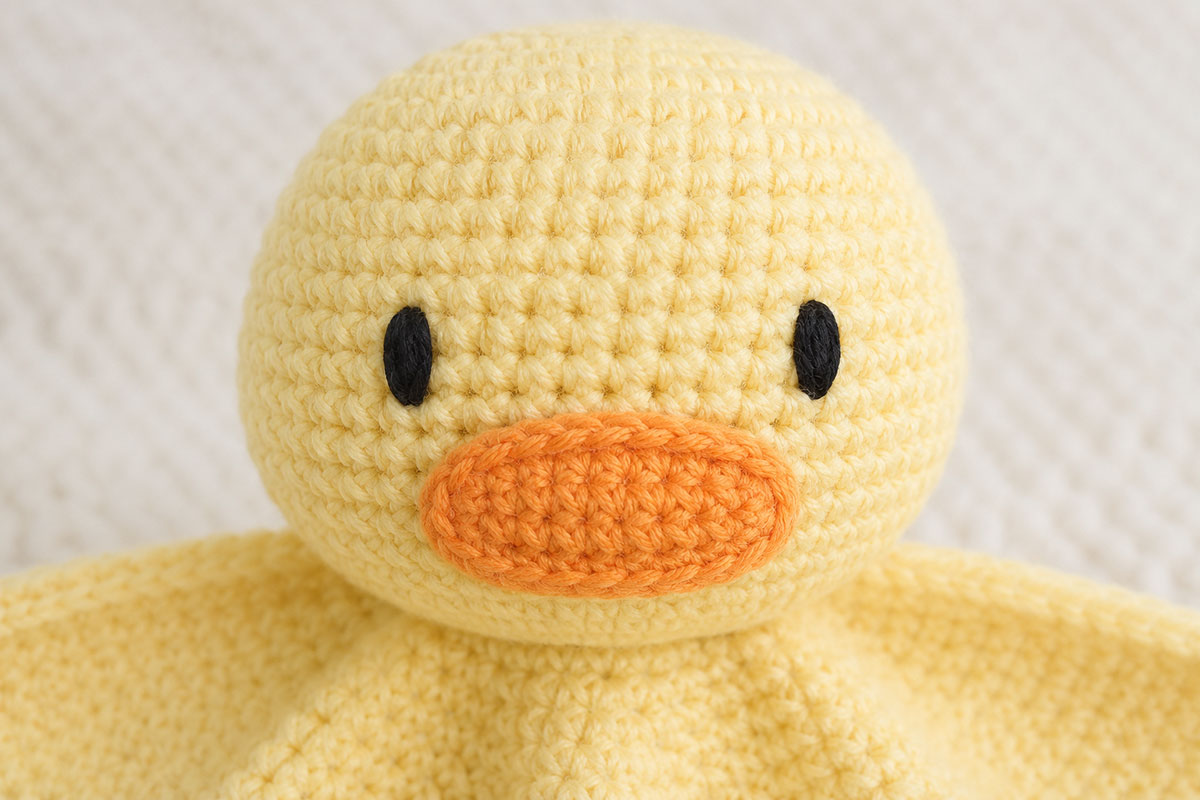
Beak checkpoint: The finished beak should be a soft horizontal oval approximately 3 to 3.5 inches wide. It should flatten easily between your fingers and should not resemble a stuffed muzzle.
Step 4. Crochet 2 duck wings
Use yellow plush yarn.
Each wing is worked as a flat oval in continuous rounds. The wings remain unstuffed so they drape naturally against the sides of the body.
Chain 7.
Round 1: Starting in the second chain from the hook, sc in the next 5 chains. Work 3 sc in the last chain. Continue along the unused loops on the opposite side of the foundation chain. Sc in the next 4 chains, then work 2 sc in the final chain. You have 14 stitches.
Round 2: Inc in the first stitch, sc in the next 4 stitches, inc in each of the next 3 stitches, sc in the next 4 stitches, then inc in each of the final 2 stitches. You have 20 stitches.
Round 3: Sc in each stitch around. Keep 20 stitches.
Round 4: Dec over the first 2 stitches, sc in the next 8 stitches, dec over the next 2 stitches, then sc in the final 8 stitches. You have 18 stitches.
Round 5: Sc in each stitch around. Keep 18 stitches.
Do not stuff the wing. Lay the wing so the foundation chain runs from the upper end to the lower end of the finished wing. Bring the 2 long sides of the opening together and flatten the piece so 9 stitches lie against the remaining 9 stitches. The closed edge should run parallel to the foundation chain, creating a long, narrow oval rather than a short, wide pouch.
Fasten off with a tail at least 30 inches long. Whipstitch the opening closed through both layers. Keep the remaining tail for attaching the wing to the body and reinforcing the attachment a second time.
Make a second wing using the same instructions.
Wing checkpoint:
Each wing should measure approximately 4 to 5 inches long and should lie flat without curling into a pouch. Place the finished wings side by side before assembly and confirm that their length, width, and closed edges match.
Step 5. Crochet 2 duck legs
Use orange plush yarn.
The legs are worked in rows as flexible flat strips. They remain unstuffed so they bend naturally between the body and feet without becoming stiff or bulky.
Chain 6.
Row 1: Starting in the second chain from the hook, sc across. You have 5 stitches.
Chain 1 and turn. The turning chain does not count as a stitch.
Rows 2 through 8: Sc in each stitch across. Keep 5 stitches for each row. Chain 1 and turn after Rows 2 through 7. Do not chain or turn after Row 8.
Fasten off with a tail approximately 18 inches long. Keep the tail for attaching the upper end of the leg to the body.
Make a second leg using the same instructions.
Leg checkpoint:
Each leg should be a flexible rectangle approximately 2 to 2.5 inches wide and 3.5 to 4.5 inches long. Lay the finished legs together and confirm that both pieces have 8 rows and matching dimensions.
Step 6. Crochet 2 duck feet
Use orange plush yarn.
Each foot is worked as a small oval pouch. The feet receive only enough stuffing to create a softly rounded shape. They should remain flexible rather than firm.
Chain 6.
Round 1: Starting in the second chain from the hook, sc in the next 4 chains. Work 3 sc in the last chain. Continue along the unused loops on the opposite side of the foundation chain. Sc in the next 3 chains, then work 2 sc in the final chain. You have 12 stitches.
Round 2: Inc in the first stitch, sc in the next 3 stitches, inc in each of the next 3 stitches, sc in the next 3 stitches, then inc in each of the final 2 stitches. You have 18 stitches.
Rounds 3 and 4: Sc in each stitch around. Keep 18 stitches for 2 rounds.
Add a small amount of stuffing. Spread it across the foot so the toe and heel are softly rounded. Do not pack the stuffing tightly.
Lay the foot so the foundation chain runs horizontally from side to side. Bring the 2 long sides of the opening together and flatten the foot so 9 stitches lie directly against the remaining 9 stitches. The closed edge should run parallel to the foundation chain, creating a wide oval that is broader from side to side than from top to bottom.
Fasten off with a tail at least 24 inches long. Whipstitch the opening closed through both layers. Keep the remaining tail for attaching the foot to the leg and reinforcing the attachment a second time.
Make a second foot using the same instructions.
Foot checkpoint:
Each foot should be a modest padded oval approximately 3.5 to 4 inches wide. The closed edge should contain 9 paired stitches, and both feet should match before they are attached to the legs.
Step 7. Prepare the pieces for assembly
Lay out the head, body, beak, 2 wings, 2 legs, and 2 feet before sewing anything together.
Confirm that the head and body each have a 24-stitch opening. Check that the wings match, the legs contain the same number of rows, and the feet are the same size.
Choose the smoothest side of the body as the front. Place a removable stitch marker at the center front of the 24-stitch opening. Count 6 stitches around the opening and place a side marker, count 6 more stitches and place the center-back marker, then count 6 more stitches and place the second side marker. The final 6 stitches should return you to the center-front marker.
Choose the smoothest side of the head as the face. Mark its 24-stitch opening in the same way, placing markers at the center front, both sides, and center back so the opening is divided into four equal sections of 6 stitches. Keep all four markers on each piece in place until the head and body have been joined.
Step 8. Attach the feet to the legs
Place one leg vertically with the foundation-chain edge at the bottom and the finishing tail at the top.
Place the foot so the closed 9-stitch edge forms the upper edge and the long axis of the oval runs from side to side. Center the 5-stitch foundation-chain edge of the leg against that closed edge. Leave 2 paired foot stitches extending beyond the leg on each side.
Use the foot tail to sew through the leg and both layers of the closed foot edge. Sew across the full width of the leg, then sew back across the attachment a second time for reinforcement.
Knot the yarn securely and bury the remaining tail inside the foot.
Repeat with the second leg and foot.
Leg and foot checkpoint: Each foot should be centered beneath its leg and should extend evenly on both sides. The legs should bend freely, while the feet should remain softly rounded.
Step 9. Position and sew on the beak
Place the head in front of you with the marked center front facing upward and the open neck pointing downward.
Center the flattened beak horizontally on the lower half of the face. Position the upper edge of the beak around Rounds 9 and 10 of the head. The lower edge should rest around Rounds 11 and 12.
Pin the beak in place and view the head from the front and both sides. Adjust it until the same amount of beak extends to the left and right of the marked center front.
Use the beak tail to sew around the entire outer edge with small whipstitches. Pass through the beak and the surface stitches of the head without pulling the face inward.
Before closing the final inch of the seam, place a very small amount of stuffing beneath the center of the beak only if it appears completely flat. The beak should have a gentle curve, not the depth of a stuffed muzzle.
Finish sewing around the beak. Knot the yarn securely and bury the tail inside the head.
Step 10. Embroider the duck's eyes
Use black embroidery floss and a tapestry needle. Do not use plastic safety eyes, buttons, beads, or glued facial pieces.
Place the eyes slightly above the beak, approximately between Rounds 7 and 9 of the head. Position the inner edges of the eyes about 5 to 6 stitches apart.
Each finished eye should be approximately 2 stitches wide and 2 rounds tall.
Bring the needle out at the lower edge of the first eye. Work several closely spaced vertical satin stitches until the eye forms a small smooth oval. Do not pull the stitches tightly enough to pucker the head.
Carry the floss securely through the inside of the head to the second eye position. Make the second eye with the same number of satin stitches and match its height and width to the first eye.
View the face from directly in front before securing the floss. Adjust any loose stitch so the eyes appear level and evenly spaced.
Knot the floss securely inside the open neck and bury the ends deeply in the stuffing. Trim away any visible ends.
Face checkpoint: The beak should be centered and gently curved. The embroidered eyes should be level, securely stitched, and free of loose loops. The finished face should remain soft without deep puckering around the eyes or beak.
Step 11. Join the head and body
Place the head above the body with both open edges facing one another. Align the center-front, center-back, and both side markers on the head with the corresponding markers on the body.
Each marked section should contain 6 head stitches and 6 body stitches. Pin or clip the four marked points together, then match the stitches one to one within each section for a total of 24 paired stitches.
Use the long body tail to sew through both loops of one body stitch and both loops of the matching head stitch. Continue around the opening, joining the stitches one to one.
After approximately 18 stitches have been joined, pause and check the stuffing. Add small pieces of stuffing through the remaining opening if the lower head or upper body has an empty area.
Do not pack the neck firmly. The joined area should feel supported but should still compress when gently squeezed.
Finish sewing the remaining stitches. Knot the body tail securely and bury it deeply inside the body.
Thread the long head tail onto the tapestry needle. Work a second reinforcing pass around the entire neck seam, placing small stitches between or directly beside the first pass. Keep the tension even so the neck does not gather. Knot the head tail securely and bury it deeply inside the body.
Remove the placement markers and gently roll the neck seam between your fingers to settle the stuffing and smooth the join.
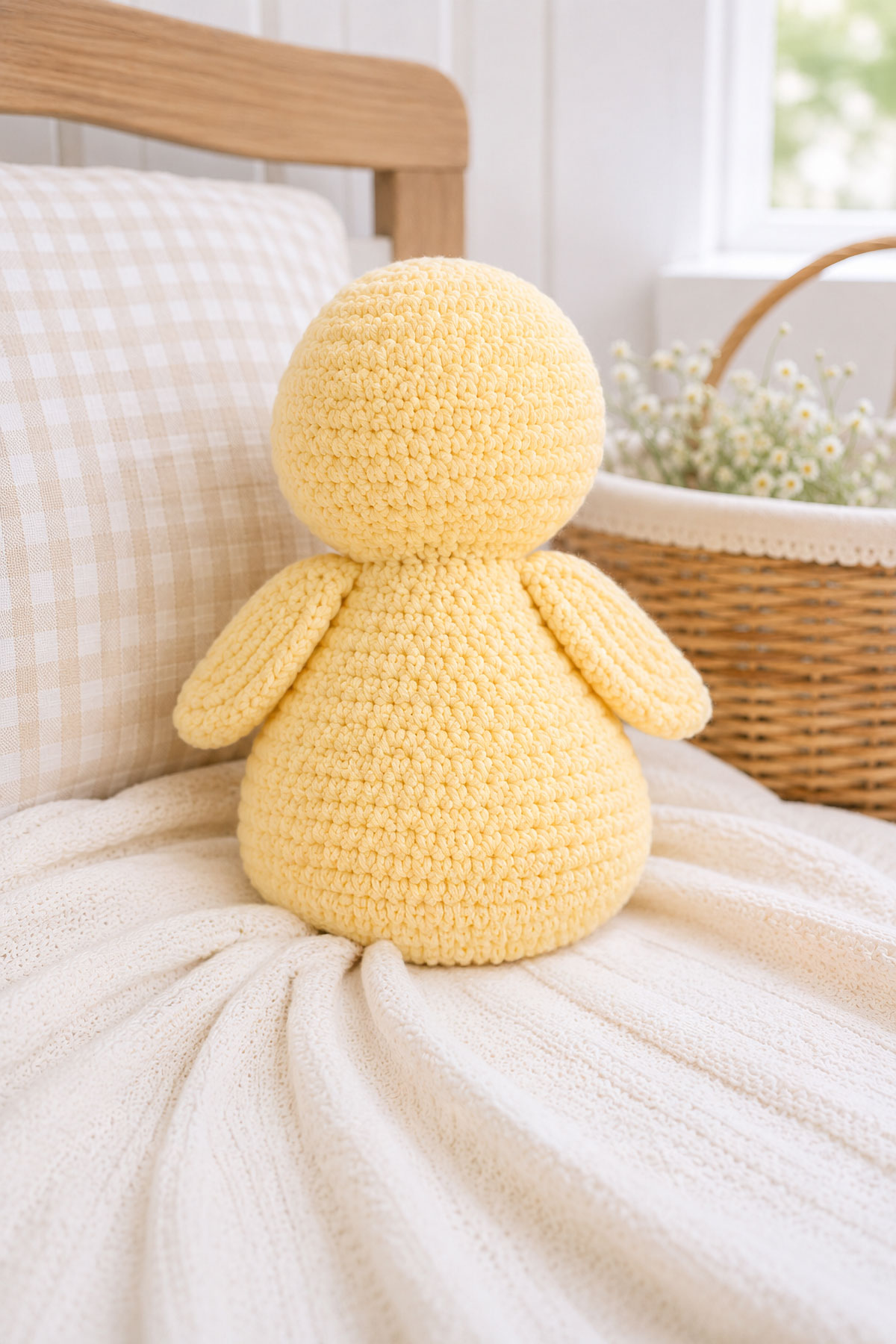
Head and body checkpoint: The head should sit centered over the body without tilting sharply forward or backward. The body should be wider than the lower head, and the neck seam should lie flat without gathering, stretching, or visible openings.
Step 12. Attach the wings
Place the duck in front of you with the face pointing forward. Identify the center of each side of the body.
Position one wing on each side with the closed edge resting against the body. The upper end of each wing should begin approximately 2 rounds below the neck seam. Angle the closed edge slightly toward the front as it extends down the body.
The lower end of the closed wing edge should rest near Round 12 of the body. The rounded free edge of the wing should point downward and slightly backward.
Pin both wings in place before sewing. View the duck from the front and back to confirm that the wings begin at the same height and hang at matching angles.
Use the long wing tail to sew the entire 9-stitch closed edge to the body. Pass the needle through both layers of the wing and through the surface stitches of the body.
Do not sew around the free rounded edge. It should remain loose so the wing can lie softly against the body.
Sew across the attached edge a second time for reinforcement. Knot the yarn securely and bury the tail deeply inside the body.
Repeat with the second wing.
Wing placement checkpoint: Both wings should begin at the same height, angle slightly forward at the top, and hang freely at the bottom. The attached edges should lie flat without pulling or puckering the body.
Step 13. Attach the legs
Place the duck on its back with the face pointing upward. Smooth the lower body so the center front is easy to identify.
Position the finishing edge of each leg against Round 8 of the lower body. Leave approximately 4 body stitches between the inner edges of the legs.
Pin both legs in place before sewing. Confirm that the legs begin on the same round and that the feet point forward rather than sideways.
Use the long leg tail to sew through all 5 stitches along the upper edge of the leg and through the surface stitches of the body.
Sew across the attachment a second time for reinforcement. Knot securely and bury the tail deeply inside the body.
Repeat with the second leg.
Lift the duck by the body and allow the legs to hang. Adjust each foot so the broad oval faces forward and its widest dimension runs from side to side. Confirm that both legs hang to approximately the same length.
Leg placement checkpoint: The legs should be evenly spaced on the lower front of the body. Both feet should face forward, and neither leg attachment should pull the body into a crease.
Step 14. Shape the finished duck lovey
Roll the head gently between your palms to distribute the stuffing and smooth the decrease rounds.
Press lightly along the sides of the body to create a soft oval shape. Move small amounts of stuffing with your fingers if one side appears fuller than the other.
The lower body should remain rounded, while the upper body should compress easily beneath the head. Do not force the duck into a rigid standing position.
Smooth the wings downward and slightly toward the back. Bend the flat legs gently where they meet the body so the feet hang naturally.
Place the duck on a flat surface. It may sit with the feet extended in front, rest on its side, or lean naturally when displayed. The body should remain soft enough to cuddle rather than standing like a firmly stuffed amigurumi toy.
Lay the duck flat with the legs extended naturally and the feet aligned, but do not stretch any part of the lovey. Measure from the top of the head to the bottom of the feet. Depending on the yarn, hook, and tension, the finished duck should measure approximately 16 to 20 inches long.
Step 15. Complete the final inspection
Check the neck seam, both wing seams, both leg attachments, and both foot attachments. Reinforce any area where the stitches separate when gently pulled.
Remove and account for every sewing pin, clip, and removable stitch marker used during assembly before the lovey is handled or gifted.
Check the embroidered eyes from several angles. There should be no loose loops, exposed knots, or embroidery ends on the surface.
Confirm that the beak is securely sewn around its entire edge and that no stuffing is visible through the head, body, feet, or seams.
Trim away loose yarn fibers. For each tail buried in a stuffed section, pass the needle through the interior and bring it out several inches away. Pull gently, trim close to the surface, and allow the cut end to retract inside. For any tail that cannot be buried in a stuffed section, weave it back and forth through several stitches before trimming.
Important baby-use reminder:
This handmade duck lovey is intended for supervised awake use. Do not place it in a crib, bassinet, play yard, or other infant sleep space. Follow the CPSC safe sleep guidance, which recommends keeping toys and other soft items out of an infant's sleep space. Inspect the lovey regularly and remove it from use if a seam opens, stuffing becomes visible, or an attached piece loosens. Follow the yarn manufacturer's washing and care instructions.
Finished duck lovey checklist
Head: Rounded and proportionate, with securely embroidered eyes
Beak: Centered, softly curved, and sewn around the entire edge
Body: Wider than the head, lightly stuffed, and flexible
Wings: Matching, unstuffed, and securely attached along one edge
Legs: Flat, flexible, evenly spaced, and reinforced at the body
Feet: Modestly padded, matching in size, and facing forward
Final seams: Closed, reinforced, and free of exposed stuffing or loose yarn ends
Troubleshooting the finished duck lovey
Plush yarn can hide stitches and make small differences in tension more noticeable. Before removing and remaking an entire piece, check the stuffing, placement, and orientation first. Those three details often cause proportion problems that look like stitch-count errors.
If the head looks too large:
Check whether the body has been stuffed fully through the lower and middle sections. An underfilled body will look smaller beside the head. Add small pieces of stuffing through the neck before the head and body seam is completely closed.
Do not add extra stuffing to the head. A tightly packed head will become wider, harder, and more top-heavy.
If the body looks too round or rigid:
Remove some stuffing from the upper and middle body. Keep more stuffing in the rounded bottom and less near the shoulders. The finished body should compress easily when held.
If the neck seam forms a ridge:
The upper body or lower head may contain too much stuffing. Move the stuffing away from the seam with your fingers and gently roll the joined area between your palms.
Confirm that the 24 head stitches were matched one to one with the 24 body stitches. Skipped or doubled stitches can gather one side of the seam.
If the beak looks crooked:
Remove only the stitches along the uneven side. Recenter the beak over the marked center front and pin both ends before resewing.
View the face from directly in front rather than from above. A beak that appears centered while the head is lying flat may look uneven when the duck is upright.
If the eyes look uneven:
Compare the upper, lower, inner, and outer edges of both embroidered eyes. Adjust the eye that differs rather than adding more stitches to both.
Keep the embroidery tension gentle. Pulling one eye more tightly than the other can create uneven indentations even when the stitch placement matches.
If the wings point outward:
The attached edge may be positioned too far toward the back or sewn too tightly. Reposition the upper edge slightly forward and leave the rounded edge completely free.
If one leg hangs lower:
Confirm that both legs contain 8 rows and that their upper edges are attached to the same body round. A foot attached off center can also make one leg appear longer.
If the feet twist sideways:
Turn each foot so the long axis of the oval runs from side to side and the broad face of the foot points forward. Add one or two small anchoring stitches between the back of the leg and the closed upper edge of the foot if the foot will not remain aligned.
Using a different yarn or hook size
You may use another yarn, but changing the yarn weight or hook size will change the finished measurements and the amount of stuffing required.
A thinner yarn will make a smaller duck with narrower limbs and less dramatic texture. Use the hook size recommended for the yarn, then move down one hook size if the fabric has visible gaps.
A thicker plush yarn will make the duck larger and may increase the finished length beyond 20 inches. Check the head and body after the increase rounds before continuing.
Use the same yarn weight and hook size for the head and body. Changing only one of those pieces can upset the proportions even when every stitch count is correct.
The orange yarn for the beak, legs, and feet should be similar in thickness to the yellow body yarn. A much thinner orange yarn will create undersized features.
How to wash and care for the crochet duck lovey
Follow the care instructions printed on the yarn label. Washing recommendations vary among plush polyester, chenille, blanket, and velvet-style yarns.
Place the lovey inside a zippered mesh laundry bag or tied pillowcase before machine washing. Use a gentle cycle and cool water unless the yarn manufacturer recommends another method.
Air drying is the gentlest option. Reshape the head, body, wings, legs, and feet while the lovey is damp. Allow the center of the head and body to dry completely before use or storage.
Inspect every seam after washing. Check the embroidered eyes, beak edge, neck seam, wings, legs, and feet before returning the lovey to use.
FAQ about the rebuilt crochet duck lovey pattern
Is the body stuffed or unstuffed?
The rebuilt body is lightly stuffed. More stuffing is used in the rounded bottom, while the middle, shoulders, and neck remain softer. This gives the duck a balanced shape without turning it into a rigid stuffed toy.
Why do the head and body both end with 24 stitches?
The matching openings allow the head and body stitches to be joined one to one. This prevents either opening from gathering, stretching, or forming an uneven neck seam.
Are the wings stuffed?
No. The wings are flattened and sewn closed without stuffing. Their rounded edges remain unattached so they can rest softly against the body.
Can I use plastic safety eyes?
This pattern uses eyes embroidered with black embroidery floss. Buttons, beads, plastic eyes, and glued facial pieces are not included in the construction.
Can the finished duck stand upright?
The duck may sit or lean when arranged for display, but it is not designed to stand rigidly. The lightly stuffed body, flexible legs, and soft wings are intended to create a cuddly snuggler.
What should I do if my duck falls outside the 16-to-20-inch size range?
Plush yarns vary considerably in thickness. A slightly smaller or larger finished measurement is not necessarily a construction error if the head, body, wings, legs, and feet remain proportionate.
Can this lovey be placed in a baby's crib?
No. Keep the duck lovey out of cribs, bassinets, play yards, and other infant sleep spaces. It is intended for supervised awake use.
How often should the seams be checked?
Inspect the lovey before use and after washing. Remove it from use if a seam opens, stuffing becomes visible, embroidery loosens, or an attached piece begins to separate.
Using the finished duck lovey as a baby gift
A handmade duck lovey works especially well for spring baby gifts, farm-themed baby showers, little duckling themes, pond nursery decor, and country-style nurseries. The soft yellow and orange colors are cheerful without being difficult to coordinate with neutral baby rooms.
Before giving the duck as a gift, include the yarn label or write down the fiber content and washing instructions. Let the recipient know that the embroidered face and attached pieces should be inspected regularly, especially after washing.
You can place the finished duck in a gift basket with a baby blanket, board book, burp cloths, or other practical items. Keep ribbons, tags, and decorative packaging separate from the lovey before it is given to a baby.
If you would rather make a different duck project, my free crochet duck pattern makes a freestanding yellow duck with a rounded body, webbed feet and embroidered eyes. My crochet duck baby blanket pattern uses flat duck appliqués on a full blanket, the free crochet mallard duck pattern creates a freestanding bird with recognizable mallard coloring, and the free crochet rubber duck pattern turns the familiar yellow rubber duck shape into a soft yarn version.More free crochet lovey patterns to make
If you enjoyed making this duck, my crochet animal lovey patterns collection includes more handmade baby gift ideas with embroidered faces and soft construction.
The owl lovey crochet pattern is a good woodland choice, while the crochet bunny lovey pattern works beautifully for spring gifts and neutral nurseries.
For another bright animal design, try the crochet bee lovey pattern. The elephant lovey free pattern offers a softer neutral palette, and the fox lovey crochet pattern fits woodland and rustic nursery themes.
Duck, chicken, cow, lamb, and barnyard projects can also be found in my crochet farm animal lovey patterns collection.
You can browse the complete collection of free baby crochet patterns for more loveys, blankets, baskets, appliqués, and handmade nursery projects.
Final notes about this crochet duck lovey pattern
The most important checkpoints are the matching 24-stitch neck openings, the lightly stuffed upper body, the centered beak, and the even placement of the wings and legs. Take time to pin every piece before sewing because small placement changes can noticeably affect the finished expression and proportions.
Plush yarn makes a soft and forgiving finished lovey, but it can make individual stitches difficult to see. Count every round, move the stitch marker consistently, and compare matching pieces before assembly.
The finished duck should have a rounded but proportionate head, a wider softly shaped body, flat floppy wings, flexible legs, and modest padded feet. It should feel soft when held and should not be packed firmly enough to become rigid.
When you click on links to various merchants on this site and make a purchase, this may result in this site earning a commission. This does not affect the price you pay.

UBGI Gold Standard 2026
Reviewed under the site's
editorial checklist.
Photos, decorating ideas, party setups and reader submissions are shared for inspiration unless a page is specifically presented as a pattern, tutorial, reference guide or step-by-step project. Follow the instructions, measurements, safety guidance and manufacturer directions provided for the particular project or product.
About Jan | Contact | Baby Nursery Ideas (Blog) | Site Map | Privacy Policy | Disclosure Policy | Disclaimer | Affiliate Disclosure | Earnings Disclosure | Facebook | Pinterest
I am a participant in the Amazon Services LLC Associates Program, an affiliate advertising program designed to provide a means for us to earn fees by linking to Amazon. As an Amazon Associate I earn from qualifying purchases.
Copyright © 2006-2026. All Rights Reserved.