Free Crochet Frog Lovey Pattern (Long Leggy Baby Snuggler)
This free crochet frog lovey pattern has long floppy legs that drape and wiggle, making them easy for little hands to hold. It won’t stay perfectly posed, and that’s exactly why I like it.
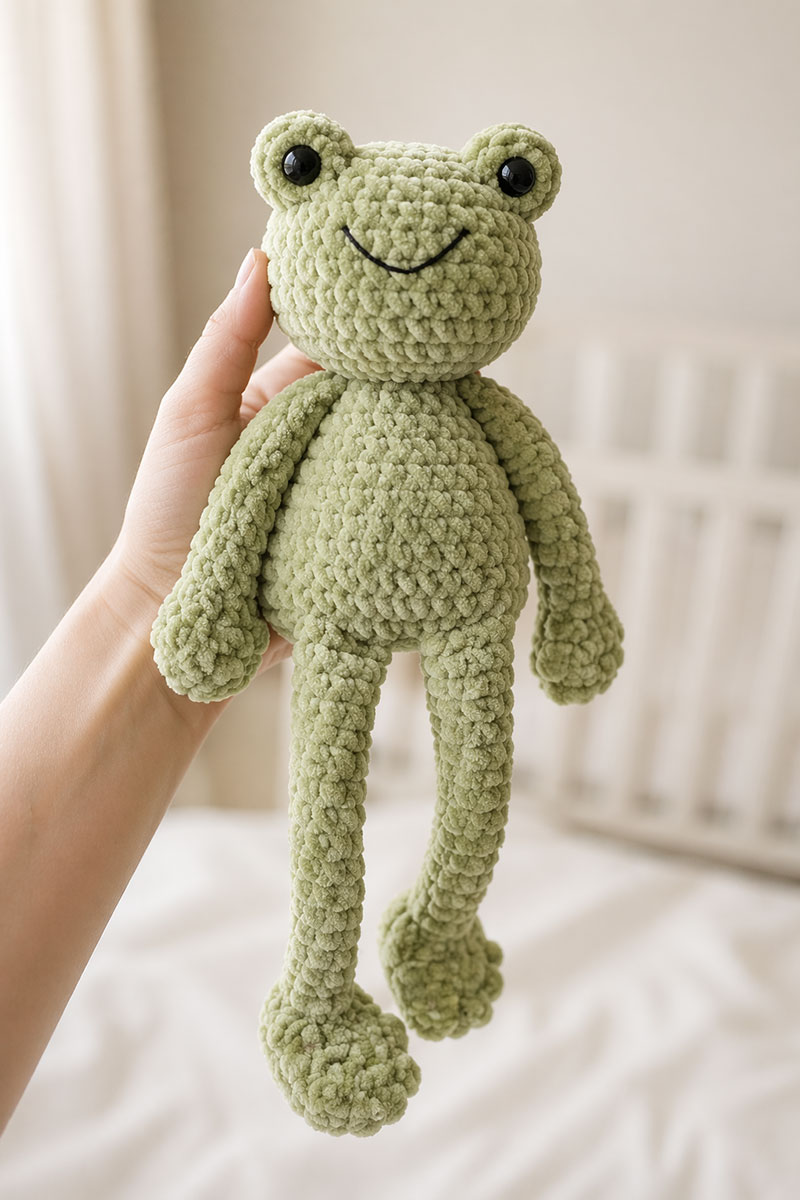
This crochet frog lovey pattern is a step-by-step guide for making a soft baby snuggler with a frog head, lightly stuffed body, and long floppy legs designed for easy grip.
If you prefer the traditional security-blanket construction instead of this long-legged snuggler, use my crochet frog blanket lovey pattern.
To see how this same lovey style changes across different animals, these crochet animal lovey patterns make it easier to compare styles, shapes, and finished looks.
My crochet cow pattern uses the same easy-to-hold lovey structure with a softer farm-style shape and a flatter blanket body that works especially well for beginner crochet projects and shower gifts.
A safari-style handmade gift set can also include my crochet lion lovey pattern with a soft blanket base, rounded ears, and textured mane.
For a woodland-inspired handmade baby gift, my crochet raccoon pattern creates a playful forest-animal lovey that pairs naturally with frog, fox, bear, and other nursery-themed crochet projects.
For another small forest animal option, my crochet hedgehog lovey pattern adds a cozy woodland baby gift to the same handmade lovey group.
For smaller beginner-friendly projects with simpler shaping and quick blanket-style construction, these easy baby lovey crochet patterns make practical handmade gifts that still feel soft, flexible, and easy for little hands to hold.
For cleaner nursery aesthetics and more understated handmade baby gifts, this minimalist crochet lovey pattern uses a simpler modern style that coordinates especially well with neutral nursery themes and contemporary baby rooms.
Another lovey with an ocean nursery angle is my seahorse crochet lovey pattern that will add a handmade sea creature project that pairs well with coastal baby rooms and baby shower gifts.
A water-animal gift like this crochet otter lovey pattern also fits beside frog, seahorse, and starfish projects when you want a nature-themed baby lovey set.
A small crochet starfish lovey pattern also fits nicely with frog, seahorse, and other handmade loveys when you want one more easy baby gift or nursery shelf accent.
A cheerful garden-themed option like my crochet ladybug lovey pattern creates, works well beside frog loveys for spring baby gifts, bug nursery themes, and bright handmade keepsakes.
Jump to what you need:
Skill Level Materials Abbreviations Frog Head Eye Bumps Body Legs and Arms Assembly Finished Size Beginner QuestionsCrochet Frog Lovey Pattern Step by Step
A crochet frog lovey is a small baby snuggler with a frog head, a lightly stuffed body, and long floppy legs that are easy for little hands to hold. This version creates a soft frog lovey inspired by the frog shown above, with a rounded head, soft flexible body, and long legs that hang naturally.
Follow the stitch count at the end of each round, and stop to recount if the shaping begins to look uneven or twisted.
Skill Level
Confident advanced beginner to intermediate. You will use magic rings, single crochet, increases, decreases, continuous rounds, simple shaping, three-piece toe joins, embroidery, stuffing, and hand sewing to assemble the finished frog.
Materials for This Crochet Frog Lovey
- Sage green chenille yarn, size 6 bulky, approximately 150 to 190 yards (usually 2 to 3 skeins, depending on skein yardage)
- 6.0 mm crochet hook
- Yarn needle
- Polyester fiberfill for the head, body, hands, and feet
- Black embroidery floss or smooth black yarn for embroidered eyes and mouth
- Stitch marker
- Scissors
For a baby lovey, embroidered eyes are the safer choice because they avoid small plastic parts that could loosen with use.
The U.S. Consumer Product Safety Commission safe sleep guidance explains that loose items should not be placed in a crib with a sleeping baby.
This frog lovey is not for sleep use.
Reference photo note: The photos show the intended overall proportions and styling, but the written pattern uses embroidered eyes. Do not copy any plastic eye detail visible in a reference photo when making this as a baby gift.
Abbreviations and Basic Terms
- sc = single crochet
- inc = increase (2 single crochet in the same stitch)
- dec = decrease (single crochet 2 stitches together)
- st = stitch
- sl st = slip stitch
- ch = chain
Whenever possible, work decreases as invisible decreases for a smoother finished shape.
If you do not know how to make a magic ring, you can chain 2 and work into the first chain.
Construction note: Unless a section says otherwise, every piece is worked in continuous rounds. Do not join or turn. Move the stitch marker to the first stitch of each new round. The head is worked from the crown down toward the neck closure. The body is worked from the top center down toward the lower closure.
Gauge and Tension
Your stitches should feel firm but not tight. When you look at the fabric, you should not see large holes. If stuffing shows through, go down one hook size.
Chenille yarn softens slightly after handling, so a slightly firm start usually settles into the right shape.
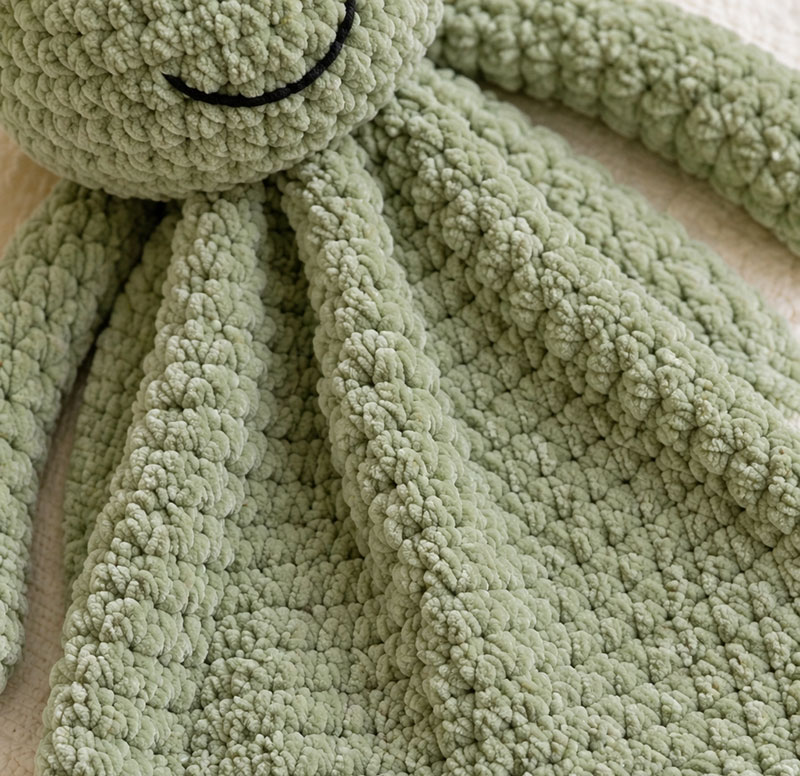
Chenille yarn can hide missed stitches, especially in darker shades. If your stitch count is off by even one or two, the shape can slowly twist instead of staying centered.
Frog Head Step by Step
Use a stitch marker and work in continuous rounds. Do not join unless told.
Round 1: Magic ring, 6 sc. You should have 6 stitches.
Round 2: inc in each stitch around. 12 stitches total.
Round 3: sc in next st, inc in next. Repeat around. 18 stitches total.
Round 4: sc in next 2 st, inc in next. Repeat around. 24 stitches total.
Round 5: sc in next 3 st, inc in next. Repeat around. 30 stitches total.
Rounds 6 to 10: sc in each st around. 30 stitches each round.
Round 11: sc in next 3 st, dec in next. Repeat around. 24 stitches.
Round 12: sc in next 2 st, dec in next. Repeat around. 18 stitches.
Stuff the head now. Fill it until rounded but still soft when pressed. Keep the stuffing away from the final stitches so the remaining decreases are easy to work.
Round 13: sc in next st, dec in next. Repeat around. 12 stitches.
Round 14: dec around. 6 stitches total.
Cut the yarn, pull the opening closed, and leave a 24-inch tail for sewing the head to the body.
The head should measure approximately 3½ to 4 inches across before the eye bumps are attached.
Frog Eye Bumps
Make 2 eye bumps.
Round 1: Magic ring, 6 sc. 6 stitches.
Round 2: inc in each stitch around. 12 stitches total.
Rounds 3 to 4: sc in each stitch around. 12 stitches each round.
Fasten off, leaving a 12-inch tail for sewing. Do not stuff the eye bumps. The magic-ring center forms the front of each eye bump, and the open Round 4 edge forms the attachment rim.
Before attaching the eye bumps, embroider a small black oval in the magic-ring center of each bump using black embroidery floss or smooth black yarn and closely packed satin stitches. Secure the embroidery ends on the inside of the bump. Do not use plastic safety eyes or other detachable facial parts.
Position the open rims of the eye bumps on top of the head between head rounds 5 and 8. Keep the inner edges approximately 2 to 3 head stitches apart and check that both embroidered eyes face forward evenly.
Using each sewing tail, whipstitch through all 12 stitches of the eye-bump rim and into the head. Distribute the stitches evenly so the rim lies flat without gathering or flaring.
Body Step by Step (Lightly Stuffed)
This body is slightly stuffed so the frog feels soft but still flexible. It should not be firm like a toy.
Round 1: Magic ring, 6 sc. 6 stitches.
Round 2: inc in each stitch around. 12 stitches total.
Round 3: sc in next st, inc in next. Repeat around. 18 stitches total.
Round 4: sc in next 2 st, inc in next. Repeat around. 24 stitches total.
Rounds 5 to 10: sc in each stitch around. 24 stitches each round.
Stuff the body lightly before completing the final decrease rounds. The body should form a soft oval and remain flexible rather than firm.
Round 11: sc in next 2 st, dec in next. Repeat around. 18 stitches total.
Round 12: sc in next st, dec in next. Repeat around. 12 stitches total.
Check the stuffing before closing. Add or remove a small amount if needed so the body keeps its oval shape without becoming firm.
Round 13: dec around. 6 stitches total.
Cut yarn, pull the opening closed, and weave the tail securely into the body. The Round 1 magic ring is the top center of the body, and the Round 13 closure is the bottom center.
Legs and Arms Step by Step
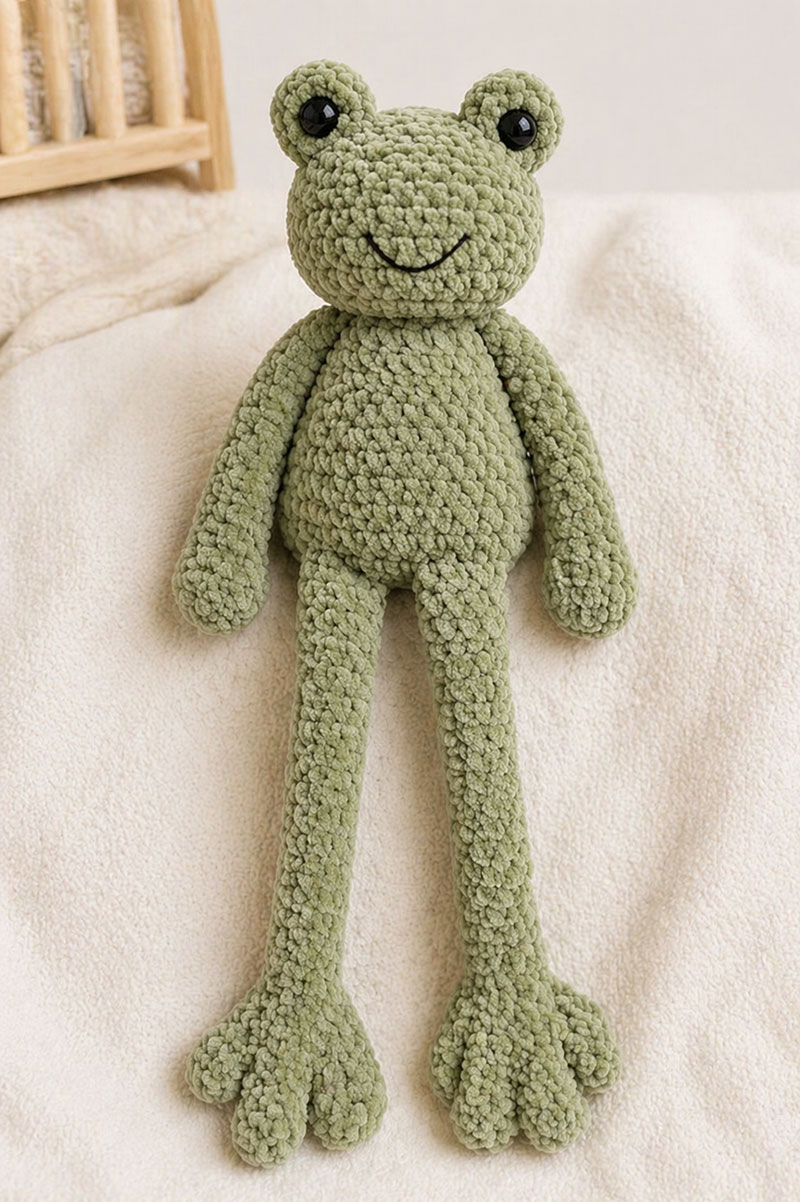
The feet are made from three joined toe pieces so they form the broad three-toe shape shown in the reference photos. The hands are worked as rounded ends. Stuff only the feet and hands. Leave the narrow leg and arm tubes unstuffed so they remain flexible and hang naturally.
Legs, make 2
Toe pieces, make 3 for each foot, 6 total
Round 1: Magic ring, 6 sc. 6 stitches.
Round 2: sc in each stitch around. 6 stitches.
For Toe 1 and Toe 2, fasten off and leave a 6-inch tail. For Toe 3, do not fasten off.
Arrange the three toes side by side with their open rounds facing upward and their magic-ring ends pointing downward. Place Toe 1 on the left, Toe 2 in the center, and Toe 3 on the right. Continue working with the yarn attached to Toe 3.
Joining Round 3: sc in the next 3 stitches of Toe 3, placing a stitch marker in the first sc. Without chaining, sc in the next 3 stitches of Toe 2. Without chaining, sc in all 6 stitches of Toe 1. Continue across the remaining 3 stitches of Toe 2, then the remaining 3 stitches of Toe 3. You should have 18 stitches around the outside of the joined toes.
Round 4: sc in each stitch around. 18 stitches.
Round 5: sc in the next stitch, dec over the next 2 stitches. Repeat around. 12 stitches.
Use the toe yarn tails to close any small gaps between the joined toes. Weave those tails into the inside of the foot.
Stuff the foot lightly, keeping the three toe shapes visible.
Round 6: dec around. 6 stitches.
Rounds 7 to 20: sc in each stitch around. 6 stitches each round.
Do not add stuffing to the narrow leg tube. After Round 20, each leg should measure approximately 7 to 9 inches from the toe tips to the open top. Because chenille gauges vary, add or remove the same number of rounds on both legs if an adjustment is necessary.
Cut the yarn, leaving an 18-inch tail. Flatten the open top so 3 stitches align with the 3 opposite stitches. Sew through all 3 pairs to close the top. Keep the remaining tail for attaching the leg to the body.
Arms, make 2
Round 1: Magic ring, 6 sc. 6 stitches.
Round 2: inc in each stitch around. 12 stitches.
Rounds 3 to 4: sc in each stitch around. 12 stitches each round.
Stuff the rounded hand lightly. Do not push stuffing into the arm shaft.
Round 5: dec around. 6 stitches.
Rounds 6 to 15: sc in each stitch around. 6 stitches each round.
Cut the yarn, leaving an 18-inch tail. Flatten the open top so 3 stitches align with the 3 opposite stitches. Sew through all 3 pairs to close the top. Keep the remaining tail for attaching the arm to the body.
Before assembly, lay the two arms and the two legs side by side. Confirm that each pair matches in length and that both sets of toes point forward when the leg tops are flattened.
Assembly Without Guesswork
Hold the body with the Round 1 magic ring at the top and the Round 13 closure at the bottom. Choose the smoothest side as the front. Place a removable marker at the visual center front of the body. This marker is an alignment guide, not a seam.
Center the Round 14 closure at the bottom of the head directly over the Round 1 center of the body. Pin the head in place so its lower curve rests evenly against the body.
Use the long head tail to sew through the 12 stitches of head Round 13 and the corresponding 12 stitches of body Round 2. Match one head stitch to one body stitch and work completely around the join. Do not pull tightly enough to gather either piece. Make a second pass around the join if additional stability is needed.
With the center-front marker facing you, pin one flattened arm top across body rounds 4 and 5 on each upper side. Keep the arm tops level and let the arms hang straight without twisting. Leave approximately 6 to 7 body stitches across the front between their inner edges. Sew each three-stitch arm top securely through both flattened layers and into the body.
Pin the flattened leg tops across body rounds 10 and 11 on the lower front, with the toes pointing forward. Leave approximately 2 to 3 body stitches between the inner edges of the legs. Sew each three-stitch leg top securely through both flattened layers and into the body.
Before tying off the limb tails, hold the frog upright by the body. The arms should fall along the sides, and the legs should hang directly beneath the body. If a leg angles outward, move its top slightly toward the center before completing the seam.
Pass every chenille sewing tail through several stitches in one direction, reverse direction, and pass it through several more stitches before trimming. Avoid pulling the seams so tightly that the head, arms, legs, or body become puckered.
Finished Size
The finished frog measures approximately 15 to 18 inches tall from the highest point of the eye bumps to the bottom of the toes when made with size 6 bulky chenille yarn and a 6.0 mm crochet hook. The finished measurement will vary with the thickness of the chenille yarn, crochet tension, stuffing, and any equal length adjustments made to both legs.
Finishing Details
Using black embroidery floss or smooth black yarn, embroider a short curved mouth across head rounds 9 and 10, centered below the space between the eyes. Bury both embroidery ends inside the head by passing them through several stitches before trimming.
Shape the head gently with your hands. Smooth the body into a soft oval without compressing the stuffing. Let the legs hang naturally.
The finished frog should feel flexible, not stiff.
Check that the head, eye bumps, arms, legs, embroidered features, and toe joins are secure. Weave in every yarn tail completely and trim any loose chenille fibers before giving the lovey as a gift.
Use the finished lovey only with direct adult supervision. Inspect the seams, embroidered features, yarn ends, and chenille fibers regularly, and stop using the lovey if any part becomes loose or damaged. Keep it out of a baby's crib, bassinet, play yard, or other sleep space.
Beginner Questions Answered
What if my frog looks too stiff?
Before closing the head, body, hands, or feet, remove a small amount of stuffing and press the piece to check its flexibility. After a piece has been closed, changing the stuffing requires reopening the closure.
What if my stitches look uneven?
Chenille yarn can hide stitches. Focus on counting instead of appearance.
Can I make the legs shorter?
Yes, but longer legs are what make this lovey easier to hold.
How should this handmade lovey be used?
Use it only with direct adult supervision. Keep it out of cribs, bassinets, play yards, and other infant sleep spaces, and stop using it if any seam, embroidered feature, yarn end, or chenille fiber becomes loose or damaged.
When you click on links to various merchants on this site and make a purchase, this may result in this site earning a commission. This does not affect the price you pay.

UBGI Gold Standard 2026
Reviewed under the site's
editorial checklist.
Photos, decorating ideas, party setups and reader submissions are shared for inspiration unless a page is specifically presented as a pattern, tutorial, reference guide or step-by-step project. Follow the instructions, measurements, safety guidance and manufacturer directions provided for the particular project or product.
About Jan | Contact | Baby Nursery Ideas (Blog) | Site Map | Privacy Policy | Disclosure Policy | Disclaimer | Affiliate Disclosure | Earnings Disclosure | Facebook | Pinterest
I am a participant in the Amazon Services LLC Associates Program, an affiliate advertising program designed to provide a means for us to earn fees by linking to Amazon. As an Amazon Associate I earn from qualifying purchases.
Copyright © 2006-2026. All Rights Reserved.