Easy Crochet Chicken Pattern (Baby Lovey)
A crochet chicken pattern is used to make a small baby lovey with a blanket body and an attached chicken head. This version includes detailed instructions for confident beginners, including shaping, assembly, measurements, and finishing guidance.
More baby crochet patterns to try next:
Crochet farm animal lovey patterns
Free crochet duck lovey pattern
Jump to the chicken lovey section you need:
A crochet chicken pattern is a step-by-step set of instructions used to create a baby lovey with a blanket base and attached chicken features such as a head, wings, and legs using basic crochet stitches.
How to Make This Crochet Chicken Pattern
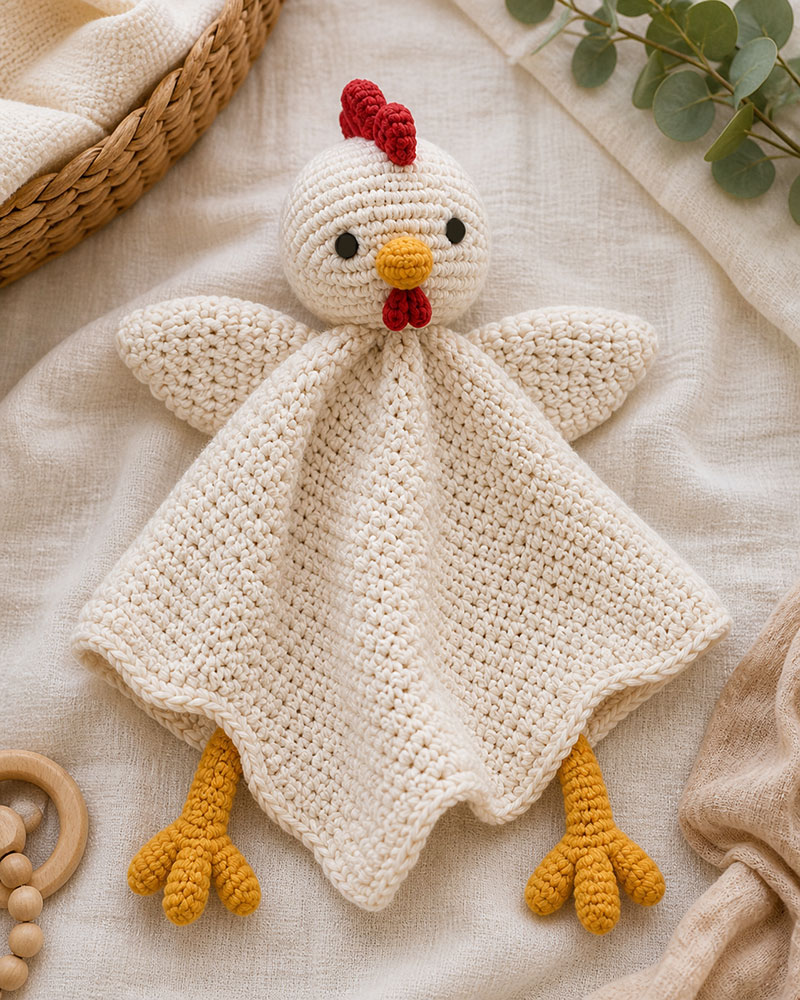
This crochet chicken lovey is designed to produce a reasonable handmade representation of the chicken shown in the hero image. It has a solid square blanket body, a round stuffed head, a dimensional beak, three comb sections, two wattles, thick tapered wings, tubular legs, and three rounded toes on each foot.
The chicken has securely embroidered black eyes worked with closely packed satin stitches to match the baby-safe finished version shown in the photo.
Skill level: Confident beginner. The pattern uses basic rows, continuous rounds, increases, decreases, light stuffing, embroidery, and sewn assembly.
Expected finished size: The center blanket panel measures about 12 inches square before the border is added. The completed bordered blanket should measure approximately 13 to 13.5 inches square. The complete lovey should measure approximately 23 to 26 inches from the top of the comb to the ends of the toes when laid flat. Final measurements will vary with yarn, round height, stuffing, and assembly placement.
Materials for This Crochet Chicken Pattern
- Approximately 350 yards of worsted weight number 4 cotton or cotton-blend yarn in cream
- Approximately 75 yards of worsted weight number 4 yarn in golden yellow
- Approximately 30 yards of worsted weight number 4 yarn in red
- Small amount of black yarn or black embroidery floss for the eyes
- 4.0 mm crochet hook for the blanket
- 3.5 mm crochet hook for the head, wings, legs, toes, beak, wattles, and comb
- Polyester fiberfill
- Locking stitch marker
- Yarn needle for sewing and weaving in yarn ends
- Embroidery needle if using embroidery floss for the eyes
- Scissors
- Rustproof pins or removable stitch markers for assembly
beginner crochet kit with hooks and tools
Chicken Lovey Gauge and Pattern Notes
Blanket gauge: 14 hdc and 11 rows should measure approximately 4 inches with the 4.0 mm hook.
Make a small gauge swatch before beginning the blanket. Change hook size if necessary. The blanket stitch and row counts are designed to produce a square when the stated gauge is matched.
For all stuffed pieces, use the 3.5 mm hook or another hook size that produces firm fabric without spaces large enough for stuffing to show.
Abbreviations:
- ch means chain
- sc means single crochet
- hdc means half double crochet
- sl st means slip stitch
- st means stitch
- inc means work 2 sc in the same stitch
- dec means single crochet 2 stitches together through the front loops
The ch 1 at the beginning of a row or round does not count as a stitch.
Work the head, wings, legs, toes, beak, and comb sections in continuous rounds unless the pattern specifically says otherwise. Do not join or turn. Place a stitch marker in the first stitch and move it upward after each round.
Numbers in parentheses show the stitch count at the end of the row or round.
Solid Crochet Chicken Lovey Blanket
Use cream yarn and the 4.0 mm hook.
The blanket is crocheted in straight half double crochet rows. It is later positioned with one corner pointing upward and one corner pointing downward.
Pattern update: This chicken lovey pattern has been revised. Older Pinterest images may show an earlier version with an open granny-style blanket and contrasting shell border. The current instructions below make the solid cream blanket shown in the main photo on this page.
Foundation: Ch 43.
Row 1: Hdc in the second ch from the hook and in each remaining ch across. Ch 1 and turn. (42 hdc)
Rows 2 through 33: Hdc in every st across. Ch 1 and turn after Rows 2 through 32. Do not turn after Row 33. (42 hdc)
Blanket checkpoint: The blanket should measure approximately 12 inches wide and 12 inches tall before the border is added. It should lie flat without pulling inward, widening, or forming a noticeable rectangle.
If the width or height differs from 12 inches by more than about one-quarter inch, check the gauge before continuing. Adding extra rows will increase only the height and will not correct an incorrect width.
Blanket Border
Fasten off after Row 33. The side facing you after completing Row 33 will be treated as the right side of the blanket. Place that side facing upward.
Join cream yarn with a sl st in one corner stitch.
Side-edge placement note: Each side edge has 31 row ends between its two corner rows. Work 1 sc in every row end and place a second sc in row ends 3, 6, 10, 13, 16, 19, 22, 26, and 29. Count the row ends beginning immediately after the corner just completed. This produces 40 sc along each side edge.
Border Round 1: Ch 1. Work 3 sc in the same corner stitch. Work 1 sc in each of the 40 stitches between the first and second corner stitches. Work 3 sc in the second corner stitch.
Work 40 sc across the next 31 row ends using the side-edge placement described above. Work 3 sc in the third corner stitch.
Work 1 sc in each of the 40 unused foundation-chain loops between the third and fourth corner stitches. Work 3 sc in the fourth corner stitch.
Work 40 sc across the remaining 31 row ends using the same side-edge placement. Sl st to the first sc. (172 sc)
Border checkpoint: The blanket should still lie flat. All four sides should have 40 stitches between the 3-sc corner groups. If a side pulls inward, recount the row-end placement before continuing.
Border Round 2: Sl st into the center sc of the first 3-sc corner group. Ch 1. Work 3 hdc in the same stitch.
Hdc in every stitch until reaching the center stitch of the next 3-sc corner group. Work 3 hdc in that center corner stitch. Repeat around. Sl st to the first hdc. (180 hdc)
Fasten off and weave the yarn ends securely into the wrong side of the blanket.
Lightly block the blanket according to the yarn manufacturer’s directions. Shape it into an even square measuring approximately 13 to 13.5 inches across. Do not stretch the corners into long points. Allow the blanket to dry completely before assembly.
Round Crochet Chicken Head
Use cream yarn and the 3.5 mm hook.
Begin at the crown of the head. The final decrease rounds will form the bottom attachment area.
Round 1: Make a magic ring. Work 6 sc into the ring. (6)
Round 2: Inc in every st around. (12)
Round 3: Sc in the next st, inc in the next st. Repeat around. (18)
Round 4: Sc in the next 2 sts, inc in the next st. Repeat around. (24)
Round 5: Sc in the next 3 sts, inc in the next st. Repeat around. (30)
Round 6: Sc in the next 4 sts, inc in the next st. Repeat around. (36)
Round 7: Sc in the next 5 sts, inc in the next st. Repeat around. (42)
Rounds 8 through 14: Sc in every st around. (42)
Embroidered Chicken Eyes
Keep the round marker at the back of the head. The front of the head is directly opposite the marker.
Using black yarn or embroidery floss, embroider two round eyes between Rounds 10 and 11. Place the centers of the eyes approximately 8 stitches apart.
Build each eye with several short satin stitches placed closely together. Each finished eye should cover approximately one stitch in width and one round in height. Knot the embroidery securely inside the head.
Do not attach buttons, beads, plastic eyes, or glued eyes to a lovey intended for a baby.
Finish Shaping the Head
Round 15: Sc in the next 5 sts, dec over the next 2 sts. Repeat around. (36)
Round 16: Sc in the next 4 sts, dec over the next 2 sts. Repeat around. (30)
Round 17: Sc in the next 3 sts, dec over the next 2 sts. Repeat around. (24)
Begin adding fiberfill. Fill the crown and sides first. Keep the head round and firm, but do not pack it so tightly that the stitches spread apart.
Round 18: Sc in the next 2 sts, dec over the next 2 sts. Repeat around. (18)
Round 19: Sc in the next st, dec over the next 2 sts. Repeat around. (12)
Add the remaining stuffing. Pay special attention to the sides of the head so the face remains round rather than pointed.
Round 20: Dec around. (6)
Fasten off, leaving a tail at least 24 inches long. Thread the tail through the front loop of each remaining stitch and pull the opening closed. Do not cut the long tail. It will be used to attach the head to the blanket.
Head checkpoint: The finished head should measure approximately 3.5 to 4 inches across when worked in firm worsted-weight single crochet. The eyes should be level, and the decrease closure should be centered underneath the head.
Beak, Wattles, and Comb for the Crochet Chicken
Dimensional Yellow Beak
Use golden yellow yarn and the 3.5 mm hook.
Round 1: Make a magic ring. Work 6 sc into the ring. (6)
Round 2: Inc in every st around. (12)
Round 3: Sc in every st around. (12)
Round 4: Sc in the next st, dec over the next 2 sts. Repeat around. (8)
Fasten off, leaving a long sewing tail. Place a very small amount of stuffing inside the beak. Keep the 8-stitch back opening open for sewing.
Center the beak between the eyes. The top edge should sit near Round 11, and the lower edge should sit near Round 14.
Pin the beak in place. Sew through every stitch around the open back edge, catching the head fabric directly beneath each stitch. Add one or two hidden stitches through the lower center of the beak if needed to keep it from tipping upward.
Red Chicken Wattles
Use red yarn and the 3.5 mm hook. Make 2.
Ch 4.
Sl st in the second ch from the hook. Sc in the next ch. Work 5 hdc in the last ch.
Working along the unused loops on the opposite side of the foundation chain, sc in the next ch and sl st in the final ch.
Fasten off, leaving a sewing tail.
Place the narrow ends of the two wattles side by side directly below the beak. Allow the rounded lower sections to hang freely. Sew the narrow upper ends securely to the head.
Three-Part Red Comb
The comb is made from one tall lobe and two shorter lobes.
Tall Center Comb Lobe
Use red yarn and the 3.5 mm hook. Make 1.
Round 1: Make a magic ring. Work 6 sc into the ring. (6)
Round 2: Inc in every st around. (12)
Rounds 3 through 5: Sc in every st around. (12)
Round 6: Sc in the next st, dec over the next 2 sts. Repeat around. (8)
Fasten off, leaving a long sewing tail. Add a very small amount of stuffing. Flatten the 8-stitch opening to form a 4-stitch-wide base.
Short Comb Lobes
Use red yarn and the 3.5 mm hook. Make 2.
Round 1: Make a magic ring. Work 6 sc into the ring. (6)
Round 2: Inc in every st around. (12)
Rounds 3 and 4: Sc in every st around. (12)
Round 5: Sc in the next st, dec over the next 2 sts. Repeat around. (8)
Fasten off, leaving a long sewing tail. Add a very small amount of stuffing. Flatten the 8-stitch opening to form a 4-stitch-wide base.
Attach the Comb
Place the tall lobe at the top center of the head. Place one short lobe immediately in front of it and the second short lobe immediately behind it. The three bases should touch without stacking on top of one another.
Pin all three sections in place before sewing. Sew each flattened base securely through both layers and into the head. Add one or two small stitches between neighboring lobes so they remain upright and do not spread apart.
Finish the facial-piece tails: After the beak, wattles, and comb are securely attached, make a small secure knot at each seam. Insert the yarn needle into the head immediately beside the knot, pass it through the stuffing, and bring it out through a different stitch several inches away. Pull firmly enough to draw the knot beneath the crocheted surface. Trim the yarn close to the surface and allow the cut end to retract inside the head. Do not leave knots, cut ends, or loose strands exposed.
Thick Tapered Chicken Wings
Use cream yarn and the 3.5 mm hook. Make 2.
Begin at the outer tip of the wing and work toward the wider attachment edge.
Round 1: Make a magic ring. Work 4 sc into the ring. (4)
Round 2: Inc in every st around. (8)
Round 3: Sc in the next st, inc in the next st. Repeat around. (12)
Round 4: Sc in the next 2 sts, inc in the next st. Repeat around. (16)
Round 5: Sc in the next 3 sts, inc in the next st. Repeat around. (20)
Rounds 6 through 17: Sc in every st around. (20)
Do not stuff the wing. Flatten the open end so 10 stitches sit along the front layer and 10 stitches sit along the back layer.
Ch 1. Working through one stitch from each layer at the same time, sc across the flattened opening. (10 sc)
Fasten off, leaving a tail at least 18 inches long for assembly.
Wing checkpoint: Each wing should measure approximately 3.5 to 4 inches from the magic-ring tip to the flattened attachment edge. Both wings should have matching lengths and matching 10-stitch attachment edges.
Tubular Chicken Legs and Rounded Toes
Use golden yellow yarn and the 3.5 mm hook.
Crochet Chicken Legs
Make 2.
Before making the starting chain, leave a yarn tail approximately 20 inches long. This starting tail will be used to finish the foot.
Foundation: Ch 10. Check that the chain is not twisted. Sl st into the first ch to form a ring.
Round 1: Ch 1. Sc in the same ch as the joining sl st and in each remaining ch around. Do not join. Place the marker in the first sc. (10)
Rounds 2 through 20: Sc in every st around. (10)
Fasten off, leaving a second tail approximately 20 inches long at the upper end of the leg. Do not close either end.
The starting tail marks the foot end. The finishing tail marks the end that will be attached to the blanket.
Long Center Toes
Use golden yellow yarn and the 3.5 mm hook. Make 2, one for each foot.
Round 1: Make a magic ring. Work 6 sc into the ring. (6)
Rounds 2 through 7: Sc in every st around. (6)
Fasten off, leaving a 10 inch sewing tail. Do not stuff and do not close the 6-stitch opening.
Short Side Toes
Use golden yellow yarn and the 3.5 mm hook. Make 4, two for each foot.
Round 1: Make a magic ring. Work 6 sc into the ring. (6)
Rounds 2 through 6: Sc in every st around. (6)
Fasten off, leaving a 10 inch sewing tail. Do not stuff and do not close the 6-stitch opening.
Assemble Each Chicken Foot
Step 1: Close the toe bases. Flatten the open 6-stitch end of each toe so 3 stitches lie along the front layer and 3 stitches lie along the back layer. Using the toe’s sewing tail, whipstitch through one front stitch and one matching back stitch across the opening. This creates a closed 3-stitch-wide base. Do not cut the remaining sewing tail.
Step 2: Close the foot end of the leg. Lay one leg down with the starting tail and foot opening nearest you. Flatten the 10-stitch opening so 5 stitches lie along the front layer and 5 stitches lie along the back layer.
Using the long starting tail, whipstitch through one front stitch and one matching back stitch across the opening. This creates a closed 5-stitch-wide foot seam. Do not cut the remaining tail.
Step 3: Position the center toe. Place one long toe over the middle of the closed foot seam. The closed 3-stitch toe base should cover the middle 3 stitch pairs of the 5-stitch foot seam. The magic-ring end of the toe should point away from the leg.
Using the toe’s sewing tail, sew through both layers of the toe base and both layers of the closed foot seam. Sew across the base twice before fastening securely.
Step 4: Position the side toes. Place one short toe on each side of the center toe. Angle the two short toes outward slightly.
Each short toe base may overlap one outer edge of the center toe base. Sew each short toe base through both layers of the toe and both layers of the closed foot seam. Sew across each base twice.
Step 5: Reinforce the foot. Use the remaining starting tail from the leg to place several additional stitches through the foot seam and all three toe bases. Add one or two stitches between neighboring toe bases so the toes cannot pull apart.
Fasten securely and weave the starting tail into the leg.
Step 6: Stuff the leg. Add a small amount of fiberfill through the open upper end of the leg. The leg should look rounded but remain soft enough to dangle naturally. Do not pack the stuffing tightly. Keep the stuffing at least one-half inch below the upper opening so the attachment end can be flattened and sewn securely to the blanket.
Repeat with the second leg and the remaining three toes.
Leg checkpoint: Both legs should be the same length. Each foot should have one slightly longer center toe and two matching side toes. The foot seam should be completely closed. Tug each toe separately to confirm that it is securely attached.
Crochet Chicken Lovey Assembly
Complete the face, beak, wattles, and comb before attaching the head to the blanket.
Step 1: Position the Blanket
Lay the blocked blanket right side up with one corner pointing upward, one corner pointing downward, and the other two corners pointing left and right.
The upward corner will sit behind the head. The downward corner will form the lowest point of the lovey.
Step 2: Attach the Wings
Measure approximately 2.5 inches down from the upper point along each sloping blanket edge. Mark the two matching positions.
Place each wing behind the blanket with its flattened 10-stitch base lying just inside the marked edge. Point the rounded tip outward and slightly upward.
Use the long cream tail to sew the complete 10-stitch wing base securely to the wrong side of the blanket. Sew through both layers of the flattened wing base and through the blanket edge.
Check the blanket from the front before fastening off. Both wings should extend at matching angles and should sit at equal distances from the upper corner.
Step 3: Position the Head
Place the head above the upper portion of the blanket with the face pointing forward. Center the decrease closure on the blanket’s vertical center line.
Bring the upper blanket corner approximately 1 to 1.5 inches up behind the lower back of the head. The head should cover the inner ends of both wing bases.
Pin or baste the head in place. Lift the lovey gently by the head to check the balance before completing the seam.
Step 4: Sew the Head to the Blanket
Thread the long cream head tail onto the yarn needle. Bring the tail from the center closing point to the outside edge of the lower head without pulling the stuffing out of shape.
Sew the lower portion of the head to the blanket in a circle approximately 2 inches across. Pass the needle through the head fabric, the blanket, and back through the head fabric.
Space the stitches closely and evenly. Do not sew repeatedly through only the six-stitch closing point, because that can cause the head to pivot or wobble.
After completing the first circle, make a second pass around the attachment area. Add two or three hidden stitches between the lower sides of the head and the inner edges of the wings. These stitches help the wings remain in the position shown in the hero image.
Tug the head gently forward, backward, and from side to side. Add more stitches anywhere the head lifts away from the blanket.
Step 5: Attach the Legs
Turn the blanket wrong side up while keeping the bottom corner pointing downward.
Measure approximately 3 inches upward from the bottom point along each lower sloping edge. Mark the two matching positions.
Place the upper opening of one leg behind each marked edge. Angle the feet slightly outward.
Flatten each 10-stitch leg opening into 5 matching stitch pairs. Using the long upper tail, sew through both layers of the flattened leg and through the blanket edge.
Sew across the attachment edge once, then sew back across it a second time. Add several reinforcing stitches at both ends of the seam.
Turn the blanket right side up and confirm that the legs hang at matching lengths and that the feet face forward rather than twisting underneath the blanket.
Step 6: Final Finishing
For tails on the blanket, weave each tail back and forth through several stitches on the wrong side before trimming it. Change direction at least once so the tail cannot slide free.
For tails on the head, wings, legs, and toes, make a small secure knot at the seam or attachment point. Insert the needle immediately beside the knot and pass it through the interior of the piece, whether the piece is stuffed or unstuffed. Bring the needle out through a different stitch at least 1 inch away. Pull firmly enough to draw the knot beneath the crocheted surface, trim the yarn close, and allow the cut end to retract inside. Do not leave exposed knots, short cut ends, or loose strands.
Check that the blanket lies flat and that the head, beak, wattles, comb, wings, legs, and toes remain secure when pulled gently.
Shape the head with both hands. Straighten the comb lobes and angle the wings outward. Arrange the three toes on each foot so the long toe points forward and the shorter toes spread slightly to each side.
Lay the finished lovey flat with the blanket in a diamond position. The head should sit at the upper point, the wings should extend to the sides, and the two feet should show below the lower blanket edges.
Baby Safety Notes for This Crochet Chicken Pattern
Use embroidered eyes and securely sewn yarn details for any lovey intended to be handled by a baby. Do not use safety eyes, buttons, beads, glued decorations, wire, or other removable parts.
The long legs, individual toes, wings, wattles, comb sections, beak, and head must be sewn with repeated stitches and checked frequently. Stop using the lovey immediately if a seam loosens, stuffing becomes visible, or a yarn strand pulls free.
Use this handmade lovey only during supervised awake time. Do not allow a baby to chew on loose yarn ends or damaged crocheted parts.
Do not place handmade loveys, blankets, pillows, toys, or other loose items in a baby’s sleep space. The U.S. Consumer Product Safety Commission safe sleep guidance recommends keeping the sleep area free of loose items.
Crochet Chicken Pattern FAQ
Is this crochet chicken pattern beginner friendly?
It is best for a confident beginner. The blanket uses straight half double crochet rows, while the head and smaller pieces require continuous rounds, increases, decreases, stuffing, embroidery, and sewn assembly.
How big is the finished chicken lovey?
The center blanket panel measures about 12 inches square before the border is added. The finished bordered blanket should measure approximately 13 to 13.5 inches square. The complete lovey should measure approximately 23 to 26 inches from the comb to the toe tips when laid flat.
Can I use safety eyes?
Do not use safety eyes on a lovey intended to be handled by a baby. Use securely embroidered eyes instead. A version made with safety eyes should be treated only as display decor and kept completely out of the baby’s reach.
Why is my chicken lovey blanket stiff or curling?
Check the blanket gauge and border counts. Tight tension can make the solid half double crochet fabric stiff. Too few stitches along the side edges can pull the blanket inward, while too many border stitches can cause rippling. Light blocking after the border is completed will help the blanket lie evenly.
Can I make the chicken lovey larger?
Yes, but do not add rows without also increasing the width. Begin with a longer foundation chain, work the same number of stitches in every row, and continue until the height matches the width. The border stitch counts and attachment positions must then be adjusted for the larger blanket.
More Free Baby Patterns to Make Next
To compare this chicken lovey with other easy baby crochet projects, visit the free baby patterns collection first. Once this chicken lovey is finished, the same basic idea can be used for other animals, including my crochet cow pattern, crochet bunny lovey pattern, and free crochet duck lovey pattern.
For more easy-to-make barnyard gift ideas, these crochet farm animal lovey patterns gather chickens, cows, ducks, lambs, and other beginner-friendly animal loveys into one easy handmade baby collection.
Chicken, duck, owl, and other feathered projects are also gathered in my free bird crochet patterns collection for nursery gifts, loveys, appliqués, mobiles, and small handmade keepsakes.
Weathered wood signs, vintage barn details, muted gingham patterns, and rustic animal accents all fit naturally with handmade barnyard crochet gifts, and these farm nursery decor ideas show how farmhouse-style nursery spaces can tie the whole look together.
For simpler security blanket-style projects that are easily manageable for beginners, these easy crochet lovey patterns for babies focus on lighter shaping, approachable construction, and quick handmade gifts that work well for baby showers and nursery baskets.
When you click on links to various merchants on this site and make a purchase, this may result in this site earning a commission. This does not affect the price you pay.

UBGI Gold Standard 2026
Reviewed under the site's
editorial checklist.
Photos, decorating ideas, party setups and reader submissions are shared for inspiration unless a page is specifically presented as a pattern, tutorial, reference guide or step-by-step project. Follow the instructions, measurements, safety guidance and manufacturer directions provided for the particular project or product.
About Jan | Contact | Baby Nursery Ideas (Blog) | Site Map | Privacy Policy | Disclosure Policy | Disclaimer | Affiliate Disclosure | Earnings Disclosure | Facebook | Pinterest
I am a participant in the Amazon Services LLC Associates Program, an affiliate advertising program designed to provide a means for us to earn fees by linking to Amazon. As an Amazon Associate I earn from qualifying purchases.
Copyright © 2006-2026. All Rights Reserved.