Puppy Lovey Crochet Pattern for Babies
This puppy lovey crochet pattern walks you through making a sweet floppy-eared crochet dog lovey with a soft blanket, cuddly head, and embroidered details. It is designed for awake, directly supervised cuddling and play or for decorative display outside a baby’s reach, and it should never be placed in a crib, bassinet, play yard, bedside sleeper, or any other infant sleep space.
The instructions use separate blanket and stuffed-piece gauges, counted rounds, measured checkpoints, and defined assembly points so each component can be checked before the puppy lovey is completed.
More Lovey Patterns and Puppy Nursery Ideas
Teddy Bear Lovey Crochet Pattern
Crochet Dinosaur Lovey Pattern
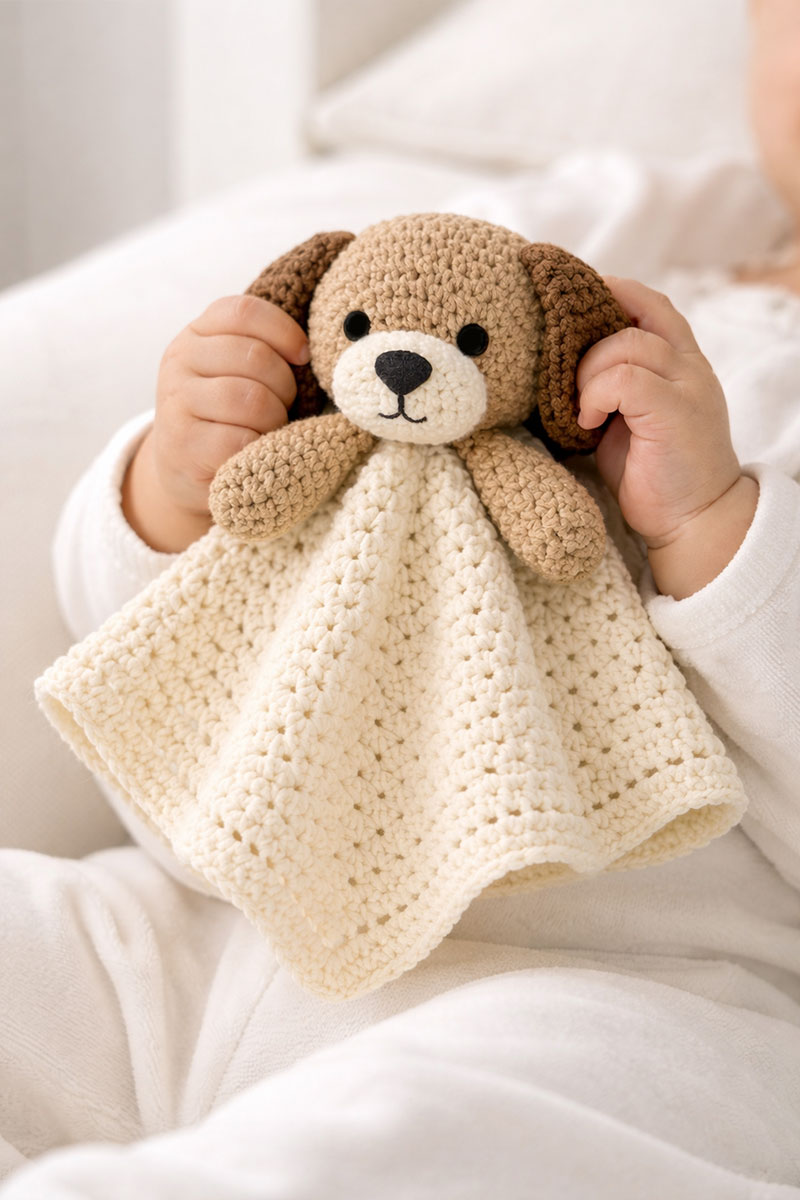
See the correct yarn for this puppy lovey style for inspiration
Prefer to shop your own stash? A soft worsted-weight acrylic or cotton-blend yarn can work well, but make a swatch with each hook size before beginning. Match the blanket gauge for drape and the tighter single-crochet gauge for the stuffed puppy pieces. Wash and dry the swatches according to the yarn label before measuring them.
Quick answer:
This puppy lovey is built around a flat center-out square blanket with four free corners. The puppy head is attached securely over the center of the blanket, while two lightly stuffed arms rest over the front folds. A separate smaller hook keeps the stuffed pieces firm enough to contain the fiberfill without making the blanket stiff.
A practical puppy lovey should fold easily, drape evenly from all four corners, and remain balanced when it is held by the puppy body. Keeping the stuffing light and attaching the head at the blanket center prevents the top of the lovey from becoming excessively heavy.
The puppy can also coordinate with a nursery without copying every dog-themed detail in the room. Cream, tan, brown, gray, and black-and-white combinations work especially well for a handmade piece that may remain on display after the nursery changes.
For more beginner-friendly projects and pattern ideas, visit free baby crochet patterns to see how different lovey styles compare.
If you want the same floppy-eared puppy look with a body instead of a blanket base, use my free crochet puppy snuggler pattern.
My frog lovey crochet pattern adds a pond-inspired option that fits naturally alongside other baby animal lovey designs.
My crochet cow pattern adds a lovey that can be crocheted to resemble a favorite breed with a security blanket body and simple shaping for handmade baby gifts and nursery gift baskets.
For more coordinated barnyard-style projects, these crochet farm animal lovey patterns gather cows, chickens, ducks, lambs, and other animal loveys into one handmade baby gift collection.
For more decorating tips, visit my puppy dog nursery theme ideas collection for puppy-themed room inspiration, wall décor, and color ideas.
Why This Puppy Lovey Construction Works
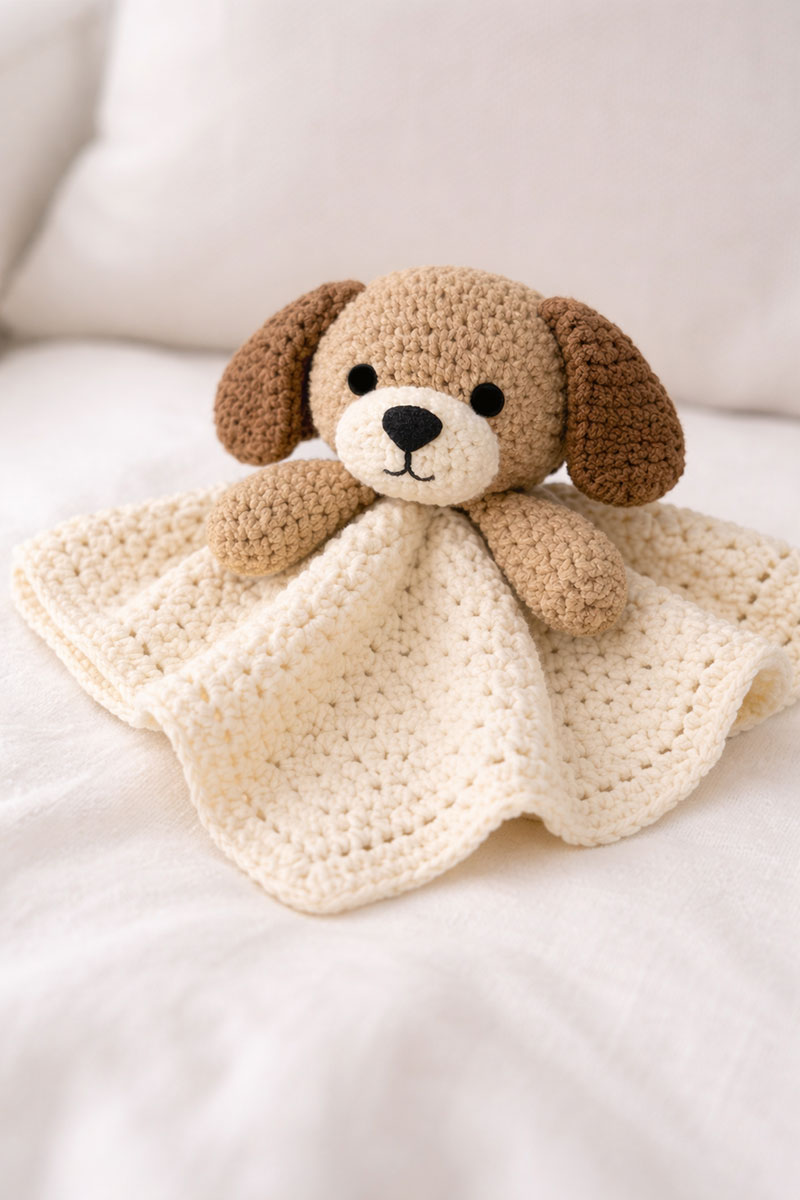
Baby-use finishing note: Use the photographs as a reference for the puppy’s proportions and blanket drape. For the version made from this pattern, embroider the eyes, nose, and short vertical line beneath the nose with black embroidery floss. Do not use plastic safety eyes, buttons, beads, glued pieces, or other detachable facial parts.
The square blanket is worked outward from its center, with increases placed consistently in four corner spaces. This construction allows the blanket to remain flat while creating four corners that can hang, fold, or be gathered beneath the puppy.
The puppy head is larger than the head in many small comfort-cloth patterns so it remains in proportion to the two arms and broad floppy ears. The head is still stuffed lightly, and only its lower attachment area is sewn to the blanket.
The two arms give the puppy the finished appearance shown in the reference photographs without trapping the blanket corners. The ears are crocheted as flattened tubes rather than single-layer strips, giving them rounded tips and enough weight to hang naturally.
To carry the same puppy look into wall art, this puppy dog paw print stencil is an easy companion idea that does not compete with the crochet piece.
Best Yarn and Supplies for a Puppy Lovey
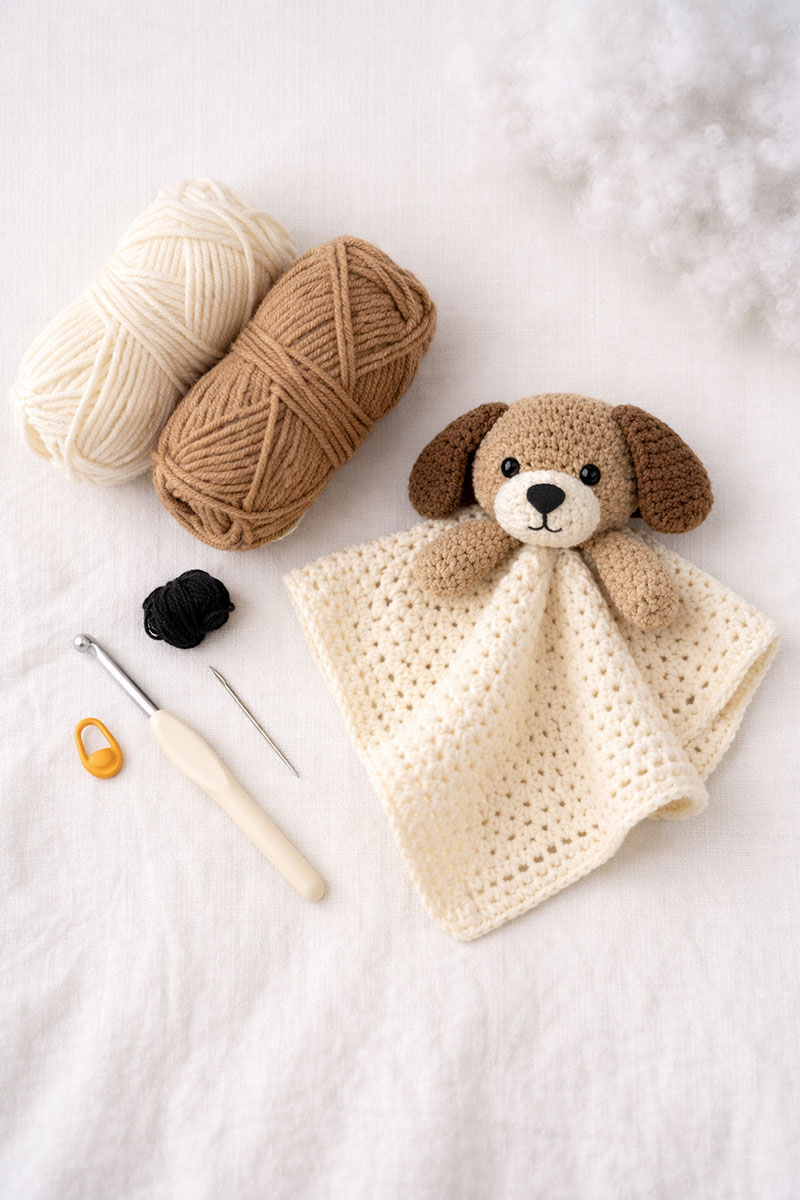
The blanket and stuffed puppy pieces use the same yarn weight but different hook sizes. The larger hook gives the blanket a softer drape. The smaller hook creates a denser fabric for the head, arms, ears, and muzzle so the stuffing does not show through the stitches.
Use a smooth worsted-weight yarn that can be washed according to the care instructions on its label. Avoid yarn that sheds fibers easily or produces a stiff fabric after washing.
Construction used in this puppy lovey
The blanket is a center-out hdc square with four defined corners. The puppy includes a larger round head, an oval muzzle, two flattened rounded ears, two lightly stuffed arms, embroidered facial features, and a reinforced circular attachment at the blanket center.
Complete Puppy Lovey Crochet Pattern
Skill level: Intermediate. A confident advanced beginner may also complete the pattern with experience working joined rounds, continuous rounds, increases, decreases, stuffing, embroidery, and multi-piece assembly.
Finished size: Measurements are approximate after washing, reshaping, and drying flat. The finished size will vary with yarn, tension, stuffing, and blocking.
Approximate Finished Measurements
Blanket: approximately 14½ to 15½ inches square
Overall hanging length: approximately 14½ to 15½ inches. Hold the finished lovey by the head so one blanket corner hangs straight down. Without stretching the head or blanket, measure vertically from the crown to the tip of the lowest blanket corner.
Head: approximately 3¾ to 4 inches across
Ear length: approximately 3½ inches
Arm length: approximately 3½ inches
Muzzle width: approximately 2¼ inches
Materials
Worsted-weight yarn
Color A: cream for the blanket and muzzle, approximately 300 yards
Color B: tan or light brown for the head and arms, approximately 140 yards
Color C: medium or dark brown for the ears, approximately 40 yards
Small amount of black six-strand embroidery floss for the eyes, nose, and short vertical line beneath the nose
Short length of contrasting scrap yarn for the removable face-center guide
5 mm crochet hook for the blanket
4 mm crochet hook for the head, muzzle, ears, and arms
Optional 3.75 mm crochet hook if the 4 mm hook leaves openings that could expose the fiberfill
Washable polyester fiberfill
Locking stitch markers
Tapestry needle
Embroidery needle
Rustproof pins
Flexible measuring tape or ruler
Scissors
Yarn reserve: Yardage is approximate. Keep at least 10 percent additional yarn available for gauge differences, sewing tails, and repairs. Do not rely on this reserve for optional extra blanket rounds; obtain additional Color A if you plan to enlarge the blanket.
If adding blanket rounds: Continue the established increase pattern. Each additional round adds 12 hdc total, or 3 hdc per side. For Border Round 1, add 8 sc to the final hdc total. For Border Round 2, add another 8 sc to the Border Round 1 total. Additional rounds will increase both the finished size and the amount of Color A required.
Abbreviations
ch = chain
sl st = slip stitch
sc = single crochet
hdc = half double crochet
inc = 2 sc in the same stitch
dec = single crochet decrease worked over the next 2 stitches
st = stitch
sts = stitches
sp = space
rnd = round
Pattern Notes
This pattern uses standard US crochet terms.
The ch 1 or ch 2 at the beginning of a round does not count as a stitch unless the instructions specifically say otherwise.
Working into joined and slip-stitched stitches: Keep all joining and positioning slip stitches loose. In Blanket Round 2, the joined first hdc is the one stitch intentionally skipped after the fourth corner; work the final 2 hdc into the next 2 stitches even though those stitches contain positioning slip stitches. In Blanket Rounds 3–15 and Border Round 1, work the final side into both the joined first stitch and the next stitch containing a positioning slip stitch. In Border Round 2, work into the joined first sc when completing the final side. Insert the hook beneath the original top loops below each slip stitch rather than working into the slip stitch itself. Following these placements produces the stated totals of 24 hdc in Round 2, 36 through 180 hdc in Rounds 3–15, 188 sc in Border Round 1, and 196 sc in Border Round 2.
The head, muzzle, ears, and arms are worked in continuous rounds. Do not join unless instructed. Place a stitch marker in the first stitch of every round and move it upward as the work progresses.
Use the 5 mm hook only for the blanket. Before beginning the puppy pieces, check the washed single-crochet swatch made with the 4 mm hook. If stretched stitches would expose the fiberfill, use the 3.75 mm hook from the beginning of the muzzle, head, both ears, and both arms without changing the stitch counts. Do not change hook sizes midway through a piece. Use the same selected hook for every puppy piece so the muzzle, head, ears, and arms remain proportional and both ears and both arms finish at matching sizes. Pieces made with the 3.75 mm hook may finish slightly smaller than the listed measurements.
The right side of the blanket is the side facing you while the joined rounds are worked. Keep this side facing upward during assembly.
Leave a sewing tail at least 18 inches long on each ear and arm. Leave a tail at least 36 inches long when closing the puppy head.
Secure every magic ring: After completing Round 3 of the blanket, head, ears, and arms, pull the starting ring completely closed. Thread the starting tail onto the tapestry needle and weave it through the wrong-side bases of the Round 1 stitches in one direction and then back through nearby stitches in the opposite direction. Complete this before blocking the blanket or stuffing and closing any puppy piece. Secure the muzzle’s foundation-chain tail inside the muzzle before sewing it to the head.
Gauge
Blanket gauge with 5 mm hook: 13 hdc stitches and 9 hdc rows measure approximately 4 inches.
Stuffed-piece gauge with 4 mm hook: 16 sc stitches and 17 sc rounds measure approximately 4 inches.
Measure both swatches after washing and drying them according to the yarn label. The blanket swatch should fold easily without standing stiffly. The single-crochet swatch should be firm enough that stretched stitches do not expose the fiberfill.
Center-Out Square Blanket
With Color A and the 5 mm hook.
Round 1: Make a magic ring. Ch 2; the beginning ch 2 does not count as a stitch. Work *3 hdc in the ring, ch 2; repeat from * 3 more times. Pull the ring closed and join with a sl st in the first hdc. (12 hdc and four ch-2 corner spaces)
Round 2: Sl st in each of the next 2 hdc and into the first ch-2 corner sp. Ch 2. Work (2 hdc, ch 2, 2 hdc) in the same corner sp. Locate the first hdc of the previous round immediately after the corner sp and skip that stitch. Work 1 hdc in each of the next 2 hdc. *Work (2 hdc, ch 2, 2 hdc) in the next corner sp, skip the first hdc immediately after that corner, and work 1 hdc in each of the next 2 hdc; repeat from * 2 more times. Join with a sl st in the first hdc. (24 hdc and four ch-2 corner spaces)
Round 3: Sl st in the next hdc and into the first ch-2 corner sp. Ch 2. Work (2 hdc, ch 2, 2 hdc) in the same corner sp. After completing the corner, skip the first hdc of the previous round immediately following that corner sp. Work 1 hdc in every remaining hdc along the side to the next corner sp. *Work (2 hdc, ch 2, 2 hdc) in the next corner sp, skip the first hdc immediately after that corner, and work 1 hdc in every remaining hdc to the next corner sp; repeat from * around. Join with a sl st in the first hdc. (36 hdc and four ch-2 corner spaces)
Skipping the first existing hdc after every corner prevents the shorter, wider hdc fabric from receiving too many increases. Each completed round adds 12 hdc, or 3 hdc along each side.
Corner-line checkpoint: Lay the square flat after completing Round 3 and examine all four corners. A narrow diagonal line beside each corner is acceptable, but the square should not rotate, lean, or form a pinwheel. If it does, undo Round 3 and confirm that exactly one hdc was skipped immediately after each corner space and that no stitch was skipped before a corner or skipped twice along one side.
Rounds 4–15: Repeat the Round 3 method. Begin each round by working 1 sl st in the next hdc and 1 sl st into the first ch-2 corner sp. Ch 2. Work (2 hdc, ch 2, 2 hdc) in the same corner sp. After each corner, skip exactly the first existing hdc immediately following the corner sp and work 1 hdc in every remaining hdc along the side to the next corner. Continue the established corner and side sequence around. Join each round with a sl st in the first hdc and follow the stitch totals listed below.
Round 4: 48 hdc and four ch-2 corner spaces
Round 5: 60 hdc and four ch-2 corner spaces
Round 6: 72 hdc and four ch-2 corner spaces
Round 7: 84 hdc and four ch-2 corner spaces
First shape checkpoint: After Round 7, each side contains 21 hdc between its two corner spaces and should measure approximately 6 to 6½ inches. Lay the blanket flat. The sides should remain straight between the corners without cupping or forming waves.
Round 8: 96 hdc and four ch-2 corner spaces
Round 9: 108 hdc and four ch-2 corner spaces
Round 10: 120 hdc and four ch-2 corner spaces
Round 11: 132 hdc and four ch-2 corner spaces
Second shape checkpoint: After Round 11, each side contains 33 hdc between its two corner spaces and should measure approximately 10 to 10½ inches.
Round 12: 144 hdc and four ch-2 corner spaces
Round 13: 156 hdc and four ch-2 corner spaces
Round 14: 168 hdc and four ch-2 corner spaces
Round 15: 180 hdc and four ch-2 corner spaces
After Round 15, each side contains 45 hdc between its two corner spaces and should measure approximately 13½ to 14 inches before the border.
Final blanket-shape checkpoint: Lay the blanket on a flat surface. All four sides should be equal, all four corners should point outward, and the center should remain flat. Stop and recheck the gauge, corner spaces, skipped stitches, and stitch counts if the blanket cups, twists, or develops waves between the corners.
Blanket Border
Border Round 1: Sl st in the next hdc and into the first ch-2 corner sp. Ch 1. Work (1 sc, ch 2, 1 sc) in the same corner sp. Work 1 sc in every hdc to the next corner sp. *Work (1 sc, ch 2, 1 sc) in the next corner sp, then work 1 sc in every hdc to the next corner sp; repeat from * around. Join with a sl st in the first sc. (188 sc and four ch-2 corner spaces)
Border Round 2: Sl st into the first ch-2 corner sp. Ch 1. Work (1 sc, ch 2, 1 sc) in the same corner sp. Work 1 sc in every sc to the next corner sp. *Work (1 sc, ch 2, 1 sc) in the next corner sp, then work 1 sc in every sc to the next corner sp; repeat from * around. Join with a sl st in the first sc. (196 sc and four ch-2 corner spaces)
Fasten off. Weave the ending tail through several stitches in one direction and then back through nearby stitches in the opposite direction.
Confirm that the magic-ring starting tail has been secured before blocking. Wash or damp-block the blanket according to the yarn label. Shape it into a square without stretching the corners beyond their natural length. Lay it flat until completely dry before attaching the puppy pieces.
Puppy Muzzle
Make the muzzle before completing the head so its sewing and embroidery tails can be secured inside the head.
With Color A and the 4 mm hook.
Foundation: Ch 7.
Round 1: Sc in the second ch from the hook and in each of the next 4 ch. Work 3 sc in the last ch. Turn the foundation chain so the unused loops are facing upward. Work 1 sc in each of the next 4 unused loops and 2 sc in the final unused loop. Do not join. (14)
Round 2: Inc in the first st, sc in each of the next 4 sts, inc in each of the next 3 sts, sc in each of the next 4 sts, and inc in each of the final 2 sts. (20)
Round 3: Sc in each st around. (20)
Remove the beginning-of-round marker. Fasten off, leaving an 18-inch sewing tail. The muzzle should form a shallow oval approximately 2¼ inches wide. Do not stuff it yet.
Puppy Head
With Color B and the 4 mm hook. Work in continuous rounds.
Round 1: Make a magic ring and work 6 sc in the ring. (6)
Round 2: Inc in each st around. (12)
Round 3: *Sc in the next st, inc in the next st; repeat from * around. (18)
Round 4: *Sc in each of the next 2 sts, inc in the next st; repeat from * around. (24)
Round 5: *Sc in each of the next 3 sts, inc in the next st; repeat from * around. (30)
Round 6: *Sc in each of the next 4 sts, inc in the next st; repeat from * around. (36)
Round 7: *Sc in each of the next 5 sts, inc in the next st; repeat from * around. (42)
Round 8: *Sc in each of the next 6 sts, inc in the next st; repeat from * around. (48)
Rounds 9–15: Sc in each st around. (48 in each round)
Round 16: *Sc in each of the next 6 sts, dec; repeat from * around. (42)
Round 17: *Sc in each of the next 5 sts, dec; repeat from * around. (36)
Round 18: *Sc in each of the next 4 sts, dec; repeat from * around. (30)
Place the Muzzle and Embroider the Face
Pause before working Round 19. Treat the stitch holding the beginning-of-round marker on Round 18 as the center back of the head. Beginning with the first stitch after that marker as stitch 1, count 15 stitches and place a second locking marker in the 15th stitch. This second marker identifies the front center of the face.
Thread a short length of contrasting yarn onto the tapestry needle. Beginning at the front-center marker on Round 18, run the contrasting strand vertically upward along the surface of the head through the stitch gaps at approximately Rounds 16, 14, 12, and 10. Do not knot the strand. This removable guide marks the face centerline while the muzzle and eyes are positioned. After the guide strand is in place, remove the front-center locking marker from Round 18.
Hold the muzzle horizontally and center it over the contrasting guide strand. Position the upper edge of the muzzle between Head Rounds 11 and 12 and the lower edge near Head Round 16.
Pin the muzzle in place. Sew around the edge, leaving approximately 1 inch open. Add a very small amount of fiberfill so the muzzle is softly raised but not firm. Finish sewing the opening closed. Secure the tail inside the head.
Eye placement: Use all six strands of black embroidery floss. Place the eyes between Head Rounds 10 and 11. Using the contrasting guide strand at Round 10 as the center point, position the center of one eye 4 stitches to the left and the center of the other eye 4 stitches to the right. Each eye should cover an area approximately 2 stitches wide and 1 round high.
Build each open eye with 3 short horizontal satin stitches placed closely together across the marked 2-stitch area. Keep the stitches short, smooth, and firm enough to lie flat without pulling the crocheted fabric inward. Match the length and tension of both eyes, then secure the floss ends inside the head.
Nose: Use the contrasting guide strand to center a small upside-down satin-stitched black triangle at the upper center of the muzzle. Add one short straight vertical black stitch directly beneath the triangle. Keep both features flat against the muzzle without pulling the fabric inward. Secure and bury the floss ends inside the open head. Remove the contrasting guide strand after the muzzle, eyes, nose, and vertical stitch are complete.
Complete and Stuff the Head
Round 19: *Sc in each of the next 3 sts, dec; repeat from * around. (24)
Begin stuffing the head with small pieces of fiberfill. Fill the crown, sides, and area behind the muzzle evenly. The head should hold its shape without becoming hard or stretching the stitches apart.
Round 20: *Sc in each of the next 2 sts, dec; repeat from * around. (18)
Locate the Round 20 stitch directly opposite the center of the muzzle. Fasten a locking marker around the vertical body of that stitch, below its top loops, so the marker does not block the loops needed for Round 21. This marks the center back of the attachment round. Leave the marker in place until the head is ready to be sewn to the blanket.
Round 21: *Sc in the next st, dec; repeat from * around. (12)
Add the final small pieces of stuffing. Check that both sides of the face remain equal and that the muzzle has not shifted.
Round 22: Dec around. (6)
Fasten off, leaving a 36-inch tail. Thread the tail through the front loop of each remaining stitch, pull the opening closed, and secure it. Do not weave in this tail because it will be used to attach the head to the blanket.
Head checkpoint: At the stated stuffed-piece gauge, the lightly stuffed head should measure approximately 3¾ to 4 inches across. The muzzle and eyes should remain centered on the front of the head directly opposite the separate Round 20 center-back attachment marker, and the lower closure should sit at the bottom of the head. Remove the movable beginning-of-round marker after completing this check. Leave only the separate Round 20 center-back attachment marker in place.
Rounded Puppy Ears
Make 2 with Color C and the 4 mm hook. Work in continuous rounds.
Round 1: Make a magic ring and work 6 sc in the ring. (6)
Round 2: Inc in each st around. (12)
Round 3: *Sc in the next st, inc in the next st; repeat from * around. (18)
Rounds 4–12: Sc in each st around. (18 in each round)
Round 13: *Sc in the next st, dec; repeat from * around. (12)
Rounds 14–15: Sc in each st around. (12 in each round)
Remove the beginning-of-round marker. Do not stuff the ear. Flatten the open end so 6 stitches are aligned along the front layer and 6 stitches are aligned along the back layer.
Sc through both layers across the opening, pairing one front stitch with one back stitch for each sc. (6)
Fasten off, leaving an 18-inch sewing tail.
Repeat for the second ear. Lay both ears beside one another before assembly. They should have matching lengths, widths, and rounded tips and should measure approximately 3½ inches long.
Puppy Arms
Make 2 with Color B and the 4 mm hook. Work in continuous rounds.
Round 1: Make a magic ring and work 6 sc in the ring. (6)
Round 2: Inc in each st around. (12)
Round 3: *Sc in the next st, inc in the next st; repeat from * around. (18)
Rounds 4–7: Sc in each st around. (18 in each round)
Round 8: *Sc in the next st, dec; repeat from * around. (12)
Add small pieces of fiberfill to Rounds 1–8. Keep the rounded paw end softly filled rather than firm.
Rounds 9–15: Sc in each st around. (12 in each round)
Remove the beginning-of-round marker. Add only enough stuffing to the middle of the arm to maintain its shape. Leave the final 2 rounds unstuffed so the attachment edge can lie flat.
Flatten the opening so 6 stitches are aligned along the front layer and 6 stitches are aligned along the back layer.
Sc through both layers across the opening, pairing one front stitch with one back stitch for each sc. (6)
Fasten off, leaving an 18-inch sewing tail.
Repeat for the second arm. Compare both pieces before assembly. They should match in length, stuffing level, and width and should measure approximately 3½ inches long.
Puppy Lovey Assembly
Attach the Ears to the Head
Place the head with the face toward you and the lower closure pointing downward.
Pin one ear to each side of the head. Position each 6-stitch closing edge in a gentle vertical curve along the side of the head, with its upper end level with Head Round 7 and its lower end level with approximately Head Round 13. Do not compress, fold, or gather the closing edge to fit the head. The rounded portion of each ear should hang downward beside the face.
Check the head from the front, top, and back. Both ears should begin at the same height and hang to the same level.
Using the ear tail, sew through each of the 6 closing stitches and into adjacent head stitches. Make a second complete pass across the same attachment line. Secure and bury the tail inside the head.
Prepare the Blanket Orientation
Lay the completely dry blanket right side up and turn it so one corner points toward you like the bottom point of a diamond. This is the front corner.
The magic-ring center of the blanket is the head attachment point. The puppy face must point toward the front corner.
Attach the Head to the Blanket Center
Thread the 36-inch head tail onto the tapestry needle. Before placing the head on the blanket, insert the needle through the closed base and guide it through the inside of the stuffed head until it exits beside the locking marker in the center-back stitch of Head Round 20. Keep this yarn path inside the head so no long strand crosses the outer surface, and do not pull tightly enough to indent the lower closure.
Place the closed bottom of the head directly over the blanket’s center ring. Pin the head so the face points toward the front corner, the marked center back points toward the opposite corner, and both ears hang evenly toward the side corners. Remove the locking marker after confirming the orientation.
Use Head Round 20, which contains 18 stitches, as the attachment line. Beginning at the tail’s center-back exit point, pass the needle around the vertical body of each Round 20 sc directly below its top loops, then through the blanket immediately around the center ring. Do not try to use the Round 20 top loops because those loops were already worked into Round 21. Space the 18 blanket insertion points evenly around a circle approximately 1½ inches across.
Complete all 18 attachment stitches once, keeping the sewing tension even and firm without cinching the blanket center. Check that the head remains upright and centered and that the blanket still lies flat. Make a second complete pass around the same 18 Round 20 stitch bodies and through the corresponding blanket points.
Secure the tail beneath the head and weave it through the blanket in two different directions before trimming it.
Attach the Arms
Position one arm at approximately the 4 o’clock position and the other at approximately the 8 o’clock position beneath the head when viewed from the front.
Angle the rounded ends toward the lower left and lower right sides of the front blanket corner. The two arms should form a shallow V beneath the muzzle.
Place each flattened 6-stitch attachment edge approximately ¼ inch outside the head attachment seam. Pin both arms before sewing and compare their lengths and angles.
Using the arm tail, sew through each of the 6 closing stitches and into the blanket. Make a second complete pass across the same 6-stitch attachment line.
Add 2 small reinforcing stitches between the upper inner edge of each arm and the lower side of the head near Head Round 19. These stitches prevent the arms from rotating without pulling them tightly against the face.
Secure and bury every tail inside the arm, head, or blanket.
Final Construction Check
Lay the lovey flat with the front corner pointing downward.
The blanket should form a flat square with four equal corners and no cupping, gathering, twisting, or rippling at the center.
The head should sit upright directly over the blanket center while the lovey lies flat. When the completed lovey is lifted gently by the head, the blanket should remain securely attached without the circular seam opening, wobbling excessively, or gathering the blanket center.
The face should point toward one blanket corner rather than toward a flat side.
The ears should begin at matching heights and hang freely without being stuffed.
The arms should match in size and angle and should not trap the blanket corners.
Confirm that every rustproof pin, locking stitch marker, removable guide strand, and other temporary construction aid has been removed from the head, muzzle, ears, arms, and blanket. Inspect the completed lovey visually and by touch before continuing.
Pull firmly but carefully on the head, ears, arms, muzzle, and embroidered features in several directions. No seam, knot, or embroidered stitch should loosen or expose a long loop.
Wash the completed lovey according to the yarn manufacturer’s instructions. A mesh laundry bag may be used if machine washing is permitted by the yarn label. Reshape the blanket, ears, arms, muzzle, and head while damp and lay the lovey flat to dry.
After it is completely dry, repeat the seam and embroidery inspection before gifting or using the lovey.
Common Construction Mistakes
- Missing one of the four blanket corner increases, which pulls the square out of shape.
- Adding extra stitches along a blanket side, which creates ripples between the corners.
- Using the larger blanket hook for the stuffed pieces, leaving gaps that expose the fiberfill.
- Stuffing the head or arms firmly enough to stretch the single-crochet stitches.
- Stuffing the ears instead of leaving them flat and flexible.
- Attaching the head away from the blanket center, causing the corners to hang unevenly.
- Pointing the face toward a blanket side instead of toward one corner.
- Attaching the ears or arms before comparing both pieces for matching size and placement.
- Using plastic safety eyes, buttons, beads, glued pieces, or other detachable facial features.
- Skipping the final pull test and post-washing inspection.
Tips to Make the Puppy Lovey Hold Up Well

Durability depends on dense stuffed-piece fabric, moderate stuffing, short secured embroidery stitches, and reinforced attachment seams. Every component should remain flexible without exposing loose loops or openings.
Use these finishing rules:
Keep the head and arms lightly stuffed. The pieces should recover their shape when gently squeezed without feeling hard.
Use embroidered satin-stitch eyes rather than plastic eyes. Keep all embroidery tails secured inside the head.
Sew the ears, arms, and head through every stitch along their defined attachment lines and repeat each structural seam a second time.
Follow the yarn label when washing and drying the finished lovey. Inspect every seam and embroidered feature again after washing.
Stop using the lovey if the yarn becomes damaged, stuffing becomes visible, embroidery loosens, or any seam begins to open.
Color ideas: Try cream and brown for a classic puppy, black and white for a spotted dog, golden tan for a retriever look, chocolate brown for a lab-inspired lovey, or tan, white, and black for a beagle-style puppy.
For current infant sleep safety information, visit the American Academy of Pediatrics safe sleep guide and the U.S. Consumer Product Safety Commission Safe Sleep page. Keep this lovey out of cribs, bassinets, play yards, bedside sleepers, and every other infant sleep space. It is intended only for awake, directly supervised interaction or decorative display beyond a baby’s reach.
Puppy Lovey Gift Ideas and Nursery Matchups

A puppy lovey can echo one or two nursery colors without matching every dog-themed item exactly. A tan and cream version works naturally with neutral rooms, woodland accents, and puppy-themed decorating.
For decorative display, place the lovey on a wall hook, high shelf, or adult chair beyond the baby’s reach. Do not use it as crib décor or leave it in any infant sleep space.
The four blanket corners remain free in this construction, allowing the blanket to fold and drape without the arms or head trapping the edges.
To make a second animal lovey for the same gift set, start with my crochet animal lovey patterns collection so you can compare different face shapes, ear placements, blanket constructions, and finished styles.
The crochet bunny lovey pattern, crochet elephant lovey free pattern, and owl baby lovey crochet pattern are gentle companion choices, while this highland cow crochet snuggler lovey pattern gives you a thicker farm-animal look.
For a safari-style handmade baby gift with a soft blanket base and textured mane, my crochet lion lovey pattern adds a bolder animal option to the same baby lovey collection.
For a woodland-style baby gift with a little more forest personality, my crochet raccoon pattern adds a striped-tail animal lovey that fits naturally with puppy, fox, bear, and other handmade nursery gift projects.
For another bear-style lovey with baby shower gift appeal, try my crochet koala lovey pattern to create an Australian companion for puppy, teddy bear, and woodland-style crochet baby gift sets.
FAQ About Puppy Lovey Crochet Patterns
What size is the blanket in this puppy lovey pattern?
The completed center-out blanket should measure approximately 14½ to 15½ inches square after washing and drying. Matching the stated blanket gauge is more reliable than adding or removing stitches from an individual side.
Why are two crochet hook sizes used?
The 5 mm hook gives the hdc blanket enough flexibility to drape and fold. The 4 mm hook produces denser single-crochet fabric for the stuffed head and arms and the double-layered ears. Change to a 3.75 mm hook for the puppy pieces if stuffing remains visible through the stitches.
Why is the blanket worked as a center-out square?
The four corner increases allow the blanket to grow evenly while remaining flat. The center also provides a clear attachment point for the puppy head, allowing all four corners to hang freely beneath it.
Should the puppy head be firmly stuffed?
No. Add enough fiberfill to hold a rounded shape without stretching the single-crochet stitches. Excessive stuffing makes the head heavy, exposes gaps, and places unnecessary strain on the center attachment seam.
Are the puppy ears stuffed?
No. Each ear is crocheted as a tube, left unstuffed, flattened, and closed through both layers. This creates a rounded double-layer ear that hangs more naturally than a stiff stuffed ear.
How are the puppy eyes made?
Each open eye is embroidered with 3 short horizontal satin stitches using black six-strand embroidery floss. Keep the stitches short and even so they lie flat without puckering the crocheted face. Do not use plastic safety eyes, buttons, beads, glued felt, or other detachable facial parts.
Can this puppy lovey be placed in a crib or bassinet?
No. Keep the lovey out of every infant sleep space, including cribs, bassinets, play yards, and bedside sleepers. Use it only for awake, directly supervised interaction or display it beyond the baby’s reach.
When you click on links to various merchants on this site and make a purchase, this may result in this site earning a commission. This does not affect the price you pay.

UBGI Gold Standard 2026
Reviewed under the site's
editorial checklist.
Photos, decorating ideas, party setups and reader submissions are shared for inspiration unless a page is specifically presented as a pattern, tutorial, reference guide or step-by-step project. Follow the instructions, measurements, safety guidance and manufacturer directions provided for the particular project or product.
About Jan | Contact | Baby Nursery Ideas (Blog) | Site Map | Privacy Policy | Disclosure Policy | Disclaimer | Affiliate Disclosure | Earnings Disclosure | Facebook | Pinterest
I am a participant in the Amazon Services LLC Associates Program, an affiliate advertising program designed to provide a means for us to earn fees by linking to Amazon. As an Amazon Associate I earn from qualifying purchases.
Copyright © 2006-2026. All Rights Reserved.