Crochet Monkey Lovey Pattern
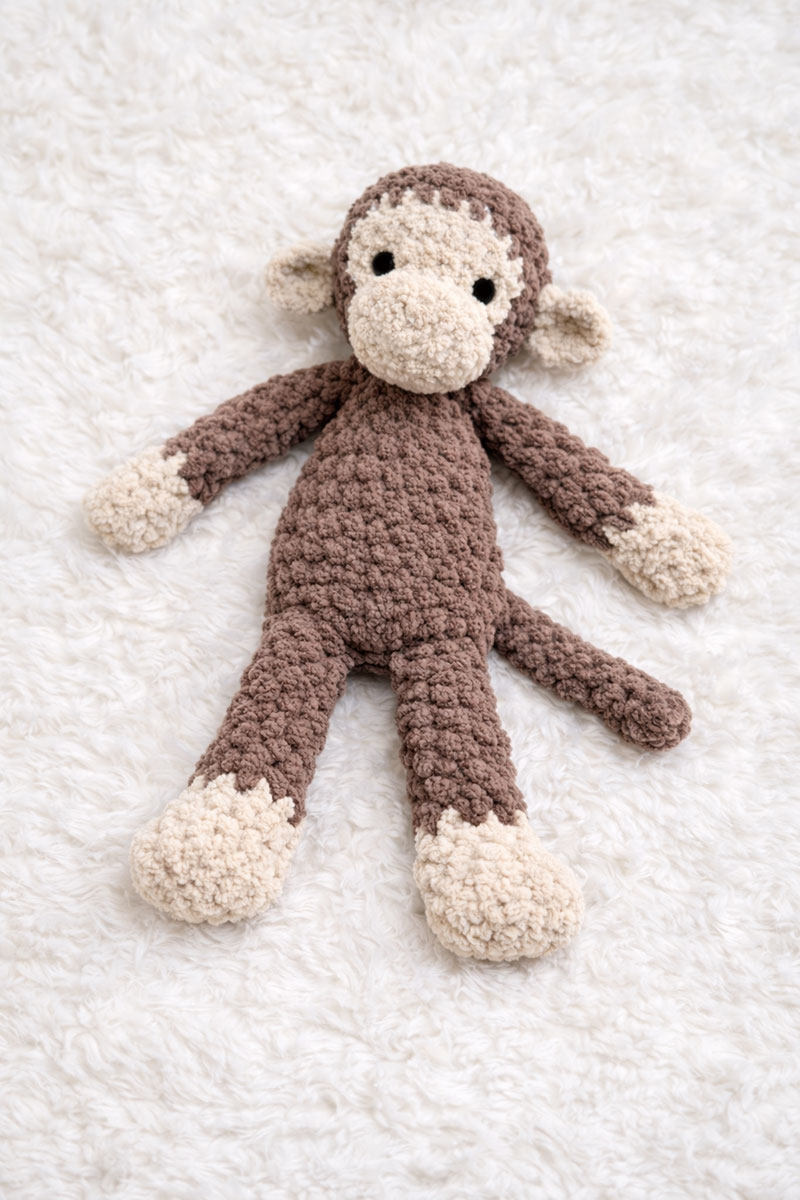
Crochet monkey lovey pattern designs like this are the ones babies tend to love and hold onto. Some snugglers sit on a shelf, while others get dragged everywhere, twisted, chewed, and used for comfort. That’s when you start noticing what really matters, how the yarn feels after a wash, how easy it is to grab, and whether the shape settles naturally instead of bunching up. This one is built for that kind of real use.
See where some monkey lovey patterns start to fall apart →
More Lovey Patterns and Safari-Style Favorites:
Crochet Elephant Lovey Pattern
Dinosaur Crochet Lovey Pattern
see the yarn you need for this project
Jump to what you want to know:
Why monkey loveys work so well →
Best yarn for a monkey lovey →
The shape babies seem to like best →
Why This Crochet Monkey Lovey Will Be a Favorite
Most parents do not notice this at first, but the lovey a baby reaches for during supervised, awake play may not be the most decorative one. It is often the one that feels easy to grab and hold. Those are the loveys that get picked up again and again, while another, possibly prettier one, may remain on its shelf.
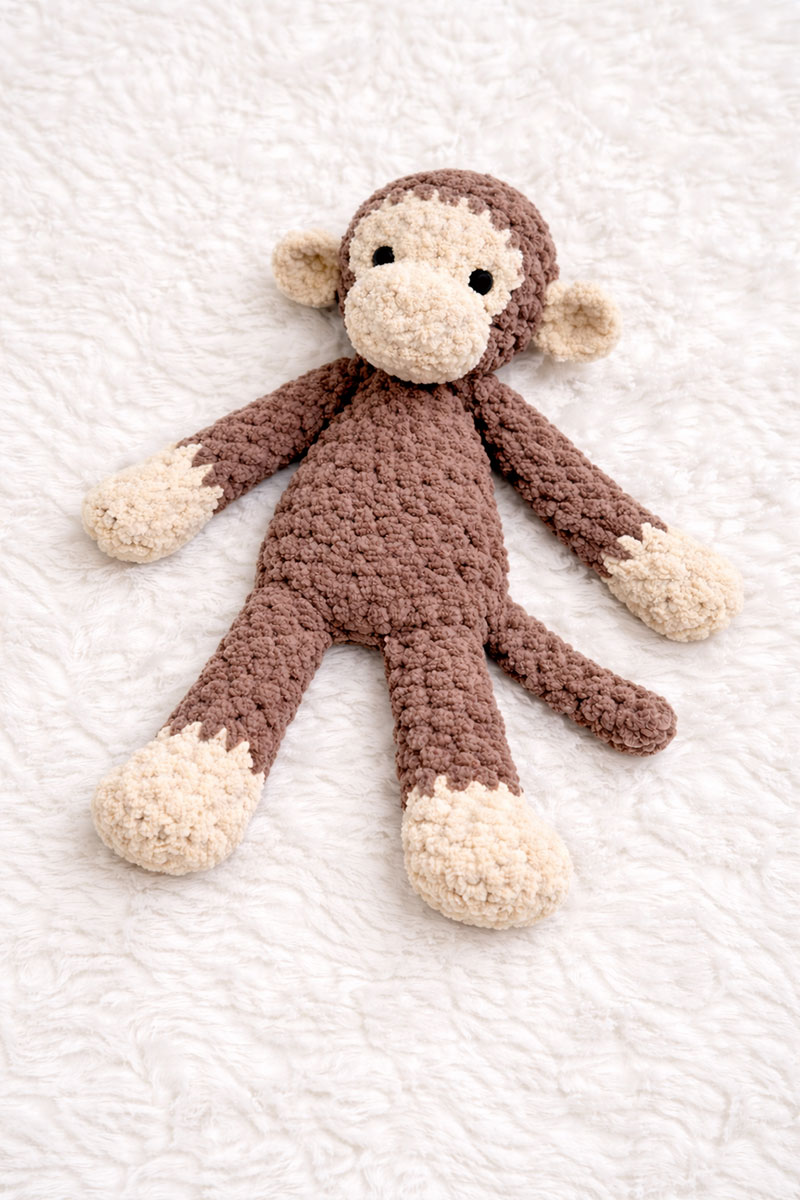
This crochet monkey lovey pattern is going to be one that's loved. It's built to move. The head holds its shape, but the body and limbs stay flexible, so it settles naturally instead of holding a fixed pose.
The crochet animal lovey pattern collection shows how this flexible monkey compares with blanket-style woodland, farm, safari and ocean animals.
For a unique look in the same lovable style, this crochet fox lovey pattern works beautifully for woodland nurseries, while the crochet sea turtle pattern, crochet jellyfish pattern, and crochet fish pattern bring in a softer ocean theme that pairs naturally with this style of handmade lovey, and this highland cow crochet snuggler lovey pattern adds a little more farm-style personality to the mix.
My crochet cow pattern keeps the same natural feel but uses a flatter blanket body and simpler farm-style shaping that works especially well for beginner crochet baby gifts.
For more barnyard-inspired handmade gift ideas, these crochet farm animal lovey patterns gather cows, chickens, ducks, lambs, and other beginner-friendly farmhouse loveys into one easy baby gift collection.
A jungle baby gift set can also include my lion lovey crochet pattern with a soft security blanket, stitched face and textured mane for a safari-style nursery project.
For a smaller monkey that can be sewn onto a blanket, banner or nursery keepsake, use my crochet monkey applique pattern with its flat layered body and curled tail.
Woodland baby gifts can take the same animal-theme idea in another direction with my crochet raccoon pattern, a seated forest animal amigurumi with a mask face, striped tail, and nursery shelf appeal.
Australian animal nursery themes fit the same handmade gift style, and this crochet koala lovey pattern gives the collection a softer eucalyptus-inspired baby lovey option.
Materials That Control The Final Shape
You should know before you start that the yarn you use controls how this turns out.
Safety and use note: Use embroidered facial features rather than plastic safety eyes, buttons, beads, or other detachable pieces. This handmade lovey is intended only for supervised, awake use. Do not place it in a crib, bassinet, play yard, or other infant sleep space. Check the embroidery, seams, and crocheted fabric regularly for loose stitches or damage.
Materials
Super bulky chenille yarn in brown and cream
6.5 mm crochet hook
Polyfill stuffing
Black embroidery floss for the eyes
Dark brown or black embroidery floss for the nostrils
Tapestry needle
Stitch marker
Removable stitch markers or rustproof pins for assembly
I’ve learned that yarn that feels slightly dense holds its structure better after repeated use.
see the yarn style that gives this result
See why some lovey shapes get ignored →
Crochet Monkey Lovey Pattern Instructions
A crochet monkey lovey works best when the head is firmly stuffed, the body is lightly filled, and the upper portions of the limbs remain flexible.
Abbreviations
sc = single crochet
inc = work 2 single crochet stitches in the same stitch
dec = invisible single crochet decrease
mc = magic circle
Construction Notes
Work all pieces in continuous spiral rounds unless another method is stated. Do not join at the end of each round. Place a stitch marker in the first stitch of each round and move it upward after every completed round. The number in parentheses is the stitch total at the end of the round.
Secure each magic circle: After completing Round 2 of a piece, pull the starting tail firmly to close the center. Thread the tail onto the tapestry needle and weave it through the backs of several stitches in one direction, then reverse direction and weave through several more stitches. For stuffed pieces, leave the secured tail inside the piece. For unstuffed pieces, including the ears and tail, weave the starting tail securely into the wrong side before trimming it.
Important photo note: Some reference photos show glossy round eyes. Follow the written instructions below and make the eyes with securely fastened embroidery floss. Do not use plastic safety eyes, buttons, beads, or glued facial pieces.
Gauge
6 sc by 6 rounds = approximately 2 inches
Skill level: Confident beginner. This pattern uses continuous rounds, increases, invisible decreases, foundation-chain ovals, embroidery, stuffing and sewn assembly.
Crochet Monkey Head Pattern
Use brown yarn.
Round 1: Make a magic circle and work 6 sc into the circle. (6)
Round 2: Inc in each stitch around. (12)
Round 3: (Sc 1, inc) 6 times. (18)
Round 4: (Sc 2, inc) 6 times. (24)
Round 5: (Sc 3, inc) 6 times. (30)
Round 6: (Sc 4, inc) 6 times. (36)
Round 7: (Sc 5, inc) 6 times. (42)
Rounds 8 through 14: Sc around. (42 stitches in each round)
Round 15: (Sc 5, dec) 6 times. (36)
Round 16: (Sc 4, dec) 6 times. (30)
Round 17: (Sc 3, dec) 6 times. (24)
Pause here. Make and attach the cream face patch and embroider the eyes while the head remains open.
Cream Face Patch
Use cream yarn.
Chain 9.
Round 1: Sc in the second chain from the hook and in the next 6 chains. Work 3 sc in the last chain. Continue along the unused loops on the opposite side of the foundation chain. Sc in the next 6 chains and work 2 sc in the remaining chain. (18)
Count note: Keep the round marker in the first stitch. The increases for the rounded end nearest the marker are divided between the beginning and end of the next round.
Round 2: Inc in the first stitch, sc in the next 6 stitches, inc in each of the next 3 stitches, sc in the next 6 stitches, and inc in each of the final 2 stitches. (24)
Round 3: Sc in the first stitch, inc in the next stitch, sc in the next 6 stitches, (sc 1, inc) 3 times, sc in the next 6 stitches, and (sc 1, inc) 2 times. (30)
Fasten off, leaving a long sewing tail. Do not stuff the face patch.
Add enough stuffing to the head to hold its shape while the patch is positioned.
Lay the cream face patch flat with its long axis running horizontally. Fold it lightly from side to side and from top to bottom to locate its vertical and horizontal centerlines. Do not crease or stretch the patch.
Mark two eye centers on the upper half of the patch. Place the centers approximately 1 1/2 inches apart, equally spaced on opposite sides of the vertical centerline, and approximately 1/2 inch above the horizontal centerline.
Center the patch on the front of the head with its long axis horizontal. Use Head Rounds 8 and 15 as approximate upper and lower placement landmarks. Keep the patch flat against the curved head and do not stretch it merely to reach both round numbers.
Check that the two temporary eye markers are level when the head is viewed from the front. Pin the patch securely in place.
Sew through every edge stitch of the patch and into the head fabric. Keep the patch smooth and centered. Secure and bury the yarn tail inside the open head.
Embroidered Eyes
Using all six strands of black embroidery floss, make one round embroidered eye at each marked position with closely packed satin stitches. Make each eye approximately 1/2 inch wide.
Check that the eyes are equal in size and level before securing the floss firmly inside the open head. Do not use plastic safety eyes, buttons, beads, or glued facial pieces.
Finish the Head
Stuff the head firmly and evenly. Add small amounts of stuffing at a time so the head remains rounded without becoming lumpy.
Round 18: (Sc 2, dec) 6 times. (18)
Round 19: (Sc 1, dec) 6 times. (12)
Round 20: Dec around. (6)
Fasten off, leaving a tail long enough to pass through the front loops of all six remaining stitches. Thread the tail through the front loops, pull the opening closed firmly, secure the yarn and bury the remaining tail inside the head.
The finished head should measure approximately 4.5 to 5 inches tall, depending on the yarn and stuffing.
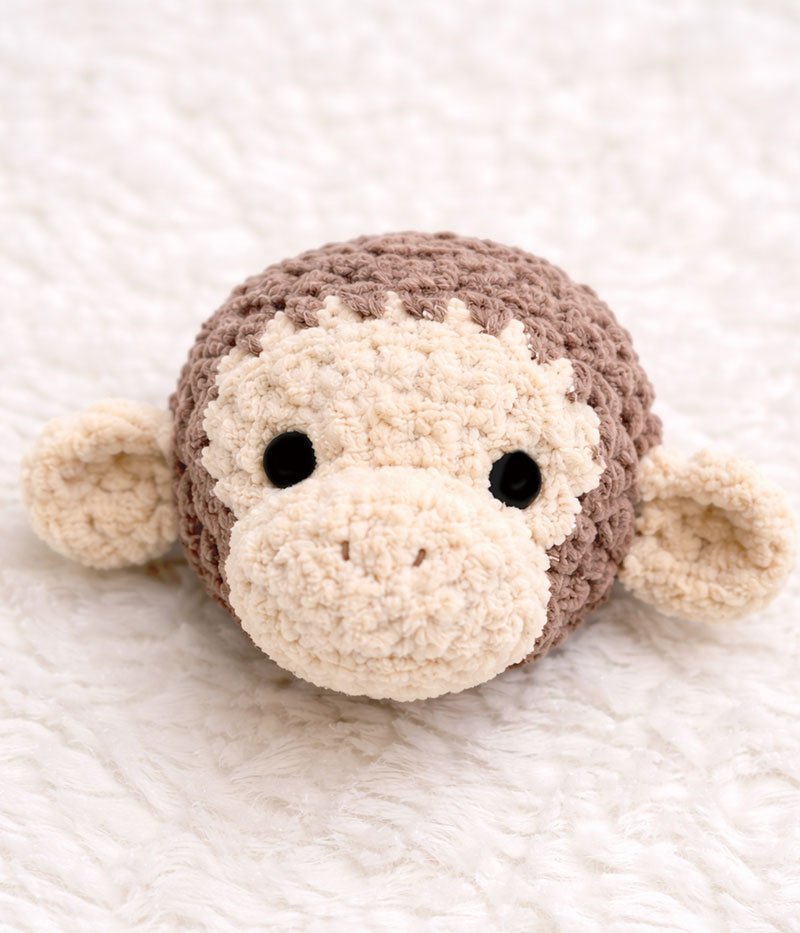
Crochet Monkey Muzzle and Ears
Muzzle
Use cream yarn.
Chain 7.
Round 1: Sc in the second chain from the hook and in the next 4 chains. Work 3 sc in the last chain. Continue along the unused loops on the opposite side of the foundation chain. Sc in the next 4 chains and work 2 sc in the remaining chain. (14)
Count note: Keep the round marker in the first stitch. The increases for the rounded end nearest the marker are divided between the beginning and end of the next round.
Round 2: Inc in the first stitch, sc in the next 4 stitches, inc in each of the next 3 stitches, sc in the next 4 stitches, and inc in each of the final 2 stitches. (20)
Round 3: Sc around. (20)
Fasten off, leaving a long sewing tail.
Before attaching the muzzle, use dark brown or black embroidery floss to make two short nostrils across its upper center. Secure the floss ends on the wrong side of the muzzle.
Place the muzzle with its long axis running horizontally. Center it over the lower half of the cream face patch, with its upper edge just below the embroidered eyes. Check that the two rounded ends extend equally to the left and right before pinning it in place.
Sew around the muzzle, leaving an opening approximately 1 inch wide. Add a small amount of stuffing so the muzzle is softly rounded rather than firm. Finish sewing the opening closed. Secure and bury the yarn tail.
Ears, Make 2
Use cream yarn.
Round 1: Make a magic circle and work 6 sc into the circle. (6)
Round 2: Inc in each stitch around. (12)
Round 3: (Sc 1, inc) 6 times. (18)
Round 4: Sc around. (18)
Fasten off, leaving a long sewing tail. Do not stuff the ears.
Keep each ear in a shallow cup with the cupped side facing forward. Pin one ear to each side of the head. Center each ear near Head Round 10, with the upper edge near Round 8 and the lower edge near Round 12.
View the head from the front and confirm that both ears are level. Sew the inner curved half of each ear, the portion resting directly against the head, from the upper placement point to the lower placement point. Leave the outer half free so the ear retains its shallow cup. Reinforce each attachment with a second pass before securing and burying the yarn tail.
Crochet Monkey Body Pattern
Use brown yarn.
Round 1: Make a magic circle and work 6 sc into the circle. (6)
Round 2: Inc in each stitch around. (12)
Round 3: (Sc 1, inc) 6 times. (18)
Round 4: (Sc 2, inc) 6 times. (24)
Round 5: (Sc 3, inc) 6 times. (30)
Round 6: (Sc 4, inc) 6 times. (36)
Rounds 7 through 15: Sc around. (36 stitches in each round)
Round 16: (Sc 4, dec) 6 times. (30)
Rounds 17 and 18: Sc around. (30 stitches in each round)
After Round 18, begin adding a light, even layer of stuffing to the lower two-thirds of the body.
Round 19: (Sc 3, dec) 6 times. (24)
Rounds 20 and 21: Sc around. (24 stitches in each round)
Round 22: (Sc 2, dec) 6 times. (18)
After Round 22, add only enough stuffing to prevent the upper body from collapsing. Keep the neck area flexible.
Round 23: Sc around. (18)
Fasten off, leaving a long tail for attaching the body to the head. Do not close the 18-stitch neck opening.
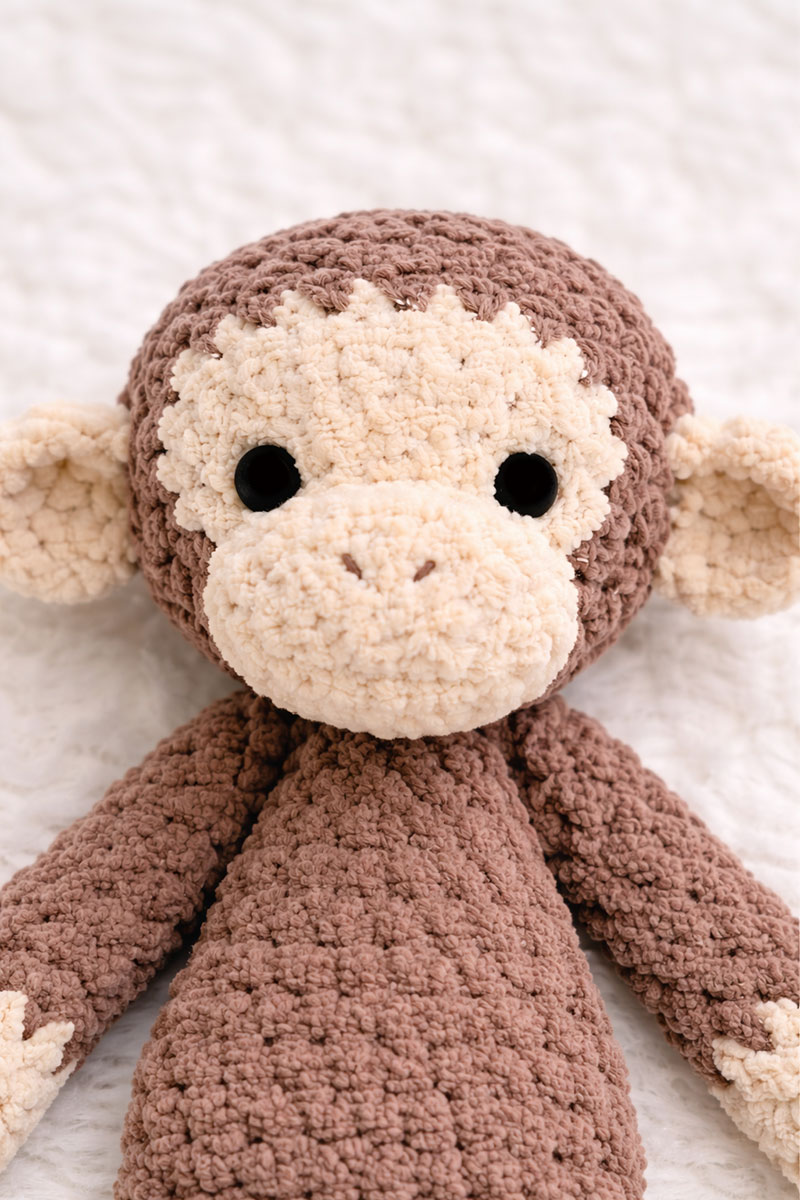
The finished body should measure approximately 7 inches from the bottom center to the neck opening and approximately 3.5 to 4 inches across its widest point.
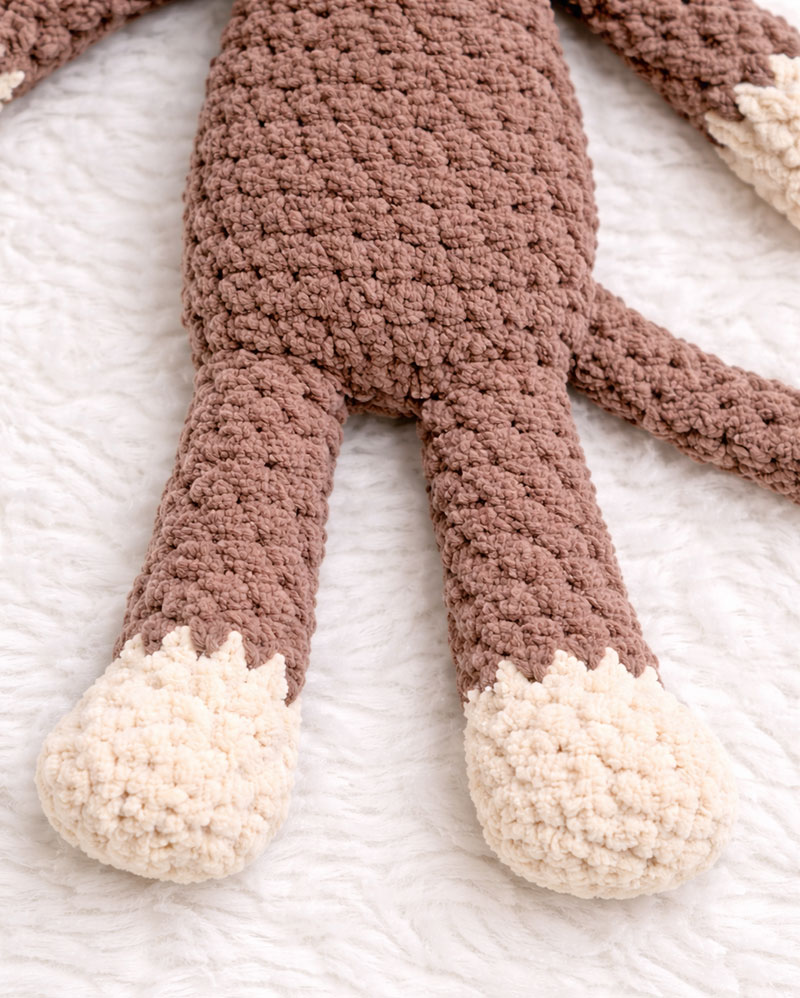
Crochet Monkey Arms and Legs
Arms, Make 2
Begin with cream yarn.
Round 1: Make a magic circle and work 6 sc into the circle. (6)
Round 2: Inc in each stitch around. (12)
Round 3: Sc around. (12)
Round 4: Sc in each of the next 11 stitches. For the final stitch, insert the hook into the stitch, yarn over with the cream yarn and pull up a loop. Join the brown yarn, leaving a 6-inch starting tail, and pull it through both loops to complete the stitch. Cut the cream yarn, leaving a 6-inch tail. Weave both color-change tails securely into the inside of the hand before stuffing. (12)
Round 5: (Sc 4, dec) 2 times. (10)
Rounds 6 and 7: Sc around. (10 stitches in each round)
Stuff the cream hand and brown Rounds 5 through 7 lightly.
Rounds 8 through 18: Sc around. (10 stitches in each round)
Leave Rounds 8 through 18 unstuffed so the arm hangs freely.
Fasten off, leaving a long sewing tail. Leave the top opening unclosed.
Each arm should measure approximately 6 inches.
Legs, Make 2
Begin with cream yarn.
Round 1: Make a magic circle and work 6 sc into the circle. (6)
Round 2: Inc in each stitch around. (12)
Round 3: (Sc 1, inc) 6 times. (18)
Round 4: Sc around. (18)
Round 5: Sc in each of the next 17 stitches. For the final stitch, insert the hook into the stitch, yarn over with the cream yarn and pull up a loop. Join the brown yarn, leaving a 6-inch starting tail, and pull it through both loops to complete the stitch. Cut the cream yarn, leaving a 6-inch tail. Weave both color-change tails securely into the inside of the foot before stuffing. (18)
Round 6: (Sc 1, dec) 6 times. (12)
Rounds 7 through 12: Sc around. (12 stitches in each round)
Stuff the cream foot firmly without overfilling it. Stuff the brown leg lightly through Round 12.
Rounds 13 through 18: Sc around. (12 stitches in each round)
Leave Rounds 13 through 18 unstuffed so the top of the leg remains flexible.
Fasten off, leaving a long sewing tail. Leave the top opening unclosed.
Each leg should measure approximately 6 inches.
Matching-piece checkpoint: Before assembly, place the two arms side by side and the two legs side by side without stretching them. Confirm that each matching pair is approximately the same length and width. Adjust stuffing if one hand or foot appears noticeably larger before attaching the pieces to the body.
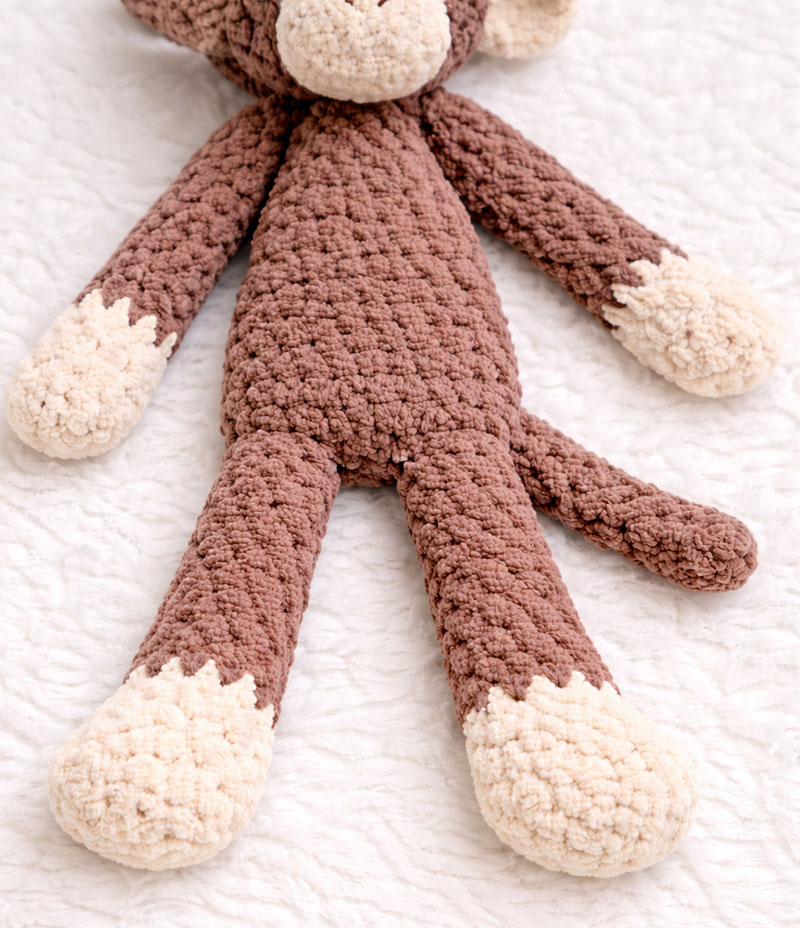
Crochet Monkey Tail Pattern
Use brown yarn.
Round 1: Make a magic circle and work 6 sc into the circle. (6)
Rounds 2 through 18: Sc around. (6 stitches in each round)
Do not stuff the tail.
Fasten off, leaving a long sewing tail. Leave the top opening unclosed.
The finished tail should measure approximately 6 inches.
Crochet Monkey Lovey Assembly
Complete the face patch, embroidered eyes, muzzle, nostrils, and ears before joining the head to the body.
Lay the body flat with the neck opening at the top. Choose the smoothest side as the front. Mark the center front and center back with removable stitch markers.
Attach the Head
Place the head above the body with the face centered over the body’s center-front marker.
The body opening contains 18 stitches. Position those 18 stitches around Head Round 18, which also contains 18 stitches.
Using the body sewing tail, sew one body stitch to one corresponding head stitch all the way around. Check that the face remains centered before tightening the seam.
Sew around the attachment a second time to reinforce it. Secure and bury the yarn tail.
Attach the Arms
Flatten the open top of each 10-stitch arm into five paired stitches.
Pin one arm to each side of Body Round 20. Center each flattened five-stitch arm opening over the side of the body. Position both arms the same distance from the center-front marker.
The cream hands should point downward and slightly forward.
Sew through both layers of the flattened arm opening and into the body. Reinforce each attachment with a second pass. Secure and bury the yarn tails.
Attach the Legs
Flatten the open top of each 12-stitch leg into six paired stitches.
Pin both legs across Body Round 6 on the lower front of the body. Leave four body stitches between the inner edges of the two flattened leg openings.
Check that both cream feet point forward and that both legs extend at the same angle.
Sew through both layers of each flattened leg opening and into the body. Reinforce each attachment with a second pass. Secure and bury the yarn tails.
Attach the Tail
Flatten the 6-stitch tail opening into three paired stitches.
Center the tail on the lower back at Body Round 6, directly opposite the space between the legs.
Sew through both layers of the flattened tail opening and into the body. Reinforce the attachment with a second pass. Secure and bury the yarn tail.
Final Construction Check
Set the monkey on a flat surface. Confirm that the face points forward, the shoulders are level, the legs are evenly spaced, the feet point forward, and the tail is centered on the back.
Check every attachment by gently pulling on the head, ears, muzzle, arms, legs, and tail. Reinforce any seam that moves or opens. Make certain that all embroidery and yarn tails are securely fastened and buried inside the crocheted fabric. Remove every rustproof pin, removable stitch marker and temporary eye-placement marker before the lovey is used.
Care and reinspection: Follow the washing and drying directions on the yarn label. Reshape the head, muzzle, ears, hands and feet while the lovey is damp, then allow it to dry completely. After washing, inspect every seam and embroidered feature before returning the lovey to supervised use.
See how this pairs with simple baby quilt ideas →
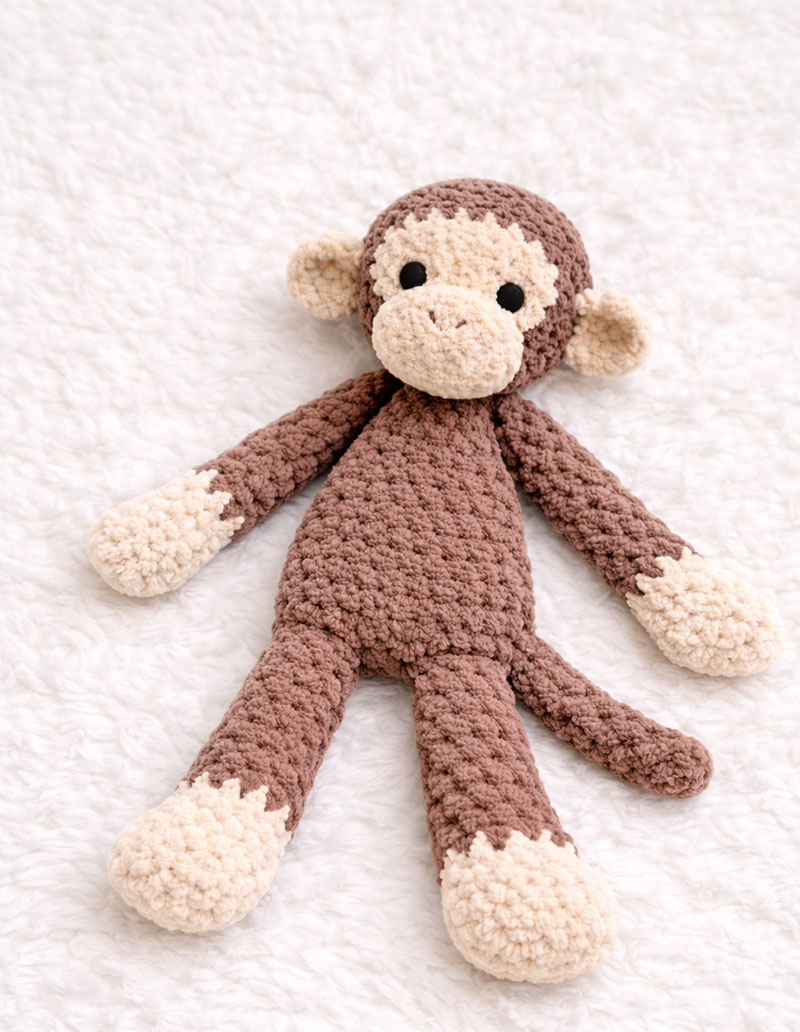
What Makes This Crochet Monkey Lovey Pattern Work
Blunt truth. If every section is filled the same way, it will not behave the same way.
Firmly and evenly stuffed head
Lightly stuffed body
Lightly stuffed hands
Firmly but not overstuffed feet
Flexible, mostly unstuffed upper limbs
Unstuffed tail
The finished lovey settles naturally because each section is stuffed according to the amount of structure or flexibility it needs.
Common Questions About Crochet Monkey Lovey Patterns
Is this safe for babies?
This handmade lovey is intended only for supervised, awake use. Use embroidered facial features rather than plastic eyes, secure every seam carefully, bury all yarn and embroidery tails, and inspect the lovey regularly for loose stitches or damage. Do not place the lovey in a crib, bassinet, play yard, or other infant sleep space.
Why does this style work better?
It moves naturally and creates easy grab points.
Does stuffing level matter?
Yes. It directly affects how the lovey behaves.
Will it hold up after washing?
Results depend on the yarn, stuffing and seam security. Follow the yarn label care instructions, reshape the lovey while it is damp, allow it to dry completely and inspect every seam and embroidered feature before supervised use.
For product safety guidance, see U.S. Consumer Product Safety Commission.
When you click on links to various merchants on this site and make a purchase, this may result in this site earning a commission. This does not affect the price you pay.

UBGI Gold Standard 2026
Reviewed under the site's
editorial checklist.
Photos, decorating ideas, party setups and reader submissions are shared for inspiration unless a page is specifically presented as a pattern, tutorial, reference guide or step-by-step project. Follow the instructions, measurements, safety guidance and manufacturer directions provided for the particular project or product.
About Jan | Contact | Baby Nursery Ideas (Blog) | Site Map | Privacy Policy | Disclosure Policy | Disclaimer | Affiliate Disclosure | Earnings Disclosure | Facebook | Pinterest
I am a participant in the Amazon Services LLC Associates Program, an affiliate advertising program designed to provide a means for us to earn fees by linking to Amazon. As an Amazon Associate I earn from qualifying purchases.
Copyright © 2006-2026. All Rights Reserved.