Fox Crochet Pattern (Cute Easy Baby Lovey Gift)
This fox crochet pattern is a cute handmade baby gift for a woodland nursery, baby shower basket, or keepsake lovey project. The finished fox has enough personality to feel special, but the pattern still uses simple stitches, basic shaping, and a small blanket base that is easy to manage.
More Baby Lovey Patterns to Make
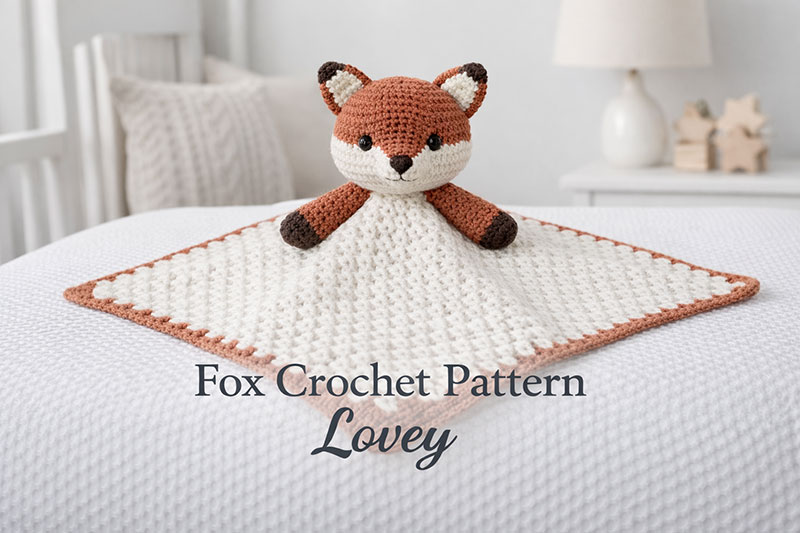
Important construction note: Follow the written pattern rather than copying removable details from styled reference images. This version uses embroidered eyes only. The written instructions create a fox with a cream face panel, a separate cream muzzle, and plain crocheted ears. Cream inner-ear pieces, dark ear tips, and removable round eye pieces are not included in the current pattern instructions, so the finished project will not reproduce every decorative detail visible in the reference images.
On This Page
See preferred worsted weight yarn set for crochet projects here
Fox Crochet Pattern for a Baby Lovey Gift
This fox crochet pattern creates a woodland-style baby lovey with a soft fox head attached to a flat square blanket. The pattern uses basic stitches, gradual shaping, a centered cream face panel worked with repeated color changes, and straightforward assembly.
For more handmade nursery gift ideas, my crochet animal lovey patterns collection includes several easy woodland animals, while these easy baby lovey crochet patterns focus on smaller blanket-style projects for newer crocheters.
Materials You Will Need
Worsted weight yarn in rust, cream, and black
Approximately 180 to 220 yards cream yarn
Approximately 90 to 130 yards rust yarn
Approximately 10 to 20 yards black yarn
H 5.0 mm crochet hook
Yarn needle
Scissors
Polyfill stuffing
Stitch marker
Straight pins for assembly
These yarn amounts are approximate for a lovey measuring about 14 to 16 inches across. Allow additional cream yarn if you continue the blanket beyond Round 10 or prefer to purchase enough yarn from one dye lot.
Unless a section states otherwise, work the fox head, muzzle, and arms in continuous rounds without joining. Place a stitch marker in the first stitch of each round and move it up as you work. The granny-square blanket rounds are joined with a slip stitch as instructed.
Secure every magic ring: After pulling a magic ring tightly closed, pass the starting tail under the stitches of the first round twice, secure it on the wrong side, and weave it through several stitches in different directions. For the stuffed head and arms, complete this step before adding stuffing. Do not trim a magic-ring tail immediately after pulling the center closed.
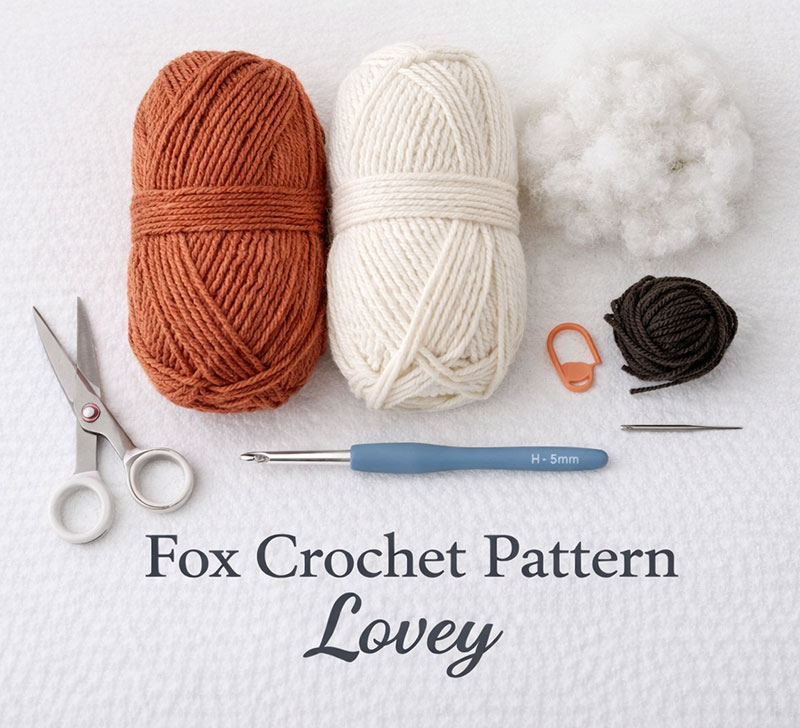
Your stitches should stay fairly tight so stuffing does not show through the fox head. If your stitches feel loose, move down one hook size.
Skill Level: Advanced Beginner. You should be comfortable working in continuous and joined rounds, making a magic ring, changing and carrying colors, increasing and decreasing, stuffing pieces, embroidering facial features, and sewing small parts together.
Abbreviations
ch = chain
sc = single crochet
dc = double crochet
inc = 2 single crochet in same stitch
dec = single crochet 2 stitches together
sl st = slip stitch
st = stitch
sp = space
The beginning chain at the start of rounds does not count as a stitch unless stated otherwise.
Color-change note: When changing colors, complete the final yarn-over of the last stitch with the new color. From Round 6 through the cream section of Round 14, carry both rust and cream around the head by crocheting over the unused strand. Keep both strands relaxed and smooth so the color changes do not narrow or pucker the head. In Round 14, cut and secure the cream yarn at the point stated in the round instructions. Do not simply drop the cream strand at the end of the face panel and expect to pick it up at the beginning of the panel on the next round, because the strand will be positioned at the opposite edge of the panel.
Quick Repeatability Notes
Gauge: After Round 3 of the blanket, the square should measure about 4 to 5 inches from one straight side edge to the opposite straight side edge through the center. Do not measure diagonally from corner to corner. Gauge does not have to be exact, but your stitches should be even and the square should lie flat.
Finished part sizes: Fox head about 3 inches tall, ears approximately 1 to 1.5 inches tall depending on stitch gauge, muzzle about 1.25 inches wide, and blanket approximately 13.5 to 15.5 inches from side to side before the border. The completed lovey should measure approximately 14 to 16 inches from side to side, but the actual blanket measurement must determine when to stop adding rounds.
Placement guide: Sew the final-row base of each ear across the upper sides of the head between approximately Rounds 4 and 7. The cream face panel is crocheted into the head during Rounds 6 through 14. Sew the separate muzzle centered over the lower part of that cream panel. Embroider the eyes about 5 stitches apart between Rounds 7 and 8.
Blanket repeat rule: Each new blanket round adds one more 3-dc side group between each corner. If Round 4 has 2 side groups, Round 5 has 3, Round 6 has 4, and so on.
Head attachment guide: Sew the head to the exact center of the blanket using a lower attachment circle approximately 1.25 to 1.5 inches across. This circle will usually pass through the head fabric around Rounds 11 and 12. Stitch around the base twice without pulling tightly enough to gather the blanket.
Fox Head Pattern
Using rust yarn for the main head and cream yarn for the lower face panel:
Round 1: Make a magic ring and work 6 sc into ring. Pull ring closed. (6)
Round 2: Inc in each stitch around. (12)
Round 3: *1 sc, inc* repeat around. (18)
Round 4: *2 sc, inc* repeat around. (24)
Round 5: *3 sc, inc* repeat around. (30)
Your piece should now look like a small rounded cup. Keep the stitch marker at the back of the head so the cream stitches sit on the front. Before starting Round 6, flatten the cup gently and choose the front center of the face so the cream panel does not drift to one side.
Round 6: With rust, sc in next 10 stitches. Change to cream and sc in next 10 stitches. Change back to rust and sc in next 10 stitches. (30)
Rounds 7 through 10: Sc in each stitch around, working rust over the rust stitches and cream over the 10 cream stitches so the cream face panel stays centered on the front of the head. (30)
Round 11: With rust, *3 sc, dec* 2 times. With cream, *3 sc, dec* 2 times. With rust, *3 sc, dec* 2 times. (24)
Round 12: With rust, *2 sc, dec* 2 times. With cream, *2 sc, dec* 2 times. With rust, *2 sc, dec* 2 times. (18)
Stuff firmly but do not overfill. The head should feel rounded without stretching the stitches.
Round 13: With rust, *1 sc, dec* 2 times. With cream, *1 sc, dec* 2 times. With rust, *1 sc, dec* 2 times. (12)
Check the head shape and add a final small amount of stuffing if needed. Fill the lower part of the head evenly without stretching the remaining stitches. This is the final stuffing checkpoint before closing the head.
Round 14: With rust, dec 2 times. With cream, dec 2 times, completing the final yarn-over of the second cream decrease with rust. Cut the cream yarn, leaving an approximately 6-inch tail. Work the final 2 rust decreases over the cream tail without pulling it tight, then tuck the remaining cream tail inside the head. (6)
Fasten off the rust yarn, leaving an approximately 10-inch tail. Thread the rust tail through the front loops of the remaining six stitches and pull the opening tightly closed. Pass the needle through the cinched stitches twice to secure the closure. Push the needle through the stuffed head and bring it out through a different stitch several inches away. Pull gently, trim the tail close to the surface, and allow the cut end to disappear inside the head.
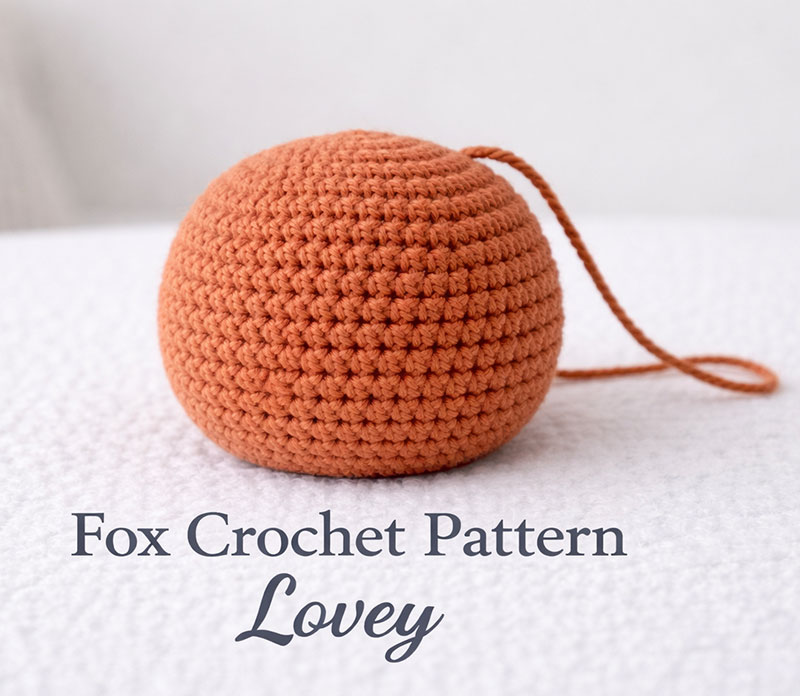
The head should feel firm and rounded without gaps between stitches. The cream stitches form the built-in lower face panel before the separate muzzle is sewn on.
Fox Ear Pattern Make Two
Using rust yarn. The turning chain does not count as a stitch:
Row 1: Ch 2. Work 3 sc into the second chain from the hook. Turn. (3)
Row 2: Ch 1. Sc in each stitch across. Turn. (3)
Row 3: Ch 1. Inc in the first stitch, sc in the next stitch, inc in the last stitch. Turn. (5)
Row 4: Ch 1. Sc in each stitch across. Turn. (5)
Row 5: Ch 1. Inc in the first stitch, sc across to the last stitch, inc in the last stitch. Turn. (7)
Row 6: Ch 1. Sc in each stitch across. (7)
Fasten off, leaving an approximately 12-inch tail for sewing.
Row 1 forms the tip of the ear and Row 6 forms the base. Lightly flatten each ear, then sew the seven-stitch Row 6 edge to the head. Make both ears at the same tension so their height and base width match.
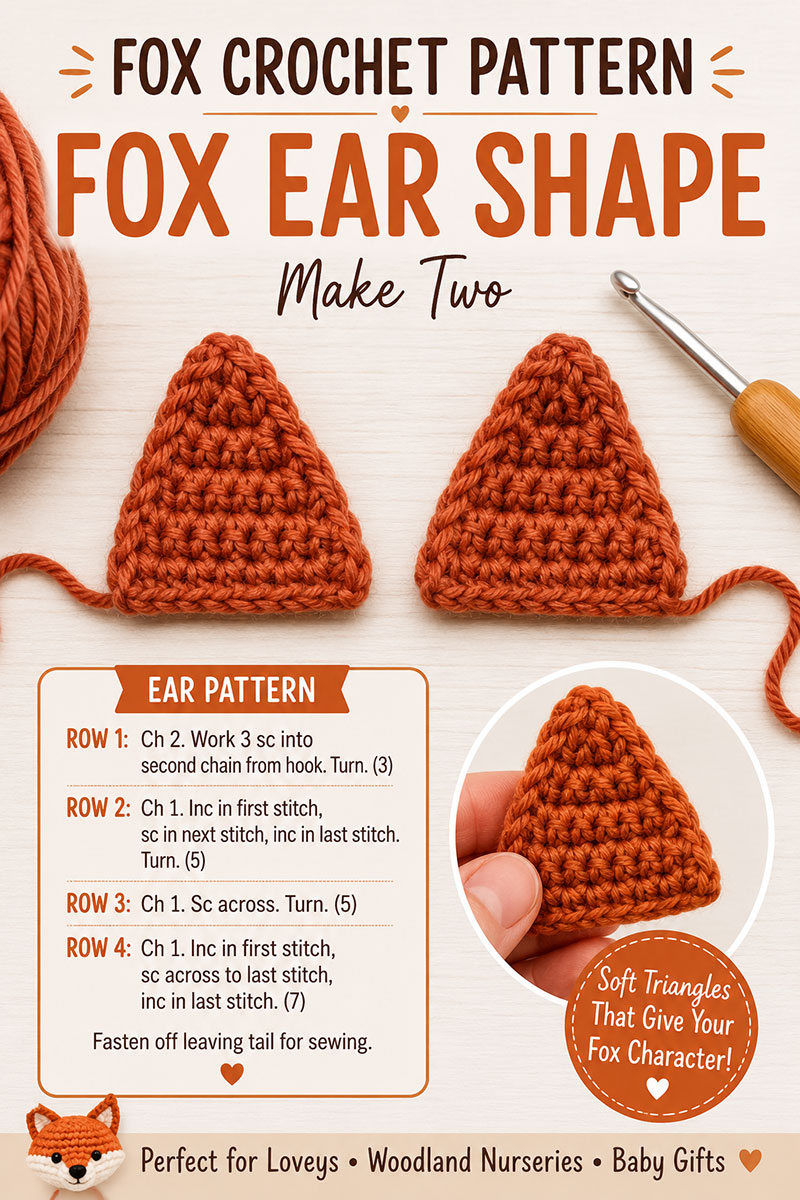
The ears should form small soft triangles that sit naturally against the head.
Fox Muzzle Pattern
The cream face panel is worked directly into the fox head during the color-change rounds above. This smaller muzzle is a separate raised oval that is sewn on top of that cream area.
Using cream yarn:
Round 1: Make a magic ring and work 6 sc into ring. (6)
Round 2: Inc around. (12)
Round 3: Sc around. (12)
Fasten off, leaving an approximately 12-inch tail for sewing.
Leave the muzzle unstuffed. Round 3 forms a shallow cup that will remain lightly raised after it is sewn to the stuffed head. Flatten it gently into an oval and pin it to the lower center of the cream face panel before sewing.
Face Placement and Assembly
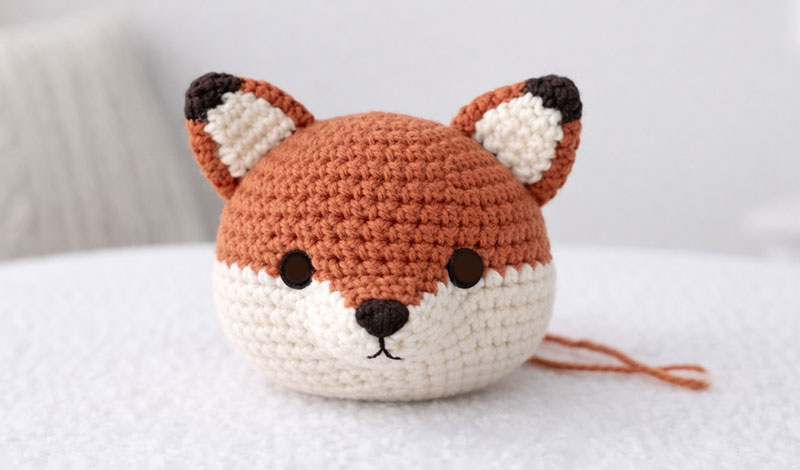
Pin the separate muzzle onto the lower center of the cream face panel before sewing.
Using whip stitches, sew through both loops around the outer edge of the muzzle.
Embroider eyes about 5 stitches apart slightly above the muzzle.
Use black yarn to stitch a small triangle nose onto the center of the muzzle.
Secure each embroidered feature separately. Begin by inserting the threaded needle through the bottom of the head inside the area that will later be covered by the blanket attachment. Leave an approximately 6-inch starting tail at the bottom, then bring the needle out at the required facial position and complete the embroidered eye or nose.
After completing the feature, pass the needle back through the stuffed head and bring the working end out beside the starting tail at the bottom. Tie the two tails together with two firm square knots. Thread both tails onto the yarn needle, pass them back through the head, bring the needle out through a different stitch, and trim the tails close to the surface so the cut ends disappear inside. Tug the completed feature firmly to confirm that it does not loosen.
Pin the ears onto the upper sides of the head before sewing so both sides match evenly.
View the head from the front before sewing permanently. Even a one-stitch difference in ear placement is noticeable.
Your fox should clearly resemble a fox face before attaching it to the blanket.
Lovey Blanket Pattern
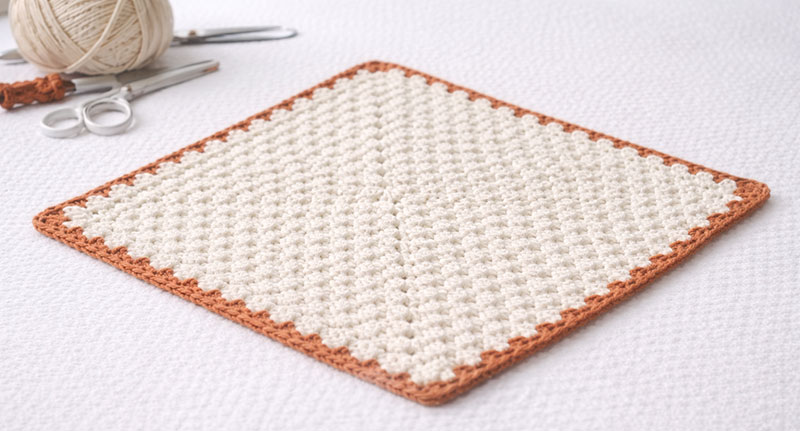
This blanket uses a traditional granny-square style layout because it stays flat, grows quickly, and is easier for beginners to check as they work.
Using cream yarn:
Round 1: Make a magic ring. Ch 3. This counts as the first dc. Work 2 dc into the ring. Ch 2. *Work 3 dc into the ring, ch 2.* Repeat from * to * 2 more times. Join with sl st to top of beginning ch 3. (12 dc total)
You should now have 4 groups of 3 dc and 4 corner chain spaces.
Round 2: Sl st into the next 2 dc and into the first corner ch-2 sp. Ch 3. Work 2 dc, ch 2, 3 dc into the same corner sp. Ch 1. *(Work 3 dc, ch 2, 3 dc into the next corner sp. Ch 1.)* Repeat from * to * 2 more times. Join with sl st to top of beginning ch 3. (24 dc total)
The square should now sit flat with 4 corner spaces and 4 side chain spaces.
Round 3: Sl st into the next 2 dc and into the first corner ch-2 sp. Ch 3. Work 2 dc, ch 2, 3 dc into the same corner sp. Ch 1. Work 3 dc into the next side ch-1 sp. Ch 1. *(Work 3 dc, ch 2, 3 dc into the next corner sp. Ch 1. Work 3 dc into the next side ch-1 sp. Ch 1.)* Repeat from * to * 2 more times. Join with sl st to top of beginning ch 3. (36 dc total)
Round 4: Repeat the same pattern, working 3 dc, ch 2, 3 dc into each corner and 3 dc into each side ch-1 sp. Ch 1 between groups. You will have 2 side groups between each corner. (48 dc total)
Round 5: Repeat the same pattern. You will have 3 side groups between each corner. (60 dc total)
Round 6: Repeat the same pattern. You will have 4 side groups between each corner. (72 dc total)
Round 7: Repeat the same pattern. You will have 5 side groups between each corner. (84 dc total)
Round 8: Repeat the same pattern. You will have 6 side groups between each corner. (96 dc total)
Lay the square flat without stretching it. Measure from the midpoint of one straight outer edge, through the center of the square, to the midpoint of the opposite edge. Do not measure diagonally from corner to corner. If the square measures about 13.5 to 15.5 inches from side to side, proceed to the border. If it is smaller, continue with the additional rounds below.
Round 9: Repeat the same pattern. You will have 7 side groups between each corner. (108 dc total)
Round 10: Repeat the same pattern. You will have 8 side groups between each corner. (120 dc total)
Continue the same established repeat only if another round is needed to reach the pre-border measurement. Each additional round adds one more 3-dc side group between every pair of corners.
The blanket should stay flat after every round. If the corners begin pulling upward, first confirm that every corner contains 3 dc, ch 2, 3 dc and that every side chain space has been worked. If the edges ripple heavily, check for accidental extra groups before changing hook size or tension.
The target measurement before the border is approximately 13.5 to 15.5 inches across. Measure the actual square rather than relying only on the number of rounds.
Border Round
Using rust yarn:
Join yarn in any corner ch-2 space. Ch 1. The beginning chain does not count as a stitch.
Work 3 sc into the same starting corner ch-2 space.
Work 1 sc in each dc and 1 sc in each ch-1 space across the first side. Work 3 sc into the next corner ch-2 space.
Work 1 sc in each dc and 1 sc in each ch-1 space across the second side. Work 3 sc into the next corner ch-2 space.
Work 1 sc in each dc and 1 sc in each ch-1 space across the third side. Work 3 sc into the next corner ch-2 space.
Work 1 sc in each dc and 1 sc in each ch-1 space across the fourth side. Do not work into the starting corner again.
Join with sl st to the first sc of the original 3-sc starting corner.
Fasten off and weave in the ends securely.
Lay the blanket flat after completing the border. Each corner should contain exactly 3 sc. The corners should remain square and the edges should not gather or flare.
Border stitch-count checkpoint: If the border is added after Round 6, you should have 104 sc total. After Round 8, you should have 136 sc; after Round 9, 152 sc; and after Round 10, 168 sc. For a later stopping point, multiply the final blanket round number by 16 and add 8. Do not count the slip-stitch join as an additional stitch.
Fox Arms and Paws Make Two
The arms are worked in continuous rounds from the dark paw upward. Do not join the rounds. Move the stitch marker to the first stitch of each new round.
Using black yarn for the paw:
Round 1: Make a magic ring and work 6 sc into ring. Pull ring closed. (6)
Round 2: Inc in each stitch around. (12)
Rounds 3 and 4: Sc in each stitch around. (12)
At the end of Round 4, complete the final yarn-over of the last black stitch with rust yarn. Cut the black yarn, leaving an approximately 6-inch tail. Secure the black tail and the rust starting tail together inside the paw, then weave each tail beneath several stitches before adding stuffing.
Continue using rust yarn for the arm:
Round 5: *4 sc, dec* repeat around. (10)
Rounds 6 through 12: Sc in each stitch around. (10)
Stuff the black paw firmly enough to hold its rounded shape. Add a smaller amount of stuffing to the rust arm so it remains soft and flexible. Leave the upper 1/2 inch of the arm unstuffed so the open end can be flattened for attachment.
Fasten off, leaving an approximately 18-inch yarn tail for sewing. Make the second arm the same way. Each finished arm should measure approximately 3 to 3.5 inches long, depending on yarn, hook size, and tension.
Positioning and Attaching the Fox Arms
Complete the blanket and border before attaching the arms. Place the fox head temporarily at the exact center of the blanket with the face pointing toward the desired front corner.
Position one arm against each lower side of the head. Angle the arms toward the lower left and lower right blanket corners so they rest naturally on top of the blanket.
Flatten the unstuffed upper end of each arm so five stitches lie along the front and five stitches lie along the back. Position the flattened shoulder ends against the lower sides of the head around Rounds 10 through 12. Turn the arms so any visible color-change jog faces downward toward the blanket.
Pin both arms in place and compare them from the front before sewing. The dark paws should extend the same distance from the head, and both arms should rest at matching angles.
Using the long rust yarn tail, sew through both layers of the flattened arm end and through the side fabric of the head. Sew across the shoulder once, then work back across the same area for a second secure pass. Repeat for the second arm.
After both arms are attached securely to the head, follow the head-attachment instructions below. Make sure the head sits closely over the upper shoulder ends without trapping or twisting the arms.
After the head has been sewn to the blanket, use rust yarn to place two or three small stitches through the underside of each arm and the blanket approximately 3/4 inch below the shoulder. These small anchoring stitches keep the arms facing forward without flattening the stuffing or making the blanket gather.
Attaching the Head

Lay the blanket flat and mark its exact center point.
Place the Round 14 closure at the center of the blanket with the fox face pointing toward the desired front corner. Check that the remaining three blanket corners fall evenly around the head.
Pin the head securely in place. The lower attachment circle should measure approximately 1.25 to 1.5 inches across. Keep the flattened shoulder seams of the arms immediately outside this circle so the head-attachment stitches do not trap or twist them.
Prepare one long strand of cream yarn and one long strand of rust yarn. Use cream yarn across the cream lower-front section of the head and rust yarn around the rust side and back sections so the attachment stitches blend into the crocheted fabric. Leave both yarn colors attached until both sewing circuits are complete.
Beginning with the cream yarn, bring the needle up through a solid blanket stitch beneath one edge of the cream section. Take a small horizontal stitch through the cream head fabric around Rounds 11 and 12, then pass the needle back through another solid blanket stitch. Continue across the cream section. Leave the cream working yarn and its starting tail loose on the underside of the blanket without knotting or trimming them.
Using the rust yarn, sew around the rust sides and back of the attachment circle. At each arm, place the head-attachment stitch immediately inside the shoulder seam rather than sewing through the arm. Overlap the cream attachment section by one small stitch at each color boundary so no unsecured gap remains. Leave the rust working yarn and its starting tail loose on the underside after completing the first circuit.
Thread the cream working yarn onto the needle again and sew a second pass across the cream section, placing the new stitches between the first set. Leave the cream yarn underneath the blanket when that section is complete.
Thread the rust working yarn onto the needle again and complete the second circuit around the rust sides and back, placing the new stitches between the first set and overlapping the cream section by one stitch at each boundary.
Do not attach the head only through the six cinched stitches from Round 14, and do not rely only on the open blanket chain spaces to hold the sewing stitches. Keep both yarn colors firm enough to stabilize the head without pulling so tightly that the blanket gathers beneath it.
Check the fox from the front, back, and both sides before securing the yarn. The head should sit upright without leaning or rotating. Tie the two cream ends together securely on the underside of the blanket and weave them through several cream stitches in different directions. Tie and weave the two rust ends in the same way before trimming all four ends.
Common Beginner Mistakes
If the blanket starts turning into a bowl shape, the corner spaces may be missing stitches.
If the edges ripple too much, stitches may be too loose or extra stitches may have been added accidentally.
If the fox head wobbles, sew around the base one more time before weaving in ends.
Beginners sometimes place the ears too low. Pinning all pieces before sewing helps the face look more balanced.
Finishing the Lovey
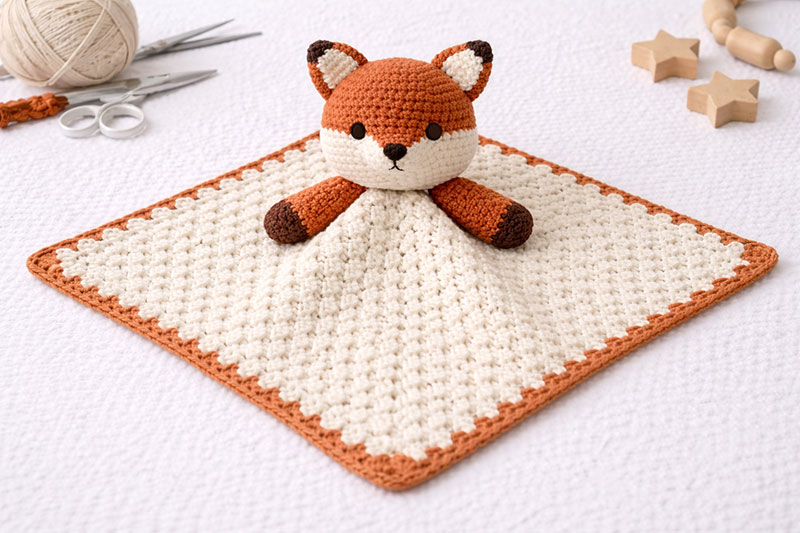
The finished fox lovey should feel balanced, flat, lightweight, and easy to fold or carry.
Weave yarn tails through several stitches in different directions before trimming to help prevent them from working loose after washing.
Remove and account for every straight pin used during assembly. Double-check the magic-ring centers, embroidered eyes and nose, muzzle, ears, both arms and paws, arm anchors, and head attachment before gifting. Stop using the lovey if a seam loosens, a yarn end becomes exposed, or stuffing can be seen through any opening.
If desired, lightly steam block the blanket portion only after confirming that the yarn label permits steam. Keep the steamer or iron above the fabric without allowing the heated surface to touch the yarn.
Size Notes
The intended finished lovey size is approximately 14 to 16 inches across, but yarn thickness, hook size, and individual tension can change the size substantially.
After Round 8, measure the square without stretching it. Continue with Round 9, Round 10, or additional established repeat rounds until the blanket measures approximately 13.5 to 15.5 inches before the border.
For a smaller lovey, stop after Round 6 only if the resulting size is appropriate for the intended use. Add the border after the blanket has reached the desired measurement and still lies flat.
Woodland Nursery Gift Ideas
A fox lovey works especially well for woodland nursery themes, forest animal baby showers, camping nursery decor, and handmade baby baskets.
To build a full room around the same little fox theme, these fox woodland nursery ideas show how forest creatures can work together to complement loveys and other decorative handmade pieces.
Our beloved woodland fox can also become practical nursery storage with this free crochet fox basket pattern, which uses pointed ears, cream facial panels, embroidered details, and an extra large basket foundation.
For a smaller fox project, my crochet fox applique pattern makes a separate decoration that can be used to embellish baby blankets, nursery banners, wall hangings and handmade gifts.
Woodland rooms usually feel far more believable once the decorative details start reinforcing the theme, and these woodland nursery decor ideas show how forest textures, rustic accents, shelving, and nature-inspired wall décor can help the room feel complete without becoming too busy.
For more woodland-style room inspiration, visit my woodland nursery ideas page.
For matching forest-style projects, browse these woodland nursery patterns.
My bear lovey pattern also pairs naturally with woodland nursery themes and handmade baby gifts.
A fawn-style handmade gift can soften the same forest animal set, and this crochet deer lovey pattern fits woodland nurseries, baby shower baskets, and gentle deer-themed keepsake projects.
A seated forest animal can round out the same woodland gift set, and my crochet raccoon pattern adds a mask face, striped tail, and shelf-ready amigurumi option beside fox, bear, and bunny projects.
Baby Safety Note
This baby lovey pattern uses embroidered facial features only. Do not substitute buttons, beads, or plastic eyes.
Use the lovey only during supervised awake time. Inspect all seams, magic-ring centers, embroidery, ears, arms, and attachment points regularly, especially after washing.
Do not place the lovey in a crib, bassinet, play yard, or any other infant sleep space during sleep or naps.
For current infant sleep guidance in the United States, visit the U.S. Consumer Product Safety Commission safe sleep recommendations.
Common Questions
Is this fox crochet pattern beginner friendly?
This pattern is suitable for an advanced beginner who is comfortable working in continuous and joined rounds, carrying yarn for color changes, stuffing pieces, embroidering facial features, and sewing small parts together.
Can I use different yarn colors?
Yes. Brown, gray, cream, and white combinations also work well.
How do I keep the blanket flat?
Make sure each corner receives the correct stitches and maintain even tension throughout the rounds.
Can I make the lovey larger?
Yes. Continue adding square rounds before the border.
Is this suitable for a baby shower gift?
Yes. The finished fox lovey works especially well for woodland nursery themes and handmade baby baskets.
Once finished, this fox crochet pattern becomes a simple handmade keepsake for nursery decor, supervised awake-time cuddles, supervised stroller outings while the baby is awake, and thoughtful baby gifts.
This pattern and all content on this page are original to Unique Baby Gear Ideas and may not be copied or reproduced.
When you click on links to various merchants on this site and make a purchase, this may result in this site earning a commission. This does not affect the price you pay.

UBGI Gold Standard 2026
Reviewed under the site's
editorial checklist.
Photos, decorating ideas, party setups and reader submissions are shared for inspiration unless a page is specifically presented as a pattern, tutorial, reference guide or step-by-step project. Follow the instructions, measurements, safety guidance and manufacturer directions provided for the particular project or product.
About Jan | Contact | Baby Nursery Ideas (Blog) | Site Map | Privacy Policy | Disclosure Policy | Disclaimer | Affiliate Disclosure | Earnings Disclosure | Facebook | Pinterest
I am a participant in the Amazon Services LLC Associates Program, an affiliate advertising program designed to provide a means for us to earn fees by linking to Amazon. As an Amazon Associate I earn from qualifying purchases.
Copyright © 2006-2026. All Rights Reserved.