Crib Safety Checklist for Safe Sleep Setup
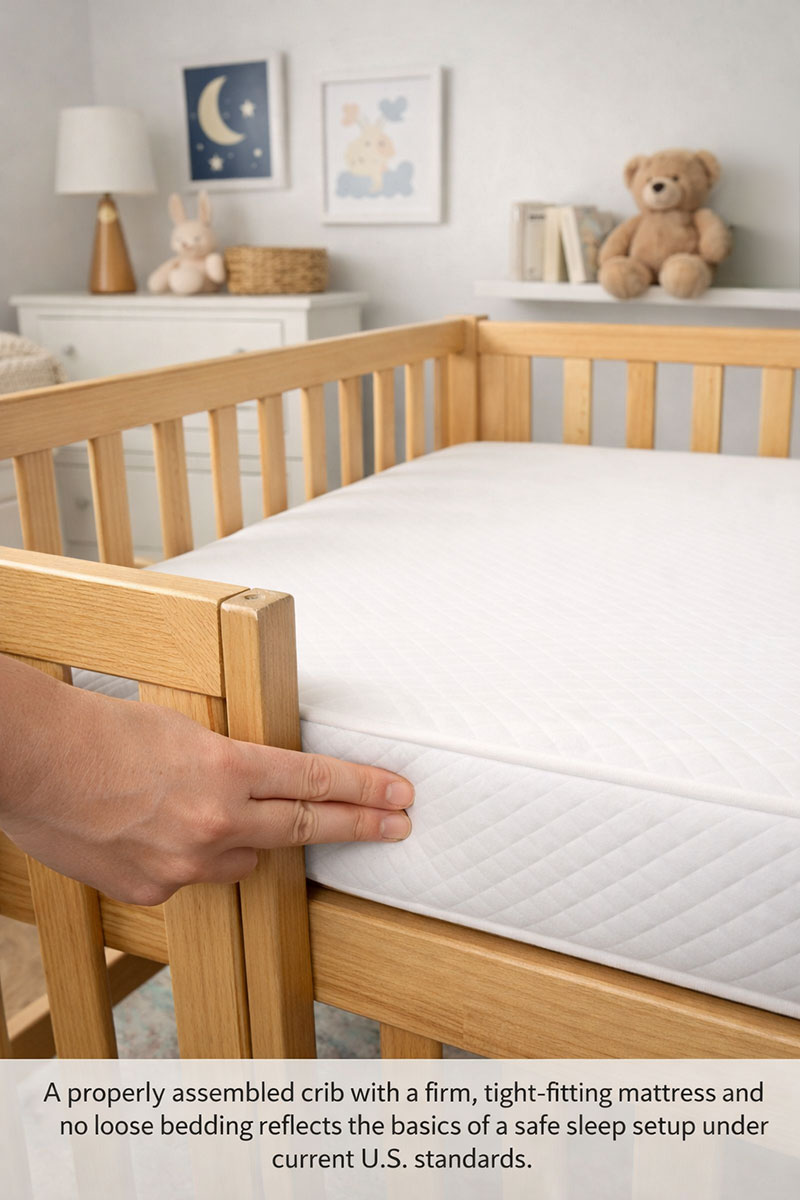
A crib safety checklist is a structured inspection framework used to evaluate a baby crib before it is used for safe sleep setup. Under current crib safety standards in the United States, a safe sleep environment depends on fixed sides, a firm tight-fitting mattress, secure manufacturer hardware, proper slat spacing, and a visible model number label. Before a baby sleeps in the crib, confirm that no parts are missing, no hardware has been substituted, and the crib matches its original documentation. Safe sleep setup means the crib is used exactly as designed, with an empty sleep space and no added padding, bumpers, or loose bedding. This crib safety checklist provides a clear inspection reference for reviewing structure, documentation, and recall status before the crib is used for sleep.
Trying to make sure the crib is safe before baby sleeps in it? Check these first:
On This Page
What a Crib Safety Checklist Is
A crib safety checklist is a simple way to look at a baby crib as a sleep product, not just a piece of nursery furniture.
In the United States, modern cribs are regulated, and the basics are not optional: fixed sides, a firm mattress, tight fit, and the right parts for that exact model.
This page explains general safety standards, not product-specific instructions, repairs, or workarounds.
In most cases, a crib should not be used for sleep until the model label and recall status are verified and the mattress fits tightly with an empty sleep space.
Some people call this a “crib inspection list,” but I’ll stick to one main term here: crib safety checklist.
What to do next matters, because this is one of those topics where a small detail can turn into a big risk.
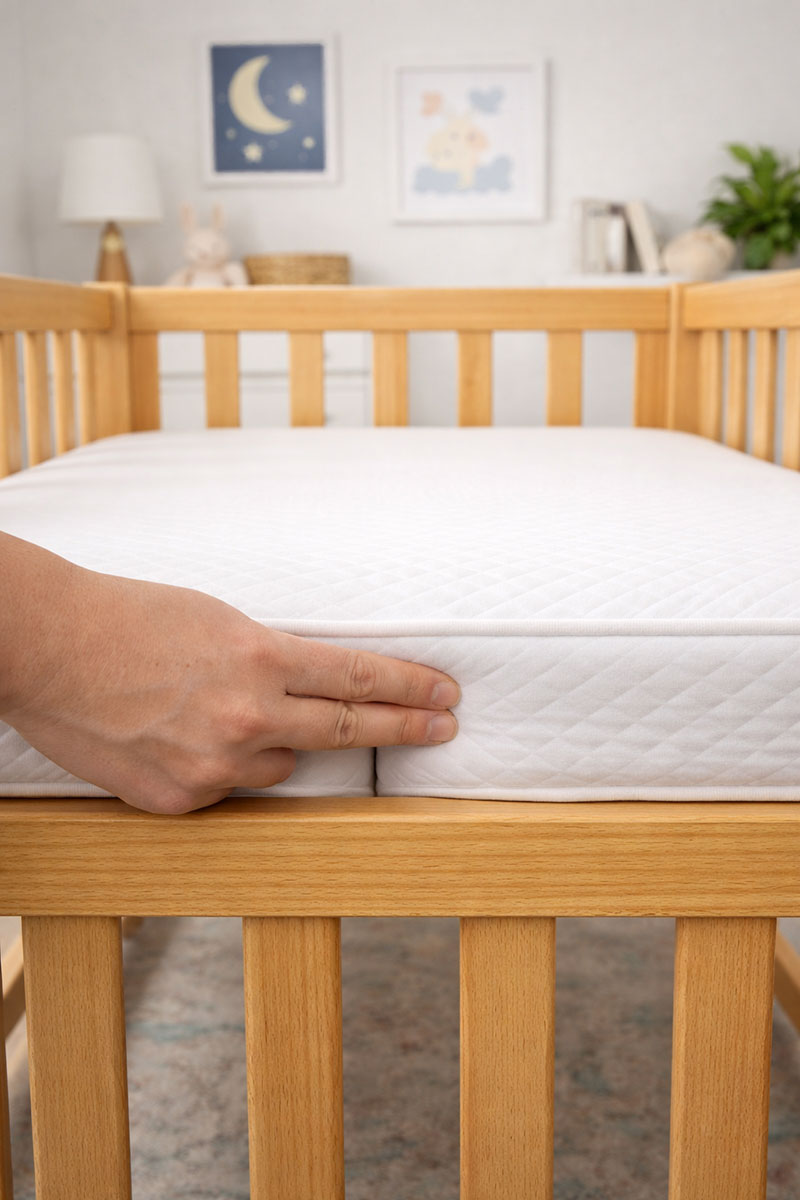
Quick fit check
The crib safety checklist is really about gaps, looseness, and missing proof.
A tight mattress fit, stable rails, and a clear model label are the three things that tell you the crib is even worth considering for sleep.
That part matters more than people think.
Why This Matters for Safe Sleep Setup
Safe sleep setup is not about making the crib feel soft or inviting. It is about creating a clear, stable sleep space with no added padding and a surface that stays firm, flat, and properly sized for the crib frame. Placement matters too, which is why crib location within the nursery furniture layout should be part of the setup, especially when wall spacing, windows, and room flow affect how the crib is used. In tighter rooms, this small-space cribs guide helps compare options that fit more cleanly without creating crowding or unsafe positioning.
Mattress fit and firmness are at the center of that setup. My safe crib mattress basics explains how edge gaps, support, and sizing come together, while this breathable crib mattress versus foam crib mattress guide breaks down how different constructions behave once placed inside a crib. My best breathable crib mattress guide then compares which airflow-focused designs continue to hold their shape, fit correctly, and maintain a stable sleep surface with real use.
When reviewing a crib safety checklist, the focus stays on where problems tend to develop: mattress edges, support platforms, corner posts, hardware connections, and rail alignment. Those are the points where gaps, shifting, or looseness can show up. A checklist helps remove guesswork, since a crib can appear solid at a glance while still missing a key fastener or sitting slightly out of alignment.
The simple part that counts
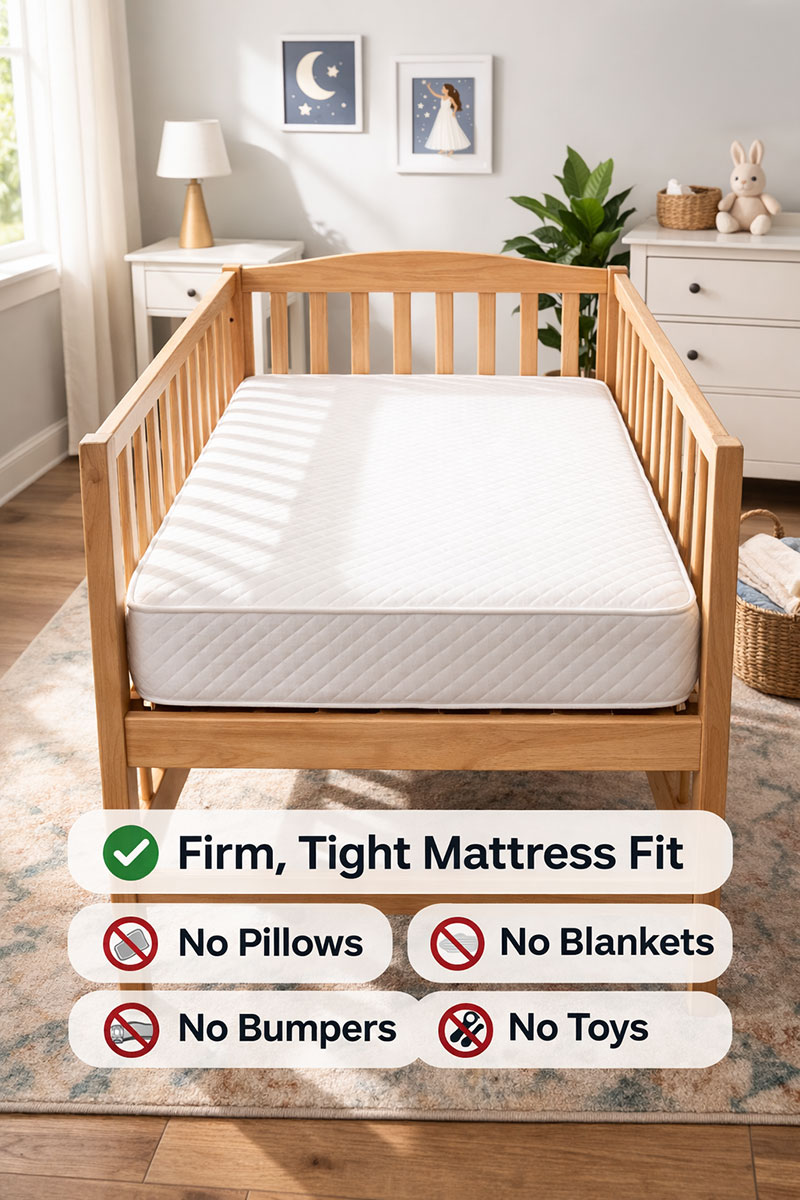
Safe sleep setup depends on an empty crib and a firm, tight-fitting mattress.
A crib safety checklist is the way you keep that rule from getting watered down by opinions, trends, or random advice.
What Goes Wrong
Most problems are not dramatic.
They’re quiet little issues that build up: a missing fastener, a mattress that shifts, a rail that flexes, a label that peeled off years ago.
This is where most parents get confused.
The biggest crib safety checklist failures usually land in three buckets: fit, parts, and proof.
Fit is the mattress and frame relationship, especially along the edges and corners.
Parts means the crib has its original manufacturer hardware, not random substitutes.
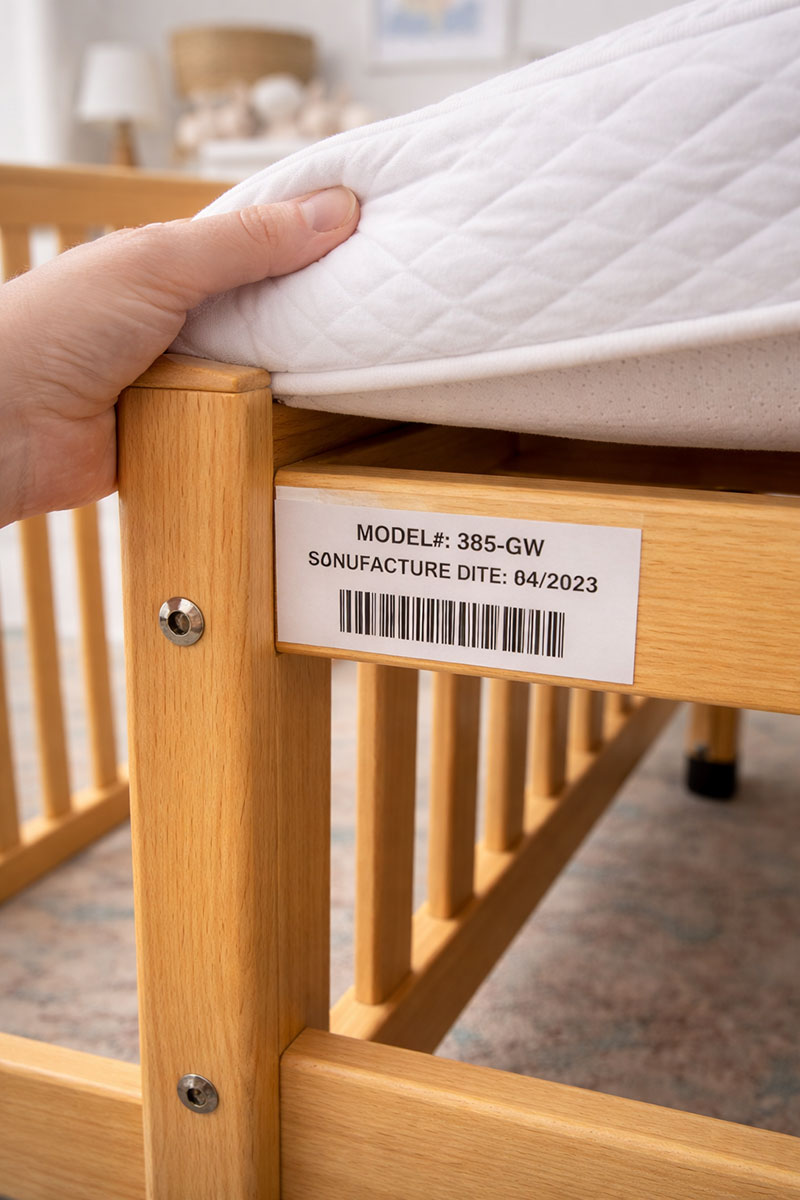
Proof is the model number label and a real manual or official record tied to that model.
When any one of those is missing, parents end up guessing.
For parents trying to determine when condition issues, missing components, or incomplete documentation shift from inconvenience to risk, review the crib structural safety limits that outline when a frame should no longer be used.
And guessing is not a plan for a sleep product.
A crib safety checklist should also catch “add-ons” that change the sleep space.
Bumpers, positioners, plush items, thick pads, and loose blankets are common in photos, but they don’t belong in a safe sleep setup.
There is a reason pediatric guidance keeps repeating the empty sleep space message, and you can read the safe sleep basics from the American Academy of Pediatrics here: AAP safe sleep recommendations.
Did I Buy Right
Parents usually ask this one in plain language: “Is this crib okay?”
A crib safety checklist can’t promise that.
What it can do is tell you whether the crib has the basic ingredients that responsible parents look for before they even consider using it for sleep.
Here are the questions I use to keep the crib safety checklist honest, without turning it into a long project.
Does the crib have fixed sides, with no drop-side or movable-side design?
Is the mattress firm and tight-fitting, without open space along the edges?
Understanding standard crib mattress dimensions compared to other bed sizes can also help clarify fit questions, which I break down in my crib mattress size vs twin comparison.
Can you see a model number label, and does it look like it belongs to this crib?
Is there a manual or official parts diagram tied to that model number?
Can you verify the recall status for the exact model, not just the brand name?
When those answers are “yes,” the crib meets the baseline conditions outlined in this crib safety checklist and can move to the next step of recall verification and final review.
When those answers are “no,” the decision is clear: keep the crib as decor, storage, or a photo prop, but not a sleep space.
Most parents choose
Most parents choose the simplest path: a crib with a readable model label, a matching manual, and a mattress that fits correctly.
The crib safety checklist is what keeps that choice calm and clean, even when the nursery budget is tight.
Quick paperwork check
A crib safety checklist is not only about what you see.
It’s also about what you can verify: model number, manual match, and recall status tied to that exact crib.
Older, Secondhand, or Missing Information
Older cribs, secondhand finds, and hand-me-downs are common.
Sometimes the manual is gone, the label is missing, or parts were swapped long ago.
This crib safety checklist does not give instructions for restoring, modifying, or making a questionable crib “work.”
It only helps you identify what you have, understand what is missing, and make a safer decision.
What Should I Do Now
What to do next depends on what your crib safety checklist shows in the first few minutes.
If the crib has a clear model label, a matching manual, fixed sides, and a tight-fitting mattress with no gaps, the next move is verifying recall status and keeping the sleep space empty.
If the label is missing, the manual doesn’t match, or the mattress fit is questionable, the safest decision is to not use that crib for sleep.
If you want a deeper reference page for terminology and what to photograph or write down, my crib hardware identification guide is here: crib hardware identification reference.
If you’re sorting out where the crib should go in the room, I also have a practical layout page here: where to put a crib in a nursery.
And if you want the broader rules in one place, the main safety hub is here: crib safety standards.
Parents comparing crib types or trying to understand how different crib styles fit into safety standards can visit my baby cribs guide for a full overview of crib categories, construction basics, and what separates decorative design from regulated sleep products.
We can keep it simple.
A crib safety checklist is just a calm way to make sure the crib you have matches what a baby sleep space requires.
If you’re standing in the nursery right now and feeling stuck, the best “what to do next” is the boring one: verify the model label and recall status, keep the mattress firm and tight-fitting, and keep the crib empty for sleep.
Near the end of any crib safety checklist, I like one final reality check: are you relying on proof, or are you relying on hope?
That question clears the fog fast.
The crib safety checklist is worth running again after a move, after storage, or after anyone takes the crib apart and puts it back together.
And yes, it still counts even when the crib “looks sturdy.”
A crib safety checklist is not about fear.
It’s about clarity.
It’s about making decisions you can feel steady about at 2 a.m.
That’s the job of a crib safety checklist.
When you click on links to various merchants on this site and make a purchase, this may result in this site earning a commission. This does not affect the price you pay.

UBGI Gold Standard 2026
Verified for performance, SEO,
and accessibility compliance.
Photos, decorating ideas, party setups, and reader submissions are shared for inspiration only and are not intended as step-by-step decorating, construction, or DIY instructions.
About Jan | Contact | Baby Room Ideas (Blog) | Site Map | Privacy Policy | Disclosure Policy | Disclaimer | Affiliate Disclosure | Earnings Disclosure | Facebook | Pinterest
I am a participant in the Amazon Services LLC Associates Program, an affiliate advertising program designed to provide a means for us to earn fees by linking to Amazon.
Copyright © 2006-2026. All Rights Reserved.