Crib Hardware Identification Guide: Bolts, Nuts, Brackets and Pins
Crib hardware identification reference helps explain the different names used for bolts, nuts, pins, brackets, spacers, and other small crib parts. This visual guide shows common hardware names and features so you can compare a loose piece with the parts list for the exact crib brand and model.
Use the right reference for your next step:
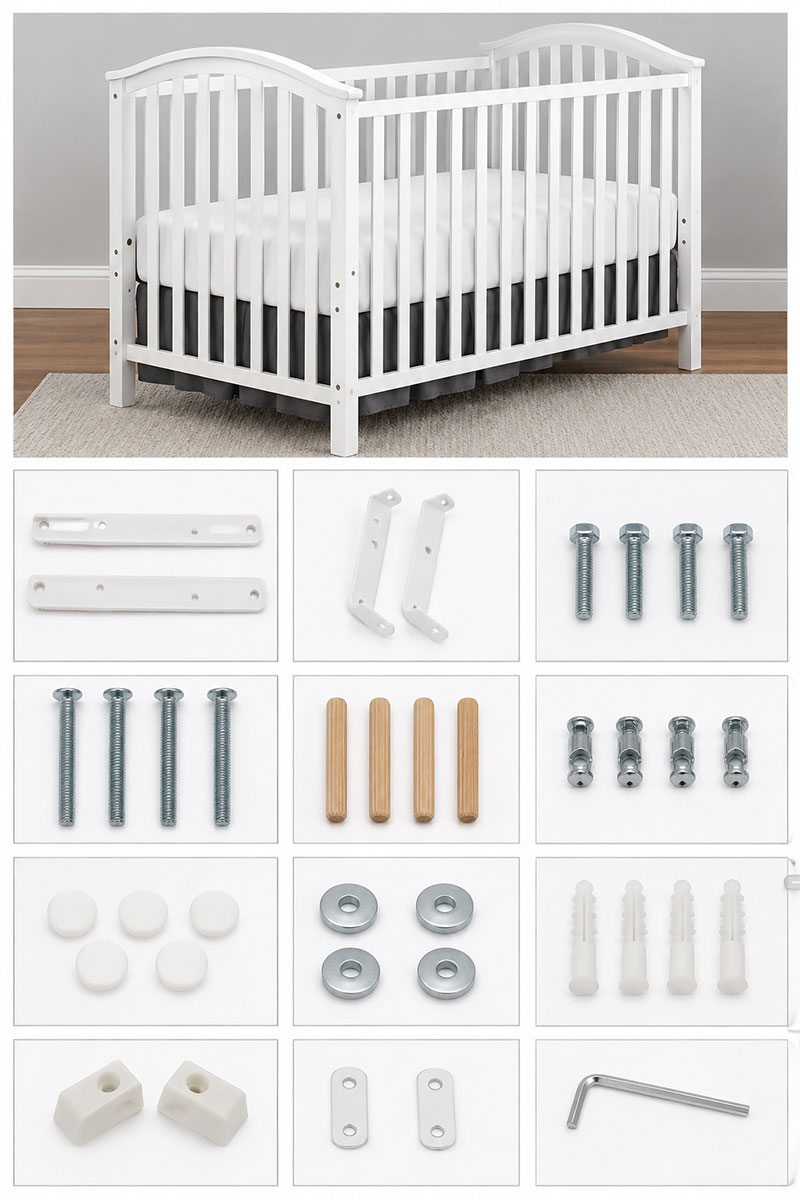
Important: This guide explains common hardware names and visible features. It does not confirm fit, compatibility, repairs, substitutes, or assembly steps. Use the manual and parts list for the exact crib brand and model.
Crib hardware identification chart
The numbered chart above shows ten common crib hardware groups. These are general names. The exact name used by a crib manufacturer may be different.
- Machine or connector bolt: A blunt-ended bolt with even machine threads. It often has an Allen, hex, Phillips, or Torx drive.
- Wood screw: A pointed screw with deeper threads made to enter wood.
- Barrel nut: A small metal cylinder with a threaded opening through the side. It may also be called a cross dowel.
- Cam lock and cam bolt: A round locking disk that turns and grips a matching cam bolt or stud.
- Washer: A flat or split metal ring placed under a bolt head, screw head, or nut.
- Spacer or bushing: A short sleeve or collar that keeps space between two connected pieces.
- Connector pin: A smooth or lightly grooved metal pin used to line up or support parts.
- Retaining clip: A small clip that helps keep a pin, rod, or support piece in place.
- Bracket or plate: A shaped metal piece with holes or slots used at a connection point.
- Mattress support hook: A bent or stamped metal piece connected with the mattress support or spring frame.
When a hook, bracket or hanger belongs to the assembly beneath the mattress, the crib mattress support hook and hanger reference explains how these parts relate to spring frames, platforms and model-specific mounting points.
Common crib hardware names and alternate names
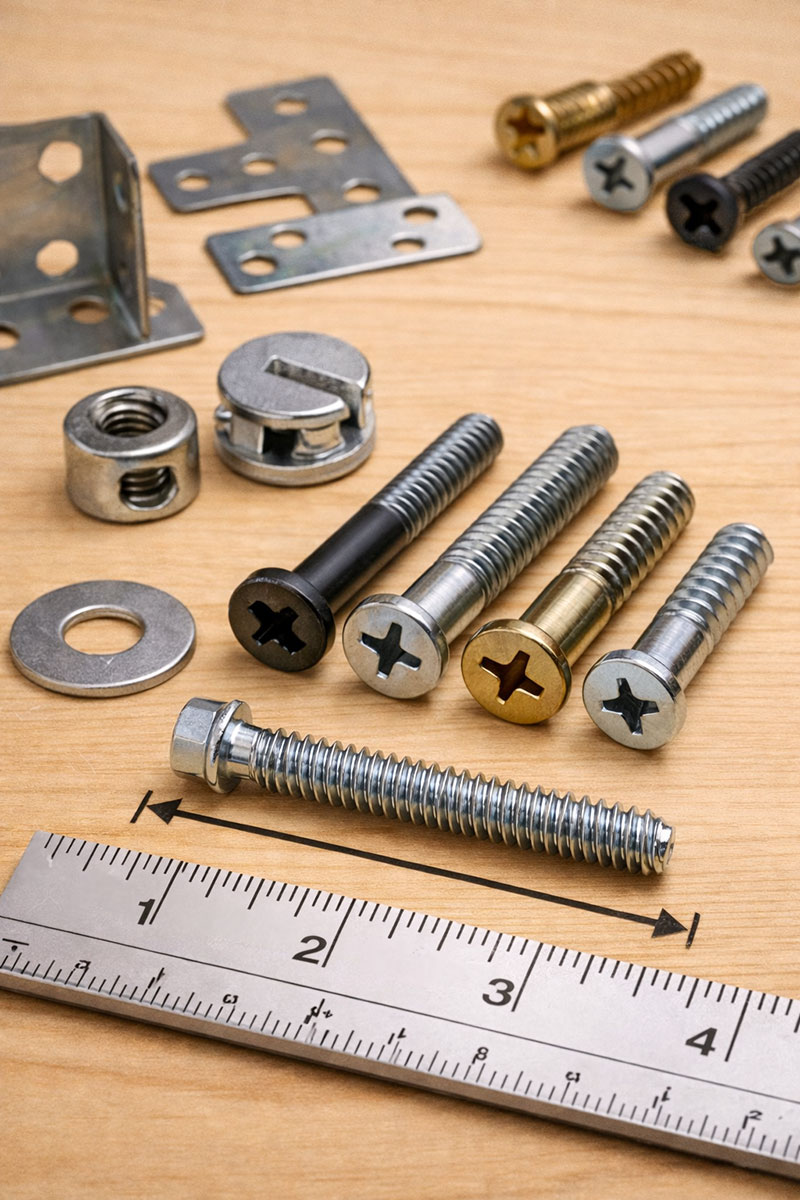
A crib manual may use a different name from the one used in a hardware store or another manufacturer’s manual. This table shows common and related terms. Some terms describe different shapes within the same general hardware group, so the manual for the exact crib model remains the final reference.
| Common name | Other terms found in manuals | What it generally looks like |
|---|---|---|
| Machine or connector bolt | Crib bolt, furniture bolt, joint bolt, assembly bolt | Blunt tip with even machine threads, often with an Allen or hex-socket head |
| Wood screw | Wood fastener, mounting screw | Pointed tip with deeper, wider threads |
| Barrel nut | Cross dowel, cross nut, cylindrical nut | Small metal cylinder with a threaded hole through the side |
| Cam lock | Cam connector, locking cam, cam nut | Round metal disk with a screwdriver slot or arrow mark |
| Cam bolt | Cam dowel, connector stud, cam screw | Threaded stud with a larger head that fits into a cam lock |
| Washer | Flat washer, lock washer, spacing washer | Thin flat or split metal ring |
| Spacer | Sleeve, bushing, collar, standoff | Short hollow tube or ring that keeps space between parts |
| Connector pin | Dowel pin, support pin, locating pin | Straight metal pin that may be smooth, grooved, or drilled for a clip |
| Retaining clip | Spring clip, locking clip, cotter clip | Small bent metal clip that holds a pin or rod in place |
| Bracket or plate | Corner bracket, rail bracket, mounting plate, support plate | Flat, bent, or L-shaped metal piece with holes or slots |
| Mattress support hook | Spring hook, support hanger, mattress bracket | Bent or stamped metal piece used near the mattress support frame |
How manufacturers label hardware in crib manuals
Manufacturers may organize and name similar hardware in different ways. These official product pages include links to model-specific instruction manuals that you can use as naming examples.
- Babyletto Hudson 3-in-1 Convertible Crib instruction manual page
- Graco Benton 5-in-1 Convertible Crib instruction manual page
- DaVinci Kalani 4-in-1 Convertible Crib instruction manual page
These manuals are examples of manufacturer terminology only. A hardware name or drawing from one manual does not identify a part for a different crib.
How crib bolt and screw measurements are described
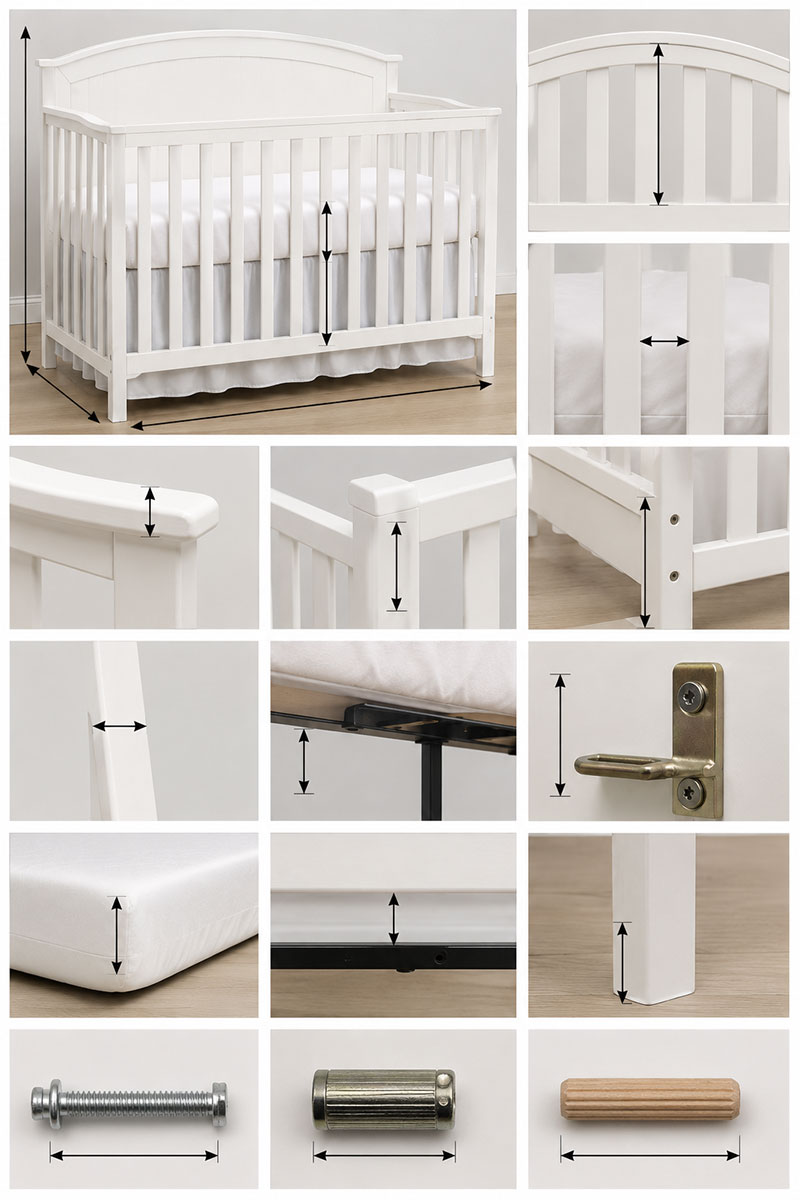
These measurement terms may appear in a crib parts list, manual, or manufacturer message.
| Term | What it means |
|---|---|
| Length | Usually measured from under the bolt head to the tip. A flat countersunk screw may be measured from the top of the head. |
| Diameter | The width of the threaded shaft, not the width of the head. |
| Head style | The outside shape of the head, such as round, pan, flat, button, or hex. |
| Drive style | The tool opening in the head, such as Allen, Phillips, slotted, or Torx. |
| Thread type | Machine threads are even and usually have a blunt tip. Wood screw threads are deeper and usually have a pointed tip. |
| Thread pitch | The spacing between the threads. Two bolts can look similar but have different thread spacing. |
For general fastener names and measurement terms, see this fastener naming and measurement reference.
Photograph checklist for a loose crib hardware piece
Use a simple, matching set of photos so the shape and measurements are easy to compare with a parts diagram.
- Full view: Photograph the complete piece on plain white paper.
- Side view: Show the shape of the shaft, threads, bends, or raised sections.
- Head or opening: Take a close-up of the Allen, Phillips, Torx, slot, hole, or clip shape.
- Measurement view: Place the part beside a ruler without covering either end.
- Markings: Photograph any stamped letters, numbers, grooves, arrows, or other marks.
A photograph can help identify the general hardware category, but the exact crib manual is still needed to confirm the manufacturer’s part name.
What this hardware guide cannot confirm
A photograph, name, or measurement can help identify the general hardware type, but it cannot prove that a part belongs to a certain crib. The manual and parts list for the exact crib model remain the final sources.
When the original manufacturer part cannot be found, see what to do if you cannot find crib replacement parts.
Crib hardware identification questions
What is another name for a crib barrel nut?
A barrel nut may also be called a cross dowel, cross nut, or cylindrical nut. The name used in the crib manual may vary.
What is the difference between a crib bolt and a wood screw?
A crib bolt usually has machine threads and a blunt tip. A wood screw usually has deeper threads and a pointed tip. The exact part must still match the model manual.
What is a crib hardware spacer?
A spacer is a short sleeve or collar that keeps a set distance between two parts. Some manuals call it a bushing, sleeve, collar, or standoff.
Can a photo prove that hardware fits a crib?
No. A photo can help identify the general type, but it cannot confirm fit or compatibility. The exact crib manual and manufacturer parts list are the final sources.
Why do crib manuals use different hardware names?
Manufacturers may use their own parts names. One manual may say barrel nut while another says cross dowel for the same general hardware category.
Related crib hardware resources
When you click on links to various merchants on this site and make a purchase, this may result in this site earning a commission. This does not affect the price you pay.

UBGI Gold Standard 2026
Reviewed under the site's
editorial checklist.
Photos, decorating ideas, party setups and reader submissions are shared for inspiration unless a page is specifically presented as a pattern, tutorial, reference guide or step-by-step project. Follow the instructions, measurements, safety guidance and manufacturer directions provided for the particular project or product.
About Jan | Contact | Baby Nursery Ideas (Blog) | Site Map | Privacy Policy | Disclosure Policy | Disclaimer | Affiliate Disclosure | Earnings Disclosure | Facebook | Pinterest
I am a participant in the Amazon Services LLC Associates Program, an affiliate advertising program designed to provide a means for us to earn fees by linking to Amazon. As an Amazon Associate I earn from qualifying purchases.
Copyright © 2006-2026. All Rights Reserved.