Crib Safety Standards: What Parents Need to Know in the United States
Crib safety standards in the United States are mandatory federal regulations enforced by the U.S. Consumer Product Safety Commission (CPSC).
These regulations define how a baby crib must be designed, tested, labeled, and sold.
Trying to understand crib safety standards without getting lost in rules? Start here:
What Are Crib Safety Standards?
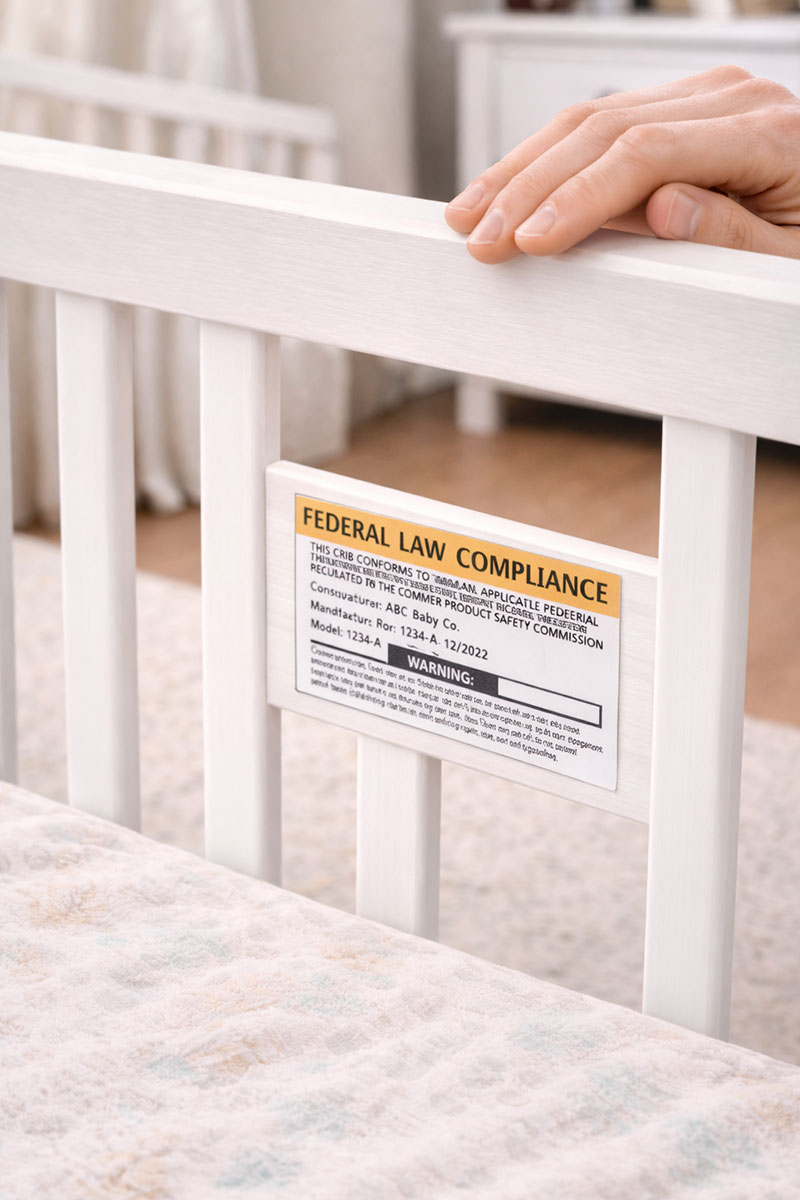
Crib safety standards are mandatory federal regulations in the United States that define how baby cribs must be designed, tested, labeled, and sold. These rules are enforced by the Consumer Product Safety Commission (CPSC) under 16 CFR Parts 1219 and 1220 and apply to both full-size and non-full-size cribs.
Full-size cribs generally follow standardized interior dimensions defined under 16 CFR 1219, while non-full-size cribs including compact or specialty models are regulated under 16 CFR 1220 with different dimensional requirements.
Crib Safety Guides
These pages explain specific crib safety rules, inspection steps, and compliance checks.
- Complete guide to baby cribs
- Crib safety regulation timeline
- Crib slat spacing rules
- Crib safety checklist
- Hidden crib dangers parents miss
- Crib weight limits and stop-use rules
- When to lower the crib mattress
- When a crib is no longer safe to use
- Is it safe to use a used crib
- Crib hardware kits and replacement parts
Last reviewed: March 2026 · Reflects current U.S. federal crib regulations (16 CFR 1219 and 1220)
On This Page
This page is for: parents verifying a crib model, caregivers checking compliance before use, and anyone evaluating whether a crib meets current U.S. federal safety standards. It is not a product repair or assembly guide.
For a historical overview of how federal crib regulations evolved — including the drop-side ban and post-2011 updates see the timeline of U.S. crib safety regulations .
Crib safety standards are one part of choosing and using a compliant crib. For a broader structural overview of crib types, safety features, and selection criteria, see my guide to baby cribs and how to choose one. That page explains how compliance fits into the bigger crib decision framework.
This page applies specifically to crib safety standards in the United States. Regulations in Canada, the United Kingdom, Australia, and other countries differ and should be verified separately.
Crib safety standards in the United States are primarily governed under federal regulation and enforced through the Consumer Product Safety Commission (CPSC). Since 2011, all cribs sold in the U.S. must comply with updated federal crib regulations that prohibit drop-side designs, require stronger mattress supports, mandate more durable hardware systems, and enforce stricter performance testing. If a crib was manufactured before these updates, it may not meet current crib safety standards even if it appears undamaged.
Here is the clear answer most parents are looking for:
A crib meets current U.S. safety standards only if all of the following are true:
- It complies with post-2011 federal crib regulations.
- The crib has not been recalled.
- No structural damage or missing parts are present.
- The crib is assembled according to the manufacturer’s instructions.
Download the U.S. Crib Safety Standards Quick Reference (16 CFR 1219 & 1220) (PDF)
This printable one-page summary outlines current federal crib requirements under 16 CFR 1219 and 1220, including post-2011 compliance rules and a fast verification checklist.
No email required. Instant download.
Download the U.S. Crib Safety Standards Quick Reference PDF
File format: PDF · 1 page · Printable · Updated 2026
If any of these conditions cannot be confirmed, the crib should not be considered compliant with current U.S. crib safety standards. When you need to verify those details step by step, the crib safety verification checklist walks through the process clearly, while my crib mattress safety guidelines explains how mattress fit and firmness connect directly to those same requirements.
Seeing how everything fits together makes the decision easier, which is why my crib mattress guide breaks down what to check before choosing, and my breathable crib mattress guide explains how airflow-focused designs fit into the broader safety picture. My best breathable crib mattress guide then compares which airflow-focused designs still stay firm, and fit exactly as they should.
This page serves as a reference overview of crib safety standards and regulatory requirements. It does not replace manufacturer documentation or official regulatory guidance, so always verify your specific crib model against current federal regulations and manufacturer-issued instructions before use.
What crib safety standards are in the United States (CPSC crib regulations)
Short answer: In the United States, crib safety standards require that full-size and non-full-size cribs comply with post-2011 federal crib regulations enforced by the CPSC. This includes fixed-side construction, proper slat spacing, durable mattress supports, secure hardware systems, and accurate manufacturer labeling.
When I say “crib safety standards,” I mean the rules a baby crib has to meet in the United States before it can be sold as a crib. Not a bassinet. Not a toddler bed. A crib. The big ones are the federal crib regulations enforced by the U.S. Consumer Product Safety Commission (CPSC), and they cover things like crib slat spacing, mattress support strength, hardware holding power, and how the crib has to be labeled.
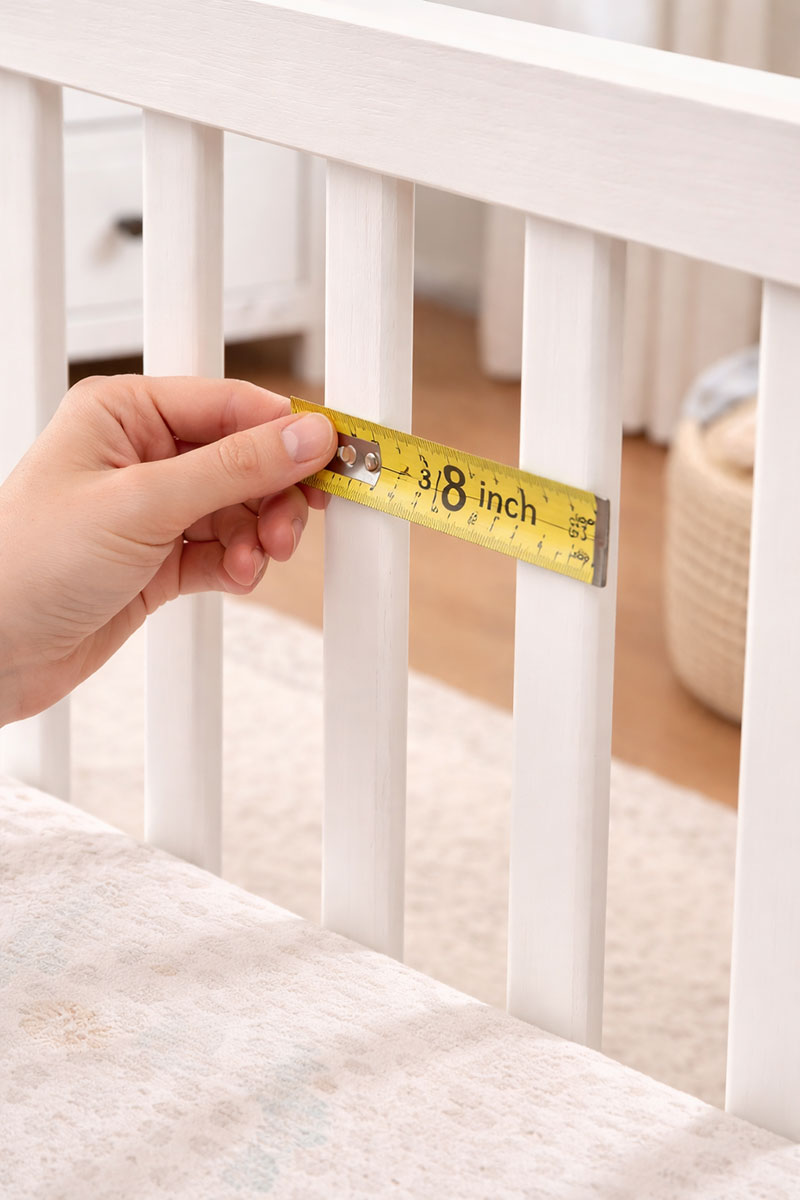
One of the most clearly defined requirements within those rules is how far apart crib slats are allowed to be. Under federal standards, slats may not be spaced more than 2⅜ inches apart, since wider gaps increase the risk of entrapment. For a detailed explanation of how this measurement is applied in practice, see crib slat spacing safety rules.
This page explains general crib safety standards, not product-specific instructions for your exact crib model.
This guide does not provide assembly instructions, repair guidance, or part compatibility advice. It focuses solely on understanding and verifying compliance with current U.S. crib safety standards.
Parents verifying a crib should focus on model identification, recall status, and confirmation that the crib complies with current federal safety regulations.
Here’s the decision in plain language: a crib meets current federal requirements only when it is a compliant, post-2011 model, it is not recalled, and it is complete and intact with no missing parts.
If you only remember one thing
Crib safety standards are not based on opinion or appearance. A crib either meets the safety rules or it does not.
That same clear pass-or-fail reality is why I explain what actually matters in the early months in this best crib mattress for newborns guide.
If your crib can’t clearly meet the current U.S. crib rule set, treat it as a stop-use situation until you can confirm it does.
Why crib safety standards matter more than people think
Most of us shop for a crib the same way we shop for a dresser. We look at the finish. The style. The price. The reviews. That’s normal.
But a crib is different because it is a piece of baby gear that has a stop-use limit, a recall history, and a real failure mode when the hardware loosens or the structure bends. That part matters more than people think.
Crib safety certification and “meets standards” language can sound comforting, but the part that really matters is the paper trail: who made it, what model it is, and whether it matches current CPSC crib regulations for full-size cribs or non-full-size cribs.
And yes, people still use older cribs. Sometimes because it was a hand-me-down. Sometimes because it’s sentimental. Sometimes because it looks solid and heavy and “better built.” I get it. We just have to separate sturdy-looking from standards-compliant.
Are all cribs required to meet federal safety standards?
Yes. In the United States, all cribs sold — including online and in retail stores — must meet federal crib safety standards. Older cribs manufactured before the current regulations may not meet those standards, even if they were legal at the time of purchase.
What to do next (right now)
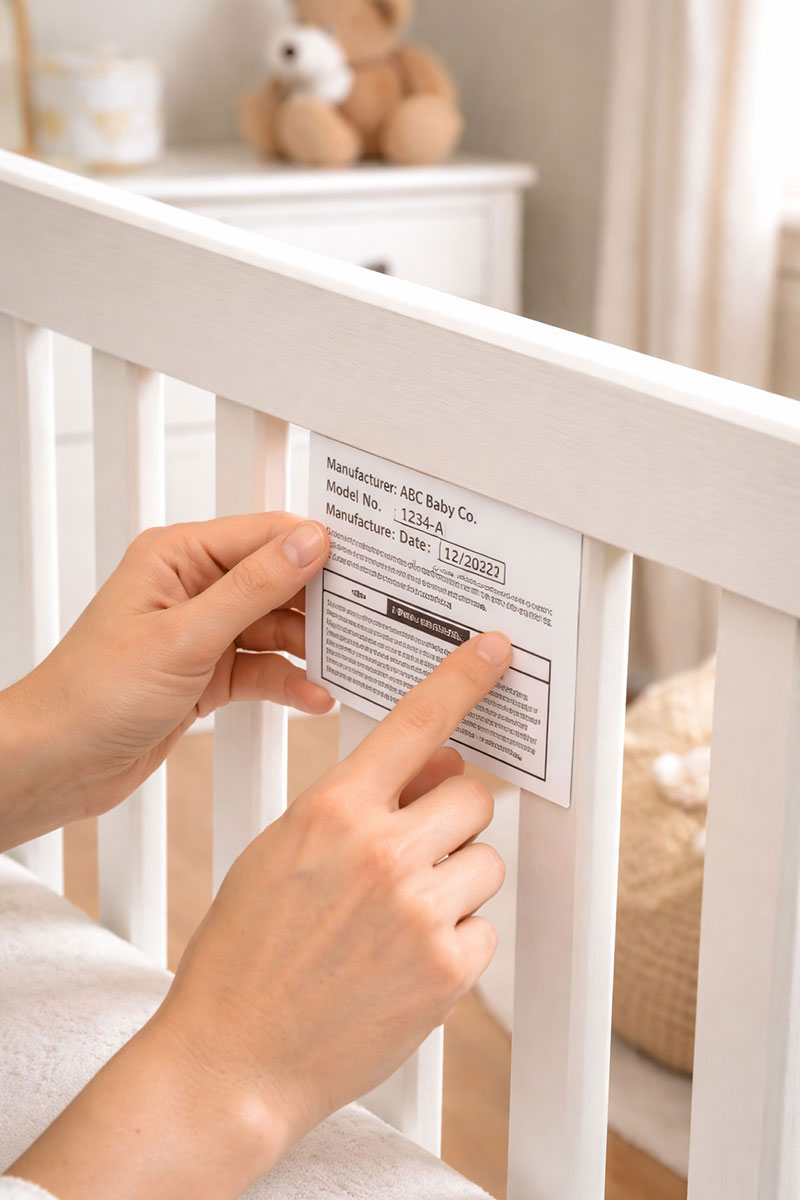
Identify the crib first: brand, model number, and date of manufacture on the crib compliance label. That one label usually tells you more than an hour of guessing.
Then compare what you have to what’s required under current U.S. safety standards, and check whether the model has a recall record.
A separate crib recall guide can help you look up the model number, manufacturer details, and official recall notices before deciding whether an older or secondhand crib should be used.
What changed in the federal crib regulations
The big modern shift happened when the United States tightened crib rules and banned drop-side cribs. After that, the testing expectations for mattress supports and hardware durability got stricter too. So when someone says, “It’s fine, it’s always been fine,” I translate that into: “We haven’t tested it against the current rule set.”
Drop-side crib ban language is a clue, not a trivia fact. It’s a marker that a crib is either part of the modern era of crib standards or it isn’t. And older designs are also where you see more missing bolts, mismatched screws, and “we lost that piece during a move” stories.
Those overlooked hardware issues are part of the broader pattern of hidden crib safety dangers parents miss, especially when a crib looks stable but no longer matches its original tested configuration.
Crib standards also care about the boring stuff: the way the mattress support holds up over time, how the hardware stays tight, and whether the frame keeps its shape. The problems don’t always show up on day one. They show up later, when the crib has been assembled, moved, and used.
For the official regulatory overview, the CPSC has a crib resource page here: CPSC crib safety information.
What goes wrong when a crib doesn’t truly meet standards
Common reasons a crib fails modern safety standards
- Manufactured before post-2011 federal crib regulations
- Recalled by the manufacturer or CPSC
- Missing original hardware or parts
- Unknown model number or removed compliance label
- Structural damage that affects mattress support or frame integrity
This is where most parents get confused.
They think “meets standards” is a permanent label. Like it was blessed once, so it stays blessed. But crib safety standards are tied to the crib as it exists today: complete, assembled correctly, not recalled, and not damaged or altered.
Here are the failure patterns I see again and again with secondhand and older cribs:
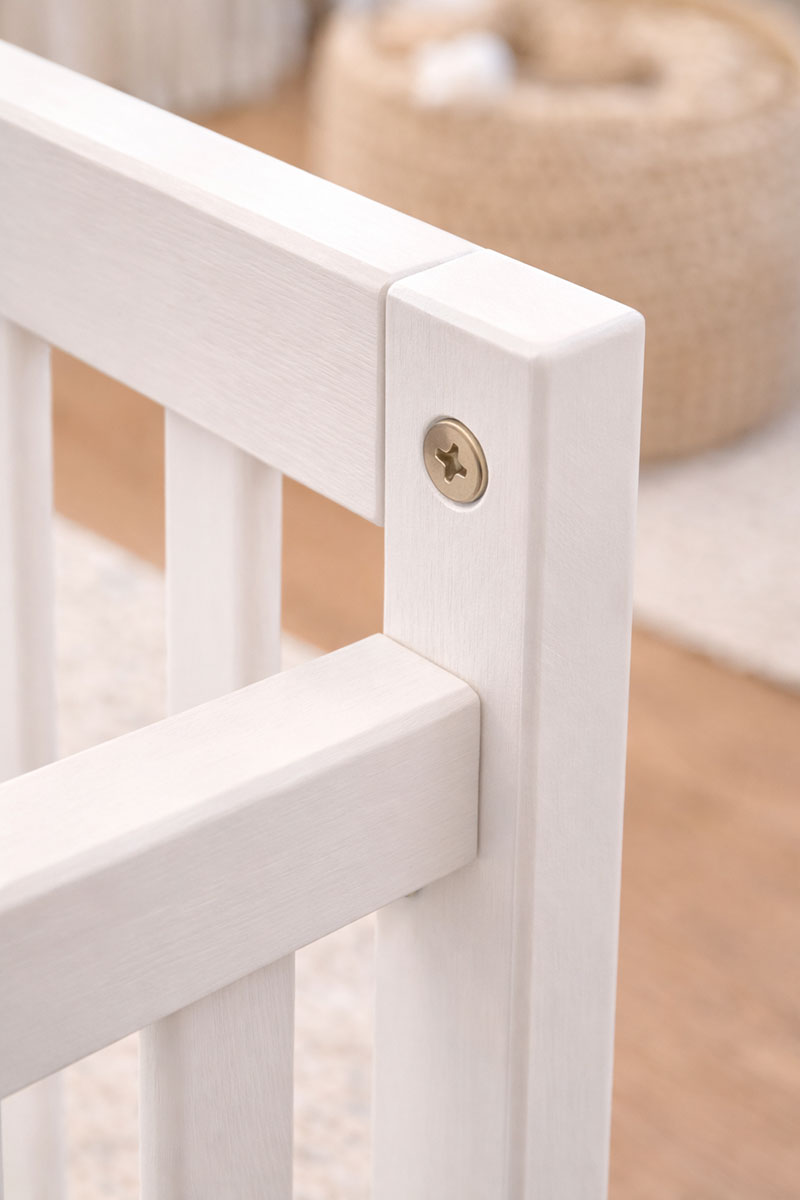
Missing parts, especially bolts or mattress support hardware, so the crib is no longer in its tested configuration.
Hardware that loosens and re-tightens over and over until the holes widen or the joints shift.
Unknown model number, so you can’t confirm the standard, the manual, or a crib recall status.
“Close enough” replacement screws that change the way the crib holds under load.
Even when nothing looks “broken,” a crib can still be outside the standard because it no longer matches the manufacturer’s designed hardware system. That’s why this topic is so tied to parts and documentation.
Related reading that stays in the same lane: understanding crib hardware kits and replacement parts.
This page explains regulatory compliance only. It does not provide instructions for repairing, modifying, or retrofitting a crib.
Did I buy the right crib for my situation
Let’s keep this simple. A lot of parents buy a crib that is “cute and popular,” and it still can be the right crib. The question is whether it’s the right crib for the way your home and your life actually function.
For example, a crib that gets taken apart and reassembled multiple times (moves, room swaps, grandma’s house) is more likely to end up with missing pieces. A crib with a messy parts history is where crib compliance problems creep in.
And some families use the crib longer, right up to the stop-use limit. In that case, the practical questions matter: do you clearly understand the crib weight limit and the mattress height adjustment timing? Those are not “extra.” They are part of responsible crib use under modern U.S. safety standards.
Two pages that connect cleanly without turning this into a lecture:
crib weight limits and stop-use guidelines
when to lower the crib mattress height
Quick check in 30 seconds
Can you identify the crib model and manufacturer from the label, and does it clearly look like a modern fixed-side crib (not a drop-side design)?
If the answer is “not sure,” that’s your signal to slow down and verify before the crib gets treated like an everyday piece of furniture.
Edge cases that deserve a calmer, stricter answer
Older cribs, secondhand cribs, and “no manual” situations are where standards get messy fast.
If the label is gone, parts are missing, or the model cannot be identified, there is no clean way to confirm it meets current federal compliance requirements.
No workarounds. No improvising. Just clarity.
Crib Safety Standards Verification Checklist
Use this simple pass/fail checklist before using any crib:
- ☐ Manufactured after 2011 federal crib regulation update
- ☐ Fixed-side design (not drop-side)
- ☐ Model number and manufacturer identifiable
- ☐ No active recall record
- ☐ Original hardware intact
- ☐ Mattress support secure and undamaged
- ☐ Assembled according to manufacturer instructions
If any box cannot be checked with certainty, pause use until confirmed.
What should I do now
Most parents want the same thing: a clear yes or no. I respect that.
Here’s the clean decision: in the United States, using a crib that cannot be verified against current standards is not worth the risk.
So what to do next is not “tinker with the crib.” It’s to identify, understand, and confirm. Confirm the model. Confirm it isn’t recalled. Confirm it is complete. Confirm it matches the manufacturer’s documentation. That’s the whole path.
This page provides regulatory reference information and does not replace pediatric medical advice or individualized safety recommendations.
Most parents choose
We either use a clearly modern, standards-compliant crib with a traceable model and documentation, or we don’t use that crib.
That sounds strict. It is. And it keeps the decision clean.
Federal Regulations vs. Certification Language
In the United States, crib compliance is governed by binding federal regulations enforced by the U.S. Consumer Product Safety Commission (CPSC).
Terms such as “ASTM compliant” or “JPMA certified” refer to voluntary standards or third-party certification programs. While they may align with federal requirements, they are not themselves federal law.
The controlling authority in the United States is the federal crib rule enforced by the CPSC.
| Term | What It Means | Legally Required? |
|---|---|---|
| Federal Crib Regulations | Mandatory U.S. crib safety standards | Yes |
| ASTM Standard | Industry consensus safety standard | Not by itself |
| JPMA Certification | Third-party certification program | No (voluntary) |
One last note on wording you’ll see online
You may see people toss around terms like ASTM crib standard, JPMA certification, or “crib safety certification.” Those phrases can be useful, but they are not a substitute for the federal crib regulations that apply in the United States. I treat them as supporting signals, not the final verdict.
And I keep one primary term in my head the whole time: crib safety standards. That’s the umbrella that keeps the focus on the actual requirement, not the marketing language.
For more context that pairs well with this page, especially for hand-me-downs, see: is it safe to buy a used baby crib.
Official Regulatory References
- U.S. Consumer Product Safety Commission — Crib Safety Guidance
- 16 CFR Part 1219 — Safety Standard for Full-Size Baby Cribs
- 16 CFR Part 1220 — Safety Standard for Non-Full-Size Baby Cribs
This page summarizes publicly available regulatory information and is intended as a reference overview. Always consult official federal documentation and manufacturer materials for authoritative determinations.
Where This Fits in the Bigger Crib Picture
Crib safety standards connect to a simple chain: identify the crib model, confirm it meets current U.S. regulations, follow the manufacturer’s documentation, and respect stop-use limits as your child grows. For the most direct “decision clarity” page in this chain, keep this one bookmarked: when a crib is no longer safe to use.
In Plain Terms:
- Cribs in the United States must comply with post-2011 federal regulations.
- Drop-side cribs are prohibited.
- Model identification and recall status must be verifiable.
- Missing hardware or altered parts can void compliance.
- If compliance cannot be confirmed, do not use the crib.
Frequently Asked Questions About Crib Safety Standards
Do used or secondhand cribs have to meet current federal standards?
Yes. Any crib in use in the United States should comply with current federal crib regulations, regardless of whether it was purchased new or used. Older models manufactured before the post-2011 updates may not meet modern compliance requirements.
Are drop-side cribs legal?
No. Drop-side cribs are prohibited under current federal crib regulations.
Does JPMA certification mean a crib meets federal law?
Certification may indicate testing alignment, but federal regulations are the legally binding requirement.
Can an old crib still meet current standards?
Only if it fully complies with post-2011 federal crib regulations and has not been recalled or altered. If you’re unsure whether an older crib is still compliant, review the warning signs that indicate when a crib is no longer safe to use.
Federal crib regulations can be updated over time. Parents and caregivers should periodically verify that the crib model in use remains compliant with current U.S. standards.
These answers summarize current U.S. federal crib regulations and are intended for general informational reference, not product-specific determination.
When you click on links to various merchants on this site and make a purchase, this may result in this site earning a commission. This does not affect the price you pay.

UBGI Gold Standard 2026
Reviewed under the site's
editorial checklist.
Photos, decorating ideas, party setups and reader submissions are shared for inspiration unless a page is specifically presented as a pattern, tutorial, reference guide or step-by-step project. Follow the instructions, measurements, safety guidance and manufacturer directions provided for the particular project or product.
About Jan | Contact | Baby Nursery Ideas (Blog) | Site Map | Privacy Policy | Disclosure Policy | Disclaimer | Affiliate Disclosure | Earnings Disclosure | Facebook | Pinterest
I am a participant in the Amazon Services LLC Associates Program, an affiliate advertising program designed to provide a means for us to earn fees by linking to Amazon. As an Amazon Associate I earn from qualifying purchases.
Copyright © 2006-2026. All Rights Reserved.