Crib Conversion Kits: Toddler Rails and Full-Bed Conversion Parts
By Jan Bay
Crib conversion kits can be confusing because one crib may need a short toddler guardrail, while another needs long rails and support parts for a full-size bed. The correct kit depends on the crib brand, model number, date code, and the bed stages listed in the original manual.
Quick answer: A crib conversion kit is a group of parts made to change a convertible crib into another bed stage. A toddler kit normally adds a short guardrail while keeping the crib mattress. A full-bed kit may include long side rails, brackets, slats, a metal frame, or other supports for a full-size mattress.
Explore More Crib Parts and Conversion Help
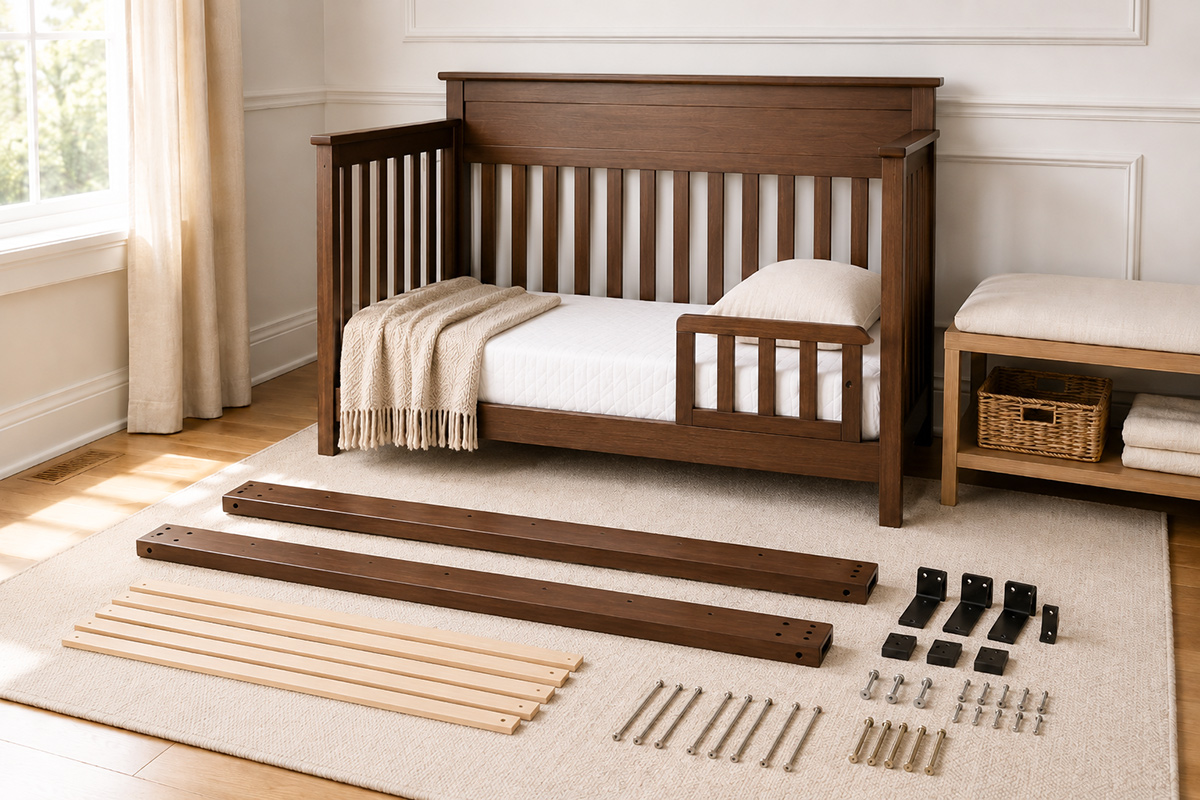
Crib Conversion Parts
Check the crib model number and manual before ordering a toddler rail or full-bed conversion kit.
On This Page
- What Is a Crib Conversion Kit?
- Toddler Bed Conversion Kits and Guardrails
- Crib to Full-Bed Conversion Kits
- Are Crib Conversion Kits Universal?
- What Size Does a Crib Convert To?
- How to Find the Correct Conversion Kit
- Can a Crib Be Converted Without a Kit?
- Are Crib Conversion Kits Necessary?
- Should You Buy the Kit With the Crib?
- Used and Discontinued Crib Conversion Parts
- Conversion Kit Compatibility Checklist
- Crib Conversion Kit FAQ
What Is a Crib Conversion Kit?
The words “crib conversion kit” can describe several very different sets of parts. Some kits contain one small toddler rail and a bag of bolts. Others arrive in a long box with two wooden bed rails. A metal frame sold for the full-bed stage may also be called a conversion kit.
The name on the box matters less than the model number stamped on the crib label. A rail can have the right color and still have the wrong mounting holes, brackets, length, or hardware.
A 3-in-1, 4-in-1, or 5-in-1 label tells you how many bed configurations the manufacturer lists for that crib. It does not tell you which conversion parts were included with the original purchase. The toddler rail may be packed with one crib and sold separately for another. Full-bed rails are often a separate purchase.
| Bed stage | Parts commonly used | Mattress |
|---|---|---|
| Toddler bed | Short guardrail, brackets, and model-matched hardware | The crib mattress |
| Daybed | The front crib rail may be removed when this setup is shown in the manual. An added kit is not required for every model. | The crib mattress |
| Full-size bed | Long side rails or a bed frame, brackets, support pieces, and hardware | A full-size mattress |
| Twin bed | A model-approved twin rail or frame kit, offered with certain convertible and mini cribs | A twin mattress |

The crib manual should name each approved bed stage and may list the matching conversion kit number. When the original booklet is missing, begin with the crib instructions and manuals guide. Copy the full model number, including any letters at the end, before searching.
Small brackets and fasteners can be just as important as the long wooden pieces. The crib hardware identification reference can help you put a useful name to an unfamiliar bolt, barrel nut, bracket, pin, or support hook before contacting the manufacturer.
Think of the kit as a matched group rather than a loose collection of bed parts. The crib, rails, brackets, hardware, mattress size, and support system all need to belong to the same approved setup.
Toddler Bed Conversion Kits and Guardrails
A toddler bed conversion kit normally changes the open side of a convertible crib by adding a short guardrail. The crib mattress stays in place, but the tall front crib panel is removed or replaced according to the instructions for that model.
The kit may contain one wooden or metal rail, mounting brackets, bolts, washers, and other small pieces. Some cribs include the toddler rail in the original box. Others require a separate kit that may be listed in the manual as a toddler guardrail, toddler safety rail, crib conversion rail, or low front rail.
The rail is small, but the match is exact.
A rail from another crib may look nearly identical and still have different holes, brackets, dimensions, or hardware. Match the complete crib model number to the conversion kit number rather than shopping by color, brand name, or appearance alone.

What Stays the Same After the Toddler Conversion?
A convertible crib used as a toddler bed continues to use its full-size crib mattress unless the manual states otherwise. This is helpful when the mattress is still in good condition and fits properly. The standard crib mattress size guide explains the dimensions used for full-size cribs and toddler beds.
Do not add a thicker mattress to make the guardrail seem taller. The mattress, support position, rail, and hardware should follow the crib manufacturer’s toddler-bed instructions as a complete setup.
When Is a Crib Toddler Bed Intended to Be Used?
The U.S. Consumer Product Safety Commission defines a toddler bed as one made for a full-size crib mattress and intended for a child who is at least 15 months old and weighs no more than 50 pounds. Read the crib manual and labels too, because they provide the directions and limits for that particular model.
The federal toddler-bed standard also includes requirements for guardrail height, openings, hardware, warning labels, and structural testing. More details are available in the CPSC toddler bed guidance.
A Toddler Guardrail Is Not a Portable Bed Rail
A crib toddler rail attaches to the convertible crib in the locations designed by its manufacturer. A portable bed rail is a separate product made for use with certain adult beds. The two names sound similar, but the parts are not interchangeable.
Before beginning the conversion, lay out every item shown in the manual. Stop when a bracket, bolt, washer, or connector is missing. The guide to cribs with missing parts explains why a nearly complete set should not be treated as complete.
Check Before Installing a Toddler Rail
- The crib manual lists a toddler-bed configuration.
- The crib model number matches the rail or kit listing.
- The kit number includes every letter and number shown in the manual.
- The brackets and mounting holes match without alteration.
- All required bolts, washers, connectors, and support pieces are present.
- The mattress and mattress support are positioned as directed in the manual.
- The crib and conversion kit are not included in a product recall.
Crib to Full-Bed Conversion Kits
A crib to full-bed conversion kit uses parts of the convertible crib as pieces of a larger bed. The crib’s tall back panel commonly becomes the headboard. Depending on the design, the front panel may become the footboard or be left out of the finished bed.
The little crib mattress is no longer used at this stage. The converted bed takes a full-size mattress, along with the support system named in the crib and conversion-kit instructions.
A long cardboard box can look reassuring, but length alone does not prove that the rails belong with your crib. The attachment plates, bolt locations, rail height, center support, and crib model all have to agree.
What May Be Included in a Full-Bed Conversion Kit
- Two long wooden or metal side rails
- Headboard and footboard brackets
- Bolts, washers, nuts, and connector hardware
- Wood slats or metal cross supports
- A center rail and support legs
- Instructions for the approved crib models
Not every box includes every item on that list. Some kits provide only the decorative wooden side rails. A separate metal frame, slat set, center support, box spring, or foundation may still be needed.

Wooden Rails and Metal Bed Frames
Wooden conversion rails are made to give the finished bed a coordinated furniture look. Their brackets normally attach directly to approved crib end panels. They may also support slats, a foundation, or a mattress support system designed for that rail set.
A metal conversion frame does the structural work beneath the mattress. Some frames attach to both the crib headboard and footboard. Others use the crib headboard alone. The finished arrangement depends on the crib instructions and the frame design.
Do not assume that a general full-size bed frame will provide the same connections as the conversion system named in the crib manual. A frame may fit a full mattress perfectly while having the wrong plates or attachment points for the crib panels.
Does the Converted Bed Need a Box Spring?
That answer comes from the conversion-kit instructions. Some full-bed setups use a box spring or mattress foundation. Others use closely spaced wooden slats, a bunkie board, or a metal support system.
The full-size mattress should rest on the support named for the finished bed. Adding or removing a foundation also changes the mattress height, which can affect how the mattress sits against the headboard and footboard.
For mattress measurements, visit the crib mattress guide. Keep in mind that the crib mattress information applies to the crib, toddler-bed, and daybed stages, not to the full-size mattress used after the final conversion.
Check the Headboard and Footboard Setup
A convertible crib may offer more than one full-bed arrangement. The manual might show a complete bed with both a headboard and footboard, as well as a second version that uses the crib back panel as a headboard without the front panel.
Do not discard a crib panel simply because it is not used during the toddler stage. That panel may be needed later as the full-bed footboard. Store unused rails and hardware together, and label the container with the crib model number before the pieces are separated during a move.
Before Ordering Full-Bed Conversion Parts
- Confirm that the crib manual lists a full-size bed stage.
- Match the complete crib model number to the rail or frame listing.
- Check whether the crib front panel becomes the footboard.
- Find out whether brackets and mounting hardware are included.
- Check whether slats, center supports, or a metal frame are sold separately.
- Confirm whether the setup calls for a foundation or box spring.
- Compare the kit finish code with the crib finish when using visible wooden rails.
When any required rail, bracket, or fastener is missing, the guide to crib parts that cannot be found explains how to continue the model and part-number search without guessing at a substitute.
Are Crib Conversion Kits Universal?
Treat a crib conversion kit as model-specific unless the crib manufacturer clearly says otherwise. The word “universal” appears on some full-size bed frames, bunkie boards, and support systems, but it does not mean that every rail or bracket fits every convertible crib.
Toddler guardrails need especially careful matching. The rail length, mounting holes, brackets, bolts, and finished height are designed around a particular crib or group of crib models. A rail that rests against the crib neatly is not necessarily a compatible rail.
Full-bed kits can be a little more confusing because the word “universal” may describe only one piece of the finished bed. An adjustable metal frame might support a standard full-size mattress, while separate brackets or wooden rails are still needed to connect that frame to the crib headboard and footboard.

What “Universal” May Actually Mean
- The frame adjusts to support more than one adult mattress size.
- The same support board fits several cribs made by one furniture company.
- One conversion kit works with a published list of crib models.
- The frame has several bracket positions for approved headboards and footboards.
- A support piece fits a product family, but the visible wooden rails remain model-specific.
Read the full compatibility list rather than stopping at the product title. A listing may say “universal full-size conversion frame” and then name the crib brands, models, brackets, or bolt patterns it is intended to fit.
Manufacturer compatibility charts can make this much clearer because they pair individual crib models with specific toddler, twin, and full-size conversion parts. The same information may appear in the crib manual, replacement-parts catalog, or product support section.
Can a Universal Kit Be Altered to Fit?
Do not drill new holes, shorten a rail, add homemade spacers, swap brackets, or force bolts into openings that do not line up. Those changes can alter how the crib panels and converted bed are supported.
The same caution applies when a secondhand seller says that a rail “should fit” several models. Ask for the part number, instruction sheet, hardware list, and compatibility information. A useful answer contains numbers, not just a similar wood color.
A Kit Is a Possible Match Only When:
- The crib is designed for the planned bed stage.
- The complete crib model number appears in the kit instructions or compatibility list.
- The rail or frame part number matches the number listed for that crib.
- The mounting brackets and holes line up without alteration.
- The required hardware and support pieces are included.
- The instructions explain how that kit connects to the crib panels.
When a seller cannot provide a model match, keep looking. The crib replacement parts guide covers the labels, numbers, manuals, and manufacturer sources that can help narrow the search without relying on a guess.
What Size Does a Convertible Crib Become?
A convertible crib may become a toddler bed, daybed, twin bed, or full-size bed, but the final size depends on the exact crib model. The words 3-in-1, 4-in-1, and 5-in-1 count the configurations offered by the manufacturer. They do not guarantee that the crib converts to every common bed size.
A standard convertible crib often keeps the crib mattress during the toddler-bed and daybed stages. A full-size mattress is used only when the crib is converted into a full bed with the required rails, frame, brackets, and supports.
| Conversion stage | Mattress commonly used | Parts that may be needed |
|---|---|---|
| Crib | Full-size crib mattress | Original crib rails, mattress support, and hardware |
| Toddler bed | The same crib mattress | Short toddler guardrail and matching hardware when required |
| Daybed | The same crib mattress | An added kit may not be needed when the manual shows an open-front daybed setup |
| Twin bed | Twin mattress | Model-approved twin rails, frame, brackets, and supports |
| Full-size bed | Full-size mattress | Long bed rails or frame, brackets, hardware, and the required mattress support |

Does a 4-in-1 Crib Always Convert to a Full Bed?
No. Many 4-in-1 cribs list crib, toddler bed, daybed, and full-size bed as their four stages, but another manufacturer may count the configurations differently. A full bed with a footboard and a full bed without a footboard may even be counted as separate stages.
Read the list of configurations rather than relying on the number in the product name. The manual should show which crib panels remain in use, which conversion parts are required, and what mattress size belongs with each setup.
Can a Mini Crib Convert to a Full-Size Crib?
A mini crib does not automatically expand into a full-size crib. Some modular crib systems include added panels and mattress support parts that create a larger crib. Other mini cribs convert into a twin bed, daybed, or small toddler bed instead.
The original product description and manual should clearly name an approved full-size crib stage before expansion parts are purchased. A twin-bed conversion kit does not turn a mini crib into a standard crib, and a full-size adult bed conversion is different from a full-size crib.
Crib Mattress Size and Full-Bed Mattress Size Are Different
The phrase “full-size crib” describes a standard crib category. It does not mean the crib uses a full-size adult mattress. A standard crib uses a crib mattress, while a crib converted into a full bed uses a much larger adult mattress.
The standard crib mattress size guide explains the measurements used during the crib, toddler-bed, and daybed stages. For a broader look at crib styles and convertible designs, visit the baby cribs guide.
Find the Final Bed Size Before Buying a Kit
- Read every conversion stage listed for the crib model.
- Confirm whether the final stage is twin or full size.
- Check whether the crib mattress remains in use during the toddler and daybed stages.
- Find out whether the full-bed setup uses both crib end panels or the headboard alone.
- Confirm the required rails, frame, slats, supports, and mattress foundation.
- Do not assume the number in “4-in-1” or “5-in-1” identifies the final mattress size.
How to Find the Correct Crib Conversion Kit
Start with the crib itself, not with a shopping result. Brand names are reused across several crib collections, and two cribs with similar names may need completely different rails. The model label gives you the details that separate one version from another.
After years of sorting through crib manuals and replacement-part questions for this site, I have learned that the full model number does more useful work than the crib’s color, collection name, or a seller’s promise that a rail should fit.
Before searching, take a clear photo of the label and write down every letter and number. A small suffix at the end of a model number can point to a different production run, finish, or conversion kit.
If you are working with a Delta crib, use my Delta conversion kit reference to narrow the search using the crib model, conversion stage and matching rail information.
1. Find the Crib Model Label
The label may be attached to the mattress support, the inside of an end panel, the lower frame, or the back of the crib. Look for the following information:
- Manufacturer or brand name
- Complete model number
- Manufacture date or date code
- Finish or color code
- Serial, lot, or production number
Do not rely on the crib’s appearance alone. White, gray, espresso, and natural wood finishes may each have separate rail numbers, even when the rail shape is the same.
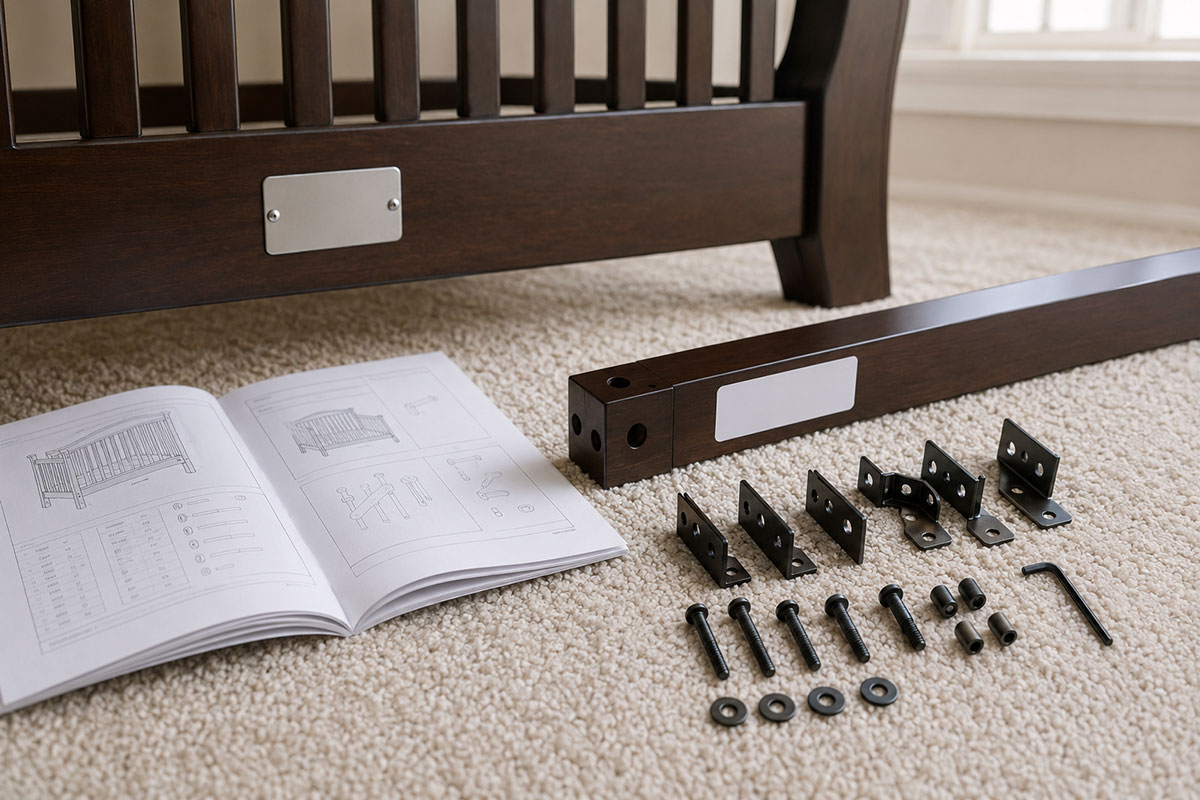
2. Locate the Original Crib Manual
The conversion section of the manual should show the approved bed stages and name any required toddler rail, full-bed rail, frame, bracket, or hardware kit. It may also include a diagram that makes a vague product listing much easier to understand.
When the paper manual is gone, use the model number to search the manufacturer’s support pages. The crib instructions and manuals guide covers several ways to track down older instruction books without depending on the crib name alone.
3. Copy the Complete Conversion Kit Number
Conversion kit numbers may include letters, dashes, finish codes, or revision numbers. Copy the entire number exactly as it appears. Searching only the first few digits can bring up a rail that belongs to another crib in the same collection.
It helps to search several combinations:
- Crib brand plus complete model number
- Crib model number plus “toddler rail”
- Crib model number plus “full-bed conversion kit”
- Exact conversion kit number in quotation marks
- Crib model number plus the finish code
4. Check the Compatibility List
A useful product listing should name the crib models it fits. Phrases such as “fits many cribs,” “compatible with select models,” or “may work with” are not enough by themselves.
Compare the listing with the manual and manufacturer information. The crib model, conversion stage, kit number, brackets, and hardware should all point to the same setup.
Details That Should Match
- Crib manufacturer
- Complete crib model number
- Approved toddler, twin, or full-bed stage
- Conversion kit or rail number
- Finish code when the rail is visible
- Bracket shape and mounting locations
- Included hardware and support pieces
- Instructions for connecting the kit to the crib panels
5. Read the Included-Parts List
A conversion kit title can sound complete even when the box contains only two rails. Read the parts list carefully and check whether brackets, bolts, slats, a center support, or a metal frame are sold separately.
Photographs are helpful, but the written parts list is more dependable. Decorative crib panels shown in a product photo may be there only to demonstrate the finished bed and may not be included with the kit.
If an unfamiliar connector or fastener appears in the instructions, compare it with the crib hardware identification reference. Knowing whether you are missing a barrel nut, hook-on bracket, machine bolt, spacer, or support pin makes a parts request much clearer.
6. Confirm the Kit Has Not Been Replaced by a New Number
Manufacturers sometimes replace an older part number with a newer kit that serves the same crib models. A replacement number can be valid, but the connection should come from the manufacturer, an official manual revision, or a current compatibility chart.
Do not assume that two numbers are interchangeable because the rails look alike. Ask for written confirmation that the newer number replaces the older one for your exact crib model.
7. Keep a Record for the Next Bed Stage
Save the manual, kit number, hardware list, receipt, and crib-label photo together. A simple note taped inside the conversion-kit box can save a great deal of searching when the crib is changed again several years later.
For an older crib whose original rail is no longer sold, the discontinued baby crib models archive provides another place to organize the brand, model, manual, and replacement-part search.
Can a Crib Be Converted Without the Original Kit?
A crib should not be changed into a toddler, twin, or full-size bed without the parts required in its manual. A rail that nearly fits is still the wrong rail, and a set of ordinary bed-frame brackets does not become a crib conversion kit simply because the holes appear close.
There is one important distinction. Some cribs have a daybed stage that uses the original crib frame with the front panel removed. When that arrangement is clearly shown in the manufacturer’s instructions, a separate conversion kit may not be needed. Follow the exact daybed diagram for that model rather than copying the appearance of another crib.
Do Not Replace a Missing Kit With Homemade Parts
A missing toddler rail should not be replaced with a board cut to a similar length. Full-bed rails should not be shortened, drilled, padded with spacers, or connected with brackets chosen from a general hardware aisle.
The same rule applies to bolts. A replacement fastener needs more than the right diameter. Its length, thread, head shape, strength, washer arrangement, and connection point must match the part specified for the crib or conversion kit.
I would not treat “it bolts together” as proof that the finished bed is correct. The parts also have to support the panels and mattress in the way the manufacturer intended.

What to Do When the Correct Kit Is Missing
- Return to the crib label. Record the complete model number, date code, serial number, and finish code.
- Find the manual. Confirm that the crib was designed for the bed stage you want to use.
- Copy the conversion kit number. Include every letter, dash, suffix, and finish code.
- Contact the manufacturer. Ask whether the original kit is still available or has an official replacement number.
- Check the complete parts list. Used rails without their brackets, supports, instructions, or hardware may not provide a complete kit.
- Check for recalls. Search by the crib brand and model before buying older or secondhand parts.
The guide for crib parts that cannot be found explains how to continue the search using manuals, model numbers, manufacturer records, and discontinued-part information.
When the crib itself has a missing rail, bracket, screw, support, or other required piece, read whether a crib with missing parts can be used before putting it back into service.
Do Not Continue the Conversion When:
- The manual does not list the planned bed stage.
- The conversion kit number cannot be matched to the crib model.
- A rail or bracket has been altered.
- Mounting holes do not line up naturally.
- Bolts, brackets, slats, center supports, or other required pieces are missing.
- The instructions for the kit are unavailable or belong to another model.
- The crib or conversion parts are included in a recall.
The CPSC crib safety guidance says a crib should have no missing, loose, broken, or improperly installed screws, brackets, or other hardware. That is a useful stopping point when a conversion kit is incomplete: identify the correct parts before going any further.
Are Crib Conversion Kits Necessary?
A conversion kit is necessary only when the crib manual requires one for the bed stage you plan to use. You do not need to buy conversion parts simply to use a convertible crib as a crib.
The answer changes when the front rail comes off or the crib panels become part of a larger bed. At that point, the required guardrail, brackets, frame, supports, and hardware become part of the approved setup.
| Planned use | Is a separate kit needed? | What to check |
|---|---|---|
| Use the furniture as a crib | No conversion kit is needed | The complete original crib, mattress support, hardware, and assembly instructions are still required |
| Convert it to a toddler bed | A toddler guardrail may be required | Check whether the model-matched rail was included with the crib or sold separately |
| Use the daybed stage | Some models need no added kit | Follow the daybed diagram for the exact crib model |
| Convert it to a twin bed | Model-approved rails or a frame are generally required | Confirm the mattress size, brackets, supports, and kit number |
| Convert it to a full-size bed | A rail or frame system is generally required | Check for long rails, brackets, slats, center supports, hardware, and foundation requirements |
Convertible Does Not Mean the Parts Are Included
A crib may be advertised as convertible even when none of the later-stage parts are packed in the box. The word describes the configurations the crib was designed to become. It does not promise that the toddler rail or full-bed frame comes with it.
Read the included-parts list before assuming a kit is missing. Some manufacturers include the toddler guardrail but sell the full-bed rails separately. Others sell both kits separately, sometimes under product numbers that are not printed prominently on the crib listing.
Do You Need Every Available Conversion Kit?
No. Buy only the parts for a bed stage you expect to use. A family planning to move from the crib directly to a separate twin bed may never need the toddler or full-bed kit.
A daybed configuration can also be useful for a short period without committing to a larger conversion, but only when that setup appears in the crib manual. Removing a front panel does not automatically create an approved daybed arrangement.
Think through the room as well as the furniture. A full-size bed takes considerably more floor space than a crib. The conversion may be possible on paper but impractical once the dresser, door swing, closet access, and walking space are considered.
What if the Crib Was Bought Secondhand?
Do not assume that a secondhand crib includes every part mentioned in the sale description. Match the loose rail and hardware to the model number, then compare the pieces with the manual’s parts list.
A bag labeled “conversion screws” is not enough without a clear connection to the crib and rail. The crib parts identification guide can help sort the original crib pieces from later conversion hardware.
The Practical Answer
Keep using the complete crib in its crib configuration until you are ready for a later stage. When that time comes, use the exact conversion parts named for the model. A kit is optional when the manual says it is optional, and necessary when the instructions make it part of the finished bed.
Should You Buy the Conversion Kit With the Crib?
Buying the matching conversion kit at the same time as the crib can save a difficult search later. Crib collections are renamed, finishes are discontinued, and replacement rails may disappear from stores long before the crib is ready to become a toddler or full-size bed.
That does not mean every convertible crib needs several extra boxes purchased on day one. Begin by checking exactly what comes with the crib and which later stages you realistically expect to use.
Buying Early Can Make Sense When:
- The conversion kit is sold separately and has a clear model number.
- You plan to use the crib through the toddler or full-bed stage.
- The crib has a distinctive wood finish that may be difficult to match later.
- The manufacturer confirms that the kit fits the exact crib model.
- You have a clean, dry place to store long rails and small hardware.
- The kit is available from the crib manufacturer or an authorized seller.
A matching toddler rail is fairly easy to store. Full-bed rails need more thought because they are long, easy to scratch, and awkward to move. Measure the storage space before ordering them, especially when the box will need to stay untouched for several years.
Check What Is Already Included
Some convertible cribs include the toddler guardrail but not the full-bed rails. Others include the daybed pieces because that setup uses the original crib frame. A few modular systems package several conversion stages together.
Read the included-parts list instead of depending on the phrases “convertible crib” or “all stages.” A product can be designed for several configurations while including only the parts needed for the crib stage.
The broader baby cribs guide can help you compare crib styles and conversion features before choosing a model.
Do Not Buy a Kit Before Confirming the Match
A low price is not a bargain when the rail belongs to another crib. Match the manufacturer, full crib model number, conversion kit number, bed stage, finish code, and included hardware before ordering.
Be careful with open-box and secondhand kits. Ask to see the label on the rails, the original instructions, and every piece of hardware. A pair of wooden rails without the proper brackets or center supports may leave you searching for another discontinued set of parts.
How to Store Conversion Rails and Hardware
- Keep the rails in their original box or wrap them so the finish cannot rub against another piece.
- Store wooden parts indoors where they will not be exposed to dampness or large temperature changes.
- Place bolts, brackets, washers, and instructions in a sealed, labeled bag.
- Write the crib model number and conversion kit number on the outside of the box.
- Keep the receipt, manual, and compatibility information with the parts.
- Do not mix the conversion hardware with spare household screws or furniture fasteners.
I believe labeling the hardware bag is just as important as protecting the rails. Years later, four nearly identical bolts on a garage shelf are much harder to identify than a sealed bag marked with the crib model and kit number.
Before Adding a Conversion Kit to the Crib Order
- Confirm which conversion parts are already included.
- Decide which later bed stages are likely to be used.
- Match the exact kit number to the crib model.
- Check the finish code and included hardware.
- Make sure there is suitable storage space.
- Save the manual, receipt, and parts list with the kit.
When a crib model is already older or the original kit has disappeared from stores, use the discontinued baby crib models archive and the guide explaining what to do when crib replacement parts cannot be found before considering a different rail or frame.
Used and Discontinued Crib Conversion Parts
Finding conversion parts for an older crib can take more digging because the rail may no longer appear under the crib’s familiar name. Product lines are retired, companies change owners, and an original kit number may be replaced by a newer number or disappear from current catalogs.
Begin with the label on the crib. A seller’s description such as “older white convertible crib” is not enough to identify a toddler rail or full-bed kit. You need the manufacturer, complete model number, manufacture date, and any finish or production codes printed on the crib.
Check the Manual Before Searching for Parts
The original manual tells you whether the crib was designed to become a toddler bed, daybed, twin bed, or full-size bed. It may also name the required conversion kit and show the pieces that belong in it.
Use the crib instructions and manuals guide when the paper booklet is missing. For models that have been out of production for some time, the discontinued baby crib models archive can help organize the search by brand, model number, manual, and part type.
Ask Whether the Old Kit Number Was Replaced
An unavailable kit number does not always mean that compatible parts no longer exist. A manufacturer may have assigned a newer stock number to the same approved rail or frame.
Ask for written confirmation that the replacement kit fits the complete crib model. Do not rely on a seller saying that the newer rail looks the same. A valid replacement should have a documented connection to the original crib and conversion stage.
Be Careful With Secondhand Conversion Rails
A used rail can be difficult to identify after its box and instructions are gone. Before buying, request clear photos of the rail label, brackets, mounting ends, hardware, and any stamped or printed part numbers.
Compare those details with the manual. Rails from two cribs made by the same brand may share a finish and general shape while using different mounting points.
Questions to Ask About a Used Conversion Kit
- What part or kit number is printed on the rail or frame?
- Which exact crib model was it used with?
- Are the original instructions included?
- Are all brackets, bolts, washers, slats, and supports present?
- Have any holes, rails, brackets, or fasteners been altered?
- Is the finish damaged, cracked, warped, or separating near an attachment point?
- Can the seller provide photos of every included piece?
A Complete Rail Without Hardware Is Still Incomplete
Long wooden rails often attract the most attention, but the small pieces may be harder to replace. Hook-on plates, corner brackets, barrel nuts, center-support feet, bolts, and washers can be specific to the conversion kit.
Do not assume that ordinary furniture hardware can fill the gaps. Use the crib hardware identification reference to describe what is missing, then compare the part with the official kit list.
Check the Crib Before Spending Money on Rare Parts
Before buying an expensive discontinued kit, confirm that the crib itself is complete and suitable for continued use. Check the model, instructions, hardware, condition, and recall information first.
The crib safety regulation timeline explains how crib requirements changed over time. You can also search the CPSC recall database by brand and model.
A rare conversion rail does not make an incomplete crib usable. When required crib or conversion pieces cannot be located, follow the lookup steps in what to do when crib replacement parts cannot be found.
Crib Conversion Kit Compatibility Checklist
Use this checklist before ordering parts and again before beginning the conversion. It is much easier to catch a wrong kit while the pieces are laid out on the floor than after the crib panels have been taken apart.
A part number is more useful than a promise that the rail looks right.
Confirm the Crib Information
- The manufacturer’s name is clearly shown on the crib label.
- The complete model number has been copied, including letters, dashes, and suffixes.
- The manufacture date or date code has been recorded.
- The finish or color code has been checked when ordering visible wooden rails.
- The crib manual belongs to the exact model rather than a similar crib from the same collection.
Confirm the Planned Bed Stage
- The manual lists the toddler, daybed, twin, or full-bed setup you plan to use.
- The mattress size agrees with the instructions for that stage.
- The diagrams show which original crib panels remain in the finished bed.
- The instructions explain whether a guardrail, side rails, frame, slats, center support, or foundation is required.
- The child meets the age, weight, and use limits printed in the crib or toddler-bed instructions.
Confirm the Conversion Kit
- The full kit number matches the number listed for the crib model.
- The compatibility list names the exact crib or product family.
- The kit is intended for the correct bed stage.
- The rail finish matches the crib when appearance matters.
- The kit has not been altered, drilled, shortened, repaired, or fitted with different brackets.
- An official source confirms any newer kit number that replaces a discontinued number.
Count the Rails, Brackets, and Hardware
Open the instructions and compare the pieces one at a time. Do not judge completeness by the largest rails alone.
- Every rail shown in the parts list is present.
- Headboard, footboard, and corner brackets are included when required.
- Bolts, washers, nuts, barrel nuts, spacers, and connector pieces match the illustrated hardware.
- Slats, cross supports, a center rail, or support legs are present when listed.
- No hardware has damaged threads, heavy rust, cracks, bends, or stripped heads.
- The instructions belong to the conversion kit being used.
Stop Before Assembly If:
- The crib model and kit number cannot be matched.
- The mounting holes do not line up without pushing or altering a part.
- A bracket, rail, fastener, slat, or support piece is missing.
- The hardware is loose, broken, bent, stripped, or badly corroded.
- The manual does not show the bed configuration being attempted.
- The crib or conversion kit appears in a recall notice.
Check the Finished Conversion
- Every fastener is installed in the location shown in the instructions.
- The rails sit squarely against the crib panels with no unexplained gaps.
- The headboard and footboard do not wobble when checked by hand.
- The mattress support, slats, center rail, or frame rests in the correct position.
- The mattress size and foundation match the completed bed setup.
- Unused crib parts and hardware have been labeled and stored together.
For a broader inspection of the crib and its original parts, work through the crib safety checklist. For recall checks, return to the used and discontinued crib conversion parts section, where the official recall link is provided.
The conversion should make sense on paper before a single bolt is removed. When the label, manual, kit number, parts list, and finished-bed diagram all agree, you have a much clearer picture of what belongs together.
Crib Conversion Kit FAQ
What Is Included in a Crib Conversion Kit?
The contents depend on the bed stage and crib model. A toddler conversion kit may include one short guardrail, brackets, bolts, washers, and installation instructions. A full-bed kit may include two long rails, hook-on plates, slats, a center support, support legs, and hardware.
Read the included-parts list carefully. Product photos may show a completed bed even though the mattress, crib panels, slats, metal frame, or foundation are sold separately.
Are Crib Conversion Rails Universal?
Most toddler guardrails are not universal. Their length, mounting holes, brackets, and hardware must match the crib.
Some full-size metal frames are described as universal, but that wording may apply only to the mattress support frame. The crib still has to be designed for the conversion, and the frame or brackets must be approved for the crib panels being used.
Do All Convertible Cribs Come With Conversion Kits?
No. Some cribs include the toddler rail, while others sell it separately. Full-bed conversion rails and frames are frequently separate purchases.
Look for an “included parts” section in the product listing or manual. The number of configurations in a 3-in-1, 4-in-1, or 5-in-1 name does not tell you which extra parts are packed with the crib.
Can I Use a Toddler Rail From the Same Crib Brand?
The brand name alone is not enough. A manufacturer may sell many crib collections with different rail lengths, attachment points, and kit numbers.
The model number does more useful work than the color name. Match the complete crib model to the exact toddler rail or conversion kit listed by the manufacturer.
What Is the Difference Between a Toddler Rail and a Full-Bed Rail?
A toddler rail is a short guardrail used while the crib mattress remains in place. It leaves an opening so the child can get in and out of the bed.
A full-bed rail is a much longer structural piece used to connect crib panels across the length of a full-size mattress. Full-bed setups may also need slats, a metal frame, center supports, brackets, or a mattress foundation.
Can a Crib Convert to a Twin Bed?
Some convertible and mini cribs have an approved twin-bed stage. Many standard convertible cribs move to a full-size bed instead.
Check the manual before buying rails. A crib-to-twin kit, mini-crib expansion kit, and crib-to-full-bed kit are three different products even when the listings use similar language.
Can I Convert a Crib Without the Instructions?
Do not rely on a picture of a finished bed or instructions for a similar model. The correct manual identifies the crib panels, hardware, mattress size, support system, and conversion kit needed for each stage.
Use the crib instructions and manuals guide to search by manufacturer and model number before taking the crib apart.
Where Is the Crib Conversion Kit Number Found?
Look in the crib manual, replacement-parts list, official product page, or manufacturer compatibility chart. The number may also appear on the original conversion rail label, shipping box, receipt, or hardware sheet.
Copy letters, dashes, finish codes, and model suffixes exactly. A shortened number may lead to a similar kit made for another crib.
Can I Buy a Used Crib Conversion Kit?
A used kit still needs a documented match to the crib model. Ask for clear pictures of the part label, brackets, mounting ends, instructions, and every piece of included hardware.
Do not buy the rails first and hope to find the missing brackets later. Small model-specific connectors can be harder to locate than the large wooden pieces.
What Should I Do if the Correct Kit Is Discontinued?
Contact the manufacturer and ask whether the original kit number has an official replacement. Search using the complete crib model number, manufacture date, finish code, and conversion kit number.
The missing crib replacement parts guide explains the next lookup steps. Older model information may also be available in the discontinued baby crib models archive.
How Much Do Crib Conversion Kits Cost?
The cost depends on what the kit actually contains. A short toddler guardrail, a pair of finished wooden bed rails, and a complete metal mattress-support frame are three different products. Brand, finish, included hardware, slats, brackets, and discontinued status can all affect the price.
Compare the complete parts list before comparing prices. A lower-priced rail that leaves out brackets, center supports, slats, or required hardware may not be the less expensive choice once the missing pieces are added.
Does a Crib Conversion Kit Include the Mattress?
Usually not. A toddler-bed conversion normally keeps the existing crib mattress. A twin or full-bed conversion normally requires a larger mattress and the support system listed in the crib manual.
Assume that the mattress, box spring, foundation, or bunkie board is sold separately unless the product listing clearly says it is included.
Should I Keep the Parts Removed During Conversion?
Yes. A front crib panel removed for the toddler stage may later become the footboard of a full-size bed. Original bolts, brackets, rails, and support pieces may also be needed if the crib is returned to an earlier configuration.
Label everything with the crib model number and bed stage. Store the manual and hardware in a sealed bag with the larger pieces rather than placing them in a general container of spare furniture parts.
Final Check Before You Order
Keep the crib label, manual, conversion kit number, and hardware list together as you work through the search. Those four pieces of information can quickly separate a true model match from a rail that only looks similar.
There is no prize for making a questionable kit fit. A clearly documented match is worth waiting for.
Keep These Details With the Crib
- A clear photo of the crib label
- The complete crib model number and manufacture date
- The original assembly and conversion manual
- The toddler rail or full-bed kit number
- The conversion-kit parts list
- Receipts and manufacturer compatibility information
- All unused rails, brackets, and hardware in labeled containers
Before using an older crib or secondhand conversion kit, use the official recall link provided in the used and discontinued crib conversion parts section.
A convertible crib can serve a family through several bed stages, but only when the right parts stay with the right model. Take your time with the numbers, compare every piece with the manual, and set aside any kit that cannot be clearly matched. That careful paper trail is far more useful than a rail that happens to be the right color.
When you click on links to various merchants on this site and make a purchase, this may result in this site earning a commission. This does not affect the price you pay.

UBGI Gold Standard 2026
Reviewed under the site's
editorial checklist.
Photos, decorating ideas, party setups and reader submissions are shared for inspiration unless a page is specifically presented as a pattern, tutorial, reference guide or step-by-step project. Follow the instructions, measurements, safety guidance and manufacturer directions provided for the particular project or product.
About Jan | Contact | Baby Nursery Ideas (Blog) | Site Map | Privacy Policy | Disclosure Policy | Disclaimer | Affiliate Disclosure | Earnings Disclosure | Facebook | Pinterest
I am a participant in the Amazon Services LLC Associates Program, an affiliate advertising program designed to provide a means for us to earn fees by linking to Amazon. As an Amazon Associate I earn from qualifying purchases.
Copyright © 2006-2026. All Rights Reserved.