Can You Use a Crib With Missing Parts?
Can you use a crib with missing parts? No. Do not use or finish putting together a crib when a required part is missing. Keep the crib unused until you can identify the exact model, find the official parts list, and confirm the correct missing piece.
Quick decision:
Is a rail, support, bracket, bolt, screw, nut, pin, lock, or other required piece missing?
Yes or unsure: Do not use the crib. Follow the decision guide below.
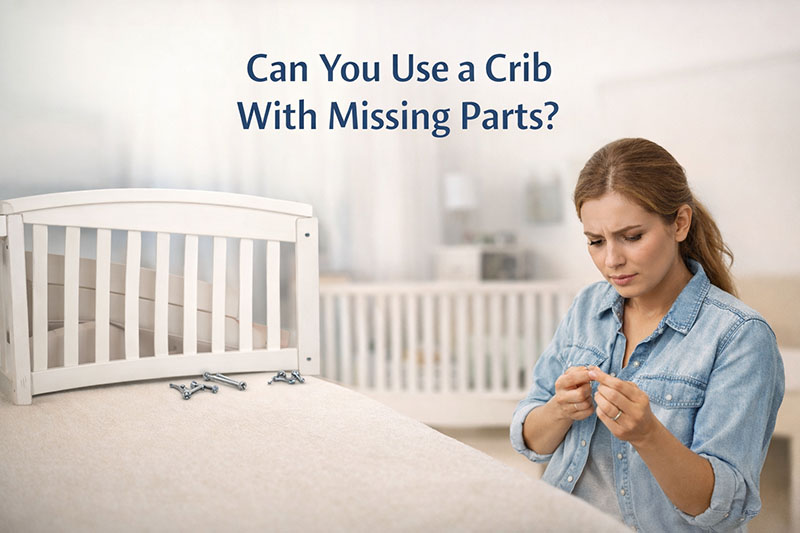
Crib parts often go missing during a move, while the crib is in storage, or when it is passed to another family. Even a small missing piece may hold a joint together, support the mattress, or keep another part from moving.
Which Missing Crib Parts Count?
A missing part counts when it holds the crib together, supports the mattress, keeps the sides aligned, or locks another piece in place.
- Headboards, footboards, and end panels
- Side rails, cross rails, and crib slats
- Mattress support frames, boards, or spring units
- Mattress support hooks and brackets
- Corner posts and stabilizer bars
- Bolts, screws, barrel nuts, washers, and spacers
- Pins, clips, latches, locks, and stop pieces
- Any other part shown as required in the assembly manual
A part does not have to be large to be important. If it appears in the official parts list or assembly steps, treat it as required.
The structural crib parts reference shows where the headboard, footboard, side rails, slats, mattress support, stabilizer bars, and other major components fit within the crib.
When the missing piece is a spring frame, support board, bracket, hook or hanger, use the crib mattress support identification guide to understand the model-specific parts that may belong to the complete assembly.
The U.S. Consumer Product Safety Commission crib safety guide says a crib should have no missing, loose, broken, or improperly installed screws, brackets, or other hardware.
Use the crib hardware identification reference to compare common bolts, nuts, brackets, pins, washers, spacers, and support pieces.
Can You Use a Crib With Missing Parts? Follow This Decision Guide
1. Is any crib part or piece of hardware missing?
No: There is no known missing-parts problem. You should still follow the official instructions and check the crib for recalls, damage, or loose parts.
Yes or unsure: Do not use the crib. Continue to question 2.
2. Can you identify the crib brand and exact model?
No: Do not order parts or assemble the crib by guessing. Use the crib parts identification guide across manufacturers to look for brand and model clues.
Yes: Continue to question 3.
3. Can you find the official assembly manual or parts list?
No: Search the crib instructions and manuals guide, or contact the manufacturer.
Yes: Compare the official parts list with every crib piece you have. Then continue to question 4.
4. Can the manufacturer confirm the exact missing part for this model?
No: Do not use the crib. A piece that looks similar is not enough to confirm that the crib is complete.
Yes: Use only the exact part the manufacturer confirms for that crib model. Follow the official assembly instructions.
5. Is the crib recalled, damaged, altered, or still incomplete?
Yes: Do not use it. Follow any official recall or manufacturer instructions.
No: This completes the missing-parts decision guide. It does not certify the crib or replace the manufacturer’s instructions.
What If Only One Screw or Bolt Is Missing?
One missing screw, bolt, nut, bracket, or support hook still counts as a missing crib part. Keep the crib unused until the exact piece can be identified and confirmed for that crib model.
Do not choose replacement hardware only because it looks similar or fits into the opening. Crib models may use fasteners with different lengths, threads, heads, or locking parts.
For help collecting the correct information, see what to do when crib screws are missing.
When the missing component is a toddler guardrail, full-size bed rail, or related hardware package, review the model-matched crib conversion parts reference.
What Information Will the Manufacturer Need?
Collect as much identifying information as possible before contacting the crib manufacturer.
- Manufacturer or brand name
- Crib model name and model number
- Date of manufacture or date code
- Serial number, lot number, batch number, or run number
- A clear photograph of the crib label
- A photograph showing the complete crib
- A close photograph of the place where the part is missing
- The name or number of the missing part shown in the manual
- The number of pieces that are missing
The label may be attached to an end panel, rail, mattress support, or another part of the crib frame. Check more than one area if the label is not easy to see.
Do not rely only on the crib color, general shape, or the previous owner’s memory. Several crib models from the same brand may look alike while using different parts.
The original manual may show the model number, complete parts list, and location of each piece. Use the crib instructions and manuals guide if the paper manual is missing.
What If the Manufacturer or Model Cannot Be Identified?
Do not use the crib when its exact brand and model cannot be confirmed. Without this information, you may not be able to find the correct manual, review the full parts list, check recalls, or confirm which hardware belongs with the crib.
Look for a label on the crib frame, end panel, rail, or mattress support. You can also use the crib parts identification guide across manufacturers to compare common brand and model clues.
Do not identify a replacement part only by measuring an empty hole or comparing the crib with an online photograph.
If the label is missing, the manufacturer cannot be found, or the correct parts are no longer available, see what to do when crib replacement parts cannot be found.
For wider concerns such as damage, alterations, mixed parts, or an older recall, review when a crib may no longer be safe.
Use the Correct Deeper Guide
This page gives the basic yes-or-no decision. Use the guide that matches the exact problem you are trying to solve.
- Identify an unknown bolt, nut, bracket, pin, washer, or support piece
- Look for the original crib manual and parts list
- Look for brand and model identification clues
- Find the next step when screws or bolts are missing
- Decide what to do when the correct crib parts cannot be found
Final Answer
Do not use a crib with a missing required part. Keep it unused until the exact crib model, official parts list, and missing component can be confirmed.
If the manufacturer cannot identify the crib or confirm the correct part, do not guess, combine hardware from different kits, or use a part only because it appears to fit.
Official crib safety information and recall records are available from the U.S. Consumer Product Safety Commission:
Editorial and Safety Notice
Unique Baby Gear Ideas is an independent informational website. This site does not certify crib safety, approve repairs, or confirm that replacement hardware is compatible with a crib.
Use this page to find the correct manufacturer, manual, or official safety source. Follow the crib manufacturer’s instructions and any recall directions issued by the manufacturer or the U.S. Consumer Product Safety Commission.
When you click on links to various merchants on this site and make a purchase, this may result in this site earning a commission. This does not affect the price you pay.

UBGI Gold Standard 2026
Reviewed under the site's
editorial checklist.
Photos, decorating ideas, party setups and reader submissions are shared for inspiration unless a page is specifically presented as a pattern, tutorial, reference guide or step-by-step project. Follow the instructions, measurements, safety guidance and manufacturer directions provided for the particular project or product.
About Jan | Contact | Baby Nursery Ideas (Blog) | Site Map | Privacy Policy | Disclosure Policy | Disclaimer | Affiliate Disclosure | Earnings Disclosure | Facebook | Pinterest
I am a participant in the Amazon Services LLC Associates Program, an affiliate advertising program designed to provide a means for us to earn fees by linking to Amazon. As an Amazon Associate I earn from qualifying purchases.
Copyright © 2006-2026. All Rights Reserved.