Teddy Bear Lovey Crochet Pattern
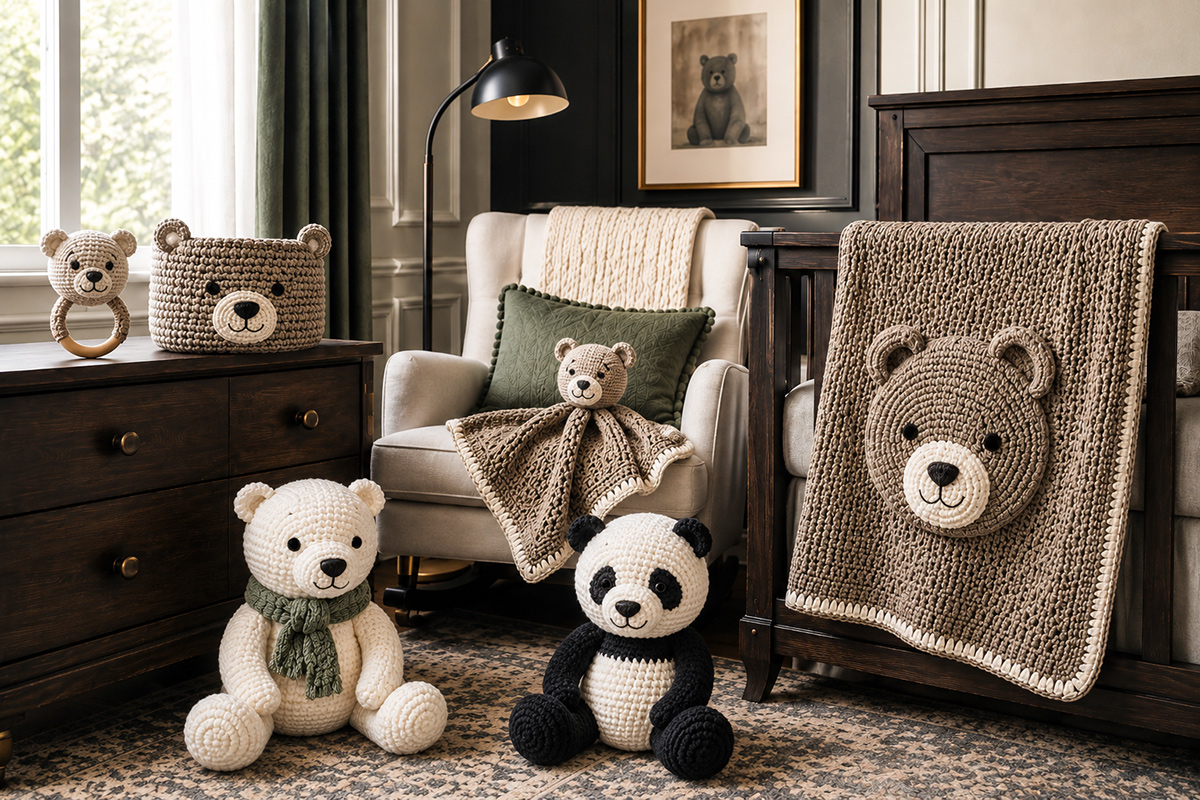
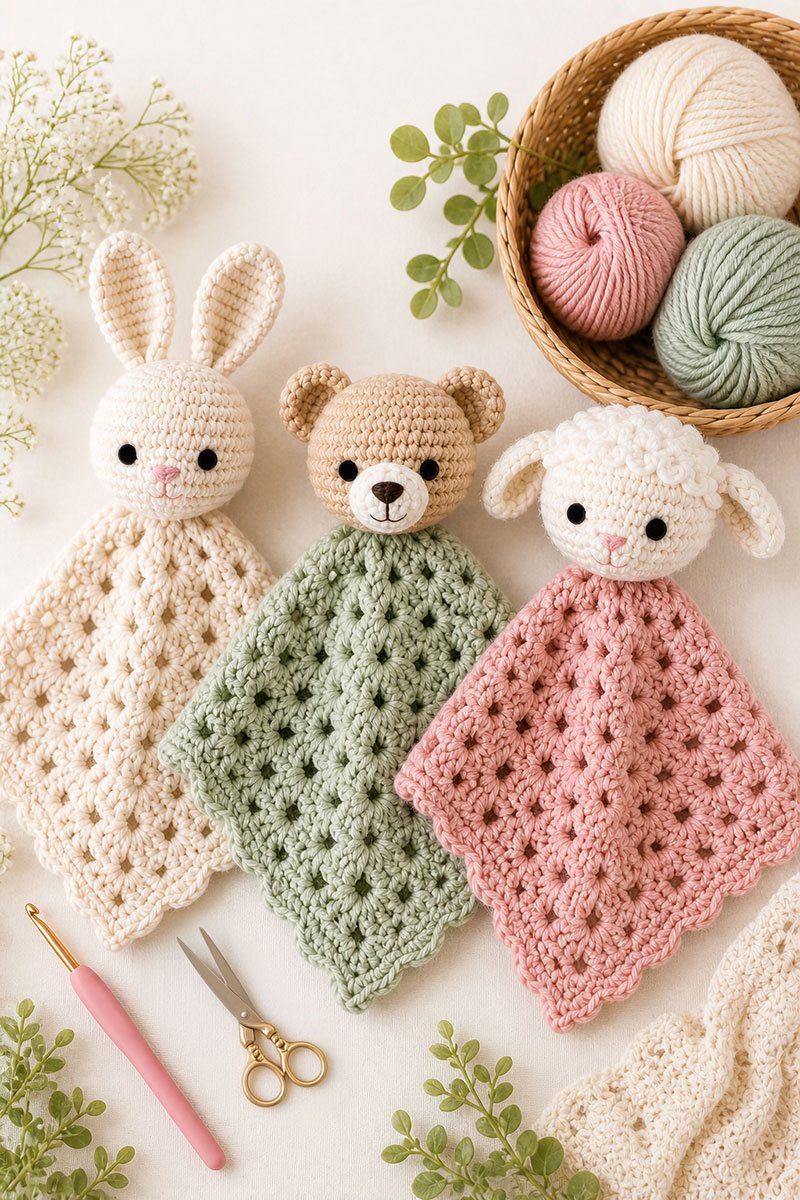
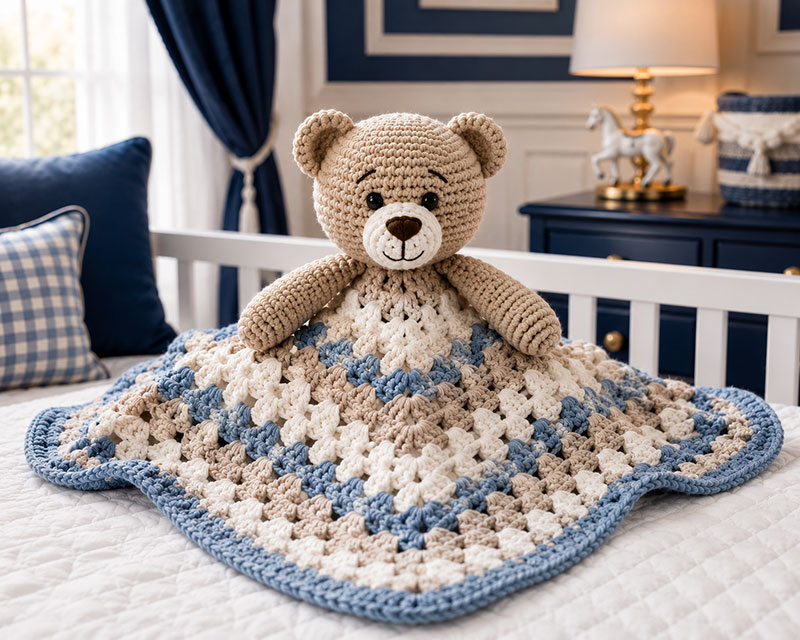
This teddy bear lovey crochet pattern is one of the best crochet projects I offer because it works as a handmade baby gift, a baby shower keepsake, and a sweet teddy bear nursery accent all in one.
Choose another handmade baby project:



Jump to the part you need first:
Gather the supplies before starting
Sew the bear on without twisting
Teddy Bear Lovey Crochet Pattern Materials
A teddy bear lovey crochet pattern should stay balanced when it is picked up from different corners, folded into a diaper bag, or washed and reshaped. A head that is too large, overstuffed, or attached through too small an area can pull the blanket out of shape.
This pattern uses a compact bear head, lightly stuffed arms, a flat granny-square blanket, and a defined circular head seam so the finished lovey folds neatly and hangs more evenly.
This is an advanced-beginner crochet pattern. You should already know how to chain, slip stitch, single crochet, half double crochet, double crochet, increase, decrease, work into both sides of a foundation chain, and crochet in continuous rounds.
Finished size: The bordered blanket should measure approximately 15 to 16½ inches square. The finished bear head should measure approximately 3¼ to 3¾ inches across, and each arm should measure approximately 2½ to 3 inches long. Yarn choice and individual tension will affect the final measurements.
Blanket gauge: After Round 4, the granny square should measure approximately 4½ inches across using worsted weight yarn and a 4.5 mm hook. Continue the blanket according to its actual measurement rather than relying only on the number of rounds.
Bear-piece gauge: The single crochet fabric should be dense enough that the fiberfill does not show between stitches. Change to a smaller hook if necessary rather than tightening your stitches so much that the pieces become stiff or pointed.
The stated head and arm measurements are progress checkpoints rather than guaranteed dimensions because worsted weight yarns vary in thickness. Check the head width after Head Round 12. For the arms, continue repeating the 8-stitch round until the first arm reaches the stated length, record the total number of rounds used, and work the second arm for exactly the same number of rounds. If the head falls substantially outside its stated range, check the yarn weight, hook size, and fabric density before continuing. Do not increase the hook size merely to lengthen the arms if doing so would create gaps that expose the fiberfill.
Approximate yarn quantities:
- 250 to 325 yards of worsted weight yarn for the blanket
- 60 to 90 yards of the main bear color for the head, ears, and arms
- 10 to 20 yards of lighter contrast yarn for the muzzle
- Small amount of black and brown embroidery floss for the face
Allow additional yarn if you make a larger blanket, use a tighter gauge, add more border rounds, or change colors frequently.
Materials:
- Worsted weight cotton or cotton-blend yarn
- Small amount of lighter worsted weight yarn for the muzzle
- 4.5 mm crochet hook for the blanket
- 4.0 mm crochet hook for the bear pieces
- Polyester fiberfill
- Yarn needle
- Stitch markers
- Scissors
- Black embroidery floss for the eyes
- Brown or black embroidery floss for the nose and mouth
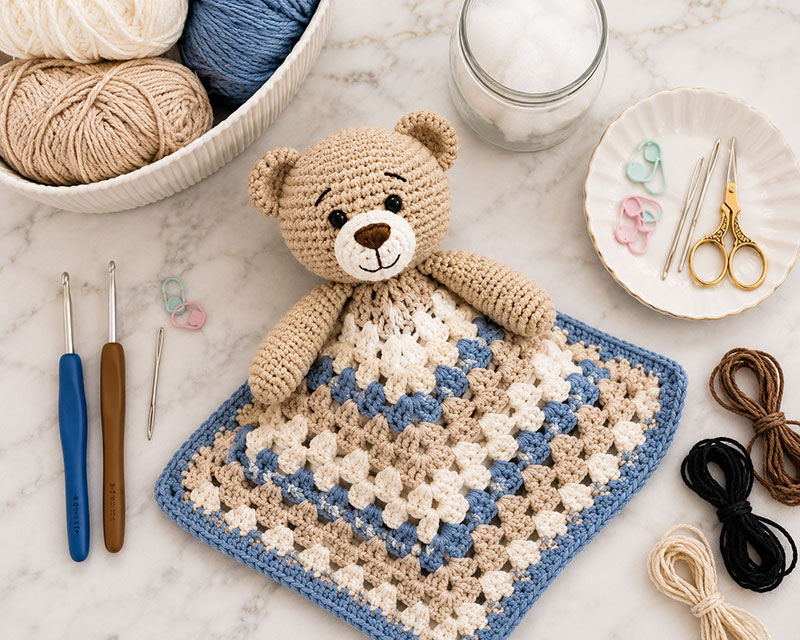
Use securely embroidered facial features. Do not use buttons, plastic safety eyes, beads, bells, ribbons, glued decorations, or other detachable pieces on a lovey intended for a baby.
Abbreviations:
- ch = chain
- sl st = slip stitch
- sc = single crochet
- hdc = half double crochet
- dc = double crochet
- inc = work 2 sc in the same stitch
- dec = single crochet 2 stitches together
- st = stitch
- sts = stitches
- RS = right side
- WS = wrong side
Pattern notes:
- The beginning ch 3 counts as the first dc in each granny-square round.
- The beginning ch 1 in the border rounds does not count as a stitch.
- Do not chain between the 3-dc side clusters. The term side space refers to the natural gap between two neighboring clusters.
- Do not turn the blanket between rounds. The side facing you while the granny-square rounds are worked is the RS. The opposite side is the WS and should face down during final assembly.
- The head, ears, muzzle, and arms are worked in continuous rounds unless instructed otherwise.
- Move the stitch marker to the first stitch of each new continuous round.
- Keep the visible round-start jog toward the back of the bear pieces.
- Secure every magic ring before stuffing or assembly. After completing Round 2 of the head, each ear, and each arm, pull the starting tail firmly to close the center. Thread the starting tail onto the yarn needle, pass it beneath several stitches on the inside of the piece, reverse direction through a different group of stitches, and pull firmly again. Do not rely only on the tightened magic ring to keep the center closed. Leave the secured tail inside stuffed pieces; for the unstuffed ears, weave the tail completely into the WS before trimming it.
Optional blanket color changes: Change colors only at the end of a completed round. Work the final slip-stitch join with the new color, fasten off the previous color, and weave in the ends securely before assembly.
For more nursery crochet projects, visit crochet animal lovey patterns and easy baby lovey crochet patterns.
A safari-style handmade gift set can also include this crochet lion lovey pattern with a soft blanket base, rounded ears, and textured mane.
A woodland-style baby gift set can include my crochet raccoon pattern as a seated forest animal project with a mask face, striped tail, and handmade nursery shelf appeal.
For a bear lovey of a different sort that also has nursery gift appeal, try my crochet koala lovey pattern to add an Australian animal option to teddy bear, woodland, and baby shower crochet gift sets.
For a flatter, more flexible teddy bear design without a square blanket base that is just as lovable, my bear snuggler crochet pattern creates a soft bear-shaped project with a flat body and crocheted teddy bear features.
Teddy Bear Lovey Crochet Pattern Blanket Base
Make the blanket before beginning the bear pieces. The finished blanket measurement determines the proportions of the completed lovey and provides the center point needed for assembly.
Round 1: With the 4.5 mm hook, ch 4. Join with sl st to the first ch to form a ring. Ch 3 and work 2 dc into the ring. Ch 2. Work 3 dc into the ring and ch 2 three more times. Join with sl st to the top of the beginning ch 3.
Count: 4 groups of 3 dc and 4 ch-2 corner spaces.
Checkpoint: The center should resemble a small square with four open corners.
Round 2: Sl st across the next 2 dc and into the first corner space. Ch 3, work 2 dc, ch 2, and 3 dc in the same corner space. In each of the remaining three corner spaces, work 3 dc, ch 2, and 3 dc. Join with sl st to the top of the beginning ch 3.
Count: 8 groups of 3 dc, with 2 clusters on each side.
Round 3: Sl st across the next 2 dc and into the first corner space. Ch 3, work 2 dc, ch 2, and 3 dc in the same corner space. Work 3 dc into the natural gap between the next two clusters. In the next corner space, work 3 dc, ch 2, and 3 dc. Continue around, working 3 dc into each natural side gap and 3 dc, ch 2, and 3 dc into each corner space. Join with sl st to the top of the beginning ch 3.
Count: 12 groups of 3 dc, with 3 clusters on each side.
Round 4 and later rounds: Sl st across the next 2 dc and into the first corner space. Ch 3, work 2 dc, ch 2, and 3 dc in the same corner space. Work 3 dc into every natural gap between side clusters. In each corner space, work 3 dc, ch 2, and 3 dc. Join with sl st to the top of the beginning ch 3.
Each completed round adds one 3-dc cluster to each side. Round 4 has 4 clusters per side and 16 clusters total. Round 5 has 5 clusters per side and 20 clusters total. In general, Round n has n clusters per side and 4 × n clusters around the square.
Continue until the unbordered blanket measures approximately 14 inches across from one outside edge to the opposite outside edge. Most crocheters using the stated gauge will need approximately 12 or 13 total granny-square rounds, but the 14-inch measurement controls when to stop.
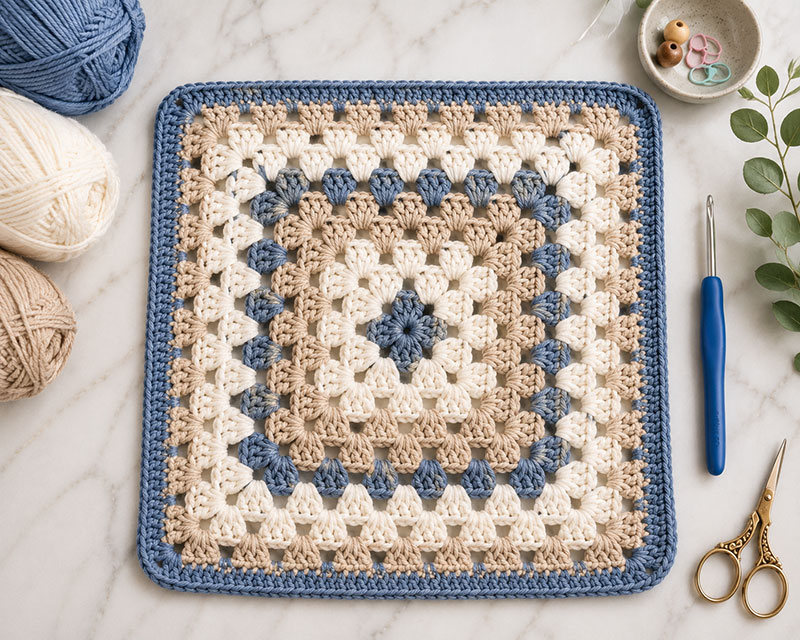
Blanket checkpoint: Lay the square on a flat surface without stretching it. Count the clusters on all four sides. Each side must contain the same number. Fold the square vertically, horizontally, and diagonally. The corresponding corners and edges should align without twisting.
If the square begins rippling before the border is added, recount the clusters and confirm that no extra cluster was placed in a side gap. If all counts are correct, the tension may be too loose. If the corners pull inward, make the ch-2 corner spaces more loosely.
Border Round 1: Sl st across the next 2 dc and into the first corner space. Ch 1; this chain does not count as a stitch. Work 3 sc in the same corner space. Work 1 sc in every dc and 1 sc in every natural gap between side clusters. Work 3 sc in each remaining corner space. Join with sl st to the first sc.
Border Round 1 count: If the blanket contains n granny-square rounds, Border Round 1 contains 16 × n + 8 sc. A 12-round blanket has 200 sc. A 13-round blanket has 216 sc.
Border Round 2: Ch 1; this chain does not count as a stitch. Work 1 hdc in each sc around. At each corner, work 3 hdc total in the center stitch of the previous round’s 3-sc corner. Do not work an additional hdc in that center stitch. Join with sl st to the first hdc.
Border Round 2 count: The second border contains 8 more stitches than Border Round 1. A 12-round blanket has 208 hdc. A 13-round blanket has 224 hdc.
Fasten off and weave the yarn tail back and forth through several stitches on the WS of the blanket before trimming it.
Measure the bordered blanket. It should finish approximately 15 to 16½ inches square. If the border ripples, verify that only 3 hdc total were worked into each corner-center stitch and that no extra stitches were added along the sides. If the border pulls inward despite correct counts, redo it with slightly looser tension or a hook one size larger.
Lightly dampen the blanket and pin it into a square without stretching it beyond the intended finished measurement. Allow it to dry completely before attaching the bear pieces.
Teddy Bear Lovey Crochet Pattern Bear Pieces
Use the 4.0 mm hook for the bear pieces. Work in continuous rounds and move the stitch marker to the first stitch of each new round.
Bear Head: The Round 1 magic-ring end forms the top of the head, and the final six-stitch decrease closure forms the bottom that will be attached to the blanket. Keep the visible round-start jog at the back and place the facial features on the opposite side at the front.
Round 1: Work 6 sc into a magic ring. 6 sts.
Round 2: Inc in each stitch around. 12 sts.
Round 3: Sc 1, inc. Repeat around. 18 sts.
Round 4: Sc 2, inc. Repeat around. 24 sts.
Round 5: Sc 3, inc. Repeat around. 30 sts.
Round 6: Sc 4, inc. Repeat around. 36 sts.
Rounds 7 through 12: Sc in each stitch around. 36 sts in each round.
Checkpoint: The open head should resemble a rounded bowl rather than a narrow cone. Measure across the widest part without flattening or stretching it. It should measure approximately 3¼ to 3¾ inches across.
Round 13: Sc 4, dec. Repeat around. 30 sts.
Round 14: Sc 3, dec. Repeat around. 24 sts.
Add fiberfill gradually. Shape the sides and top while stuffing so the head remains round. The head should hold its shape but still compress slightly when squeezed. Leave enough space to reach the inside surface while attaching the muzzle and embroidery.
Mark the face: Position the visible round-start jog toward the back. Place a temporary marker at the center front of the head between Rounds 9 and 10.
Attach the muzzle before closing the head: Follow the muzzle instructions below, then center its top edge near Round 8 and its bottom edge near Round 11. Pin it in place before sewing. Sew most of the way around, add a very small amount of fiberfill, and complete the seam. Secure the sewing tail through several stitches on the inside of the head.
Embroider the eyes before closing the head: Mark the eye positions between Rounds 7 and 8, with 5 unused stitches between the two marked eye stitches. Check that both eyes are equally spaced from the muzzle.
Using black embroidery floss, make each open eye with 4 to 6 short satin stitches worked over the height of approximately one crochet round. Keep the stitches close together without pulling them tightly enough to dent the head.
Embroider the nose and mouth: Center a small triangular or softly rounded nose on the upper half of the muzzle. Work several closely packed satin stitches until the yarn underneath is covered. Bring one strand down from the center of the nose and add two short curved mouth stitches.
On the inside of the head, pass each embroidery tail beneath several crochet stitches, tie the matching tails together securely, and leave enough tail length that the knots cannot pull through the fabric. Cover the secured ends with additional fiberfill.
Add the remaining stuffing, checking that no embroidery ends, knots, or loose yarn tails remain accessible from the outside.
Round 15: Sc 2, dec. Repeat around. 18 sts.
Round 16: Sc 1, dec. Repeat around. 12 sts.
Round 17: Dec around. 6 sts.
Fasten off with a tail at least 36 inches long. Thread the tail through the front loops of the final 6 stitches and pull the opening closed. Pass the needle through the center of the closed opening and bring the tail out between Rounds 14 and 15. Reserve the full remaining tail for attaching the head around Round 15, completing the second reinforcing seam, and securely burying the end.
Ears, make 2:
Round 1: Work 6 sc into a magic ring. 6 sts.
Round 2: Inc in each stitch around. 12 sts.
Round 3: Sc in each stitch around. 12 sts.
Fasten off, leaving a sewing tail approximately 15 inches long. Do not stuff the ears.
Press each shallow cup flat so 6 stitches on the front align with 6 stitches on the back. Keep the curved top rounded rather than sharply creasing it. Using the sewing tail, sew through all 6 paired stitch positions across the lower edge to hold the ear in a secure semicircle shape. Leave the remaining tail for attaching the ear to the head.
Ear checkpoint: Place the two ears together before attaching them. Their lower edges, height, and curved upper edges should match.
Muzzle:
Ch 5.
Round 1: Sc in the second ch from the hook. Sc in each of the next 2 ch. Work 3 sc in the final ch. Rotate the work and continue along the unused loops on the opposite side of the foundation chain. Sc in each of the next 2 ch. Work 2 sc in the final unused loop. 10 sts.
Round 2: Work 2 sc in the first stitch. Sc in each of the next 2 stitches. Work 2 sc in each of the next 3 stitches around the first rounded end. Sc in each of the next 2 stitches. Work 2 sc in each of the final 2 stitches around the second rounded end. 16 sts.
Round 3: Sc in each stitch around. 16 sts.
Fasten off, leaving a sewing tail approximately 18 inches long.
Muzzle checkpoint: Lay the muzzle flat with the foundation chain running horizontally. The two rounded ends should match, and the muzzle should not lean or twist toward either side.
Before attaching the muzzle, hold it against the center front of the head. It should fit approximately between Head Rounds 8 and 11 without covering or crowding the marked eye positions. If it extends into the eye area or looks disproportionately small, check the yarn weight, hook size, and tension before assembly.
Arms, make 2:
Round 1: Work 6 sc into a magic ring. 6 sts.
Round 2: Sc in each of the next 2 stitches, inc in the next stitch. Repeat once more. 8 sts.
Round 3 and later rounds: Sc in each stitch around. 8 sts in each round.
Continue repeating this 8-stitch round until the arm measures approximately 2½ to 3 inches from the center of the magic-ring tip to the open upper edge. Record the total number of rounds used for the first arm and work the second arm for exactly the same number of rounds.
Arm measurement checkpoint: Measure the arm before stuffing and without stretching it. If the stitches are loose enough for fiberfill to show, do not increase the hook size merely to reach the stated length. Continue adding 8-stitch rounds until the arm reaches the measurement while maintaining dense fabric.
Stuff only the lower third to half of the arm. Leave the upper portion unstuffed so it can lie flat against the blanket.
Flatten the opening so 4 stitches align with the remaining 4 stitches. Cut the yarn, leaving a sewing tail approximately 24 inches long, and fasten off. Thread the tail onto the yarn needle and whip stitch through the 4 pairs of aligned stitches to close the opening evenly. Do not cut the remaining tail; use it to attach the arm to the blanket and add the lower tack stitches.
Arm checkpoint: Place the two arms together. Their total round counts, lengths, widths, stuffing levels, and closed upper edges should match before assembly.
Teddy Bear Lovey Crochet Pattern Assembly
Do not attach any piece permanently until the blanket, head, ears, and arms have been pinned and checked from the front, back, and both sides.
Place the blanket RS up. Choose one blanket edge to serve as the top and mark it. Fold the blanket vertically and horizontally to locate the exact center point. Mark the center with a stitch marker.
Attach the ears to the head: Pin one ear on each side of the upper head curve. Position the lower edge of each ear across approximately Rounds 5 through 7, with about 7 stitches between the inner ear edges across the top of the head.
Check the head from the front and back. The ears should match in height and angle. Sew through the closed lower edge of each ear and into the head with small stitches. Pass the sewing tail through the stuffed head, bring it out at a different point, and trim it close so the end retracts into the head.
Position the head: Place the bottom of the head, with the final six-stitch decrease closure centered directly over the marked blanket center. Keep the Round 1 magic-ring end at the top of the head. Face the bear toward the blanket edge previously marked as the top. Pin the head through several points around Round 15 so it cannot rotate while being sewn.
Attach the head: Using the long head tail, sew around the 18-stitch circle formed by Round 15. Catch one head stitch at a time and several strands from the central blanket clusters underneath it. Do not rely on a single chain loop or sew only through the final 6-stitch closure.
Complete one full seam around Round 15. Check that the blanket remains flat and that the head is upright. Complete a second reinforcing seam around the same attachment circle, placing the second stitches between the first ones where possible. Do not pull the seam tightly enough to pucker the blanket or flatten the bottom of the head.
Secure the remaining head tail beneath the attached head where it cannot be reached. Pass the tail through several nearby blanket stitches, reverse direction once, then bring the needle through the stuffed head and out at a different point. Pull gently and trim the yarn close so the cut end retracts inside the head.
Head attachment checkpoint: Lift the blanket gently from each of its four corners. The head should remain upright without rocking around the final closed opening. Lay the blanket flat again and confirm that the center has not gathered.
Attach the arms: Pin the closed upper edge of each arm to the blanket immediately below and slightly to the side of the head. Leave approximately one blanket stitch of space between each arm and the head seam.
Measure from the head seam to the top of each arm so both are positioned at the same height. Angle the arms slightly outward. Sew the closed 4-pair edge of each arm securely to solid blanket stitches.
Add two small tack stitches through the unstuffed upper portion of each arm and into the blanket approximately ½ inch below the main arm seam. These stitches should prevent rotation without pulling the arm tightly against the blanket.
After attaching each arm, secure the sewing tail on the WS of the blanket. Weave it through several nearby blanket stitches, reverse direction at least once, and trim only after confirming that the arm seam and lower tack stitches do not loosen or rotate.
Final orientation checkpoint: Lay the lovey flat with the marked blanket edge at the top. The face should point toward that edge. The ears should match in height, the arms should match in angle, and the head should sit directly over the folded center lines.
Teddy Bear Lovey Crochet Pattern Troubleshooting
If the blanket ripples before the border: Confirm that every side contains the same number of clusters and that no extra cluster was worked into a side gap. If the counts are correct, loosened tension may be causing the sides to flare.
If the border ripples: Confirm that Border Round 1 contains only 1 sc in each dc, 1 sc in each natural side gap, and 3 sc in each corner. In Border Round 2, each center-corner stitch should contain 3 hdc total rather than 4.
If the corners pull inward: Make the ch-2 granny-square corners more loosely. If only the border pulls inward, use looser hdc tension or a hook one size larger for Border Round 2.
If the head looks pointed: Confirm that all six increase points were worked in every increase round. Add stuffing gradually around the sides instead of packing most of it into the top. Gently rolling the stuffed head may soften a minor point, but it will not correct a missing increase.
If the muzzle leans sideways: Check that Round 2 contains three increases around each rounded end. Align the horizontal foundation chain with the center-front marker before sewing.
If the ears fold forward: Confirm that the lower edges were flattened and secured evenly. Add several small stitches through the closed lower edge and deeper into the head.
If the head rocks or leans: Confirm that it was attached around the 18-stitch circle of Round 15 rather than only through the final 6-stitch closure. Reinforce any loose section of the circular seam without tightening the blanket center.
If the arms rotate: Confirm that the upper opening was closed evenly into four paired stitches and add the two lower tack stitches through the unstuffed portion.
Holding the blanket by each corner is a useful balance check, but it does not replace a secure-attachment inspection. Test every sewn and embroidered component separately before gifting.
Final Inspection Checklist
- ✓ The bordered blanket measures approximately 15 to 16½ inches square.
- ✓ All four blanket sides contain matching cluster and border counts.
- ✓ The blanket folds evenly vertically, horizontally, and diagonally.
- ✓ The head is attached around Round 15 rather than only through the final closure.
- ✓ The blanket center remains flat without gathering.
- ✓ The bear head sits centered without leaning or rocking.
- ✓ The two arms match in length, height, angle, and stuffing level.
- ✓ The two ears match in height, angle, and shape.
- ✓ The muzzle is centered and fully secured.
- ✓ The embroidered eyes, nose, and mouth cannot be pulled loose.
- ✓ All yarn and embroidery tails are secured and inaccessible.
- ✓ No fiberfill shows through the stitches or seams.
Baby Safety Notes for a Teddy Bear Lovey Crochet Pattern
This teddy bear lovey crochet pattern should be treated as a supervised comfort item, photo prop, nursery keepsake, or baby shower gift. Do not place a lovey, blanket, stuffed item, or other loose object in an infant’s crib, bassinet, play yard, or other sleep space.
The U.S. Consumer Product Safety Commission recommends placing babies to sleep on their backs on a firm, flat sleep surface and keeping the sleep space bare except for a properly fitted sheet. For current guidance, visit the CPSC Safe Sleep recommendations.
Before gifting the lovey, pull firmly but carefully on each ear, the muzzle, both arms, the head seam, and every embroidered facial feature. Reinforce any component that moves, stretches away from the fabric, exposes a yarn tail, or reveals fiberfill.
Before gifting, wash and dry the completed lovey according to the most restrictive care instructions for the yarn and fiberfill used. Reshape the blanket while damp if needed and allow the entire project to dry completely.
After washing, repeat the final inspection. Tug carefully on the head seam, ears, muzzle, arms, and embroidered facial features, and check that no yarn tails or fiberfill have become exposed.
Inspect the lovey regularly during use and after future washing. Stop using it if stitches break, seams loosen, fiberfill becomes visible, or any embroidered feature begins to pull free.
If you are putting together a handmade nursery gift set, these baby shower gift basket ideas pair naturally with this teddy bear lovey crochet pattern as will my crochet bear blanket pattern.
My crochet bear blanket pattern with repeating teddy bear granny squares and a finished blanket layout would be a nice addition as well.
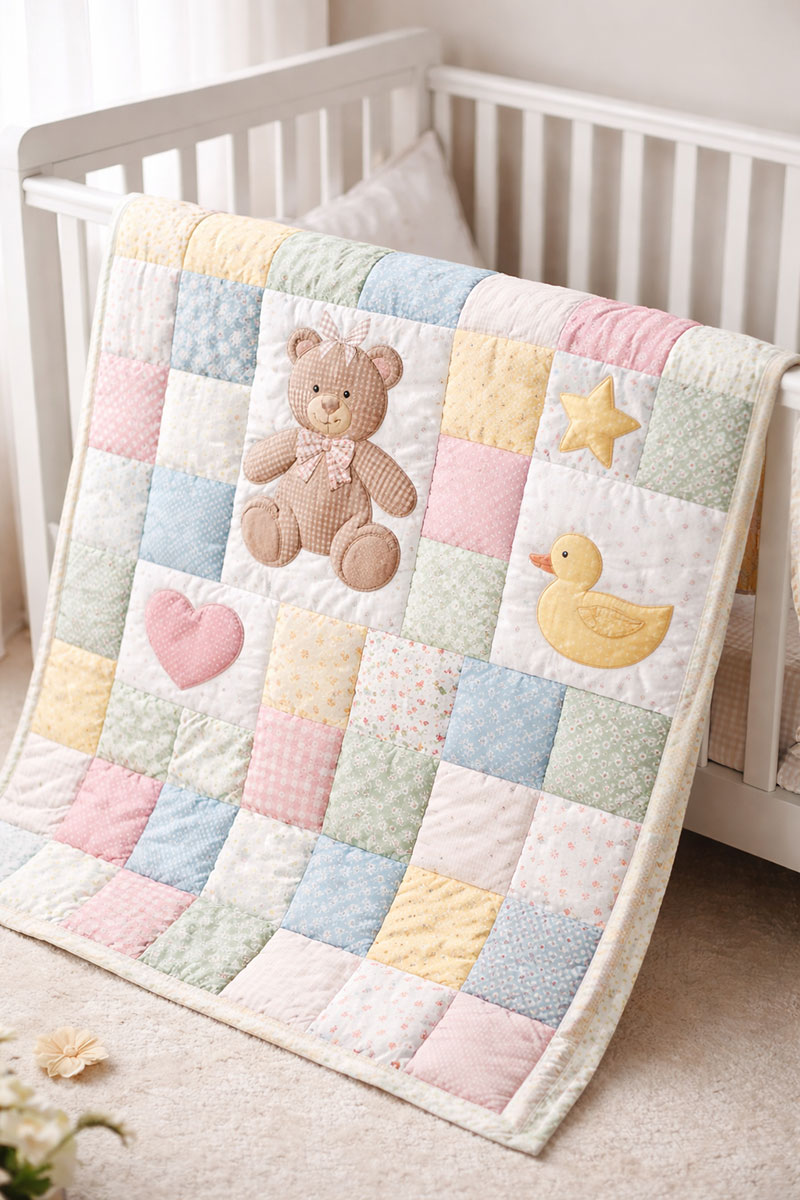
If granny squares are not your taste, browse these bear baby quilt patterns, featuring teddy bear, woodland bear, appliqué, and patchwork quilt ideas that pair with a crocheted bear lovey.
Teddy Bear Lovey Crochet Pattern FAQ
Is this teddy bear lovey crochet pattern beginner-friendly?
It is best suited to an advanced beginner. The crochet stitches are repetitive, but the project also requires continuous rounds, an oval worked around a foundation chain, stuffing, facial embroidery, accurate placement, and secure dimensional assembly.
Why does my teddy bear head lean sideways?
The head may be off center, or the circular attachment seam may be uneven. The head should be centered over the blanket’s folded center lines and sewn around all 18 stitches of Head Round 15. Attaching only through the final 6-stitch closure creates an unstable pivot point.
Can I use acrylic yarn for this teddy bear lovey crochet pattern?
Yes. Choose a soft, washable yarn that produces dense single crochet fabric for the stuffed pieces. Acrylic yarn may respond differently to damp blocking, so reshape the blanket after washing according to the yarn manufacturer’s care instructions.
Should the arms be stuffed firmly?
No. Stuff only the lower third to half of each arm. The upper portion should remain flat and flexible so it can be sewn securely to the blanket without creating a heavy lump.
Can I use safety eyes on this lovey?
No. Use securely embroidered eyes and avoid plastic safety eyes, buttons, beads, or other detachable facial pieces on a lovey intended for a baby.
What size should the finished lovey be?
The bordered blanket should measure approximately 15 to 16½ inches square. The finished bear head should measure approximately 3¼ to 3¾ inches across, and the arms should measure approximately 2½ to 3 inches long.
How many blanket rounds should I make?
Continue until the unbordered square measures approximately 14 inches across. Most crocheters using the stated yarn, hook, and gauge will need about 12 or 13 granny-square rounds, but the measurement determines when to stop.
How do I know the blanket shape is correct before assembly?
Count the clusters and border stitches on all four sides, then fold the blanket vertically, horizontally, and diagonally. Corresponding corners and edges should align without twisting, pulling, or rippling.
When should I embroider the face?
Attach the muzzle and complete all facial embroidery after Head Round 14 but before working the final three decrease rounds. This leaves access to the inside of the head so the embroidery ends can be secured and covered by the remaining fiberfill.
For nursery inspiration built around handmade pieces, visit baby nursery themes and nursery ideas.
When you click on links to various merchants on this site and make a purchase, this may result in this site earning a commission. This does not affect the price you pay.

UBGI Gold Standard 2026
Reviewed under the site's
editorial checklist.
Photos, decorating ideas, party setups and reader submissions are shared for inspiration unless a page is specifically presented as a pattern, tutorial, reference guide or step-by-step project. Follow the instructions, measurements, safety guidance and manufacturer directions provided for the particular project or product.
About Jan | Contact | Baby Nursery Ideas (Blog) | Site Map | Privacy Policy | Disclosure Policy | Disclaimer | Affiliate Disclosure | Earnings Disclosure | Facebook | Pinterest
I am a participant in the Amazon Services LLC Associates Program, an affiliate advertising program designed to provide a means for us to earn fees by linking to Amazon. As an Amazon Associate I earn from qualifying purchases.
Copyright © 2006-2026. All Rights Reserved.