Free Crochet Penguin Lovey Pattern
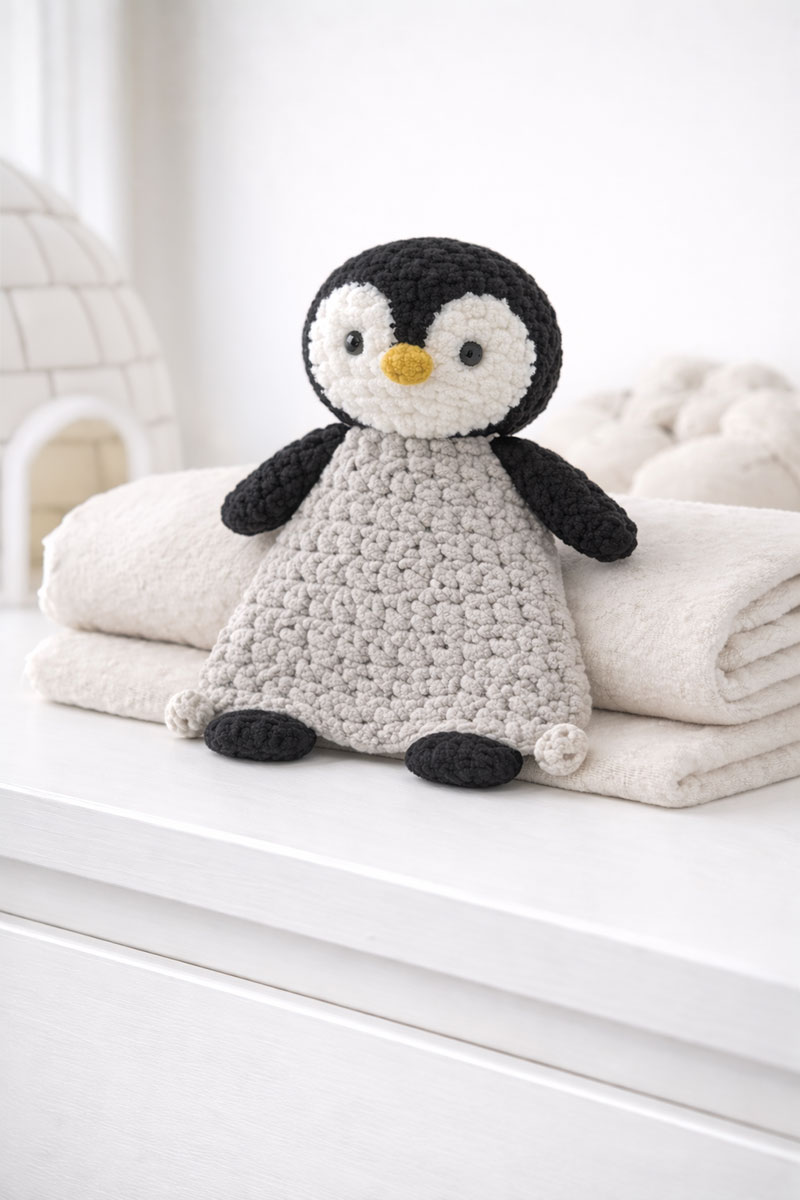
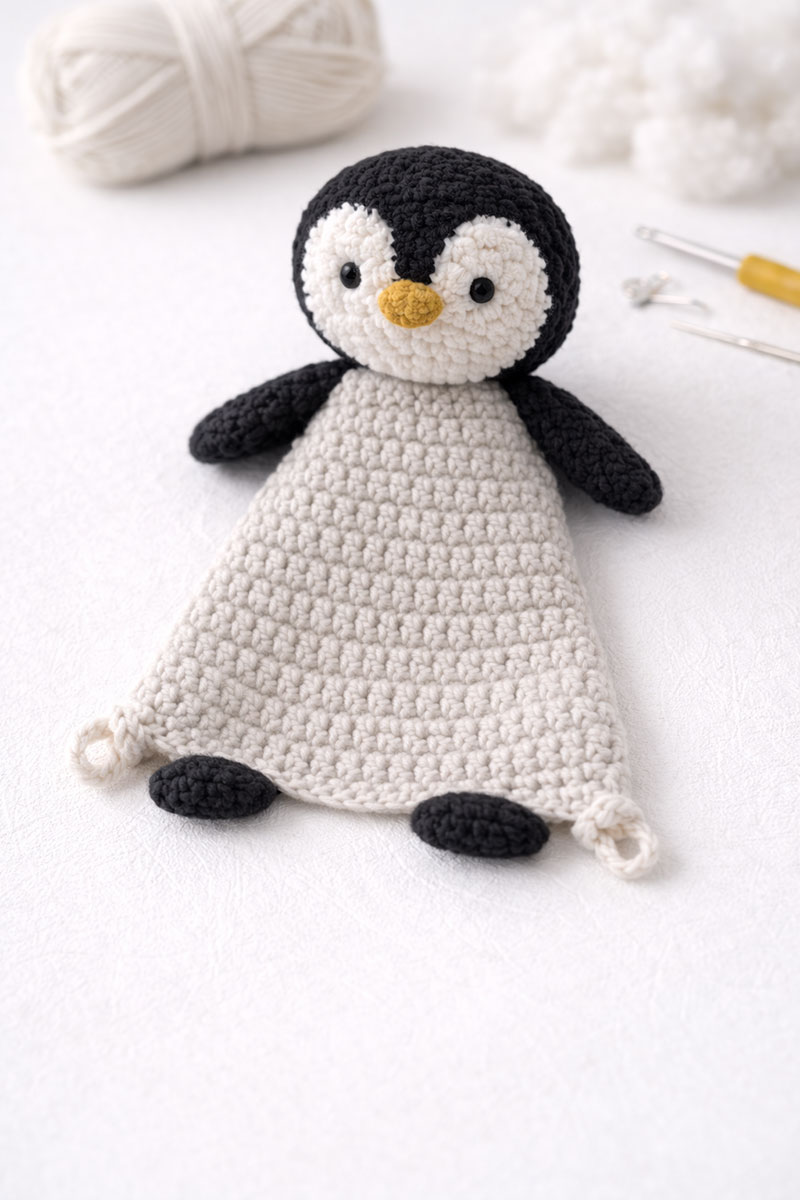
My free crochet penguin lovey pattern is a sweet choice if you want to make a soft baby snuggler with simple stitches, an adorable little face, and a handmade look that feels special right from the start.
Two small knotted loops are built into the lower corners of the flat snuggler body, giving little hands an easy place to hold during supervised awake time.
More Free Lovey Patterns and Nursery Favorites:
Crochet Elephant Lovey Pattern
Dinosaur Crochet Lovey Pattern
Soft yarn needed for this project
Why This Crochet Penguin Lovey Pattern Works
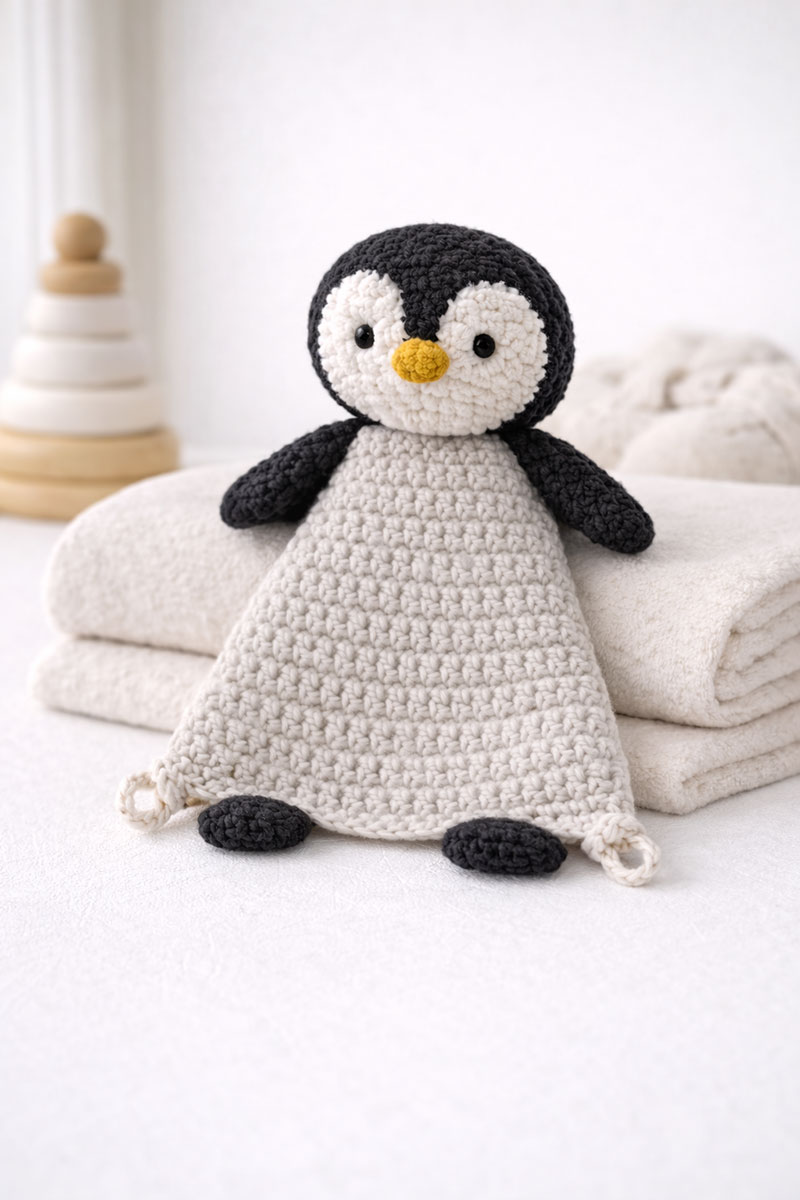
Most parents notice pretty quickly which handmade baby gifts actually get picked up and carried around. Usually it is the smaller pieces that fit one hand and do not drag extra fabric everywhere. This crochet penguin lovey pattern is built that way on purpose, with a rounded head, a flat tapered snuggler body, long wings, flat feet, and two knotted lower corner loops.
This crochet penguin lovey pattern is designed to stay simple while still creating a finished piece that looks clean and balanced.
The pattern below is designed as a reasonable handmade representation of the photographed penguin. It uses a rounded stuffed head, two white face panels, long black wings, a flat tapered snuggler body, two oval feet, and two knotted lower corner loops.
Yarn choice, gauge, stuffing, and individual tension can change the finished proportions. The pattern should not be described as an exact photographic match until a physical sample has been completed and compared with the page images.
If you would enjoy making small handmade baby gifts in a few different styles, my crochet bunny lovey pattern is a sweet classic option, while the crochet sea turtle pattern, crochet jellyfish pattern, and crochet fish pattern bring in a softer ocean theme. To compare all of the animal-style projects together, visit my crochet animal lovey patterns page.
My crochet cow pattern adds a country, farm themed lovey with a flatter blanket body and simple shaping that works especially well for beginner crochet baby gifts.
Quick Answer
A crochet penguin lovey is a small comfort toy made with a crocheted penguin head attached securely to a flat snuggler body. This version is smaller and easier to carry than a full baby blanket.
Materials for This Crochet Penguin Lovey
This pattern uses a separate flat body rather than a body worked in rounds. That construction is intended to create the wide, softly tapered shape, two lower corner loops, long wings, and flat feet seen in the styled photographs.
Skill level: Confident beginner to intermediate. You should be comfortable working continuous rounds, increasing, decreasing, crocheting around both sides of a foundation chain, sewing appliqués, and assembling several pieces.
Finished size: Approximately 12 to 13 inches tall from the top of the head to the lower body edge. The body should measure about 8 inches long, approximately 3 1/2 inches across the top, and approximately 8 inches across the bottom.
Gauge: Approximately 18 sc and 20 rows equal 4 inches in flat, turned single crochet rows with the 4.0 mm hook. Measure the swatch after it has rested and without stretching it. Exact gauge is less important for the head and small pieces, but the body gauge affects the finished proportions.
Measure all finished pieces while they are lying flat and without stretching or pulling the fabric.
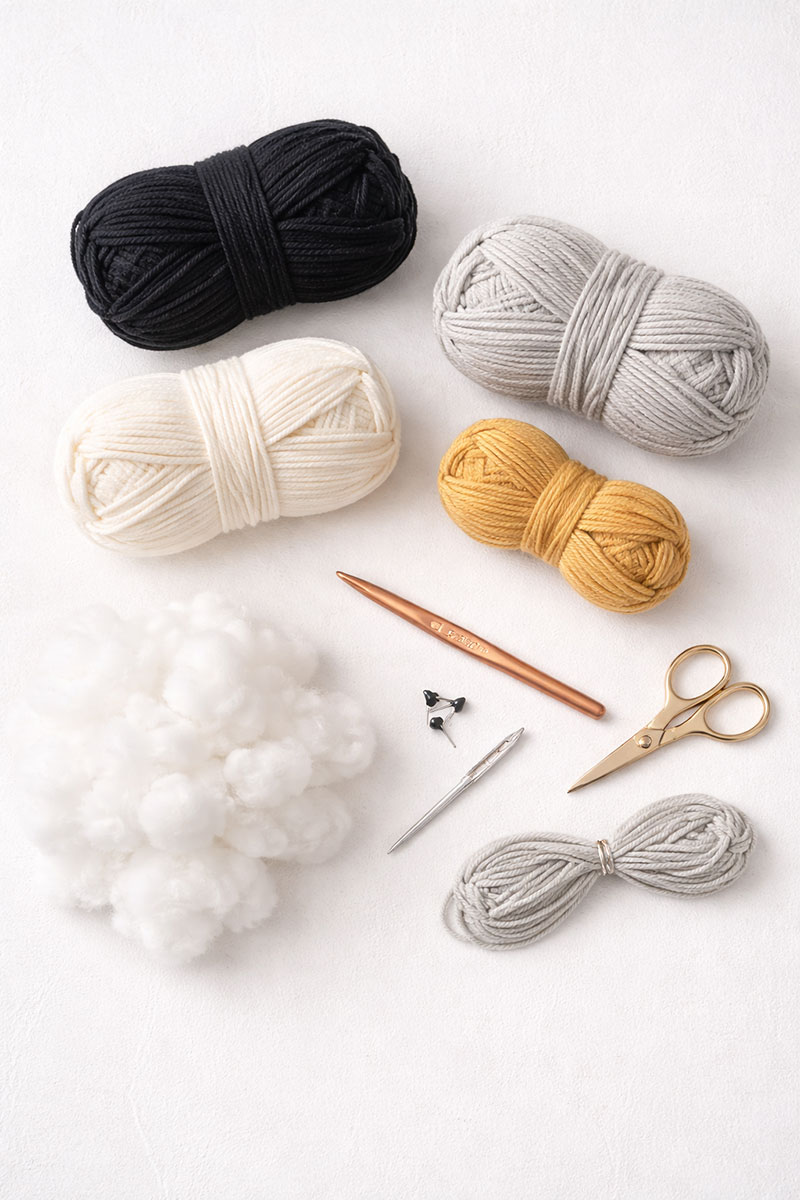
You will need:
- Approximately 120 to 150 yards black worsted weight yarn for the head, wings, and feet
- Approximately 180 to 220 yards pale gray or cream worsted weight yarn for the body
- Approximately 40 to 60 yards white worsted weight yarn for the face panels
- A small amount of gold or mustard worsted weight yarn for the beak
- 4.0 mm crochet hook
- Polyester fiberfill for the head and beak
- Yarn needle
- Stitch marker
- Scissors
- Rustproof pins for positioning the pieces before sewing
Baby-Safety Note: The styled photographs show plastic eyes, but the baby-use version of this pattern uses securely embroidered eyes. Do not add plastic safety eyes, buttons, beads, or other removable facial pieces to an item intended for a baby.
Use this lovey only during supervised awake time. Keep loveys, toys, blankets, and other soft items out of a baby's crib, bassinet, or other sleep space. See safe sleep recommendations for babies.
Soft washable baby yarn for crocheted baby gifts
Pattern Notes Before You Start
This pattern uses US crochet terminology.
Abbreviations: ch means chain, sc means single crochet, inc means 2 sc in the same stitch, dec means single crochet 2 stitches together, sl st means slip stitch, st means stitch, and sts means stitches.
The head, face panels, beak, wings, and feet are worked in continuous rounds unless the instructions say otherwise. Place a stitch marker in the first stitch and move it up after each round.
Secure every magic ring: After completing Round 2, pull the center tightly closed. Thread the starting tail through several wrong-side loops around Round 1, reverse direction, and weave through the same area again. Tie a small secure knot around one wrong-side stitch. Leave the secured head starting tail inside the stuffed piece. On each face panel, weave in only the starting magic-ring tail. Keep the long finishing tail available for sewing the panel to the head.
When positioning the finished head, place the slight spiral jog from the continuous rounds toward the back. Use the smoother side as the front of the face.
The body is worked separately in turned rows from the narrow neck edge down to the wide lower edge. Ch 1 at the beginning of a body row does not count as a stitch.
Either side of the completed body can be used as the front. Before adding the lower loops, choose the smoother side as the front and place a removable marker on that side.
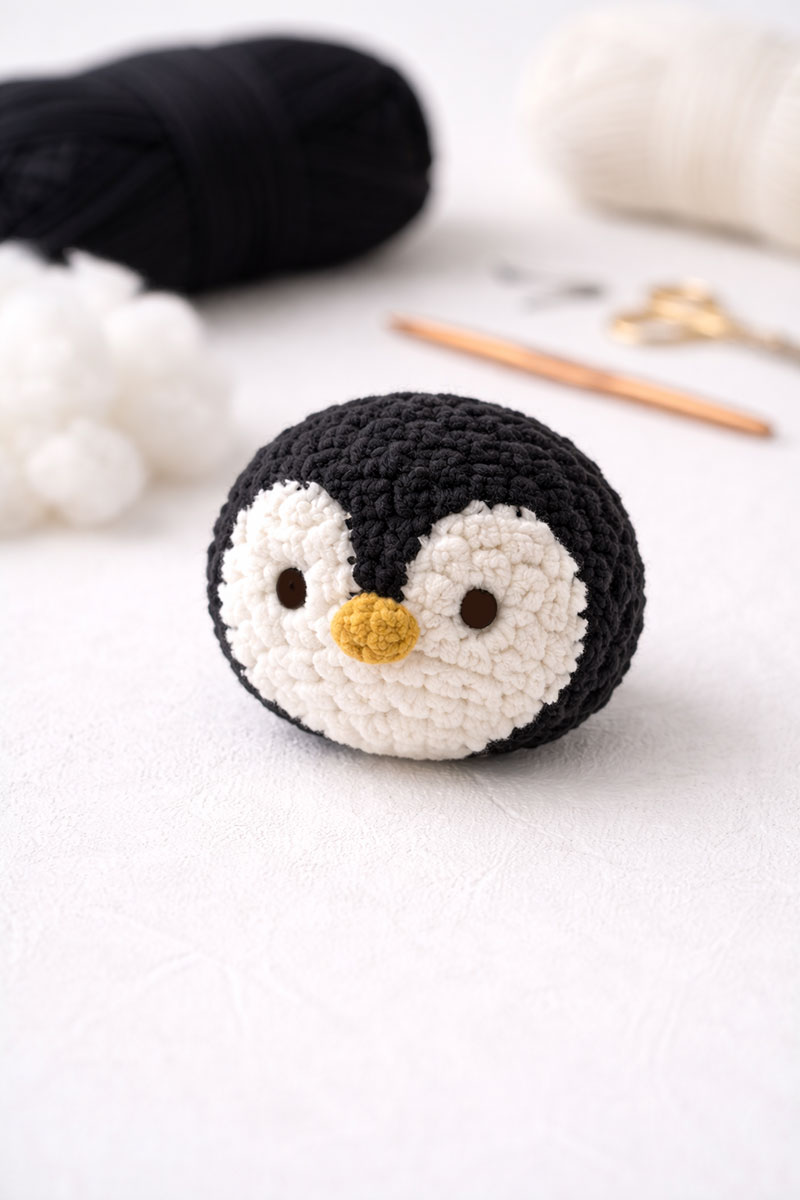
The two round face panels overlap slightly near the lower center. This produces the broad white face and black center point seen in the photographs without requiring a complicated colorwork head.
This is a newly drafted pattern based on the visual proportions of the styled photographs. The stitch counts and construction have been checked, but a physical sample has not yet been completed. Use the stated measurements as checkpoints rather than guaranteed dimensions.
Step by Step Penguin Head Pattern
With black yarn, make a magic ring.
Round 1: Work 6 sc into the ring. Pull the ring closed. 6 sts.
Round 2: Inc in each stitch around. 12 sts.
Round 3: Repeat (sc in the next stitch, inc in the next stitch) around. 18 sts.
Round 4: Repeat (sc in the next 2 stitches, inc in the next stitch) around. 24 sts.
Round 5: Repeat (sc in the next 3 stitches, inc in the next stitch) around. 30 sts.
Round 6: Repeat (sc in the next 4 stitches, inc in the next stitch) around. 36 sts.
Round 7: Repeat (sc in the next 5 stitches, inc in the next stitch) around. 42 sts.
Round 8: Repeat (sc in the next 6 stitches, inc in the next stitch) around. 48 sts.
Round 9: Repeat (sc in the next 7 stitches, inc in the next stitch) around. 54 sts.
Round 10: Repeat (sc in the next 8 stitches, inc in the next stitch) around. 60 sts.
Round 11: Repeat (sc in the next 9 stitches, inc in the next stitch) around. 66 sts.
Rounds 12 through 15: Sc in each stitch around. 66 sts.
Round 16: Repeat (sc in the next 9 stitches, dec) around. 60 sts.
Round 17: Repeat (sc in the next 8 stitches, dec) around. 54 sts.
Round 18: Repeat (sc in the next 7 stitches, dec) around. 48 sts.
Round 19: Repeat (sc in the next 6 stitches, dec) around. 42 sts.
Round 20: Repeat (sc in the next 5 stitches, dec) around. 36 sts.
Round 21: Repeat (sc in the next 4 stitches, dec) around. 30 sts.
Round 22: Repeat (sc in the next 3 stitches, dec) around. 24 sts.
Round 23: Repeat (sc in the next 2 stitches, dec) around. 18 sts.
Stuff the head evenly, shaping it into a round form as you work. It should hold its shape without becoming hard or showing gaps between the stitches.
Round 24: Repeat (sc in the next stitch, dec) around. 12 sts.
Add a small amount of stuffing if needed.
Round 25: Dec around. 6 sts.
Fasten off, leaving a long tail. Thread the tail through the front loops of the remaining six stitches and pull the opening closed. Knot securely and bury the tail through the stuffed head.
Head checkpoint: At the stated gauge, the stuffed head should measure approximately 4 1/2 to 5 inches across. It should look round when viewed from the front and should be clearly wider than the narrow upper edge of the body.
Step by Step White Face Panels
Make 2 matching round face panels with white yarn.
Round 1: Make a magic ring and work 6 sc into the ring. Pull the ring closed. 6 sts.
Round 2: Inc in each stitch around. 12 sts.
Round 3: Repeat (sc in the next stitch, inc in the next stitch) around. 18 sts.
Round 4: Repeat (sc in the next 2 stitches, inc in the next stitch) around. 24 sts.
Round 5: Repeat (sc in the next 3 stitches, inc in the next stitch) around. 30 sts.
Sl st in the next stitch and fasten off, leaving a long tail for sewing.
Repeat for the second face panel.
Flatten both panels and compare them before assembly. At the stated gauge, each panel should measure approximately 2 to 2 1/2 inches across. The two pieces must match before they are sewn to the head.
Step by Step Rounded Beak
With gold or mustard yarn, ch 5. Work around both sides of the foundation chain in continuous rounds.
Round 1: Starting in the second ch from the hook, sc in the next 3 chains. Work 3 sc in the last chain. Working back along the other side, sc in the next 2 chains and work 2 sc in the final chain. 10 sts.
Rounds 2 and 3: Sc in each stitch around. 10 sts.
Fasten off, leaving a long tail for closing and attaching the beak. Place a very small amount of fiberfill inside the beak. Flatten the open edge and use part of the yarn tail to sew it closed. Do not cut or weave in the remaining tail because it will be used to attach the beak to the face panels.
The finished beak should form a small horizontal oval. Do not overstuff it.
How to Assemble the Penguin Face
Place the head so the magic-ring beginning is at the top, the final six-stitch closing point is at the bottom, and the slight spiral jog is toward the back.
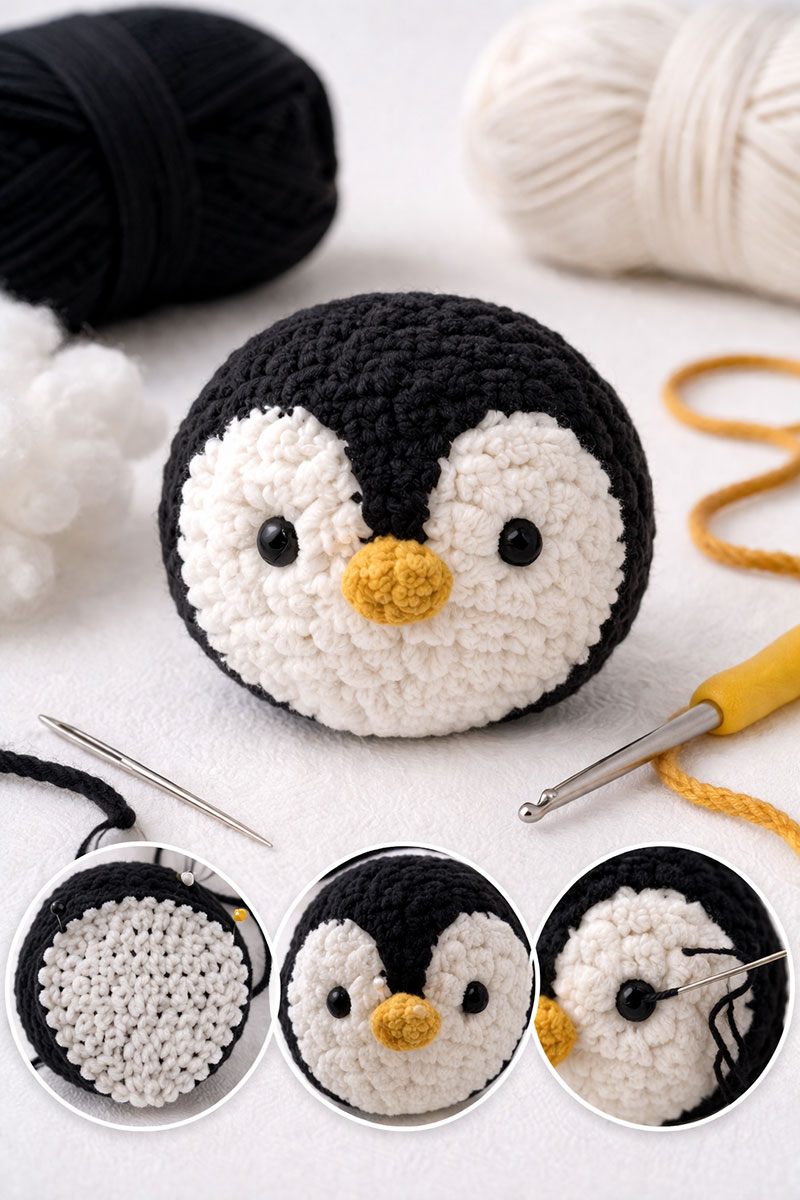
Pin one white panel on the lower left front of the head. Place its top edge near Head Round 7 or 8 and its lower edge near Head Round 18.
Pin the second panel on the lower right front at the same height. Leave approximately 2 or 3 black stitches visible between the upper inner edges. Allow the lower inner edges to overlap by approximately 1 or 2 stitches.
Gently ease each round panel over the curved head. The panels should form two broad white lobes with a narrow black point coming down between them.
Sew the left panel in place first. Sew the right panel in place second, covering the small lower overlap. Keep the outer edges smooth and do not pull the sewing stitches tightly enough to pucker the head.
Place the beak horizontally over the lower overlap between the two panels. Sew the flattened back edge securely to both panels.
Embroider the eyes one at a time. Thread the yarn needle with black yarn, leaving a starting tail approximately 5 inches long. Insert the needle at the lower inner edge of one white panel, close to the beak, and bring it out where the first eye stitch will begin. Leave the starting tail outside at the lower panel edge.
Make several short satin stitches in the same small area to form the eye. After the final stitch, pass the needle back through the stuffed head and bring it out beside the waiting starting tail at the lower edge of the panel.
Tie the starting and finishing ends together securely. Thread both ends onto the yarn needle, insert the needle beside the knot, and bring it out through the black fabric on the back of the head. Pull gently until the knot slips beneath the edge of the white panel, then trim the yarn close to the black surface. Repeat for the second eye and tug-test both embroidered eyes.
Step by Step Long Penguin Wings
Make 2 matching wings with black yarn.
Ch 12. Work around both sides of the foundation chain in continuous rounds.
Round 1: Starting in the second ch from the hook, sc in the next 10 chains. Work 3 sc in the last chain. Working back along the other side of the foundation chain, sc in the next 9 chains and work 2 sc in the final chain. 24 sts.
Round 2: Inc in the first stitch, sc in the next 9 stitches, inc in each of the next 3 stitches, sc in the next 9 stitches, and inc in each of the final 2 stitches. 30 sts.
Sl st in the next stitch and fasten off, leaving a long tail for sewing.
Do not stuff the wings. Flatten each wing and gently shape it into a long oval. Compare both wings before sewing them to the penguin.
Wing checkpoint: At the stated gauge, each wing should measure approximately 3 to 3 1/2 inches long. Compare the two wings and correct any noticeable size difference before assembly.
Step by Step Flat Penguin Feet
Make 2 matching feet with black yarn.
Ch 8. Work around both sides of the foundation chain in continuous rounds.
Round 1: Starting in the second ch from the hook, sc in the next 6 chains. Work 3 sc in the last chain. Working back along the other side of the foundation chain, sc in the next 5 chains and work 2 sc in the final chain. 16 sts.
Round 2: Inc in the first stitch, sc in the next 5 stitches, inc in each of the next 3 stitches, sc in the next 5 stitches, and inc in each of the final 2 stitches. 22 sts.
Sl st in the next stitch and fasten off, leaving a long tail for sewing.
Do not stuff the feet. Flatten each foot and compare the two pieces before assembly.
Foot checkpoint: At the stated gauge, each foot should measure approximately 2 to 2 1/2 inches long. Compare the two feet before assembly.
Step by Step Flat Snuggler Body
With pale gray or cream yarn, ch 17.
Row 1: Starting in the second ch from the hook, sc in each chain across. Ch 1 and turn. 16 sts.
Row 2: Inc in the first stitch, sc in each stitch across to the final stitch, and inc in the final stitch. Ch 1 and turn. 18 sts.
Rows 3 and 4: Sc in each stitch across. Ch 1 and turn. 18 sts.
Row 5: Inc in the first stitch, sc across to the final stitch, and inc in the final stitch. Ch 1 and turn. 20 sts.
Rows 6 and 7: Sc in each stitch across. Ch 1 and turn. 20 sts.
Row 8: Inc in the first stitch, sc across to the final stitch, and inc in the final stitch. Ch 1 and turn. 22 sts.
Rows 9 and 10: Sc in each stitch across. Ch 1 and turn. 22 sts.
Row 11: Inc in the first stitch, sc across to the final stitch, and inc in the final stitch. Ch 1 and turn. 24 sts.
Rows 12 and 13: Sc in each stitch across. Ch 1 and turn. 24 sts.
Row 14: Inc in the first stitch, sc across to the final stitch, and inc in the final stitch. Ch 1 and turn. 26 sts.
Rows 15 and 16: Sc in each stitch across. Ch 1 and turn. 26 sts.
Row 17: Inc in the first stitch, sc across to the final stitch, and inc in the final stitch. Ch 1 and turn. 28 sts.
Rows 18 and 19: Sc in each stitch across. Ch 1 and turn. 28 sts.
Row 20: Inc in the first stitch, sc across to the final stitch, and inc in the final stitch. Ch 1 and turn. 30 sts.
Rows 21 and 22: Sc in each stitch across. Ch 1 and turn. 30 sts.
Row 23: Inc in the first stitch, sc across to the final stitch, and inc in the final stitch. Ch 1 and turn. 32 sts.
Rows 24 and 25: Sc in each stitch across. Ch 1 and turn. 32 sts.
Row 26: Inc in the first stitch, sc across to the final stitch, and inc in the final stitch. Ch 1 and turn. 34 sts.
Rows 27 and 28: Sc in each stitch across. Ch 1 and turn. 34 sts.
Row 29: Inc in the first stitch, sc across to the final stitch, and inc in the final stitch. Ch 1 and turn. 36 sts.
Rows 30 through 39: Sc in each stitch across. Ch 1 and turn. 36 sts.
Row 40: Sc in each stitch across. 36 sts.
Fasten off, leaving a tail long enough to weave in securely.
Lay the body flat and choose the smoother-looking side as the front or right side. Place a removable marker on the front before adding the loops or attaching any other pieces.
Body checkpoint: Without stretching, the body should measure approximately 8 inches long, 3 1/2 inches across the top, and 8 inches across the bottom. The sides should widen gradually without rippling or sharply stepped edges.
Make the Two Lower Corner Loops
With the right side of the body facing you, leave an 8 to 10-inch starting tail and join the body-color yarn in one lower corner stitch.
Ch 12 and sl st back into the same corner stitch to form a closed chain loop. Fasten off, leaving a second 8 to 10-inch tail.
Repeat at the opposite lower corner, again leaving long starting and ending tails for securing the loop.
Keep each chain loop untwisted. To form the knot, fold the rounded end of the loop toward the body corner. Cross the rounded end over the base of the loop to make a small opening, then pass the entire rounded end through that opening. Pull gently to form a small overhand knot. Adjust both knots until they match and a small open loop remains beyond each knot.
Use both the beginning and ending yarn tails to stitch the base of each loop securely to the body corner. Take several small stitches through each knot so it cannot loosen or slide. Weave each tail through the body in one direction and then back in the opposite direction.
How to Assemble the Penguin Lovey
Attach the Body to the Head
Lay the body flat with the marked right side facing up and the narrow foundation-chain edge at the top. The attachment edge is the original chain edge into which Row 1 was worked, not the stitch tops between Rows 1 and 2.
Identify the 16 foundation-chain positions along this narrow edge. These 16 edge positions correspond to the 16 stitches made in Body Row 1.
Place the completed head face up over the narrow body edge. Position the body behind the lower part of the head so the center of the 16-position foundation edge lines up directly below the center of the beak.
On the back of Head Round 21, mark a group of 16 consecutive stitches. Center this group across the back of the head, directly opposite the beak. Pin the 16 foundation-chain edge positions to the 16 marked head stitches one-to-one. The lower portion of the head, Rounds 22 through 25, should overlap the top body edge when viewed from the front.
Using body-color yarn, sew through the edge of each of the 16 foundation chains and one corresponding marked stitch of Head Round 21. Make a second sewing pass in the opposite direction for additional strength. Keep the seam firm, but do not pull tightly enough to shorten the foundation edge, gather the body, or flatten the head.
Attach the Wings
Place one wing at each side of the head and body seam. Angle the wings downward so their rounded ends hang beside the upper body.
Sew the upper third of each wing securely to the side of the head and the upper side edge of the body. Leave the lower portion of each wing free so it can lie naturally against the body.
Check the penguin from the front before completing the seams. Both wings should begin at the same height and hang at matching angles.
Attach the Feet
Lay the two feet horizontally along the lower front edge of the body.
Center the left foot approximately over Body Row 40 stitches 7 through 14. Center the right foot approximately over stitches 23 through 30.
Allow the lower half of each foot to extend slightly below the body edge. Sew the upper long edge of each foot securely to the front of the body. Keep the feet flat and do not stuff them.
Final Finishing
Hold the lovey by the top of the head and allow the body to hang freely. Confirm that the face is centered, the body hangs straight, the wings match, the feet sit evenly, and the two lower knots are the same size.
Weave every remaining yarn end through several stitches and in more than one direction. Do not simply cut the ends close to the surface.
Tug-test the embroidered eyes, face panels, beak, head seam, wings, feet, lower knots, and all other attached pieces.
Gently reshape the head and flatten the body, wings, and feet by hand. No stuffing is added to the body, wings, or feet.
Remove every pin, removable stitch marker, and temporary placement marker. Check the front, back, seams, and folds carefully to confirm that nothing remains inside or attached to the lovey.
Before gifting or using the lovey, wash it according to the care instructions on the yarn label and allow it to dry completely. Reshape it while damp if needed. After washing and drying, repeat the visual inspection and tug-test every embroidered and attached piece.
Why This Penguin Lovey Makes a Good Baby Gift
Some handmade gifts are mainly for display. This one has a better chance of being used because it is small enough to carry and simple enough not to feel bulky. Parents often reach for the items that fit into one hand and do not need constant rearranging, and this style fits that pattern very well.
This handmade idea also fits nicely with many popular baby nursery themes.
For decor in an ocean or beach themed direction, pairing this with the crochet octopus pattern or crochet fish pattern creates a coordinated handmade set that works especially well in ocean and under the sea themed nursery decor.
If you are building a fuller handmade gift set, a smart next stop is Baby Quilts.
easy care yarn for baby gift patterns
Crochet Penguin Lovey Pattern FAQ
Is this crochet penguin lovey pattern beginner friendly?
It is best for a confident beginner who already knows how to work single crochet in continuous rounds, increase, decrease, crochet around both sides of a foundation chain, embroider simple features, and sew several pieces together.
Will this pattern make a penguin similar to the one shown in the hero image?
Yes. The construction includes the main visual features shown in the photographs: a rounded black head, two white face panels, a small mustard beak, long black wings, a wide flat body, two oval feet, and two lower corner loops. The finished proportions may vary with yarn, gauge, stuffing, and individual tension, so it is a reasonable representation rather than an exact photographic match.
Is this a blanket lovey?
It is a compact flat-panel lovey rather than a full baby blanket. The separate tapered body is sewn securely to the completed penguin head.
Why use worsted yarn for this version?
Worsted yarn keeps the stitches visible and supports the stated gauge, piece measurements, and flat body construction. Plush or chenille yarn would produce different dimensions and a much thicker drape.
Can I change the body color?
Yes. White or pale gray gives the closest match to the page images, but other light neutrals can also work.
When you click on links to various merchants on this site and make a purchase, this may result in this site earning a commission. This does not affect the price you pay.

UBGI Gold Standard 2026
Reviewed under the site's
editorial checklist.
Photos, decorating ideas, party setups and reader submissions are shared for inspiration unless a page is specifically presented as a pattern, tutorial, reference guide or step-by-step project. Follow the instructions, measurements, safety guidance and manufacturer directions provided for the particular project or product.
About Jan | Contact | Baby Nursery Ideas (Blog) | Site Map | Privacy Policy | Disclosure Policy | Disclaimer | Affiliate Disclosure | Earnings Disclosure | Facebook | Pinterest
I am a participant in the Amazon Services LLC Associates Program, an affiliate advertising program designed to provide a means for us to earn fees by linking to Amazon. As an Amazon Associate I earn from qualifying purchases.
Copyright © 2006-2026. All Rights Reserved.