Drop-Side Cribs: The Ban, Safety Risks, Parts and Alternatives
By Jan Bay
A drop-side crib has a movable side rail that lowers or slides to make it easier to reach the mattress. These cribs were removed from the United States market after rail and hardware failures created dangerous gaps. This guide explains how to recognize one, why the design was banned, what the rule means for old cribs and why replacement parts should not be used to restore an unidentified drop-side crib.
Check an Older Crib Before Using It
Check the Brand and Model for a Recall
I have found that old crib questions rarely arrive with everything needed to answer them. The name may be missing, the screws may be loose in a plastic bag, and the only description may be “Jenny Lind” or “the crib my mother saved.” That is why I start with the label and recall record rather than the appearance of the hardware.
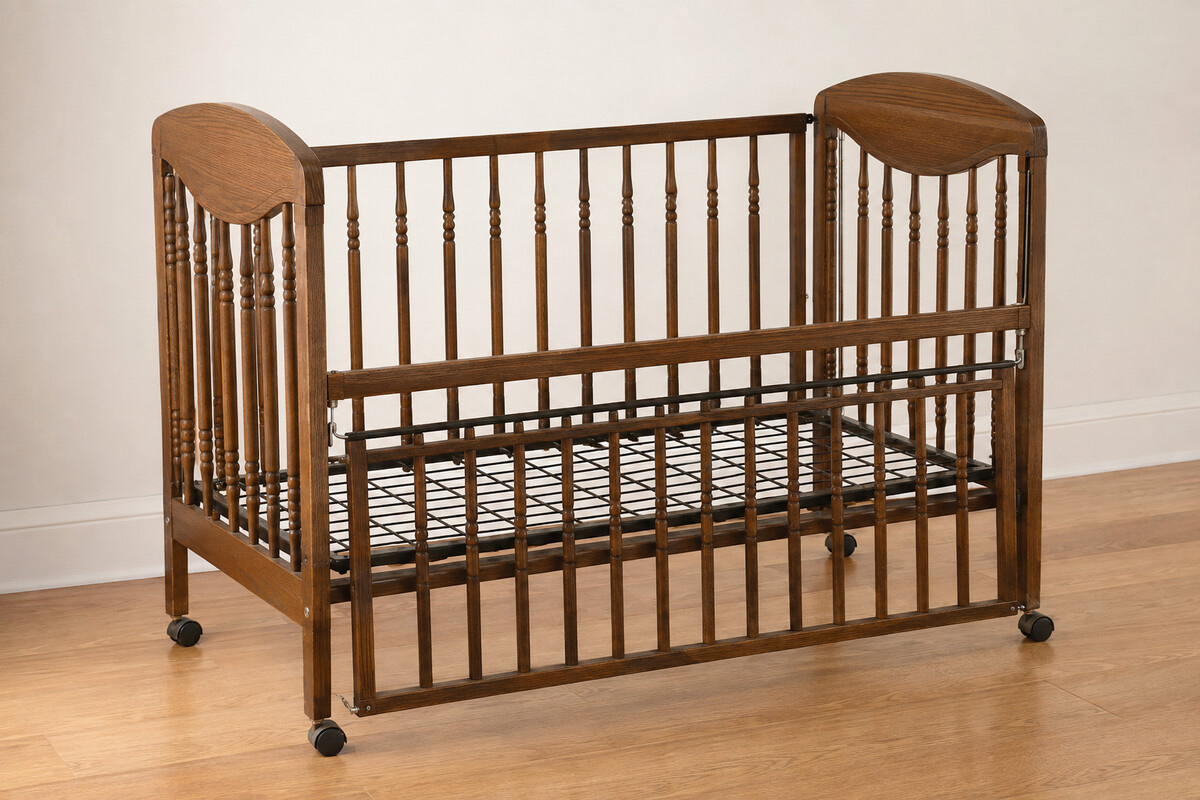
A traditional drop-side crib has a side rail that moves vertically. This image is for identification only, not repair or assembly guidance.
What Is a Drop-Side Crib?
A traditional drop-side crib has at least one side rail that moves vertically. Depending on the model, the rail may travel along plastic tracks, metal rods, guides, trigger latches or other moving hardware. Lowering the rail once gave an adult easier access to the mattress.
The movable rail is different from an adjustable mattress platform. A current fixed-side crib may allow its mattress support to be installed at different heights while all four crib sides remain stationary.
Older product descriptions may use several names for the same general design, including drop-side crib, drop-rail crib, crib with a sliding side, crib with a drop-down side or crib with a movable rail.
Why Regulators Moved to Ban Drop-Side Cribs
The movable side relied on several connection points remaining properly aligned. Hardware could loosen, wear, break or be installed incorrectly after the crib was assembled, moved, stored or taken apart. When a rail partially detached, a dangerous opening could form between the side of the crib and the mattress.
A baby could become trapped in that opening or fall from the crib. The U.S. Consumer Product Safety Commission associated drop-side failures with numerous incidents, injuries and fatalities before adopting stronger federal crib requirements.
The concern was not simply that owners failed to maintain individual cribs. Regulators determined that traditional drop-side hardware did not provide the structural reliability required under the stronger crib standard.
For the historical findings behind the rule, see the CPSC warning about drop-side crib failures.
Regulatory Review and Federal Action
The CPSC approved new federal crib standards in December 2010. The requirements took effect for manufacturers, importers and retailers on June 28, 2011. Traditional drop-side cribs could no longer be manufactured or sold as compliant cribs in the United States.
The stronger standard also applied to cribs provided for use in places such as child-care facilities, family child-care homes, hotels and motels under the implementation dates established for those settings.
The rule addressed the crib design category rather than banning only a short list of brands. A drop-side crib does not become compliant merely because it looks sturdy, has been stored carefully or does not appear in one particular recall notice.
Read the current CPSC guidance for full-size baby cribs for the federal requirements.
Drop-Side Crib Replacement Parts and Immobilizer Kits
Before and around the time the stronger crib rule took effect, some manufacturers and CPSC recall notices offered immobilizer kits for specific recalled models. An immobilizer prevented the movable rail from operating as a drop side. These were model-specific recall remedies—not universal hardware kits.
An old immobilizer is not automatically correct for another crib, even when the rail or brackets look similar. Do not use a homemade device, a secondhand kit of uncertain origin or generic replacement hardware to convert an unidentified drop-side crib.
Begin with the manufacturer, exact model number, manufacture date and official recall notice. If the original manufacturer is gone, the model cannot be identified or the official remedy is no longer available, do not try to make the crib usable with substitute parts.
What I have learned from sorting through crib-part questions is that a close visual match proves very little. Two brackets can look nearly identical in a photograph while differing in thickness, hole placement or the crib model they were designed to support.
The guide to baby crib parts and replacement hardware explains how to locate a crib label and research model-specific documentation. It does not authorize the repair or reuse of a drop-side crib.
For searches involving old rails, rods, brackets and immobilizers, see what to check before looking for drop-side crib replacement parts.
Crib Instructions and Manufacturer Documentation
An original manual can help identify a crib, its model number and the names of its hardware. It does not prove that the crib meets current standards or that it should be placed back into service.
Match every document to the exact manufacturer, model number and production date. Similar crib names were sometimes reused across different models and manufacturing periods.
Use the crib instructions and manuals guide for document research. Then check the exact model in the official CPSC recall database.
Used and Stored Drop-Side Cribs
Drop-side cribs still turn up in attics, storage buildings, resale listings and family hand-me-downs. A clean appearance does not show whether the rail hardware is worn, incorrectly assembled, incomplete or affected by an old recall.
A freshly polished crib can feel reassuring, especially when it carries a family story. Unfortunately, a pretty finish cannot tell us what happened to its rails, fasteners and connection points during decades of moving, storage and reassembly.
Do not sell, donate or give away a traditional drop-side crib for use as a baby’s sleep space. If someone offers you one, do not assume that replacing a few screws or securing the rail will bring it up to current crib standards.
Before considering any used crib, review what to check when buying or accepting a used baby crib and complete the crib safety checklist.
Safer Alternatives to a Drop-Side Crib
A current fixed-side crib can still make daily access easier when the mattress support is placed at the correct height for the baby’s age and development. The mattress platform is lowered as the baby becomes able to sit, pull up or stand, while the crib rails remain fixed.
Parents who are short, have limited reach or experience back pain may need more than a standard shopping recommendation. Look for a current product designed for the intended use, confirm that it meets applicable federal requirements and follow its manufacturer instructions exactly.
Do not confuse a traditional drop-side crib with a bedside sleeper, bassinet, play yard, portable crib or accessibility product. These are different product categories with different age, weight and configuration limits.
Compare safer drop-side crib alternatives for easier mattress access before choosing a new sleep product.
Changes in Crib Testing Standards
Earlier crib testing protocols permitted component adjustments between test phases. Updated federal standards, implemented alongside the ban drop-side cribs action, evaluate crib structures without adjustment once testing begins.
Modern testing protocols also include repeated stress applications and load simulations. These procedures measure structural performance over extended use rather than initial assembly condition.
These structural tests are part of the stronger federal requirements summarized in the CPSC guidance for full-size baby cribs.
Market Removal and Distribution Limits
Traditional drop-side cribs cannot be manufactured or sold as compliant baby cribs in the United States. The federal requirements also prevent covered businesses and child-care providers from continuing to supply noncompliant cribs for infant sleep.
Online listings may still appear because sellers misidentify the crib, use terms such as movable rail or sliding side, or do not understand the current rule. The existence of a listing does not show that the crib is legal to sell or safe to use.
When researching a specific crib, use its label rather than the seller’s description. Record the manufacturer, model number and manufacture date, then check the CPSC recall database.
Disposition of Recalled Drop-Side Cribs
Follow the remedy and disposal directions in the official recall notice for the exact crib. A notice may identify a manufacturer remedy, instruct owners to stop using the crib or explain how to prevent the product from returning to the secondhand market.
If no official remedy remains available, do not sell, donate or pass the crib to another family for infant sleep. Contact the manufacturer, local waste authority or recycling program for appropriate disposal requirements in your area.
Do not leave the crib where someone else could retrieve, reassemble or reuse it for infant sleep. Follow the exact recall notice, manufacturer directions and local disposal requirements. CPSC guidance recommends disassembling a noncompliant crib before discarding it.
Drop-Side Crib Questions
Can I buy a new drop-side crib in the United States?
No. Traditional drop-side cribs cannot be manufactured or sold as compliant new cribs in the United States. Products described online as having an adjustable mattress height, removable bedside panel or portable design may belong to a different product category and should not automatically be treated as traditional drop-side cribs.
Are drop-side cribs banned in the United States?
Yes. Traditional drop-side crib designs do not meet the stronger federal crib standards that took effect for manufacturers, importers and retailers in 2011. They cannot be manufactured or sold as compliant cribs in the United States.
Are all drop-side cribs recalled?
No single recall notice covers every drop-side crib ever made. Many brands and models were recalled separately. The broader federal crib standard applies to the traditional design category even when a particular model is not found in one recall announcement.
Can I make a drop-side crib safe with replacement parts?
Do not use generic parts, substituted hardware or a homemade immobilizer to restore a drop-side crib. Some historical recalls supplied official immobilizer kits for exact models, but those remedies were manufacturer- and model-specific. A kit intended for one crib should not be assumed to fit or correct another.
Can I sell or donate an old drop-side crib?
Do not sell, donate or give away a traditional drop-side crib for infant sleep. Dismantle it as directed by an applicable recall notice, manufacturer or local disposal authority so it cannot return to use as a crib.
Is a crib with an adjustable mattress height a drop-side crib?
No. In a fixed-side crib, the mattress support may have several installation heights while all four crib sides remain stationary. A traditional drop-side crib has a side rail that slides or lowers.
What should I do if I find an old drop-side crib?
Do not place a baby in it. Photograph the label, record the manufacturer, model number and manufacture date, and search the official CPSC recall database. Follow the exact recall or manufacturer directions rather than attempting a repair with similar-looking hardware.
When you click on links to various merchants on this site and make a purchase, this may result in this site earning a commission. This does not affect the price you pay.

UBGI Gold Standard 2026
Reviewed under the site's
editorial checklist.
Photos, decorating ideas, party setups and reader submissions are shared for inspiration unless a page is specifically presented as a pattern, tutorial, reference guide or step-by-step project. Follow the instructions, measurements, safety guidance and manufacturer directions provided for the particular project or product.
About Jan | Contact | Baby Nursery Ideas (Blog) | Site Map | Privacy Policy | Disclosure Policy | Disclaimer | Affiliate Disclosure | Earnings Disclosure | Facebook | Pinterest
I am a participant in the Amazon Services LLC Associates Program, an affiliate advertising program designed to provide a means for us to earn fees by linking to Amazon. As an Amazon Associate I earn from qualifying purchases.
Copyright © 2006-2026. All Rights Reserved.