Free Heart Baby Blanket Knitting Pattern
By Jan Bay
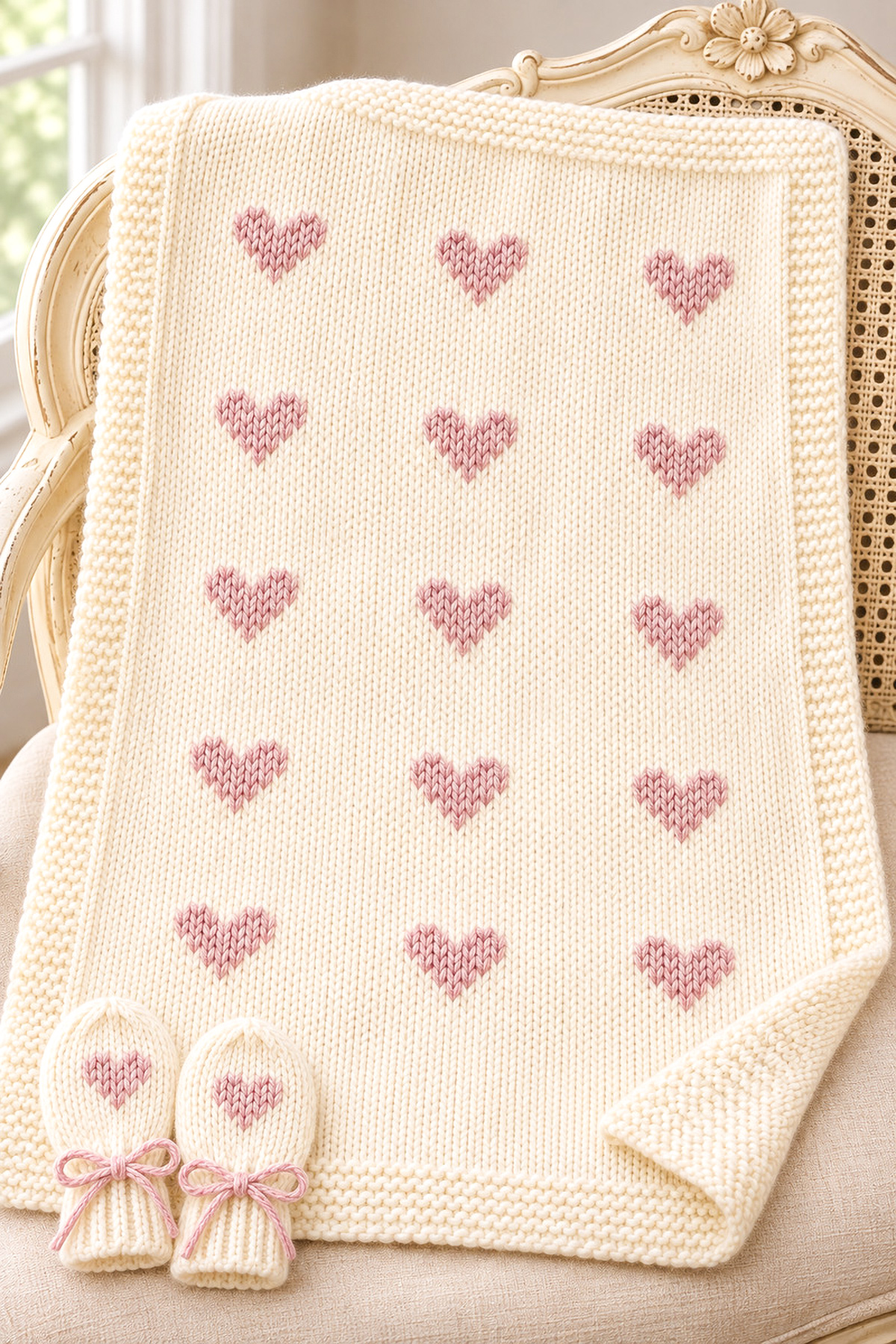
This free heart baby blanket knitting pattern features fifteen dusty-pink hearts knitted directly into a soft ivory blanket. Three hearts across and five rows down create a sweet, evenly spaced design on a smooth stockinette background. A classic garter stitch border gives the 30-by-36-inch blanket a neat finish, while matching knitted heart baby mittens make the project a lovely handmade baby shower gift set that sends lots of love to the new baby.
Explore More Free Baby Knitting Patterns and Blanket Projects
Free Heart Baby Mittens Knitting Pattern
Baby Blanket Patterns and Ideas
See Supplies for This Project Here.
On This Page — Heart Baby Blanket Knitting Pattern
About This Free Heart Baby Blanket Knitting Pattern
Those little pink hearts are the whole point of this blanket. There are fifteen of them, arranged in five rows of three, with plenty of ivory knitting between them. Nothing fancy around the hearts. Just smooth stockinette stitches that let the color stand out.
The hearts aren't sewn on afterward. They're knitted directly into the blanket with dusty-pink yarn, so they become part of the fabric itself. That gives the blanket the smooth look shown in the finished example image.
The design has three main parts:
- A soft ivory stockinette center with fifteen knitted pink hearts.
- A simple ivory garter stitch border worked along all four edges.
- Even spacing between the heart motifs, with plain ivory knitting above, below and between the five heart rows.
The matching heart mittens in the photograph are a separate knitting project. Together, the two designs make a sweet little baby shower gift set, but you can make the blanket all by itself.
I'm keeping the stitch pattern simple because there's already plenty of interest in the pink hearts. A wide lace border or another decorative stitch would only compete with them.
The blanket is worked in one flat piece from the bottom up. There are no separate squares to join, no heart appliqués to sew down and no additional edging to attach afterward.
At the planned gauge, the finished blanket measures approximately 30 inches wide and 36 inches long. The exact measurements depend on your yarn, stitch tension and the way the garter border settles after blocking.
A note about baby blankets: This knitted blanket is intended for gifting, display or supervised use outside an infant's sleep space. Loose blankets do not belong in an infant crib, bassinet or play yard during sleep. The U.S. Consumer Product Safety Commission's safe sleep information explains why infant sleep spaces are kept clear of loose bedding.
Yarn, Knitting Needles and Supplies
For this design, I'm keeping the yarn lightweight enough to show the individual knitted stitches. A smooth DK-weight yarn makes more sense than a thick, fuzzy yarn because the little hearts have to stay easy to see.
Materials
- Main color: Approximately 1,000 to 1,200 yards of DK-weight ivory yarn.
- Contrast color: Approximately 150 to 200 yards of DK-weight dusty-pink yarn.
- Knitting needles: US size 6 (4 mm) circular needles with a cable at least 32 inches long, or the needle size required to obtain gauge.
- Stitch markers: Two markers for separating the stockinette center from the garter borders, plus optional removable row markers.
- Yarn bobbins or butterflies: Three dusty-pink yarn supplies for the main heart sections, three additional small pink supplies for the upper lobes, and separate ivory supplies for the background and heart notches.
- Tapestry needle: For weaving in yarn ends.
- Scissors and measuring tape.
- Blocking supplies: A clean flat drying surface and rustproof pins if appropriate for the yarn.
The yarn amounts are planning estimates, not quantities verified from a physically knitted sample. Allowing extra ivory yarn is sensible because the blanket contains more than 45,000 stitches, including its border. The pink yarn covers a much smaller area, but the separate hearts also create ends that have to be woven in.
Which yarn works for the hearts?
Choose two yarns of the same weight and similar fiber content. The ivory and pink stitches will sit together in the same fabric, so a difference in thickness could make the hearts stand up or pull inward.
I'd choose a smooth, machine-washable yarn with clear stitch definition. The dusty pink can be a little muted. It doesn't have to be bright to show against ivory.
Skip the fuzzy yarn for this particular project. The heart shapes depend on being able to see the knitted stitches clearly.
Why circular knitting needles?
The blanket is knitted back and forth in rows, not in the round. The circular needle simply provides enough room to hold all 167 stitches without crowding them onto a straight needle.
Keep the color-change twists and loose yarn tails on the wrong side of the blanket. On wrong-side rows, that is the side facing you while you're purling the center stitches. A few small yarn butterflies are easier to untangle than several full-size balls rolling around together.
Gauge, Finished Size and Stitch Counts
Here's the measurement checkpoint before you cast on the full blanket. The pink hearts are arranged around a fixed stitch count, so it's worth knowing what your yarn does on the needles.
Knitting gauge
The target gauge is 22 stitches and 30 rows over 4 inches in blocked stockinette stitch, using US size 6 (4 mm) needles or whichever size gives you that gauge.
Work a stockinette swatch large enough to measure the center without including its edges. Measure the swatch after washing and drying it according to the yarn label.
If you have more than 22 stitches in 4 inches, try a larger needle. If you have fewer than 22 stitches, try a smaller needle. Check the row gauge as well, because that affects the length and spacing of the hearts.
Blanket stitch layout
| Component | Count |
|---|---|
| Cast-on stitches | 167 |
| Left garter border | 10 stitches |
| Stockinette center | 147 stitches |
| Right garter border | 10 stitches |
| Bottom garter border | 16 rows |
| Main blanket section | 238 rows |
| Top garter border | 16 rows |
| Total knitted rows | 270 |
There are no increases or decreases anywhere in the blanket. Every row contains 167 stitches from cast-on through the final bind-off.
Heart spacing across the blanket
Inside the 147-stitch center, the arrangement is:
20 ivory + 19 heart + 25 ivory + 19 heart + 25 ivory + 19 heart + 20 ivory = 147 stitches
Each heart occupies a 19-stitch-wide chart area. The ivory stitches inside that area are part of the heart chart, not extra spacing stitches. The centers of the three hearts remain 44 stitches apart.
The three heart centers are 44 stitches apart. At the planned gauge, that's approximately 8 inches from one heart center to the next.
Heart spacing from bottom to top
Work 36 plain center rows before the first heart band. Each band contains 19 rows of heart knitting. Between the five bands are 23 plain rows, and after the fifth band there are 15 plain rows before the top border.
The count is:
36 + (5 × 19) + (4 × 23) + 15 = 238 body rows
Add the two 16-row garter borders and the total is 270 knitted rows.
At the stated stockinette gauge, the main 238-row section measures approximately 31.7 inches tall. The garter borders have their own row gauge, so the finished blanket is expected to measure approximately 35 to 36 inches long rather than a guaranteed exact 36 inches.
Keep the 167-stitch arrangement unchanged if you're making the photographed version. Changing the width without recalculating the ivory spacing would move the hearts out of position.
Pink Heart Knitting Chart for the Baby Blanket
Each heart is 19 stitches wide and 19 rows tall. The shape begins with a single pink stitch at the bottom, grows wider through the middle and finishes with two rounded lobes separated by a small ivory notch.
There are fifteen identical hearts in the blanket. You only have to learn this one chart, then repeat it three times across each of the five heart bands.
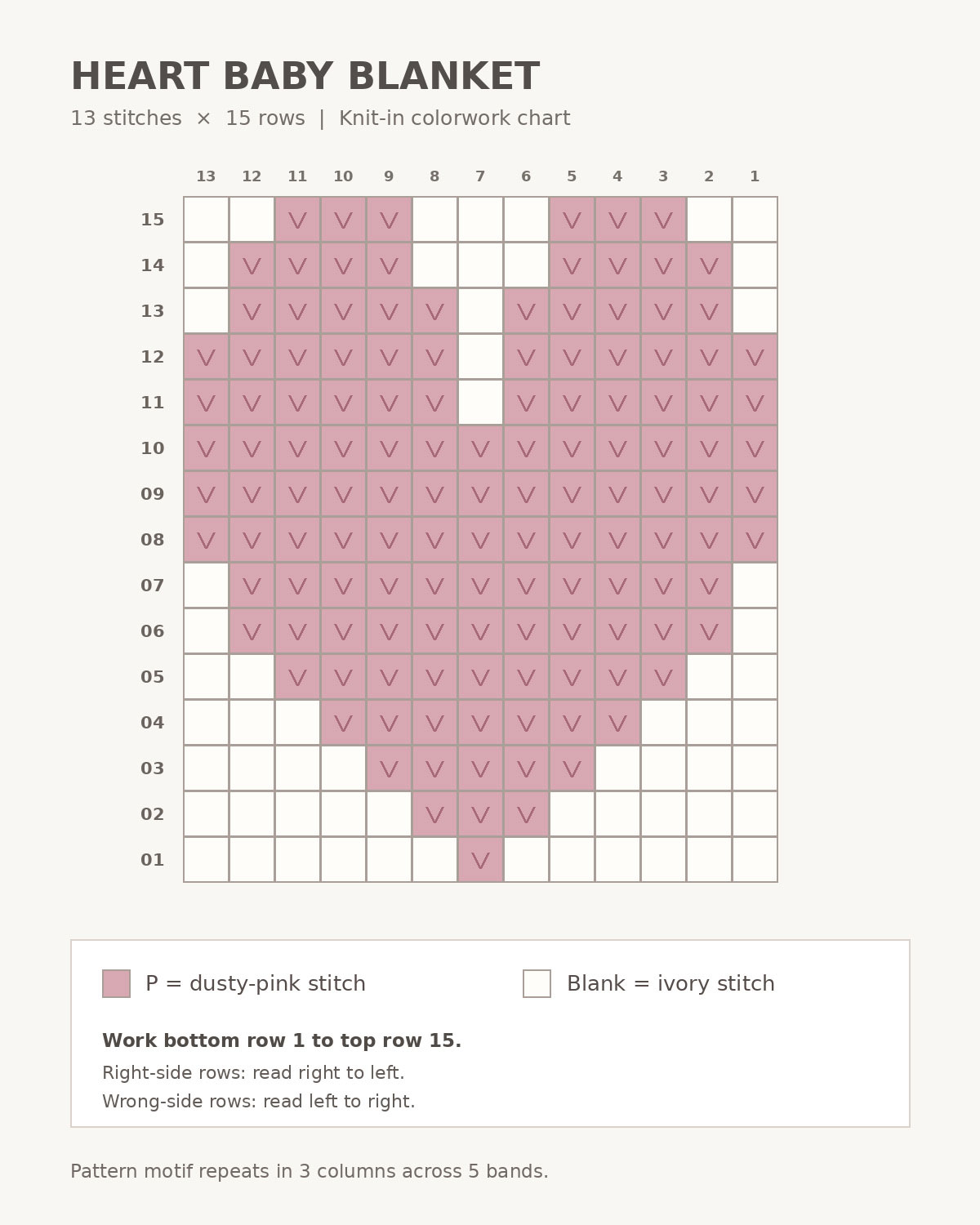
Read the chart from the bottom row, numbered 1, upward to row 19. On right-side rows, read the squares from right to left. On wrong-side rows, read from left to right.
Chart key: MC means ivory main-color yarn. CC means dusty-pink contrast-color yarn. Every motif row contains exactly 19 stitches.
Written heart chart, row by row
The following instructions give the colors for one complete heart. The sequences are symmetrical, so they read the same in either working direction. Knit the center stitches on right-side rows and purl them on wrong-side rows, changing yarn colors as indicated.
- Row 1: 9 MC, 1 CC, 9 MC.
- Row 2: 8 MC, 3 CC, 8 MC.
- Row 3: 7 MC, 5 CC, 7 MC.
- Row 4: 6 MC, 7 CC, 6 MC.
- Row 5: 5 MC, 9 CC, 5 MC.
- Row 6: 4 MC, 11 CC, 4 MC.
- Row 7: 3 MC, 13 CC, 3 MC.
- Row 8: 2 MC, 15 CC, 2 MC.
- Row 9: 1 MC, 17 CC, 1 MC.
- Row 10: 19 CC.
- Row 11: 19 CC.
- Row 12: 19 CC.
- Row 13: 19 CC.
- Row 14: 19 CC.
- Row 15: 9 CC, 1 MC, 9 CC.
- Row 16: 9 CC, 1 MC, 9 CC.
- Row 17: 1 MC, 8 CC, 1 MC, 8 CC, 1 MC.
- Row 18: 1 MC, 7 CC, 3 MC, 7 CC, 1 MC.
- Row 19: 2 MC, 6 CC, 3 MC, 6 CC, 2 MC.
Rows 15 through 19 create the ivory notch between the heart's two pink lobes. Keep that opening centered. It belongs to the heart itself, so it mustn't be shifted into the surrounding ivory stitches.
The chart contains 254 pink stitches per heart. Across all fifteen hearts, that's 3,810 pink stitches. The calculations account for all 19 stitches in each of the nineteen motif rows.
Complete Heart Baby Blanket Knitting Instructions
Now for the actual knitting. The blanket begins with a garter stitch border, continues through the ivory stockinette center with five bands of pink hearts, and ends with another garter stitch border.
You'll work the entire blanket as one piece. The stitch count stays at 167 from beginning to end.
Knitting abbreviations
- MC: Main color, ivory.
- CC: Contrast color, dusty pink.
- k: Knit.
- p: Purl.
- RS: Right side of the work.
- WS: Wrong side of the work.
- sts: Stitches.
- Garter stitch: Knit every row.
- Stockinette stitch: Knit on right-side rows and purl on wrong-side rows.
- Intarsia: Knitting separate blocks of color using individual yarn supplies.
Step 1: Cast on the blanket stitches
- With ivory yarn and US size 6 (4 mm) circular knitting needles, cast on 167 stitches using a flexible long-tail cast-on or another comfortable cast-on method.
- Do not join the stitches into a round. The blanket is knitted flat, turning the work at the end of each row.
- Keep the cast-on edge relaxed enough that the bottom border can lie flat.
Stitch count: 167 stitches.
Step 2: Knit the bottom garter stitch border
- Rows 1 through 16: Knit all 167 stitches in ivory.
- Turn the work after every row.
- After completing row 16, the right side of the blanket is facing you, ready for the next row.
These sixteen rows form the lower ivory border. The garter ridges will continue around the sides as you knit the rest of the blanket.
Step 3: Establish the stockinette center and side borders
From this point forward, count the main blanket section separately, beginning with body row 1. The bottom garter border is already complete.
The stitch arrangement remains:
10 garter stitches + 147 center stitches + 10 garter stitches = 167 stitches.
Work the plain ivory body rows as follows:
- Right-side row: Knit all 167 stitches.
- Wrong-side row: Knit 10 stitches, purl 147 stitches, knit the final 10 stitches.
Keep those first and last ten stitches in garter stitch throughout the entire main section. Don't switch them to stockinette when the heart rows begin.
Place markers between the tenth and eleventh stitches and between the 157th and 158th stitches if you want a clear reminder of where the center begins and ends.
Step 4: Knit the first 36 plain ivory rows
Work body rows 1 through 36 in ivory using the stockinette center and garter border instructions above.
After body row 36, you'll have a plain ivory section below the first row of hearts. The next row is a right-side row.
Count these rows carefully because the heart placement depends on beginning at the correct height.
Step 5: Set up the three pink hearts
The hearts are worked using intarsia colorwork. Each heart has its own dusty-pink yarn supply, while separate ivory yarn supplies keep the fabric smooth between the pink areas.
- Prepare three small dusty-pink yarn butterflies or bobbins, one for each heart. Keep three additional small pink supplies available for the upper lobes.
- Keep the main ivory yarn attached at the beginning of the row.
- As the first pink heart begins, introduce its pink yarn supply and then a separate ivory yarn supply for the stitches following that heart.
- Repeat the same arrangement for the second and third hearts. During the lower heart rows, the four separate ivory background areas and three pink areas require individual working yarn supplies.
- Beginning with heart chart row 15, introduce a separate ivory supply for the center notch and a second pink supply for the opposite upper lobe of each heart.
- Leave approximately six-inch starting tails wherever new yarn is introduced.
At each ivory-to-pink or pink-to-ivory boundary, bring the new yarn up from underneath the previous yarn on the wrong side. That little twist joins the neighboring color sections and prevents an open gap.
Don't carry a pink strand behind the 25 ivory stitches between hearts. The three hearts are separate color areas, so each one has its own pink yarn supply.
Step 6: Work one complete row of three hearts
Every row containing hearts follows the same overall arrangement. Only the pink and ivory stitches inside each 19-stitch heart panel change according to the chart.
On each heart row, work:
- 10 ivory garter stitches.
- 20 ivory center stitches.
- 19 stitches following the current row of the pink heart chart.
- 25 ivory center stitches.
- 19 stitches following the same heart chart row.
- 25 ivory center stitches.
- 19 stitches following the same heart chart row.
- 20 ivory center stitches.
- 10 ivory garter stitches.
That arrangement accounts for all 167 stitches.
On right-side rows, knit the stitches using the colors shown in the chart. On wrong-side rows, knit the ten border stitches at each edge and purl the center stitches using the colors shown.
All three hearts in a band must be on the same chart row. For example, when working heart chart row 4, each of the three 19-stitch panels contains 6 ivory stitches, 7 pink stitches and 6 ivory stitches.
Check after heart chart row 1: Before working chart row 2, count all 167 stitches. You should have exactly three pink stitches in the row, one at blanket stitch 40, one at stitch 84 and one at stitch 128, counting from the same edge each time. Every other stitch in this row is ivory. If a pink stitch is one stitch too far left or right, undo the row back to that color change and knit it again in the correct position. If there's a gap where the colors meet, undo those stitches and twist the two yarns together on the wrong side before continuing. Repeat this check at the beginning of each new heart band.
Step 7: Form the rounded tops of the hearts
Heart chart rows 15 through 19 contain the ivory opening between the two pink lobes. That's what gives the top its recognizable heart shape rather than making it look like a rounded diamond.
- Chart row 15: Work 9 pink stitches with the first pink yarn supply. Introduce a separate ivory supply for the single center stitch, then a second pink supply for the remaining 9 pink stitches. Before continuing to chart row 16, check each heart. You should see exactly 9 pink stitches, 1 centered ivory stitch and 9 pink stitches across its 19-stitch chart area. The ivory notch must fall at blanket stitch 40, 84 or 128, depending on which heart you're checking. Look at the wrong side, too. There shouldn't be a pink strand stretched behind the ivory notch. If a notch is misplaced or the yarn crosses behind it, undo the affected stitches and work them again using separate pink supplies for the two lobes and a separate ivory supply for the notch.
- Chart row 16: Repeat the arrangement of 9 pink stitches, 1 ivory stitch and 9 pink stitches, keeping the two pink lobes on separate yarn supplies.
- Chart row 17: Work 1 ivory stitch, 8 pink stitches, 1 ivory center stitch, 8 pink stitches and 1 ivory stitch.
- Chart row 18: Work 1 ivory stitch, 7 pink stitches, 3 ivory center stitches, 7 pink stitches and 1 ivory stitch.
- Chart row 19: Work 2 ivory stitches, 6 pink stitches, 3 ivory center stitches, 6 pink stitches and 2 ivory stitches.
- After completing chart row 19, cut the inactive pink and extra ivory yarn supplies, leaving approximately six-inch tails for weaving in.
Work each upper pink lobe with its own yarn supply rather than carrying a pink strand behind the ivory notch. Twist the yarns together at each color boundary on the wrong side to keep the separate sections joined neatly.
The finished heart is 19 stitches wide at its widest point and 19 rows tall.
Step 8: Work all five heart bands
Here's the complete row schedule for the blanket's main section. These are body-row numbers, counted after the first sixteen garter border rows.
| Body rows | Knitting instructions |
|---|---|
| 1–36 | Work 36 plain ivory rows, maintaining the stockinette center and garter side borders. |
| 37–55 | Heart band 1. Work heart chart rows 1–19, repeating the motif three times across each row. |
| 56–78 | Work 23 plain ivory rows. Resume using one continuous ivory yarn supply and weave the extra colorwork ends in later. |
| 79–97 | Heart band 2. Repeat heart chart rows 1–19, with three hearts across. |
| 98–120 | Work 23 plain ivory rows. |
| 121–139 | Heart band 3. Repeat heart chart rows 1–19, with three hearts across. |
| 140–162 | Work 23 plain ivory rows. |
| 163–181 | Heart band 4. Repeat heart chart rows 1–19, with three hearts across. |
| 182–204 | Work 23 plain ivory rows. |
| 205–223 | Heart band 5. Repeat heart chart rows 1–19, with three hearts across. |
| 224–238 | Work the final 15 plain ivory rows. |
Each new heart band begins on a right-side row. That means chart row 1 always begins on the right side, chart row 2 is worked on the wrong side, and the chart continues alternating in the same way through row 19.
Once you've completed the fifth heart band, count the hearts. You should see three across each of five rows, for a total of fifteen.
Keep the spaces between the heart bands plain. No extra pink stitches, decorative lines or additional pattern repeats belong in those areas.
Step 9: Knit the top garter border
After completing body row 238, the entire heart pattern and the plain upper section are finished.
- Continue with ivory yarn only.
- Top border rows 1 through 16: Knit all 167 stitches on every row.
- After the sixteenth garter row, bind off all 167 stitches knitwise using a flexible bind-off.
- Keep the bind-off tension relaxed so the top border doesn't pull inward.
The top garter border now matches the sixteen-row bottom border. The ten-stitch garter borders along both sides have been worked continuously, so there's no edging to pick up and knit afterward.
Final stitch and row count
- 167 stitches cast on.
- 16 bottom garter rows.
- 238 main blanket rows.
- 16 top garter rows.
- 270 total knitted rows.
- 15 pink hearts.
- 19 stitches and 19 rows per heart motif.
- No increases or decreases.
- No separate appliqués, seams or added border pieces.
That's the complete blanket construction. The remaining work is weaving in the yarn ends and blocking the finished fabric.
Finishing and Blocking the Knitted Heart Baby Blanket
There will be more yarn ends than you'd have with a plain one-color blanket. That's normal for this design because each little pink heart is knitted separately into the ivory fabric.
Weaving in the ends
- Turn the blanket to the wrong side.
- Thread a yarn tail through a blunt tapestry needle.
- Weave each tail through neighboring wrong-side stitches of the same color wherever possible.
- Change direction to secure the yarn without pulling the fabric into a wrinkle.
- Trim the remaining tail after it is secured.
- Repeat with the pink heart ends, the additional ivory colorwork ends and the starting and finishing yarn tails.
Pay particular attention to the bottom point and the upper notch of every heart. Those little color transitions are what give each heart its shape. Pulling an end too tightly can make one side look smaller than the other.
Don't cut a tail close to the fabric before it has been woven in.
Blocking the blanket
- Follow the washing instructions provided on the yarn label.
- Gently remove excess water without twisting or wringing the blanket.
- Lay the blanket flat on a clean drying surface.
- Arrange the corners so the blanket forms an even rectangle.
- Smooth the garter borders and stockinette center without stretching the heart motifs.
- Allow the blanket to dry completely before folding or storing it.
The garter border is meant to sit neatly around the center, not flare out or draw the fabric inward. If the border looks uneven, check whether the tension changed between the garter and stockinette sections before attempting to stretch it into shape.
Check the finished blanket against the example image
Before putting it away, lay the blanket flat and check the details that make this pattern recognizable.
- There are fifteen pink hearts, not twelve or sixteen.
- The hearts form three straight columns and five evenly spaced bands.
- Each heart has two rounded upper lobes and a centered lower point.
- The pink color is knitted into the ivory fabric.
- The stockinette background remains plain between the motifs.
- The ivory garter border runs continuously around all four sides.
- There are no sewn-on decorative hearts or additional lace panels.
That's enough. The little hearts are the decoration, and the rest of the blanket can stay simple.
The finished dimensions are expected measurements based on the stated knitting gauge. The instructions and stitch counts have been calculated, but this version has not been physically knitted or independently measured from a completed sample.
Download the Free Heart Baby Blanket Knitting Pattern PDF
Want a copy you can keep beside your knitting? The printable pattern includes the complete blanket instructions, the pink heart stitch chart, all five heart-band placements and the finishing details.
The chart is particularly handy because every heart follows the same nineteen rows. Once you've finished the first band, the remaining four follow exactly the same instructions.
Download the Free Heart Baby Blanket Knitting Pattern (PDF)
The printable is five pages, including the colorwork chart and complete row instructions.
Heart Baby Blanket Knitting Pattern FAQs
Is this a beginner baby blanket knitting pattern?
The basic blanket stitches are simple. You'll knit, purl and work a garter stitch border without any shaping.
The pink hearts add another skill, though. Intarsia knitting means managing several yarn supplies and changing colors without leaving holes between them. If you already know how to knit and purl comfortably, this can be a first colorwork project, but it isn't quite the same as knitting a plain beginner blanket.
Can I knit the blanket with straight knitting needles?
Yes, provided the needles are long enough to hold all 167 stitches without crowding them. A circular knitting needle is more convenient for a blanket this wide, but the actual knitting is worked back and forth in flat rows.
What if the pink hearts look uneven?
Check the color transitions first. A gap at the edge of a heart often means the two yarn colors weren't twisted together when the new yarn was introduced. A puckered heart can mean the pink yarn was pulled too tightly, especially across the little ivory notch at the top.
Also count the nineteen stitches in the motif. One extra ivory or pink stitch can shift the heart's point or make one lobe wider than the other.
Can I make the blanket larger or smaller?
Changing the yarn or needles will change the finished dimensions, even when the stitch count stays the same. A larger blanket with the same heart size would require a recalculated stitch layout and additional plain knitting around the motifs.
For the blanket shown in the example image, keep the original 167-stitch cast-on and the established heart spacing. That preserves the proportions of the approved design.
Why are there so many ivory yarn supplies during the heart rows?
Each pink heart separates the ivory background into neighboring color sections. Working from separate yarn supplies keeps long strands from stretching across the back of the blanket.
The additional ivory strands are only involved while knitting the heart bands. Once a nineteen-row band is complete, the following plain ivory rows can be worked from one continuous yarn supply.
The finished blanket doesn't have to look complicated. All those color changes disappear into the fabric, leaving fifteen little hearts on a soft ivory background.
When you click on links to various merchants on this site and make a purchase, this may result in this site earning a commission. This does not affect the price you pay.

UBGI Gold Standard 2026
Reviewed under the site's
editorial checklist.
Photos, decorating ideas, party setups and reader submissions are shared for inspiration unless a page is specifically presented as a pattern, tutorial, reference guide or step-by-step project. Follow the instructions, measurements, safety guidance and manufacturer directions provided for the particular project or product.
About Jan | Contact | Baby Nursery Ideas (Blog) | Site Map | Privacy Policy | Disclosure Policy | Disclaimer | Affiliate Disclosure | Earnings Disclosure | Facebook | Pinterest
I am a participant in the Amazon Services LLC Associates Program, an affiliate advertising program designed to provide a means for us to earn fees by linking to Amazon. As an Amazon Associate I earn from qualifying purchases.
Copyright © 2006-2026. All Rights Reserved.