How to Choose Paint for Baby Crafts
By Jan Bay
For a painted baby handprint or footprint, use only a product whose current label specifically permits the intended hand or foot contact for the baby’s age. The words “washable” and “non-toxic” are not enough on their own. An ACMI AP seal and an ASTM D-4236 statement are useful additional checks, but neither replaces the manufacturer’s directions or guarantees that a paint is appropriate for every baby. Keep paint away from the mouth, eyes, broken or irritated skin, supervise continuously and wash it off promptly after the print is made.
Important Safety Notice
This page provides general educational information and is not medical advice. Jan Bay and Unique Baby Gear Ideas do not manufacture, formulate, test or certify the paints, print kits or other products discussed or linked on this page and cannot guarantee that a product is appropriate for a particular baby.
Product formulas, labels, warnings and age recommendations can change. Read the complete current label and the manufacturer’s directions before every use. Do not apply a product to a baby’s skin unless its label clearly permits that use for the baby’s age.
Do not use paint or a print product on broken, irritated or inflamed skin. Ask the baby’s pediatrician before proceeding when there is eczema, a known allergy, unusual skin sensitivity or another medical concern.
Explore More Baby Handprint and Keepsake Ideas
Baby Handprint Crafts and Gift Ideas
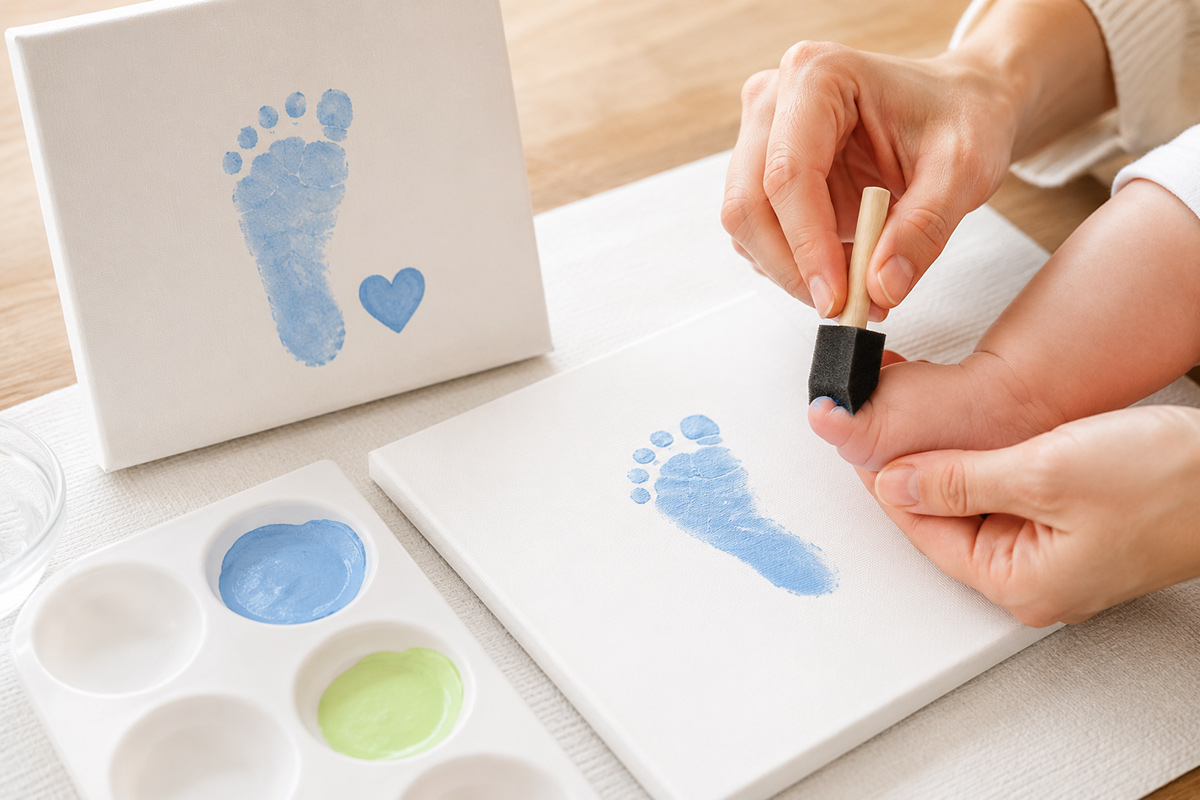
Affiliate disclosure: As an Amazon Associate I earn from qualifying purchases.
Compare Washable Children’s Finger Paint Options and Current Labels
Before ordering, enlarge the current label photographs and check the intended use, age guidance, warnings and cleanup directions. Check the physical container again when it arrives because listings, packaging and formulas can change.
Jump to the Paint Guide
What to Check Before Choosing Paint
Paints to Avoid on Baby’s Skin
Using Paint for a Baby Handprint
Using Paint for a Baby Footprint
Paper, Canvas and Other Surfaces
What to Check Before Using Paint for Baby Crafts
When a paint is described as “non-toxic,” that does not automatically mean it was made to be spread on a baby’s skin. For a handprint or footprint keepsake, use only a washable children’s finger paint whose current label specifically permits the intended direct application for the baby’s age. General wording about incidental or limited skin contact is not permission to apply the product to a baby. Follow the manufacturer’s age and use directions rather than relying on a general craft description.
I would begin with the one detail that matters most: the current label must permit the intended contact for the baby’s age. Then use the remaining label information as additional checks.
- Intended use and age guidance, including wording that permits finger painting or direct hand application for the baby’s age.
- Washable children’s finger paint, not permanent craft paint, fabric paint or artist acrylic paint.
- The ACMI AP seal, which shows that the art material has been evaluated by a toxicologist for its intended use.
- “Conforms to ASTM D-4236”, which shows that the formulation received the required chronic-hazard review and carries any necessary warnings.
The AP seal and ASTM statement are helpful checks, but they are not permission to leave paint on a baby’s skin. The Art and Creative Materials Institute explains that certified art materials anticipate only incidental or limited skin contact. Keep the paint away from the baby’s mouth, eyes, broken skin and irritated areas, then wash it off as soon as the print is complete.
A simple rule for choosing paint
Use a fresh, washable finger paint made for children, read the entire label and skip any product that carries a cautionary or hazard warning. When the label does not clearly permit the intended use and age, do not use that paint. Consider an inkless print kit only after checking that kit’s current contact, age and warning directions just as carefully.
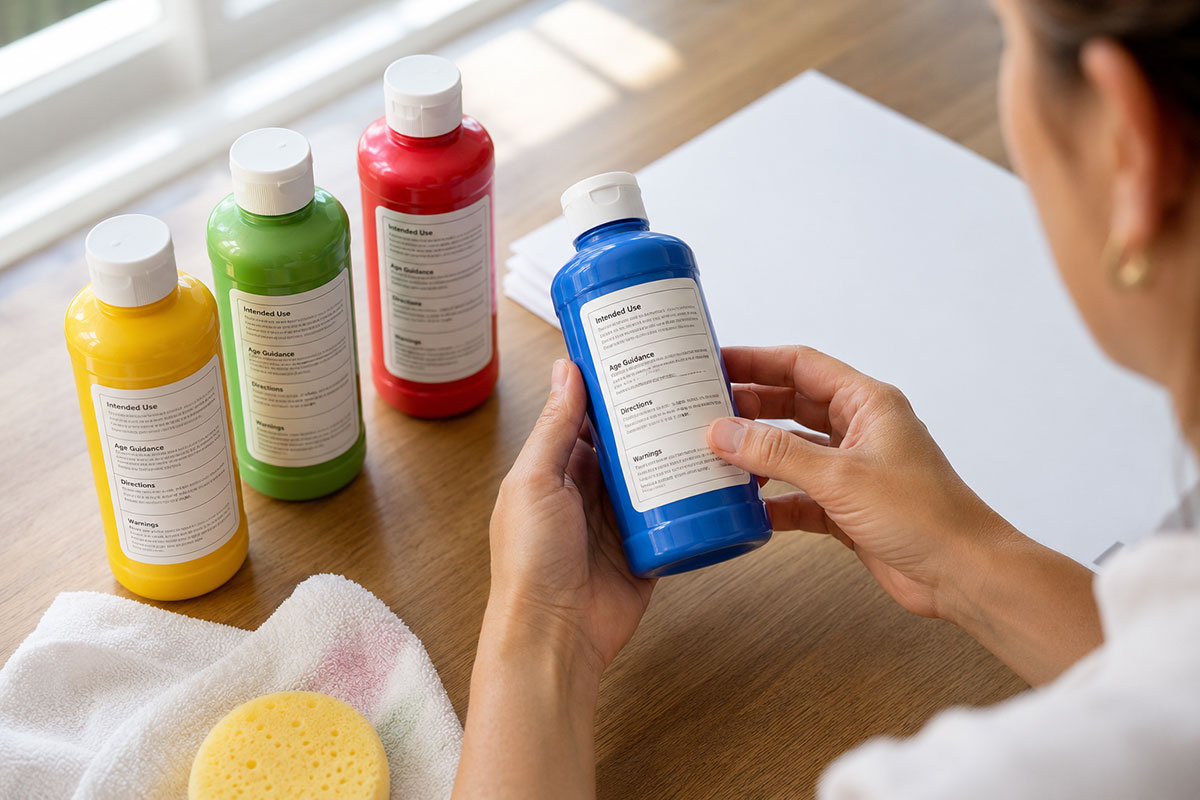
How to Read Paint Safety Labels Before You Begin
The front of a paint bottle may say washable, non-toxic or made for children, but turn the container around before using it for a handprint or footprint. The smaller wording tells you more about the product’s intended use, age range and precautions.
| Label wording | What it means for a baby craft |
|---|---|
| ACMI AP seal | The art material has received a toxicological evaluation and is considered non-injurious when used as intended. Treat the seal as an additional label check, not permission to apply the product to a baby. |
| ACMI CL seal | The product requires cautionary labeling. Do not apply a CL-sealed art material to a baby’s hands or feet. |
| Conforms to ASTM D-4236 | The art material has been reviewed for possible chronic health hazards and labeled accordingly. This statement is required on art materials, so it does not by itself mean that a paint is suitable for skin contact. |
| Washable | The paint is designed to wash from many surfaces under the manufacturer’s stated conditions. It does not guarantee that every color will come out of clothing, upholstery or grout. |
| Finger paint | This is more appropriate than ordinary tempera or acrylic paint because finger paint is intended for direct hand application. Check the stated age range before using it with an infant. |
The U.S. Consumer Product Safety Commission explains the labeling requirements for art materials, including the ASTM D-4236 conformance statement. That statement is useful, but it should be read together with the complete product label.
An ACMI AP seal is not the same as an FDA-regulated cosmetic or skin-care approval. Incidental or limited skin contact does not, by itself, permit deliberate application to a baby’s hand or foot. Proceed only when the exact current label permits the intended contact for the baby’s age, then use a thin layer, make the print promptly and wash the skin according to the manufacturer’s directions.
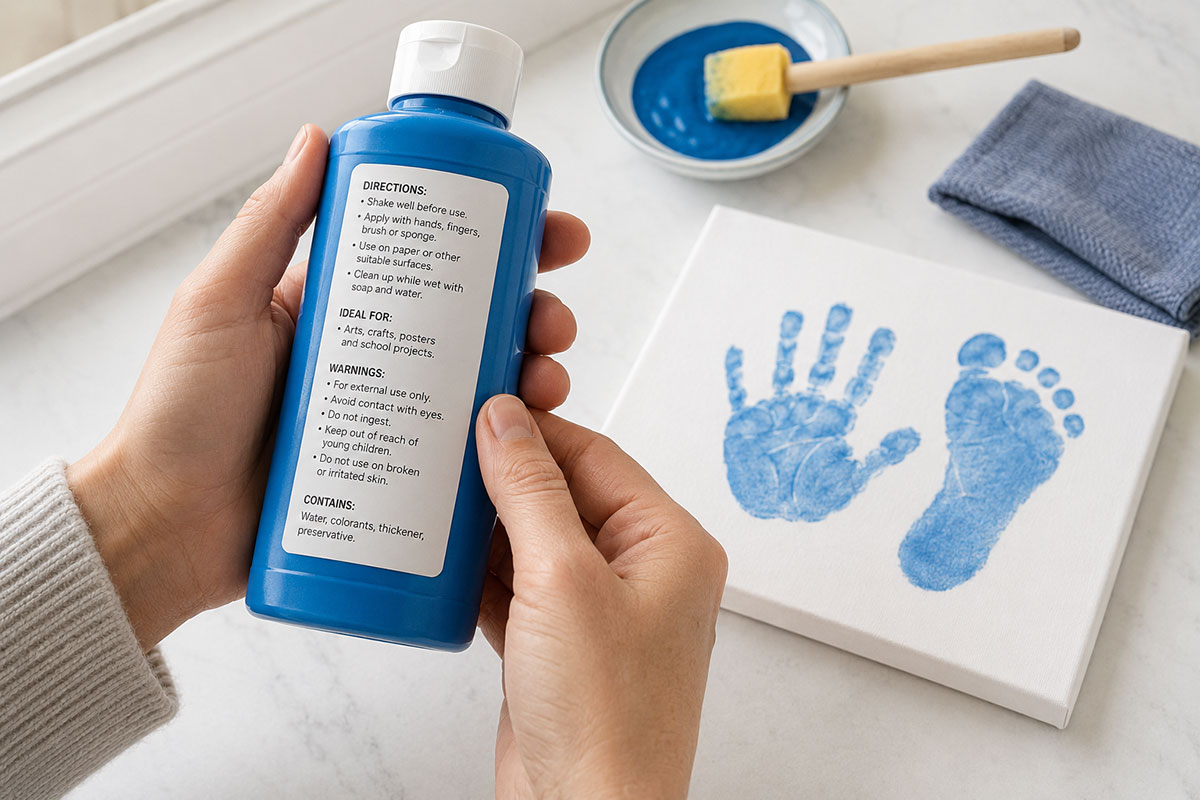
Paints to Avoid on a Baby’s Hands and Feet
Acrylic paint may make a crisp print on paper or canvas, but even a bottle marked non-toxic is not automatically intended for skin. The same caution applies to ordinary tempera paint, watercolor pans and other art supplies that were designed for brushes rather than finger painting.
Do not put these products on a baby’s hands or feet:
- Acrylic craft paint, including non-toxic acrylic paint
- Fabric paint, dimensional paint and puff paint
- Oil paint, enamel paint or model paint
- House paint, furniture paint or chalk-style decorative paint
- Spray paint or paint markers
- Paint that carries an ACMI CL seal or another cautionary warning
- Old, dried-out or unlabeled paint
- Any product whose directions say to avoid skin contact
Permanent paints can be used later to decorate the background, frame or lettering after the baby is no longer involved. Make the handprint or footprint with the appropriate washable finger paint first, allow it to dry and add the decorative portions separately.
Skip paint when the skin needs extra care
Do not apply paint over a cut, rash, eczema patch, blister or irritated area. Do not assume that an inkless kit is automatically appropriate for sensitive or irritated skin. Follow the kit’s current label and ask the baby’s healthcare professional when a skin condition or known allergy is involved.
Homemade paint is not automatically a safer choice. Food ingredients can cause reactions, recipes may spoil and food coloring can stain skin. A properly labeled children’s finger paint is easier to evaluate because its intended use and safety information are printed on the container.
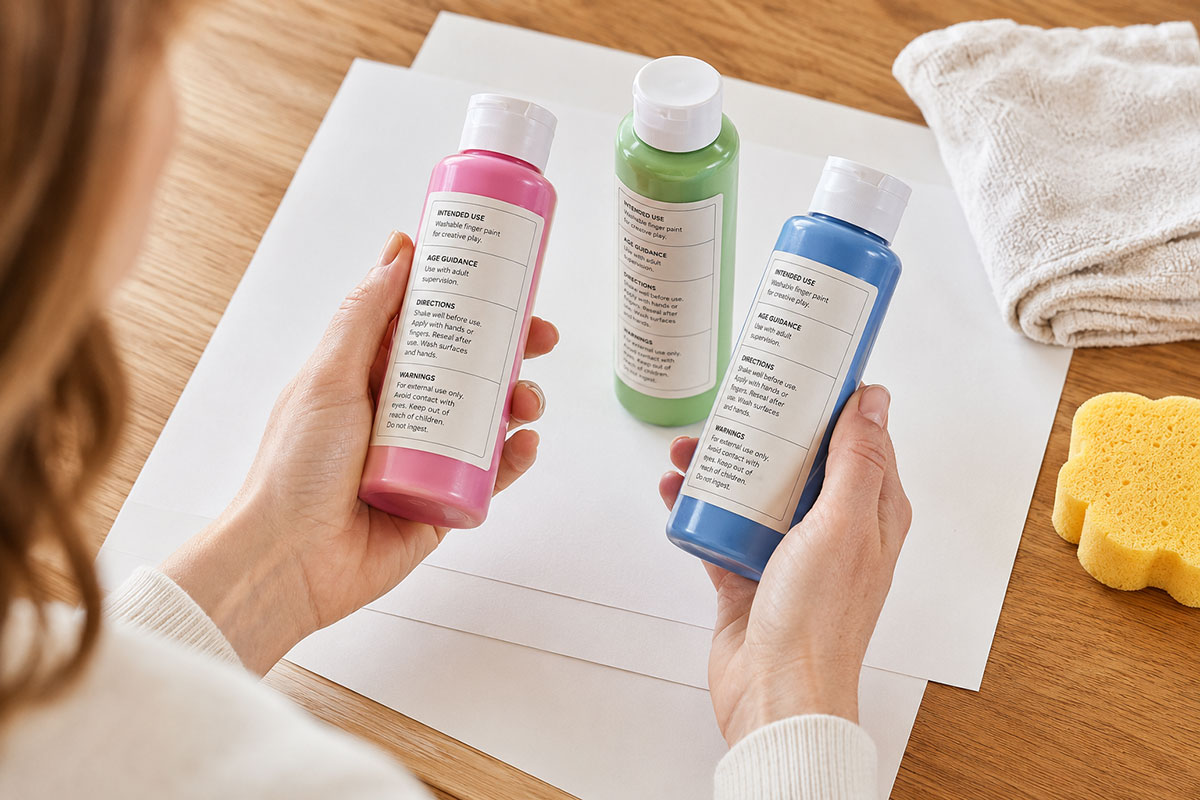
How to Use Paint for a Baby Handprint
A clear baby handprint takes a little preparation because babies naturally curl their fingers. Set out every supply before bringing the baby to the table, and ask another adult to help support the baby and guide the hand.
Supplies
- Washable children’s finger paint that is appropriate for the stated age
- Heavy white cardstock, watercolor paper or a prepared canvas
- A clean foam sponge or soft cosmetic sponge
- A shallow disposable plate for a small amount of paint
- A damp washcloth
- A bowl of warm water or access to a sink
- A dry towel
- Scrap paper for a practice print
- A washable table covering
Step-by-Step Baby Handprint Instructions
- Protect the work area. Cover the table and remove anything that could be stained or knocked over.
- Prepare the paper. Place the cardstock or canvas on a firm, flat surface. Tape the corners down with removable tape if the paper slides.
- Pour out a small amount of paint. Keep the main container closed and out of the baby’s reach. Stir the paint if the label directs you to do so.
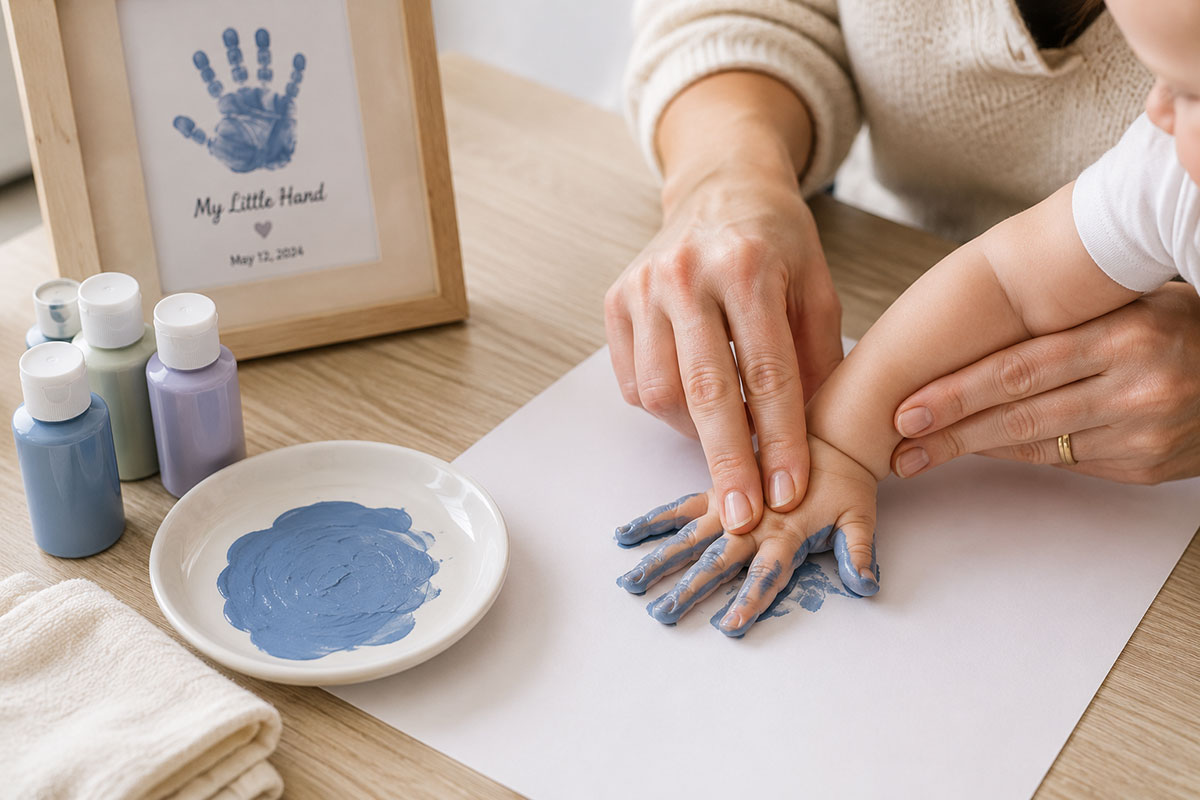
- Apply a thin coat. Dab paint onto the palm and fingers with the sponge. Do not dip the baby’s entire hand into a container of paint. A thick layer can smear and fill the small spaces between the fingers.
- Open the fingers gently. One adult can hold the baby securely while the other supports the wrist and eases the fingers open. Never pull or force a finger into position.
- Lower the hand straight down. Press the palm onto the paper first, followed by the fingers. Apply light, even pressure across the back of the hand.
- Lift the hand straight up. Avoid sliding it sideways, which can blur the print.
- Wash the hand immediately. Wipe away the first layer with the damp cloth, then wash thoroughly with warm water according to the paint manufacturer’s directions. Check between the fingers and around the nails.
- Let the print dry flat. Keep it beyond the baby’s reach until the paint is completely dry.
Make one practice print before using an expensive canvas, ornament or framed keepsake board. The test shows whether the paint layer is too heavy and gives the adults a chance to coordinate the press and lift.
A handprint with one imperfect finger can still become a lovely keepsake. Adding more paint and pressing the same hand over the first mark nearly always makes the result muddier. It is better to begin again on a fresh sheet and use the first print for a smaller craft from the baby handprint crafts collection.
How to Use Paint for a Baby Footprint
Footprints are often easier to capture than handprints because there are no curled fingers to open. The heel and toes still need even contact, though, and too much paint can turn the tiny lines into one solid shape.
Supplies
- Washable children’s finger paint that is suitable for the stated age
- Heavy cardstock, watercolor paper or a prepared canvas
- A soft foam sponge
- A shallow disposable plate
- A firm board or clipboard to support the paper
- A damp washcloth
- Warm water and a dry towel
- Scrap paper for a test print
- A washable covering for the floor or table
Step-by-Step Baby Footprint Instructions
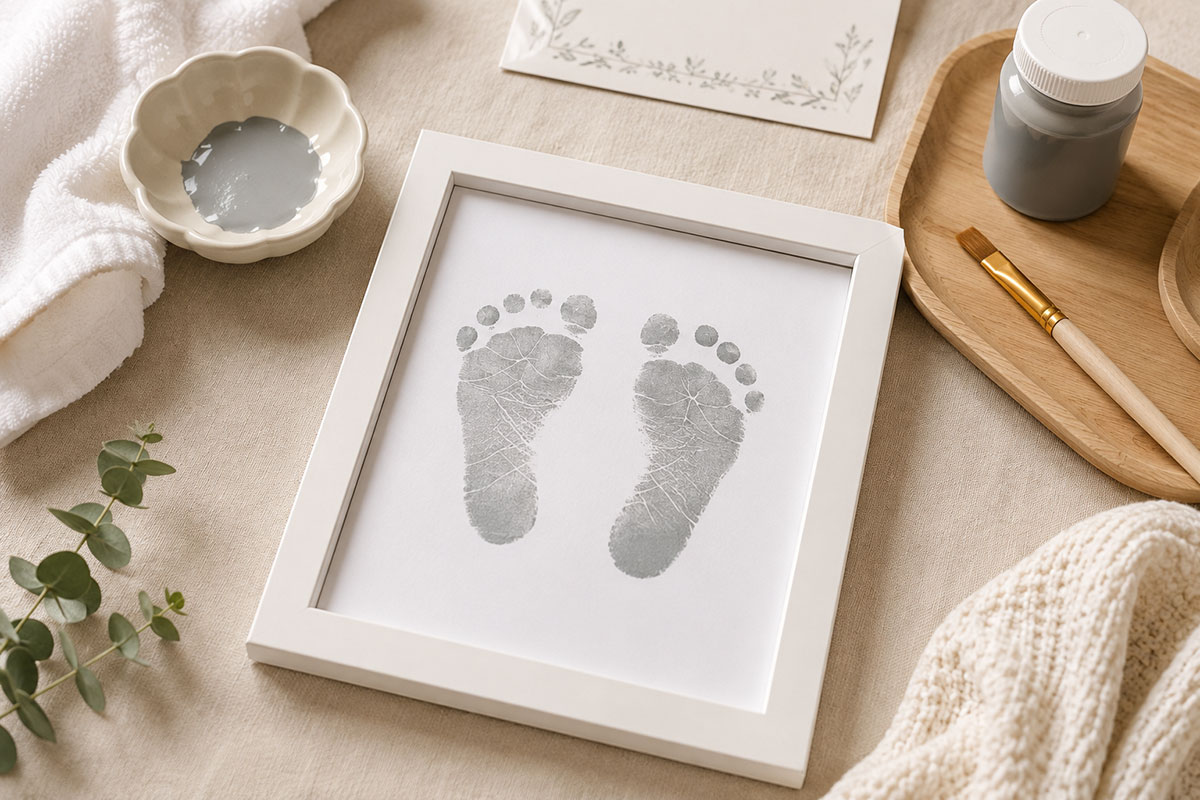
- Choose a comfortable position. One adult can hold the baby securely while seated, with the baby’s leg supported and the foot facing outward. Do not balance the baby over the paper or press a standing baby’s foot into paint.
- Secure the paper. Place it on a clipboard, firm board or flat table so it cannot shift during the print.
- Apply a thin, even coat of paint. Use the sponge to cover the heel, ball of the foot and toes. Check that paint has not pooled between the toes.
- Bring the paper to the foot. For a young baby, it may be easier to hold the supported board against the foot rather than lowering the foot toward a table.
- Press the heel first. Gently roll the rest of the foot forward until the ball and toes touch the paper. Use light pressure and avoid rocking the foot from side to side.
- Lift the paper straight away. Pulling it sideways can stretch the toes and blur the outer edge.
- Clean the foot immediately. Wipe off the surface paint, then wash the sole, toes and spaces between the toes according to the directions on the paint container.
- Allow the print to dry flat. Add the baby’s name, date or other decoration only after the footprint is completely dry.
A footprint does not need to be perfectly centered to be useful. Leave a generous border around the paper so the print can be trimmed, mounted or placed inside a mat later.
Before committing to a gift or framed piece, compare the finished mark with the ideas on the baby footprint keepsake page. The shape of the project may help you decide whether one footprint, a matching pair or extra space for a name and date will look best.
For a cleaner pair of footprints
Print one foot, clean it completely and let everyone reset before beginning the second. Trying to paint and press both feet at once makes it harder to support the baby and keep wet paint away from clothing.
How to Wash Paint Off a Baby’s Hands and Feet
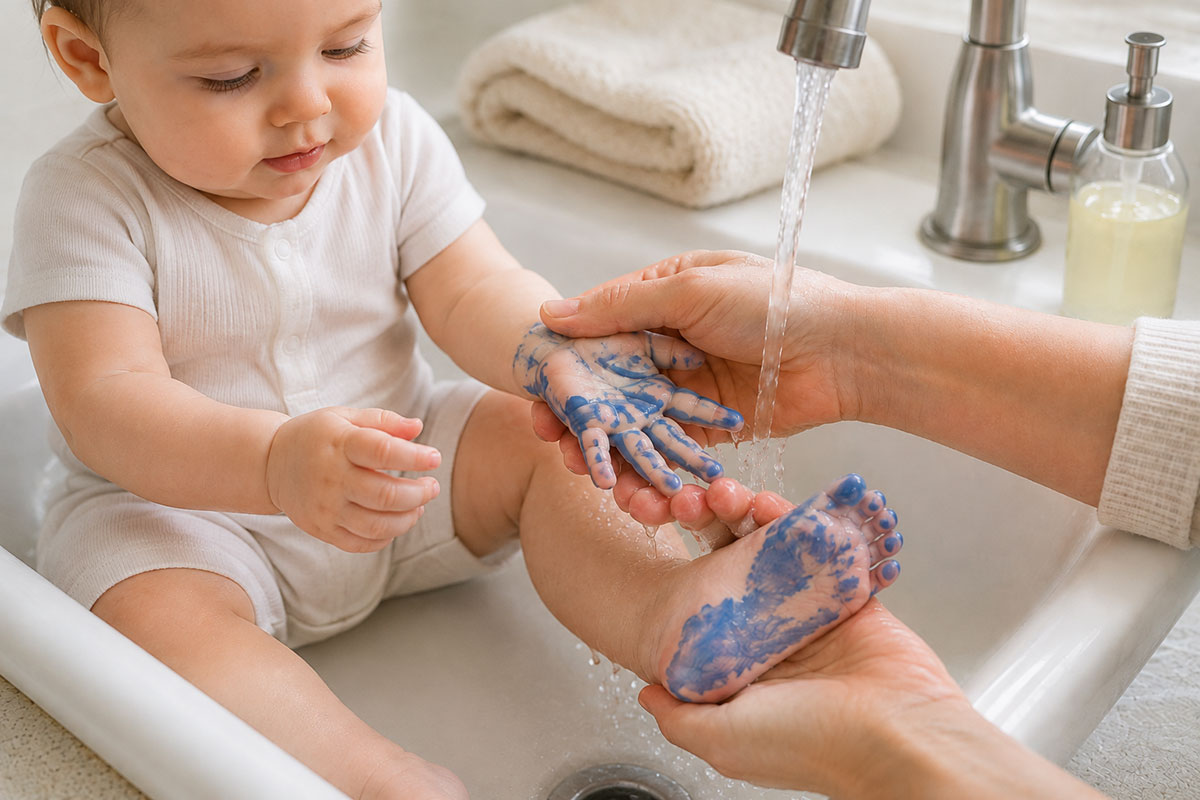
Have the washcloth, warm water and towel ready before opening the paint. Cleaning should begin as soon as the print is finished, while the paint is still wet and easy to remove.
- Wipe away the surface paint. Use a soft, damp washcloth to lift off most of the color without rubbing hard.
- Wash with warm water. Follow the cleaning directions on the paint label. Use a small amount of mild soap only when needed and rinse it away completely.
- Clean the small spaces. Check between the fingers or toes, around the nails and inside any skin creases where paint may collect.
- Pat the skin dry. Use a clean towel rather than rubbing the skin.
- Check clothing and nearby surfaces. Washable paint is easiest to remove before it dries, so deal with drips and smudges promptly.
Do not use rubbing alcohol, nail polish remover, paint thinner or household cleaning products on a baby’s skin. If ordinary washing does not remove every faint trace, stop scrubbing and follow the product manufacturer’s instructions.
If paint enters the eyes or mouth, or the skin becomes irritated, stop the activity and follow the first-aid directions printed on the container. Keep the paint bottle available so the exact product information can be given to a medical professional if needed.
Make clean-up part of the setup
Place the open damp washcloth beside the paper before applying paint. A baby can move from a perfect print to a painted sleeve in a second, and having the cloth within reach keeps the clean-up simple.
Once the baby is clean and comfortable, let the keepsake dry somewhere protected. You can then add a date, name or short message and use the finished print in one of these baby hand and footprint keepsake ideas.
Questions About Paint for Baby Crafts
What should I look for in paint for a baby handprint or footprint?
Use only a product whose current label specifically permits finger painting or direct skin application for the baby’s age. An ACMI AP seal and an ASTM D-4236 statement are additional checks, not proof that every paint is suitable for every baby. Follow all warnings, supervise the activity continuously and wash the paint off promptly.
Does non-toxic mean a paint is safe for a baby’s skin?
No. “Non-toxic” does not mean that a product was designed for use on skin. Acrylic paint, tempera paint and other art materials may be labeled non-toxic while still being intended for brush application. Finger paint with clear age and use directions is the better choice.
Can I use washable tempera paint for a baby footprint?
Use tempera paint only when the manufacturer specifically describes it as finger paint or approves it for direct hand application within the stated age range. Ordinary classroom tempera paint should not be treated as skin paint simply because it is washable.
Can acrylic paint be used for baby handprints?
Acrylic craft paint is not the right choice for direct application to a baby’s hand or foot. It can dry quickly, may be difficult to remove and is normally intended for craft surfaces rather than skin. Acrylic paint can be used later for lettering or background decoration after the baby’s washable print has dried.
Are homemade flour paints safer for babies?
Not necessarily. Homemade recipes do not come with toxicological testing, age directions or standardized safety labels. Ingredients may also cause a reaction, grow bacteria during storage or leave stubborn stains. A fresh, properly labeled children’s finger paint is easier to assess and use correctly.
Can I use finger paint labeled for ages three and older on a baby?
No. Follow the minimum age on the exact current label and choose another product that explicitly permits the intended use for the baby’s age.
Can I make a painted handprint with a newborn?
Use a product only when its current label permits the intended contact for a newborn’s age. Many finger paints are labeled for older children. An inkless kit is not automatically appropriate for a newborn either, so compare its age, contact and warning directions before use.
Can I choose paint by brand name alone?
No. A manufacturer may sell several formulas under similar names, and the directions may change. Check the exact container’s intended use, age guidance, warnings and cleanup instructions before every project.
What should I do if my baby puts a painted hand in the mouth?
Stop the activity, wipe away visible paint from the lips and skin, and follow the first-aid directions on the product label. Keep the container nearby and contact Poison Control promptly for instructions. Do not induce vomiting unless a poison specialist or medical professional directs you to do so.
How can I keep a painted baby print from fading?
Let the print dry completely, then frame it behind glass or store it away from direct sunlight and moisture. Do not spray a sealer while the baby is nearby. Any varnish or protective coating should be applied outdoors or in a well-ventilated work area according to its label directions.
Is an inkless print kit better than paint?
Neither method is automatically appropriate for every baby. Compare the current age, contact, warning and first-aid directions on the exact products you are considering. An inkless kit may reduce mess and capture fine lines, but it should not be used on broken or irritated skin unless the product directions and the baby’s healthcare professional support that use.
The paint is only one part of a successful keepsake. A prepared work area, a second adult and a quick clean-up make the process safer and far less fussy. For project ideas that use the finished prints, visit the baby handprint crafts page.
When paint exposure needs immediate guidance
If a baby swallows paint, gets it in the eyes or develops a reaction, keep the product container available and contact Poison Control promptly for instructions. In the United States, call 1-800-222-1222. Do not induce vomiting or use a home remedy unless a poison specialist or medical professional instructs you to do so. Call 911 immediately if the baby has trouble breathing, has a seizure, collapses or cannot be awakened.
The information on this page is general craft-safety guidance and is not a substitute for advice from a pediatrician or poison specialist.
Before You Make the Handprint or Footprint
A few minutes of preparation can make the difference between a clear keepsake and a hurried mess. Set up the project while the baby is comfortable, fed and alert, and stop if the baby becomes upset or keeps pulling the painted hand or foot toward the face.
- Read the paint label, age guidance and clean-up directions.
- Check that the skin is free from cuts, rashes and irritation.
- Cover the table, floor and nearby upholstery.
- Place the paper or canvas on a firm, non-slip surface.
- Pour out only the small amount of paint you need.
- Open the damp washcloth and place it within reach.
- Ask another adult to hold and support the baby.
- Make a practice print on scrap paper.
- Apply a thin coat rather than dipping the hand or foot.
- Wash the paint off immediately after the print.
Write the baby’s name and the date lightly in pencil on the back before the finished print is set aside to dry. That small step prevents a treasured keepsake from becoming an unidentified print later.
For a clearer impression, use sturdy paper and press once rather than rocking the hand or foot back and forth. The tips on the baby footprint picture guide can help when you are planning a print for a frame, ornament or handmade gift.
Choose a Surface That Gives the Paint a Fair Chance
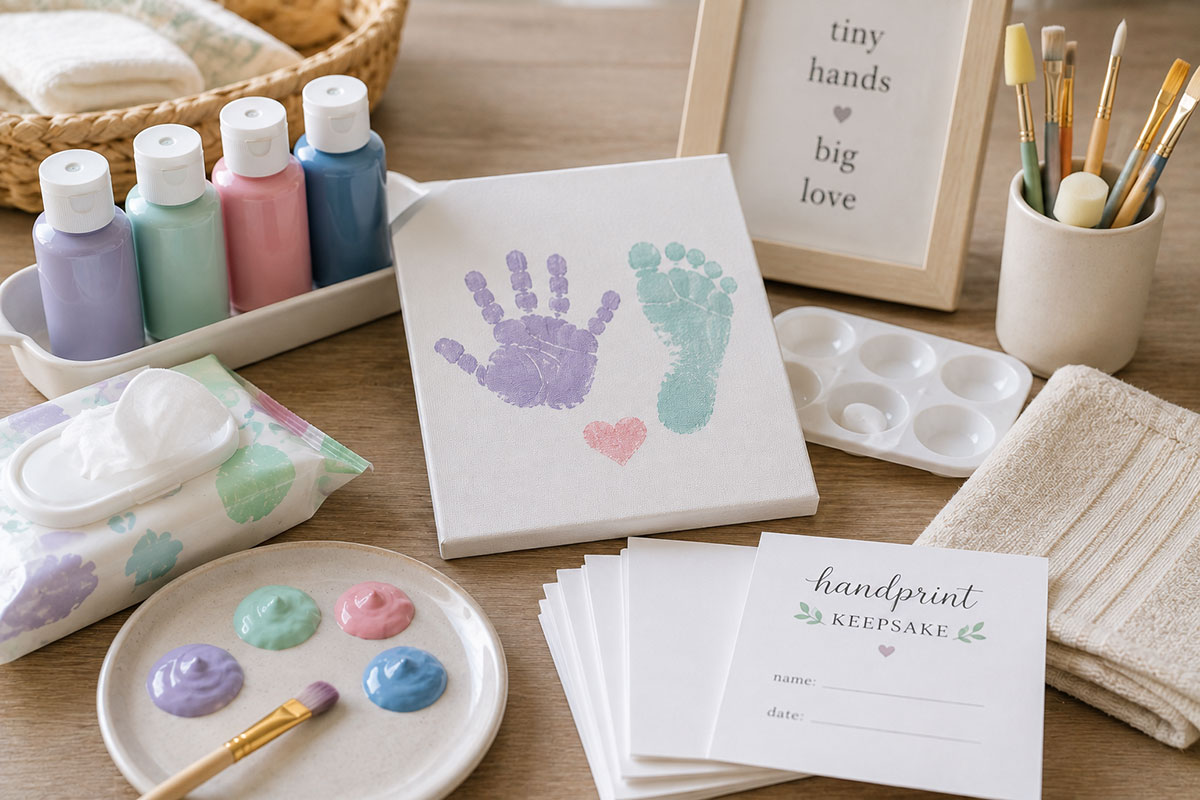
Washable finger paint behaves differently from acrylic craft paint. It may look bright while wet and dry to a softer finish, especially on an absorbent surface. Test the paint on a scrap of the same material before using the baby’s hand or foot.
Heavy Paper and Cardstock
Smooth, heavyweight cardstock is a practical choice for framed prints, cards and scrapbook pages. Thin printer paper can wrinkle as it absorbs moisture, while heavily textured paper may leave gaps in the palm, heel and toes.
Choose acid-free paper when the print will be framed or stored as a keepsake. Leave enough empty space around the impression for a mat, name, date or short message.
Canvas Panels
A small prepared canvas panel can work, but its woven texture may keep every line from printing clearly. A thin coat of paint and gentle, even pressure will give a cleaner result than pressing hard.
Test the exact finger paint on the canvas first. Some washable paints do not bond well to a slick or heavily primed surface and may rub away after drying.
Wood, Ceramic and Ornaments
Washable finger paint may bead, smear or flake from sealed wood, glazed ceramic, glass and shiny ornaments. Do not switch to permanent paint on the baby’s skin just because it sticks better to the project surface.
Make the print on suitable paper instead, then scan or photograph it and transfer the design to the ornament later. Another option is to mount the original paper print inside a frame, shadow box or clear keepsake ornament.
Preserve the original before decorating it
Take a clear photograph or scan of the dried handprint or footprint before adding names, borders or other painted elements. You will still have a clean copy if the lettering goes crooked or the finished craft is damaged later.
Once the print is dry, the ideas in the baby handprint crafts collection can help you turn it into nursery art, a holiday keepsake or a handmade gift without putting another type of paint on the baby’s skin.
When an Inkless Print Kit May Be the Better Choice
Paint is not necessary for every handprint or footprint keepsake. An inkless kit may be an alternative when you prefer not to coat the baby’s hand or foot with wet paint, but these products also vary. Use only a kit whose current label permits the intended contact and the baby’s age, and follow its directions exactly.
Inkless kits do not all work the same way. Some use a no-contact pad, while others require a treated wipe or solution to touch the hand or foot before the print is made on special paper. Read the exact kit directions, keep every component away from the baby’s mouth and eyes, and do not assume that “inkless” means nothing touches the skin.
An inkless kit may be a good choice when:
- The finger-paint label does not include the baby’s age group.
- You prefer a method that does not require coating the hand or foot with wet paint.
- You want very fine palm, heel and toe lines.
- You need a quick print with less washing afterward.
- The finished image will be scanned and used in several keepsake projects.
Paint remains useful when color is part of the design, but an inkless print often gives a sharper image for framed nursery art, jewelry engraving and printed gifts. You can also use an inkless original as a template and add color to a copy later.
Keep the original print flat and protected after it develops. The baby hand and footprint keepsake ideas include several ways to display or reuse a clear print without putting more art materials on the baby’s skin.
Keep the Craft Simple and the Baby Comfortable
The finished keepsake does not depend on expensive supplies or a perfectly shaped print. A clearly labeled washable finger paint, a thin coat, a prepared work area and immediate clean-up are the parts that matter.
Do not continue through fussing, repeated attempts or irritated skin just to get a more even result. A smudged toe or curled finger still records how small the baby was on that day, and that is what gives the print its meaning.
After the paint is dry, add the baby’s name and date with an archival pen or mount the print on a contrasting sheet of acid-free paper. Keep the original away from direct sunlight and make a digital copy before turning it into cards, ornaments or gifts.
When you are ready to use the finished print, explore these baby handprint craft and keepsake ideas for projects designed to be displayed, framed and saved.
When you click on links to various merchants on this site and make a purchase, this may result in this site earning a commission. This does not affect the price you pay.

UBGI Gold Standard 2026
Reviewed under the site's
editorial checklist.
Photos, decorating ideas, party setups and reader submissions are shared for inspiration unless a page is specifically presented as a pattern, tutorial, reference guide or step-by-step project. Follow the instructions, measurements, safety guidance and manufacturer directions provided for the particular project or product.
About Jan | Contact | Baby Nursery Ideas (Blog) | Site Map | Privacy Policy | Disclosure Policy | Disclaimer | Affiliate Disclosure | Earnings Disclosure | Facebook | Pinterest
I am a participant in the Amazon Services LLC Associates Program, an affiliate advertising program designed to provide a means for us to earn fees by linking to Amazon. As an Amazon Associate I earn from qualifying purchases.
Copyright © 2006-2026. All Rights Reserved.