Mom and Baby Halloween Costumes That Are Cute and Easy to Wear
By Jan Bay
The best mom and baby Halloween costumes keep the baby's part simple and comfortable while mom's outfit makes the whole idea easy to recognize. A soft sleeper, bodysuit or everyday outfit can be enough for the baby when mom adds the color, clothing or accessories that turn the two outfits into one coordinated costume.
More Baby Halloween Costume Ideas
Ready-Made Mom and Baby Halloween Costumes
Mom and Baby Halloween Costumes
Before buying a coordinated set, check whether the pieces are sold together or separately, the baby's size range, diaper access, fabric weight, detachable pieces and whether any headwear can be removed without losing the theme.
Best Mom and Baby Halloween Costumes
A good mom and baby costume does not have to mean two elaborate outfits. In fact, the easiest pairings often start with the baby's clothes first. Choose something soft, simple and easy to move in, then let mom's outfit explain the rest of the costume.
That opens up many more possibilities than searching only for matching costume sets. A brown sleeper can become a little woodland animal when mom dresses as a forest ranger or woodland-inspired character. An orange sleeper can be the pumpkin in a harvest pairing. A black bodysuit can work with a moon, star, bat or cat theme without adding wings, masks or bulky pieces to the baby.
A few pairings that are especially easy to recognize:
- Pumpkin and harvest: Baby wears orange while mom uses warm fall colors, a simple straw hat or other harvest-inspired details.
- Moon and star: Baby wears a dark navy or black outfit with one simple star detail while mom dresses in silver, midnight blue or a moon-inspired look.
- Woodland pair: Baby wears soft brown, rust or gray while mom provides the woodland setting with forest colors and an easy animal or outdoors-inspired costume.
- Little bat and nighttime sky: Baby stays in a plain black outfit while mom carries the more recognizable nighttime or Halloween details.
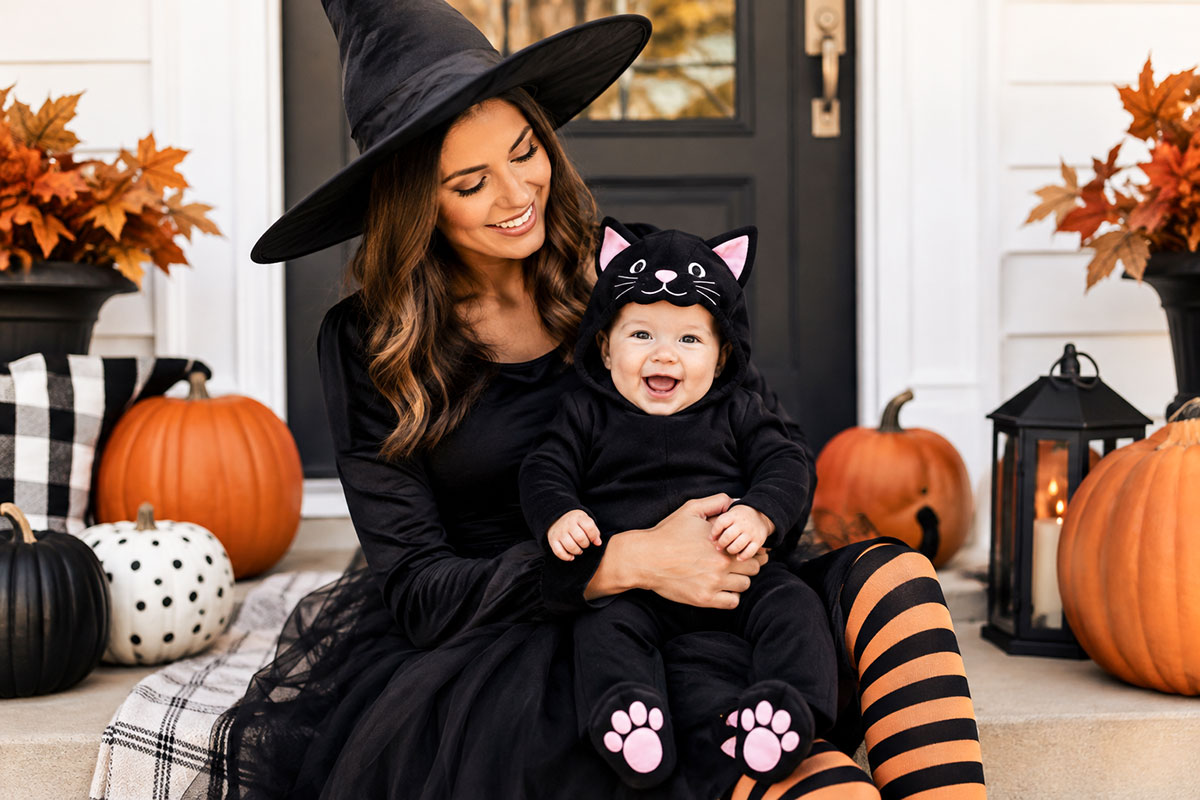
- Cat and witch-inspired pairing: Baby can wear a simple black outfit while mom's hat and clothing make the theme clear. There is no need to add a tail, mask or pointed hat to the baby.
- Farm pairing: A baby in white, brown or black can become the simple animal half of the costume while mom dresses as a farmer.
I prefer pairings where you can remove one accessory from mom and the baby's clothing is still perfectly ordinary. It makes feeding, changing clothes and taking a break from the costume much easier.
For a very young baby, keep the baby's side of the idea particularly uncomplicated. The infant Halloween costume ideas page goes deeper into choices for newborns and younger infants.
The goal is not to make the baby carry half of the visual work. Let the baby's clothes stay comfortable, then use mom's color, silhouette and a few well-chosen accessories to make the pair instantly understandable.
Easy Mom and Baby Halloween Costumes
Easy does not have to look thrown together. The simplest mom and baby costumes often come from choosing one color or recognizable theme, then giving mom the more detailed half of the idea.
Start in the baby's dresser before buying anything. A plain sleeper or bodysuit in orange, black, brown, white, gray or navy can become the base for several costumes. Then look at what mom already owns that can finish the pairing.
Black baby outfit + witch-inspired mom: Keep the baby in plain black and let mom wear the pointed hat, dark dress or cape-style layer. The baby can read as a little cat, bat or simply the witch's tiny Halloween companion without wearing extra pieces.
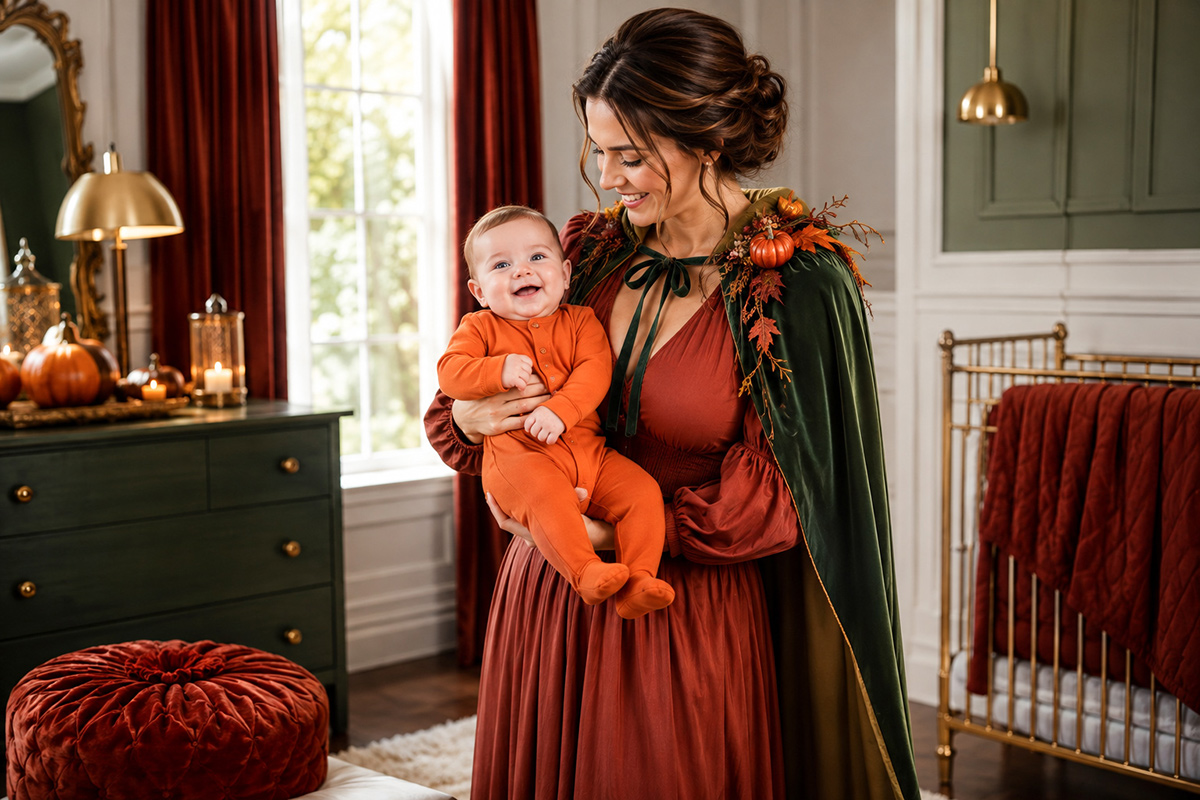
Orange baby outfit + harvest mom: An orange sleeper gives you an instant pumpkin color without putting the baby into a round, padded costume. Mom can wear rust, deep green or brown with a simple harvest-inspired accessory.
Brown baby outfit + woodland mom: A brown or tan sleeper works for a bear, deer or other woodland idea. Mom can wear forest green, plaid or another outdoors-inspired combination that gives the pair its setting.
White baby outfit + cloud or weather pairing: Baby stays in a soft white outfit while mom becomes the more colorful part of the weather theme. Mom can wear blue with a simple sun or raindrop-inspired accessory to make the pairing clear without attaching anything complicated to the baby.
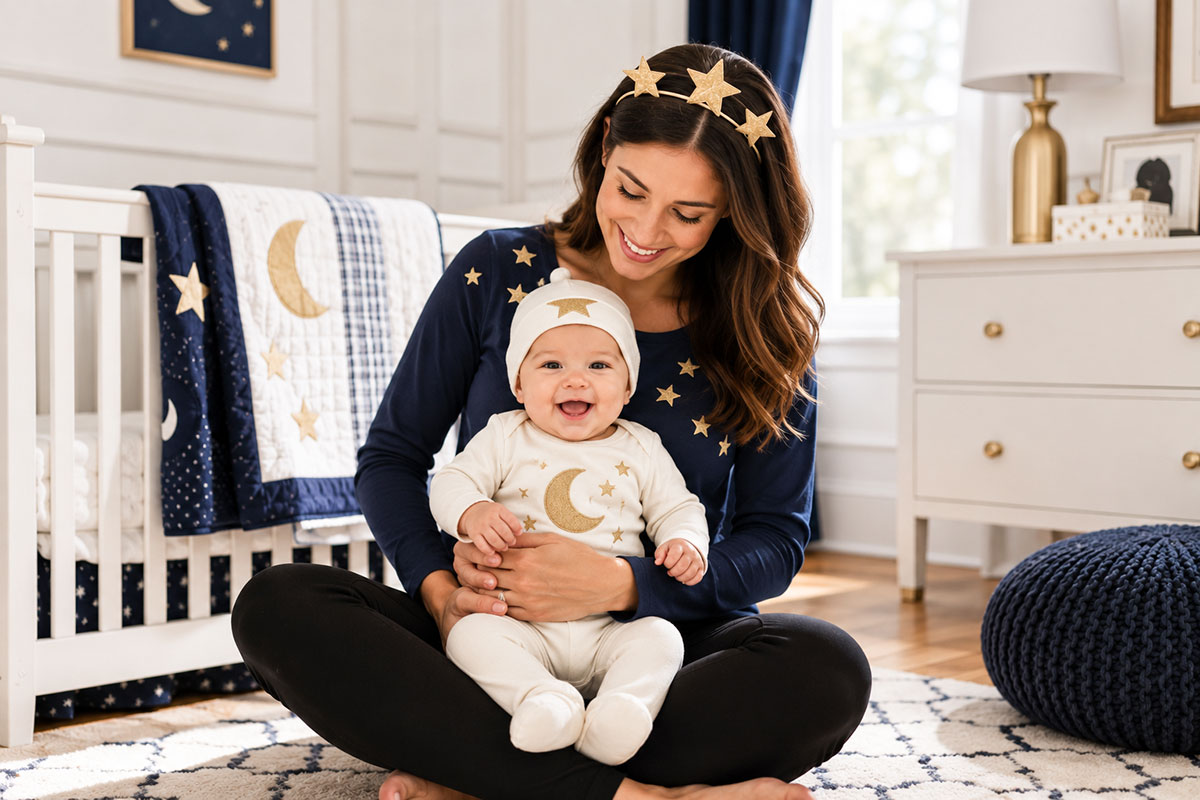
Navy baby outfit + night-sky mom: Navy is especially useful when you want something less expected than black. Baby can be the night sky while mom uses a moon or star-inspired outfit to finish the idea.
Another shortcut is to coordinate instead of match. Mom and baby do not need identical prints, hats or accessories. Repeating one color two or three times is often enough to make separate outfits look intentional in photos.
For even more starting points, the Baby Halloween Costumes guide has broader costume ideas that can be adapted into a two-person pairing.
If you can build the baby's half from comfortable everyday clothing and make the costume recognizable from mom's side, you have an easy pairing that is also much simpler to adjust when the baby needs feeding, a diaper change or a clothing change.
Mom and Newborn Halloween Costume Ideas
With a newborn, the baby's costume should be the easiest part of the pairing. A soft sleeper, gown or bodysuit can provide the color while mom's outfit supplies the theme.
Pumpkin and patch: Dress the baby in orange and let mom wear green, brown or rust with a simple harvest-inspired hat or scarf. The pairing reads clearly without putting the newborn into a padded pumpkin suit.
Little moon and night sky: A white or pale gray sleeper can become the moon while mom wears deep navy with a few simple star details. This is especially easy when the baby will spend much of the evening being held.
Woodland baby and forest mom: A tan, brown or rust-colored outfit can suggest a tiny woodland animal while mom wears forest green, plaid or other outdoor colors. Keep ears, tails and other removable pieces on mom rather than loading them onto the baby.
Cloud and storm-sky theme: Baby wears white while mom uses blue, silver or storm-gray clothing to create a cloud-and-sky pairing. The idea works without attaching anything around the baby's face or head.
Little ghost and classic Halloween mom: A plain white sleeper can be enough for the baby's side of a ghost-inspired pairing. Mom can carry the recognizable Halloween details with black clothing, a cape-style layer or another simple classic costume.
Newborn costumes also need to be easy to interrupt. Feeding, diaper changes and temperature changes are more important than keeping every costume piece in place. If the baby needs to come out of the outfit after ten minutes, the costume should be easy to remove without undoing a complicated set of accessories.
For more age-specific ideas, see the newborn and infant Halloween costume guide.
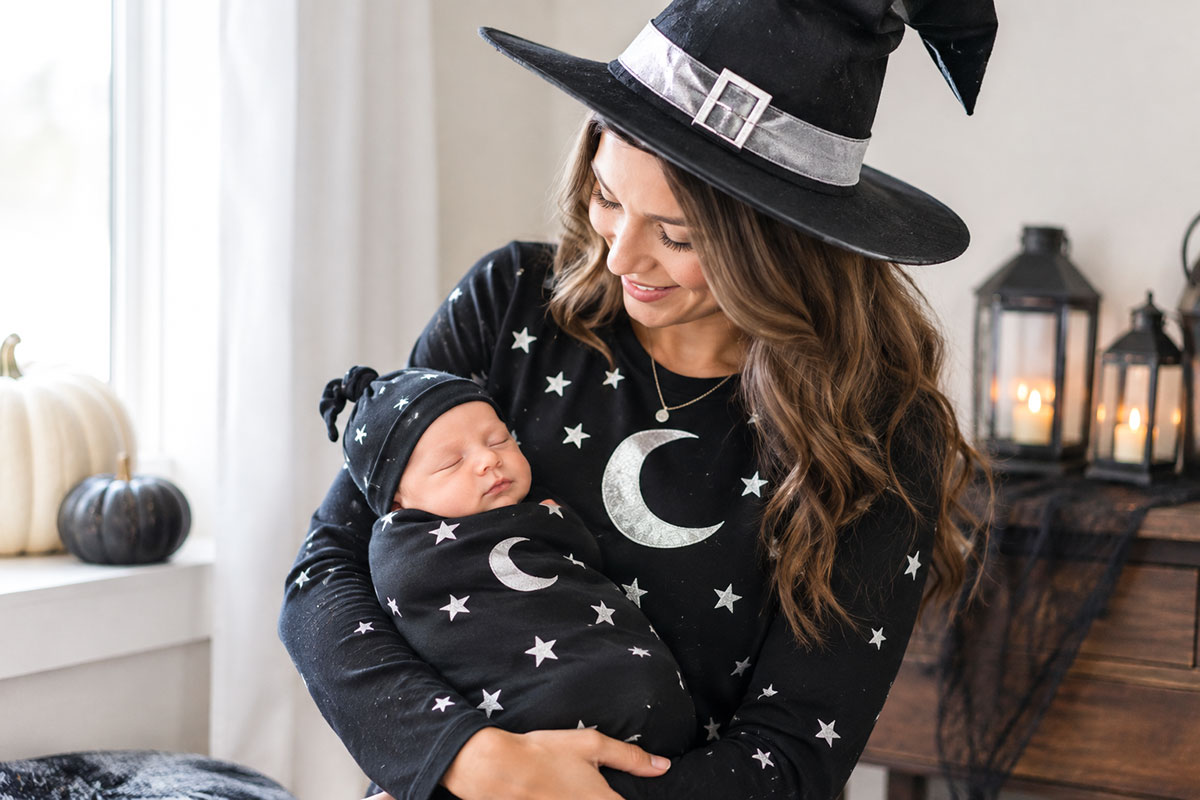
A newborn does not need wings, masks, stiff hats or bulky layers to look like part of a costume. When mom carries the visual theme, the baby can stay dressed much more like a baby.
Classic Halloween Mom and Baby Costumes
Classic Halloween themes are useful because people recognize them immediately. You do not need a complicated costume to explain a witch, bat, cat, pumpkin or moon-and-stars pairing.
Witch and little black cat: Baby wears a plain black sleeper or bodysuit while mom wears the witch hat and dark clothing. Skip a tail or ears on the baby if they will be grabbed, chewed or pulled off.
Bat and moon: Dress the baby in black or charcoal and let mom wear a moon-inspired outfit in silver, gray or deep blue. If you want wings, put them on mom rather than behind a baby who will be carried or seated.
Pumpkin and witch: An orange baby outfit paired with a simple witch costume for mom gives you two familiar Halloween symbols without requiring a matching set.
Black cat and moon: Mom can wear the cat ears and black clothing while baby wears pale gray, white or silver as the moon. Reversing the expected roles makes the pairing a little less predictable.
Little ghost and black cat: A white baby sleeper gives you the ghost color while mom wears black with simple cat ears. There is no need to cover the baby's face or use a loose sheet-style costume.
Spider and web: Keep the baby in a dark outfit and let mom carry the web part of the idea through clothing or a removable accessory. Avoid dangling strands around the baby.
The easiest way to keep these ideas from looking like two unrelated costumes is to repeat one color. Black in both outfits, orange in both outfits or a shared silver accent can visually tie the pair together.
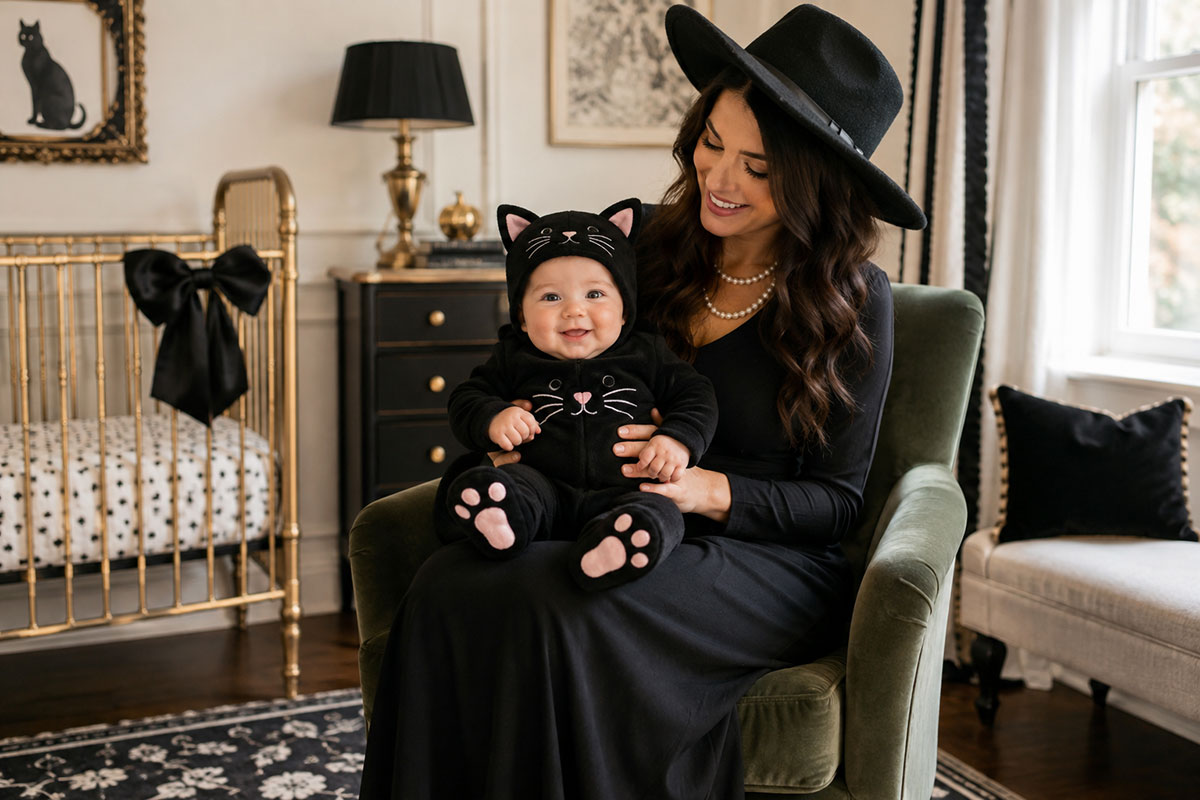
These familiar themes are also easy to adapt when plans change. If the baby refuses a hat, removes an accessory or needs to change clothes, mom's costume can still carry enough of the idea for the pairing to make sense.
Mom and Baby Halloween Costumes Using a Baby Carrier
A baby carrier can do more than keep the baby close. It can become part of the costume itself, which means the baby can stay in a soft, familiar outfit while mom handles nearly all of the decorating and costume detail.
For more themes built specifically around this setup, see the complete guide to baby carrier Halloween costumes for parents and infants.
Flower and garden: Baby wears a simple green, pink or yellow outfit while mom's clothing creates the garden theme. Decorative flowers or leaves can stay on mom's clothing rather than being attached to the baby.
Little animal and woodland setting: A brown, gray or rust baby outfit can suggest a bear, fox or other woodland animal. Mom can wear forest colors and use her own accessories to create the setting around the baby.
Moon and night sky: Baby wears pale gray or white while mom dresses in deep navy or black. A few moon-and-star details on mom's clothing can make the theme recognizable without adding loose pieces to the carrier.
Farm baby and farmer mom: A white, brown or black baby outfit can become the animal part of the pairing while mom wears denim, plaid or another simple farm-inspired look.
Under-the-sea pairing: Dress the baby in a soft blue, aqua or gray outfit while mom becomes the more decorative ocean half of the costume. Keep fins, tentacles and other dimensional pieces on mom where they will not interfere with the baby's face or position in the carrier.
The carrier itself does not need to disappear under decorations. A few carefully placed details on mom's clothing can frame the baby visually while leaving the carrier's straps, buckles and fit alone. Follow the carrier manufacturer's instructions and keep anything decorative away from the baby's face and from parts of the carrier needed for safe use.
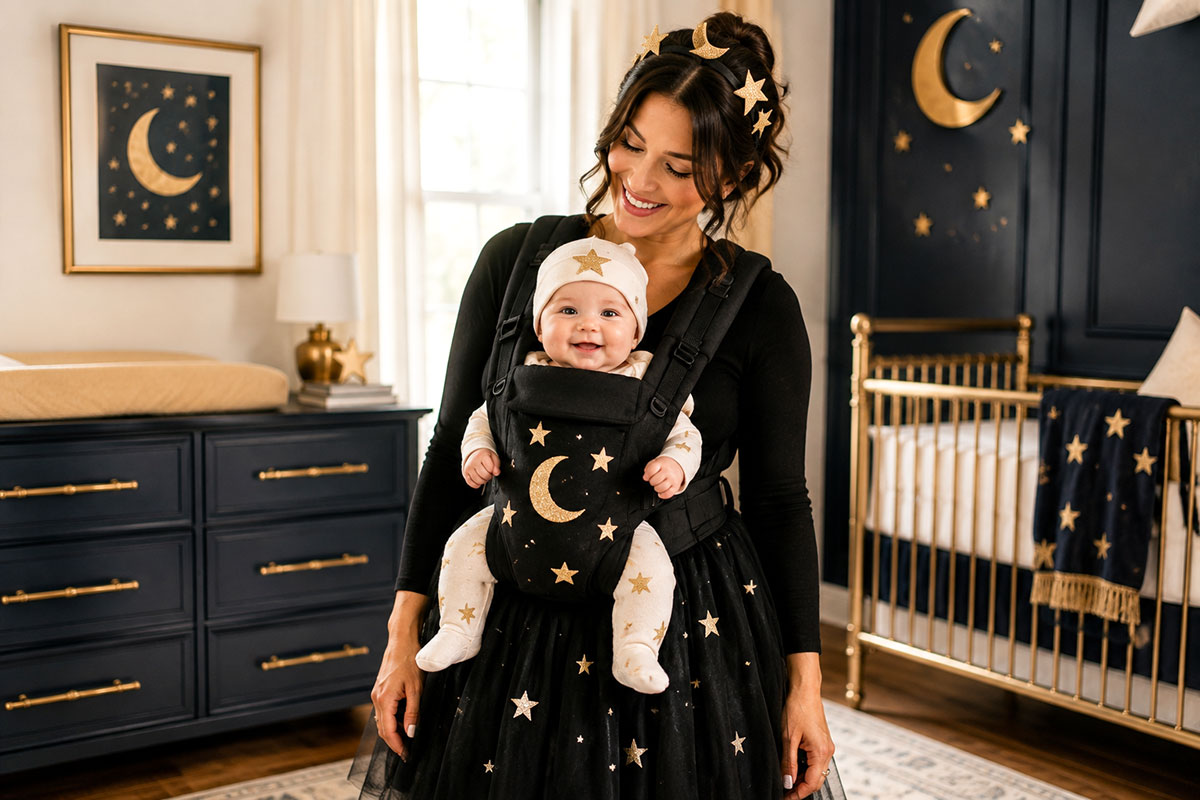
A carrier costume works best when the theme still makes sense even if every decorative extra comes off. The carrier's job is still to carry the baby. The costume should work around it, not change how it fits.
Easy DIY Mom and Baby Halloween Costumes
A DIY mom and baby costume does not need to start with sewing. The easiest approach is often to use ordinary clothing as the base, then add just enough detail to mom's outfit to make the pairing clear.
Color-pair costumes: Start with two colors that belong together. Orange and green can suggest pumpkin and vine. Brown and forest green can become woodland. Navy and silver can turn into night sky and moon. The baby's clothes can stay completely plain while mom adds the recognizable details.
Felt details on mom: Simple felt shapes can change an everyday shirt, cardigan or cape-style layer into part of a costume. Leaves, stars, moons, feathers or animal markings can all stay on mom's clothing instead of being attached to the baby's outfit.
Mom wears the headpiece: If ears, a hat, antennae or another headpiece makes the costume recognizable, put it on mom. A baby does not need to wear the same accessory for the pairing to work.
Use the baby's sleeper as the costume base: A solid-color sleeper is one of the most useful pieces for a last-minute DIY pairing. Brown can become a woodland animal, orange can become a pumpkin, black can work for a cat or bat theme, and white can become a cloud, moon or little ghost.
Add removable details away from the baby: Fabric leaves, ribbon-free bows, lightweight felt shapes or yarn accents can be added to mom's clothing and removed after Halloween. Keep loose decorative pieces away from the baby's hands, face and mouth.
If you enjoy making the decorative part yourself, the Baby Halloween Crafts page has more handmade ideas that can be used alongside a costume without turning the baby's outfit into a complicated project.
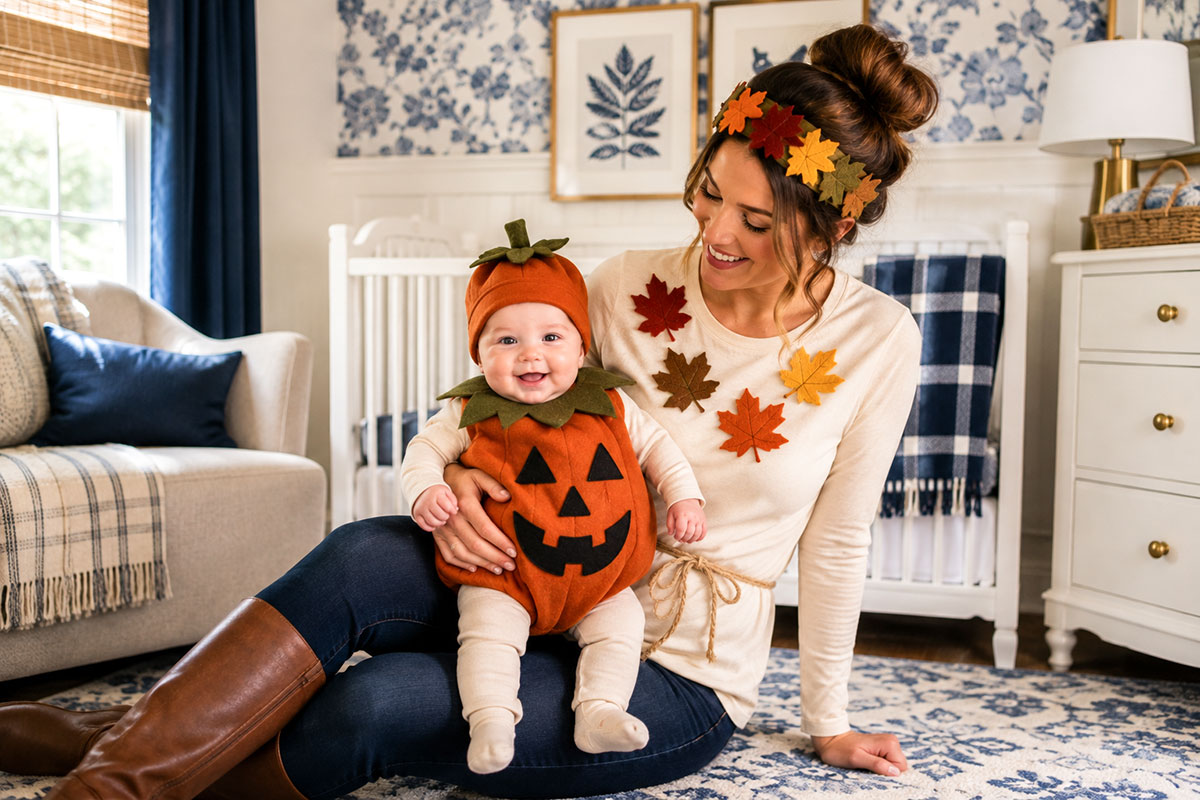
The best DIY shortcut is to ask what makes the costume recognizable from across the room. Put that part on mom. Let the baby's outfit stay soft, simple and easy to change.
Last-Minute Mom and Baby Halloween Costumes
A last-minute costume is easiest when you stop trying to build two complete outfits. Start with what the baby already owns, then use one recognizable piece on mom to pull the idea together.
Orange baby + green mom: An orange sleeper or bodysuit can become the pumpkin while mom wears green and adds a simple leaf or vine detail to her own outfit.
Black baby + witch mom: Dress the baby in black and let a pointed hat do most of the work for mom. Add a black dress, sweater or leggings and the pairing is finished.
White baby + night-sky mom: Baby wears white or pale gray while mom wears navy or black with a moon or star detail. This works especially well when you need something that can be assembled from ordinary clothes.
Brown baby + forest mom: A tan or brown baby outfit can suggest a woodland animal while mom wears green, brown or plaid. A simple pair of ears on mom can make the theme more obvious without adding anything to the baby.
Black and white pair: If both closets are short on Halloween colors, build around contrast instead. A white baby outfit and black clothing for mom can become a ghost-and-cat, moon-and-night or other classic pairing with just one small accessory added to mom.
Look at sleepers, pajamas, leggings, sweaters and plain shirts before shopping for costume pieces. Halloween is much easier when the clothing underneath can keep being worn after the accessories come off.
If plans suddenly expand beyond just mom and baby, the family Halloween costumes with baby guide has ideas for turning a two-person theme into a coordinated family costume.
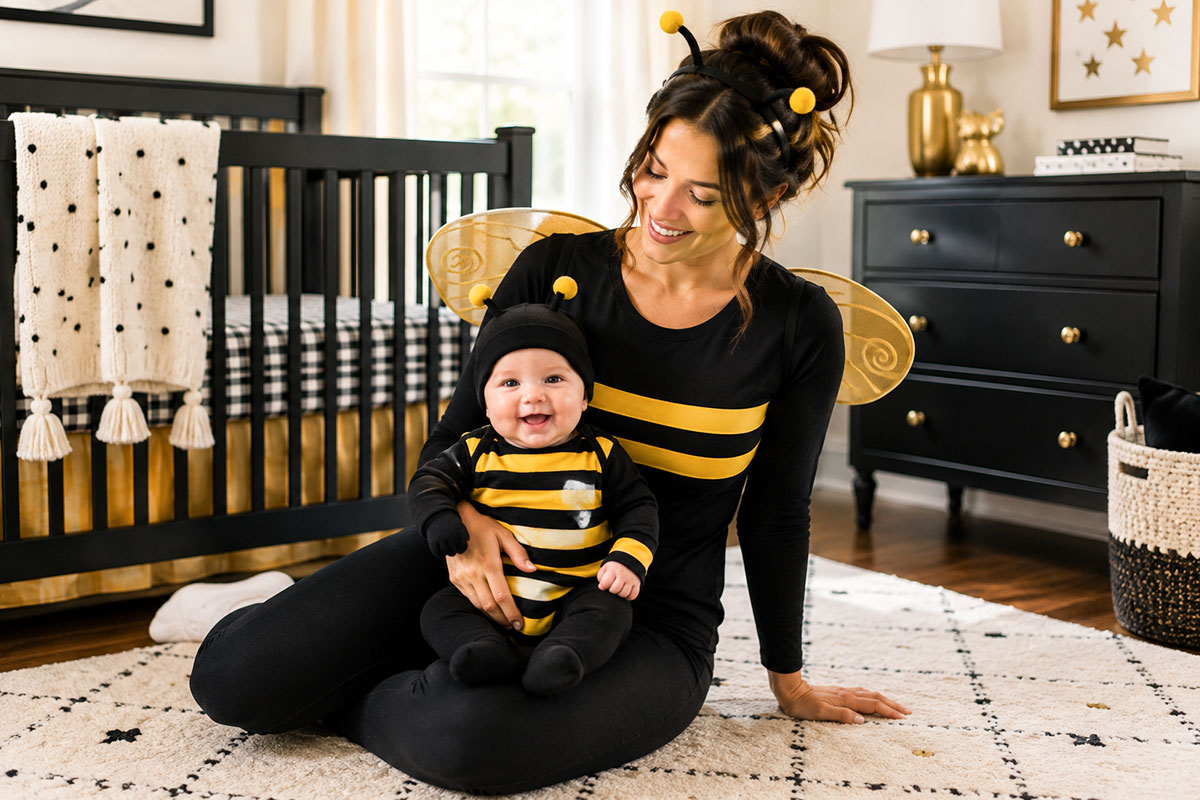
A costume put together from regular clothing can still look intentional. Repeating one color, one shape or one theme is often enough to make mom and baby look coordinated without creating a project the night before Halloween.
Matching Without Wearing Identical Costumes
Mom and baby do not need matching outfits to look like a pair. In many cases, the costume is more interesting when each person represents a different part of the same idea.
Think in terms of connections rather than copies. A pumpkin does not need another pumpkin. Pair it with a harvest look. A moon can go with the night sky. A little woodland animal can go with the forest. A farm animal can go with a farmer.
You can connect two different outfits in several simple ways:
- Repeat a color. Use the baby's orange outfit again in a small detail on mom.
- Choose two parts of one scene. Baby can be the moon while mom becomes the night sky.
- Use related characters rather than identical ones. A little black cat and a witch make more sense together than two complicated matching costumes.
- Let mom create the setting. A baby in brown can suggest a woodland animal when mom's clothing clearly establishes the forest theme.
- Repeat one shape or motif. A few stars on mom's outfit can connect with a baby dressed as the moon without covering both outfits in the same design.
This approach is especially handy when the baby's clothing needs to stay very simple. Mom can wear the hat, cape, ears or decorative pieces while the baby contributes little more than the right color.
It also gives you more freedom to use clothing already in the closet. Instead of searching for two matching costumes in the correct sizes, choose one theme and build each half separately.
The two outfits should look as though they belong in the same little Halloween story. They do not have to look alike.
Choosing a Mom and Baby Costume for Baby's Stage
The same costume idea can work very differently for a newborn, a baby who sits independently and a baby who wants to crawl everywhere. Choose the baby's clothes around what the baby will actually be doing, then adapt mom's half of the costume around that.
Newborn: Keep the baby's outfit soft and uncomplicated. A sleeper or bodysuit in the right color may be all you need. Mom can provide nearly every recognizable costume detail.
Carried baby: Choose an idea that still reads clearly when only the baby's head, arms and part of the outfit are visible. Moon and night sky, woodland animal and forest, pumpkin and harvest, or farm animal and farmer all work well this way.
Sitting baby: Think about what the costume looks like from the front. Details placed only across the back may disappear once the baby is seated. A simple color-blocked outfit or recognizable front detail photographs more clearly without adding bulk.
Crawling baby: Keep hands, knees and feet free to move normally. Skip long tails, dangling fabric, stiff skirts, floor-length pieces and anything that trails behind the baby. Mom can wear those more dramatic elements instead.
Baby who is starting to move around: The costume may need to survive sitting, reaching, scooting and being picked up repeatedly. Secure, ordinary clothing makes a much better base than accessories that have to be repositioned every few minutes.
Development does not follow one exact timetable, so choose according to what your baby is doing now rather than the age printed on a costume package.
A useful test is to picture the baby wearing the outfit without mom beside them. If it still looks like comfortable baby clothing, you have plenty of room to make mom's half more playful.
Dressing Mom and Baby for Warm or Cold Halloween Weather
A costume that looks perfect indoors can become uncomfortable once you step outside. Build the baby's outfit around the actual temperature first, then adjust the theme with mom's clothing instead of piling decorative layers onto the baby.
For warm weather: Choose lightweight, breathable clothing and keep the costume loose enough for normal movement. A short-sleeve bodysuit or light sleeper in the right color can still carry the baby's half of the theme. Save capes, jackets and heavier accessories for mom.
For cool weather: Start with comfortable layers the baby would normally wear for the temperature. A long-sleeve bodysuit, sleeper or soft pants can become part of the costume rather than hiding underneath it. Orange layers can still suggest a pumpkin, brown can work for woodland themes and navy can become a night-sky costume.
For changing temperatures: Make the costume work with pieces that can come off easily. Mom can lose a cape, cardigan or hat without changing the whole idea, while the baby's basic outfit remains comfortable.
Check the baby during the evening instead of assuming the temperature feels the same to both of you. Indoor parties, crowded rooms, porch visits and outdoor walks can all feel different within a short period of time.
Costume accessories should never make it harder to add or remove normal clothing layers. If the weather requires a complete rebuild of the costume, simplify the baby's part and let mom carry more of the theme.
The best pairing is one that still makes sense after a sweater comes off, a blanket is added or the evening turns warmer than expected.
Diaper Changes, Feeding and Practical Costume Fit
A mom and baby Halloween costume has to work between the pictures, too. Babies still need diaper changes, feeding, burping, carrying and the occasional complete outfit change, so the costume should make those ordinary moments easy.
Keep diaper access simple. A sleeper with a zipper or a bodysuit with snaps is much easier to manage than layers that have to be removed one at a time. Avoid decorative pieces that cover the diaper area or have to be untied before every change.
Plan for feeding. If the baby will be held or fed during an event, check that costume pieces do not bunch around the baby's neck or face. Mom's costume should also allow her to sit, bend and hold the baby comfortably.
Make the costume easy to pause. A useful pairing still works when the hat comes off, mom removes an accessory or the baby changes into a backup sleeper. The theme should not depend on keeping every little piece in place.
Watch the fit when baby moves. Fabric should not drag around crawling hands and knees, and bulky decorative pieces should not make sitting or being carried awkward. Costumes that look adorable while a baby is perfectly still can become impractical as soon as that baby decides to move.
Bring an ordinary backup outfit. If the costume becomes wet, warm, uncomfortable or simply unpopular with the baby, changing clothes should not end mom's costume too. This is another reason I like pairings where mom carries more of the recognizable theme.
Before leaving the house, try the complete outfit during a normal diaper change and a few minutes of holding or floor play. If something constantly needs adjusting, simplify it before Halloween rather than spending the evening fixing the costume.
Mom and Baby Halloween Photo Ideas
You do not need an elaborate setup to get a good picture of a coordinated costume. The clearest photos usually show the relationship between the two outfits without surrounding mom and baby with extra Halloween props.
Let the costumes explain the scene. A pumpkin-and-harvest pairing can work on a porch or against a simple outdoor fall background. A moon-and-night-sky costume may look better against a plain wall where the navy, silver and white colors stand out.
Photograph the baby doing something natural. A sitter can be photographed sitting while mom crouches nearby. A carried baby can stay in mom's arms or carrier. A crawler does not need to be posed upright just to show the costume.
Get one full-length photo. This is the picture that shows how the two costumes connect. Include enough of mom's outfit to make the pairing recognizable rather than cropping tightly around the baby's face.
Then move closer. A second photo can concentrate on the baby's simple costume and one recognizable detail from mom's outfit. A little orange sleeper beside mom's green sleeve and harvest accessory may tell the story better than adding more decorations.
Try a different angle instead of another pose. A slightly elevated view can work well when mom is seated with the baby. For a crawling baby, getting the camera closer to floor level can show the costume without trying to keep the baby still.
Take the photographs while the baby is comfortable rather than waiting for perfect light, a perfect pose and every accessory to stay exactly where it belongs. If the hat comes off after three pictures, you probably already have the picture you needed.
And remember that the photograph does not have to prove how much work went into the costumes. A simple pairing with a clear idea can make a much better picture than two outfits crowded with details.
Baby Halloween Costume Safety
The baby's costume can be simple and still look wonderful beside mom's. Keeping decorative pieces on the adult side of the pairing also makes it easier to avoid accessories that interfere with the baby's face, movement or normal clothing.
Keep small and loose pieces away from baby. Skip detachable decorations that can be pulled off and mouthed. Long cords, ties, loose ribbons and dangling accessories are better left out of the baby's costume entirely.
Leave the face uncovered. Avoid masks and anything that can slide across the baby's nose or mouth. Hats and headpieces are optional, not essential. If the pairing needs one to be recognizable, mom can wear it.
Protect normal movement. Crawling babies need their hands and knees free. Babies who are sitting or being carried should not have stiff wings, bulky tails or large decorations pressing behind them.
Watch the temperature. Costume fabric, extra layers and indoor crowds can make a baby warmer than expected. Build the outfit from clothing appropriate for the temperature instead of adding heavy layers just to create a certain shape.
Keep the baby carrier functional. Do not cover, alter or obstruct straps, buckles or other parts needed to use the carrier correctly. Decorations should stay clear of the baby's face and should not change the carrier's fit.
Take costume bulk off before using the car seat. A thick or padded Halloween costume can interfere with a snug harness just as bulky winter clothing can. In the United States, the National Highway Traffic Safety Administration advises that bulky clothing or blankets can prevent a snug harness fit. Buckle and tighten the harness correctly first, then place a coat or blanket over the harness for warmth. See NHTSA's rear-facing infant car seat guidance for current instructions.
You do not have to make every cute costume feature wearable by the baby. When a tail, cape, hat or decorative piece creates a practical problem, move that detail to mom's outfit or leave it out. The pairing can still tell the same Halloween story.
Frequently Asked Questions About Mom and Baby Halloween Costumes
What are good mom and baby Halloween costumes?
Good pairings give the baby a simple, comfortable role and let mom carry more of the recognizable costume details. Pumpkin and harvest, moon and night sky, woodland animal and forest, little black cat and witch, and farm animal and farmer are all easy to understand without requiring two elaborate costumes.
What is an easy Halloween costume for mom and baby?
Start with a solid-color baby outfit you already own. Orange, black, white, brown and navy are especially useful. Then choose one accessory or clothing combination for mom that turns that color into a recognizable theme.
What can mom and a newborn dress as for Halloween?
Keep the newborn in a soft sleeper, gown or bodysuit and build the theme around mom. An orange newborn with a harvest-inspired mom, a white newborn with a night-sky mom, or a brown newborn with a woodland-inspired mom can all work without adding bulky costume pieces to the baby.
What are easy DIY mom and baby Halloween costumes?
Use ordinary clothing in coordinated colors and put homemade details on mom rather than the baby. Felt leaves, stars, animal ears or other simple accessories can make the theme recognizable while the baby's outfit remains everyday clothing.
What mom and baby costumes work with a baby carrier?
Choose a theme where the baby's simple outfit can be seen within the larger idea. Woodland, moon and night sky, farm, garden and under-the-sea pairings all adapt well because mom's clothing can create the setting around the carried baby.
How can mom and baby coordinate without matching outfits?
Choose two related parts of one idea instead of dressing alike. The baby can be the pumpkin while mom represents the harvest, the moon while mom becomes the night sky, or a woodland animal while mom creates the forest theme.
What kind of Halloween costume works for a crawling baby?
Choose soft clothing that leaves the baby's hands and knees free. Avoid long tails, trailing fabric, stiff wings and loose accessories. Put those decorative elements on mom if they are important to the theme.
What can I make at the last minute?
Look for a solid-color sleeper or bodysuit first. Add a recognizable accessory to mom and repeat one of the baby's colors in her outfit. A costume assembled this way can come together quickly without looking accidental.
How do I keep a baby comfortable in a Halloween costume?
Dress for the temperature, keep the baby's face uncovered, allow normal movement and avoid unnecessary layers or accessories. The costume should also be easy to remove for feeding, diaper changes or a complete clothing change.
Can a baby wear a Halloween costume in a car seat?
A baby can wear clothing that allows the harness to fit correctly, but thick, padded or bulky costume layers should not interfere with a snug harness. Remove costume bulk before buckling the baby in and follow the car seat manufacturer's instructions for proper harness fit.
Once you start thinking of mom's outfit as the part that explains the costume, there are dozens of ways to keep the baby's side simple. For broader ideas beyond the two-person pairing, browse the Baby Halloween Costumes collection.
When you click on links to various merchants on this site and make a purchase, this may result in this site earning a commission. This does not affect the price you pay.

UBGI Gold Standard 2026
Reviewed under the site's
editorial checklist.
Photos, decorating ideas, party setups and reader submissions are shared for inspiration unless a page is specifically presented as a pattern, tutorial, reference guide or step-by-step project. Follow the instructions, measurements, safety guidance and manufacturer directions provided for the particular project or product.
About Jan | Contact | Baby Nursery Ideas (Blog) | Site Map | Privacy Policy | Disclosure Policy | Disclaimer | Affiliate Disclosure | Earnings Disclosure | Facebook | Pinterest
I am a participant in the Amazon Services LLC Associates Program, an affiliate advertising program designed to provide a means for us to earn fees by linking to Amazon. As an Amazon Associate I earn from qualifying purchases.
Copyright © 2006-2026. All Rights Reserved.