When to Lower a Crib Mattress
When to lower a crib mattress is one of those questions that sneaks up on parents. It can feel intimidating because the answer isn’t tied to a specific age on the calendar. Instead, it’s about watching how your baby moves, noticing which new skills are showing up, and recognizing when crib height needs to change to match development rather than waiting for a rule or reminder.
Wondering if it’s already time to lower the crib mattress? Check these first:
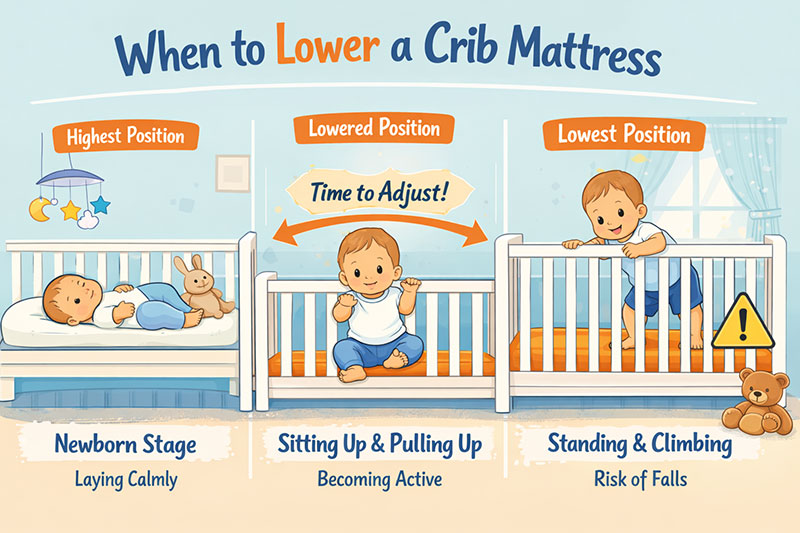
What “lowering a crib mattress” actually means
Lowering a crib mattress means moving the mattress support to a lower setting inside a baby crib, so the top edge of the crib rail stays tall enough as your baby gets more mobile.
Same crib. Same mattress. Just a different height setting. People call it “lowering the crib mattress,” “dropping the mattress,” or “changing the crib height.” I’m going to use one main term here: lower the crib mattress.
In the United States, this question shows up fast because crib use changes the minute babies go from “lying there” to “trying things.”
This page explains general US safety standards and common milestone timing, not product-specific instructions for any crib model.
For parents planning ahead and trying to time crib assembly, room setup, and early safety adjustments correctly, I break that down clearly on when to set up a nursery so the crib is ready before these milestone changes happen.
Parents usually start searching for when to lower a crib mattress right when their baby’s movement changes from passive to purposeful, and that timing question comes up fast.
Decision in one sentence
Lower the crib mattress as soon as your baby can sit up steadily or pull up on the rails, because that’s when rail height starts to matter in real life.
This is where most parents get confused.
When to lower a crib mattress
When to lower a crib mattress is mostly about movement, not age. Some babies are early climbers. Some are late bloomers. So the clean way to think about it is simple: lowering becomes urgent when your baby can get higher in the crib without you doing anything.
That’s why the question of when to lower a crib mattress usually comes up suddenly, right when a baby’s strength and confidence shift almost overnight.
Rolling is a big milestone, but it’s not usually the moment that forces a height change. Sitting up without tipping, pulling to stand, and that “I’m going to try this” energy? That’s the shift.
If you want a quick anchor, these are the milestones that most often line up with lowering: sitting independently, pulling up on the rails, and standing with support.
If you only remember one thing
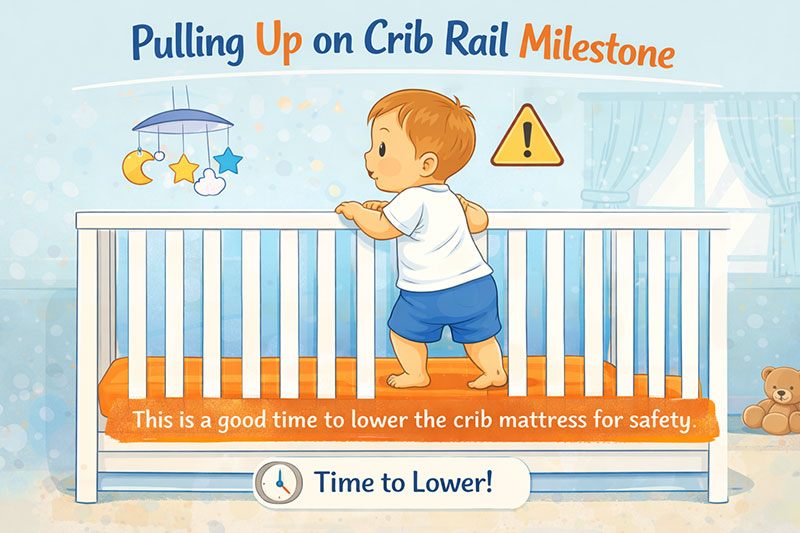
If your baby can pull up on the crib rail, the crib mattress should not be at the highest setting anymore.
Not later. Not “after this weekend.” That’s the tipping point for most families.
Why crib mattress height matters more than people think
A crib looks tall. It feels sturdy. So it’s easy to assume the height setting is just about convenience for the parent.
It’s not.
Crib rail height is one of the quiet parts of crib use that changes as soon as a baby can lift their chest, get a knee under them, and rise up
That change in reach is exactly why mattress height matters, and this crib mattress height adjustment guide shows how those height settings actually work inside the crib.
The mattress height setting is how the crib “keeps up” with your baby’s new reach.
This is also why two families can own the exact same crib and have totally different timelines. One baby is chill. Another baby is a tiny gymnast. Same crib. Different reality.
If you’re sorting out the bigger crib timeline too, this page connects the dots without drama: crib lifespan and when it’s time to replace a crib.
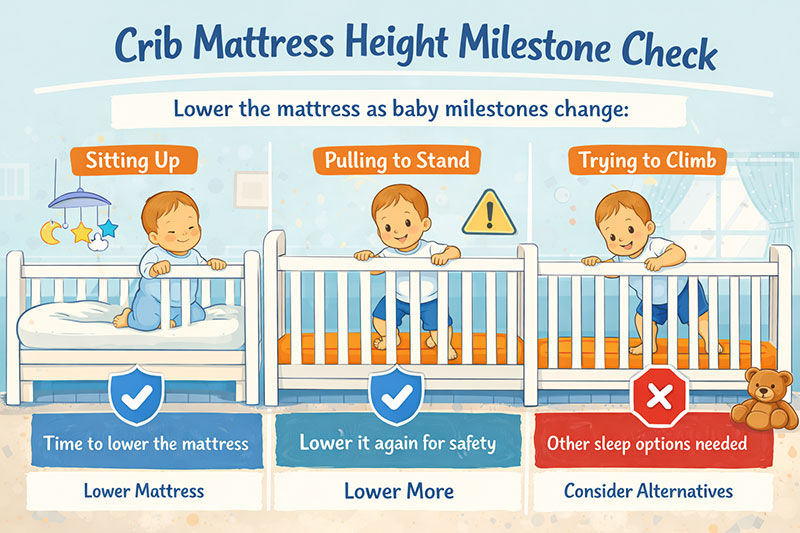
What goes wrong when you wait too long
Most parents don’t “forget.” They just don’t realize how quickly things change once babies get strong.
Here’s what usually happens: one day your baby is sitting and smiling. A week later they’re pulling up. Another week later they’re testing balance and reach. The crib didn’t change. Your baby did.
Waiting too long can mean your baby’s upper body gets close to the top of the rail during normal movement. That’s not a number you should try to “eyeball” and gamble on. It’s a sign you’re behind the milestone.
And there’s another thing. Parents lean in. We reach. We put pressure on rails without thinking. A more active baby plus a crib setup that hasn’t “kept up” can make the whole sleep setup feel less steady, even if nothing is broken.
That part matters more than people think.
Quick fit check
If your baby can get upright and their hands can grab the rail in a controlled way, treat that as the moment the crib setup needs a height change.
It’s a movement threshold. Not a birthday.
Common signs it’s time to lower the crib mattress
Parents search “when should I lower the crib mattress” because the signs feel subtle until they don’t. So here are the signs in plain words.
Sitting up without wobbling much. Pulling up on the rail even for a second. Getting knees under the body and rocking forward. Standing while holding the rail and looking proud of it. Those are the big ones.
Another sign is energy. A baby who repeatedly scoots to the edge, reaches for the rail, and tests balance is telling you something. You don’t need to wait for a perfect “first pull-up” moment to take it seriously.
If your question is more about the mechanical “levels” and how crib mattress height settings differ by crib style, this crib mattress height adjustment basics page covers that lane.
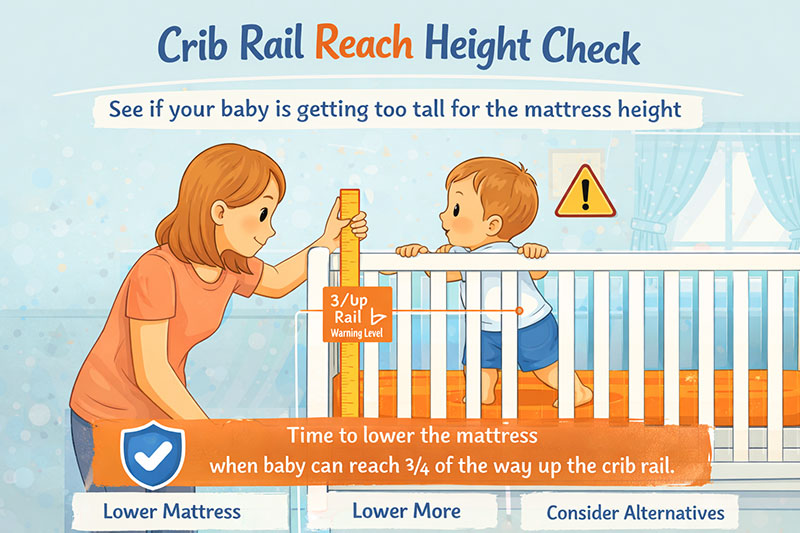
Mini FAQ: real questions parents ask about lowering a crib mattress
These are the questions I hear over and over. Short answers. No fluff.
When should you lower a crib mattress?
This is why questions about when to lower a crib mattress are really about recognizing developmental shifts, not following a calendar date.
Lower the crib mattress when your baby can sit up steadily or pull up on the rails. That’s the moment the crib needs more rail height during normal movement.
Is there a specific age to lower a crib mattress?
No single age fits every baby. Milestones are the reliable signal, because babies gain strength and mobility on different timelines.
Should you lower the crib mattress when a baby starts pulling up?
Yes. Pulling up is one of the clearest “time to lower” signs, because your baby’s body is now rising higher inside the crib.
Can you lower a crib mattress too early?
Lowering earlier than necessary usually affects adult convenience, not baby comfort. The bigger risk is waiting until your baby is already upright and reaching high.
What happens if you wait too long to lower a crib mattress?
Waiting too long can reduce the effective rail height as your baby grows and gets stronger. The crib feels the same, but your baby’s reach changes fast.
Did I buy the right crib type for my lifestyle?
A lot of stress around crib mattress height timing comes from the crib type itself. Some cribs sit taller. Some are compact. Some have different stage limits. And parents hear the same word—“crib”—for totally different products.
A full-size crib is built for daily sleep across a longer stretch. A mini crib can be a great space saver, but it’s still a different setup. A travel crib is fantastic for travel, but it’s not built to feel identical to a full-size crib in everyday use. None of that is “bad.” It’s just matching the product to the season you’re in.
This timing question also connects to the bigger picture of everyday crib use, which we cover more broadly on our baby cribs overview page.
If you’re still deciding between sleep setups, this comparison page connects the lifestyle pieces: crib vs bassinet vs mini crib.
And if your question is partly about size and fit in your room, this one keeps it simple: crib dimensions and standard sizes.
Most parents choose
Most parents feel best with a sturdy full-size crib setup, then lowering the crib mattress early enough that they’re not watching every rail grab like it’s a suspense movie.
Peace matters.
A short edge-case note on older or secondhand cribs
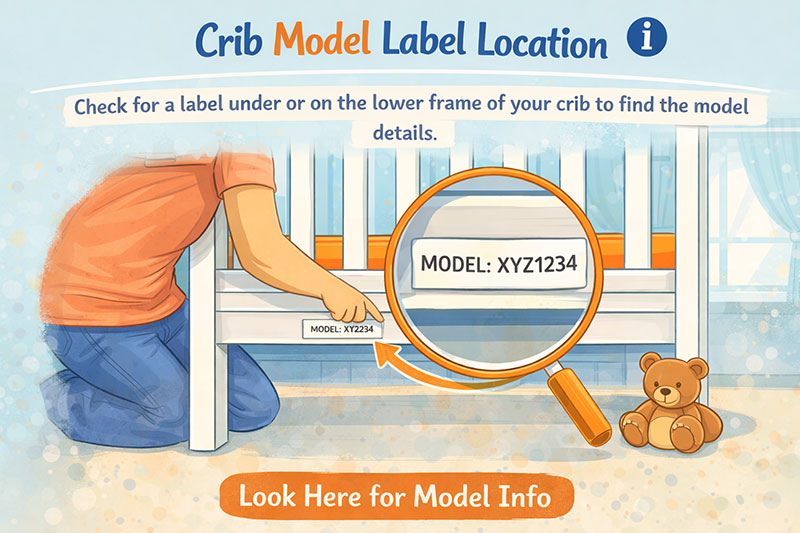
Older cribs and secondhand finds can be beautiful. They can also be missing a manual, missing a model label, or built under older US rules.
If you can’t clearly identify the crib model and its mattress height system, treat the setup as “unknown” and don’t guess your way through it.
For the bigger secondhand question, this page lays out what matters in plain language: is it safe to use a used crib.
What should I do now?
What to do next is simple: look at what your baby can do today, not what a chart says “should” happen.
If sitting is solid or pulling up has started, treat that as your decision point for lowering the crib mattress. That’s the cleanest answer that matches real baby behavior and how cribs are meant to be used under US safety standards.
Then keep it calm. A stable, predictable sleep setup beats a stressful one every time.
If you need help identifying manuals, model details, or reference material for your crib, these hubs can be useful: crib instructions and baby crib parts.
And for the most authoritative US reference on crib standards and recalls, the US Consumer Product Safety Commission is the best place to verify public guidance: CPSC crib safety information.
What to do next
Pick one thing to confirm today: what your baby can do at the rail. Sitting. Pulling up. Standing attempts.
That single observation answers the question better than any age guess.
If this sounds picky, it is—and for a reason.
When you click on links to various merchants on this site and make a purchase, this may result in this site earning a commission. This does not affect the price you pay.

UBGI Gold Standard 2026
Reviewed under the site's
editorial checklist.
Photos, decorating ideas, party setups and reader submissions are shared for inspiration unless a page is specifically presented as a pattern, tutorial, reference guide or step-by-step project. Follow the instructions, measurements, safety guidance and manufacturer directions provided for the particular project or product.
About Jan | Contact | Baby Nursery Ideas (Blog) | Site Map | Privacy Policy | Disclosure Policy | Disclaimer | Affiliate Disclosure | Earnings Disclosure | Facebook | Pinterest
I am a participant in the Amazon Services LLC Associates Program, an affiliate advertising program designed to provide a means for us to earn fees by linking to Amazon. As an Amazon Associate I earn from qualifying purchases.
Copyright © 2006-2026. All Rights Reserved.