Crib vs Bassinet vs Mini Crib: Which One Actually Fits Your Home and Lifestyle?
The issue of crib vs bassinet vs mini crib is not just about product choices or price; it’s a decision shaped by your home layout, sleep routines, and how you actually live day to day with a new baby. Some families need something compact and close at hand for the early months, others want a longer-term sleep solution that works in a dedicated nursery, and many fall somewhere in between. Understanding how each option fits into real homes and real lifestyles makes the decision clearer and far less overwhelming.
Most parents do not realize how different these baby sleep setups really are until they run out of space, time, or flexibility:
What kind of crib actually works in a small nursery?
The mini crib mattress mistake many parents make
Why some travel cribs become everyday sleep spaces
These two products are often confused — but they are not the same
All cribs, mini cribs, and bassinets discussed on this site are interpreted within the context of current United States sleep product safety standards, manufacturer documentation, and regulatory classifications. Full-size cribs and mini cribs are regulated crib structures with defined dimensions, hardware requirements, and use limits. Bassinets are regulated under a separate product category with different size expectations and intended duration of use. This page provides category-level comparison only and does not provide product-specific instructions, safety approvals, or individualized recommendations.
What “crib vs bassinet vs mini crib” really means in real homes
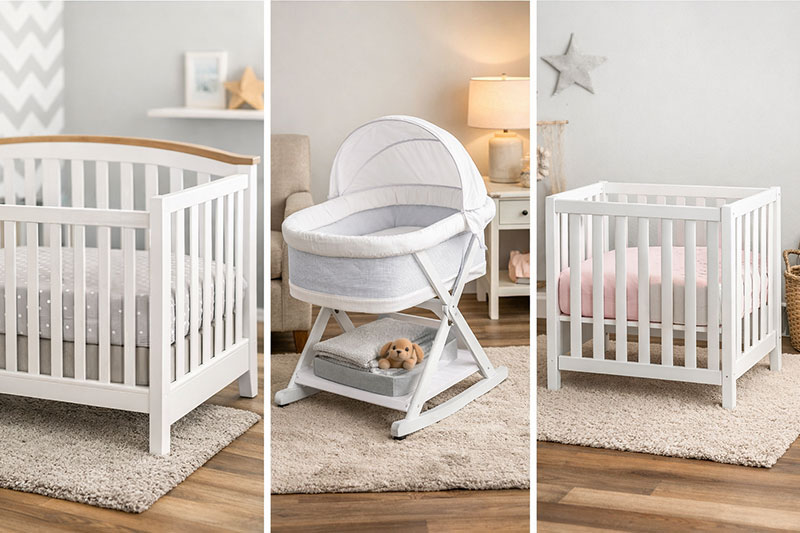
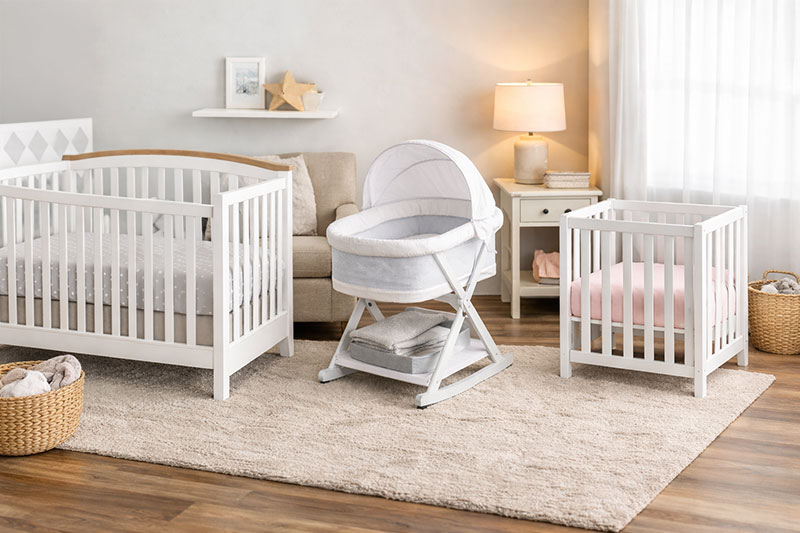
A full-size crib is a long-term regulated crib structure, a bassinet is a short-term proximity sleep product, and a mini crib is a compact crib structure with a smaller footprint but longer use than a bassinet.
Crib vs bassinet vs mini crib is not a style debate or a trend question. It is a practical choice between three baby sleep spaces that work very differently inside real homes in the United States.
We are talking about completely different options here: a full-size crib, a bassinet, and a mini crib. When parents search for the terms crib vs bassinet vs mini crib, they are usually trying to match space, day to day routines, and how long each option will last.
This page explains general US safety standards and real-life fit factors, not product-specific instructions.
That part matters more than people think.
What to do next: keep reading until you can identify your space limitations and your time limit. The answers to those two questions usually settle the crib vs bassinet vs mini crib decision.
Details on Each Option
Full-size crib
A full-size crib is the long-haul sleep work horse. It is the standard nursery crib most people picture when comparing crib vs bassinet vs mini crib options. It takes up the most floor space and usually has the longest lifespan.
In real life, this is the steady choice. Not perfect. Just consistent.
Bassinet
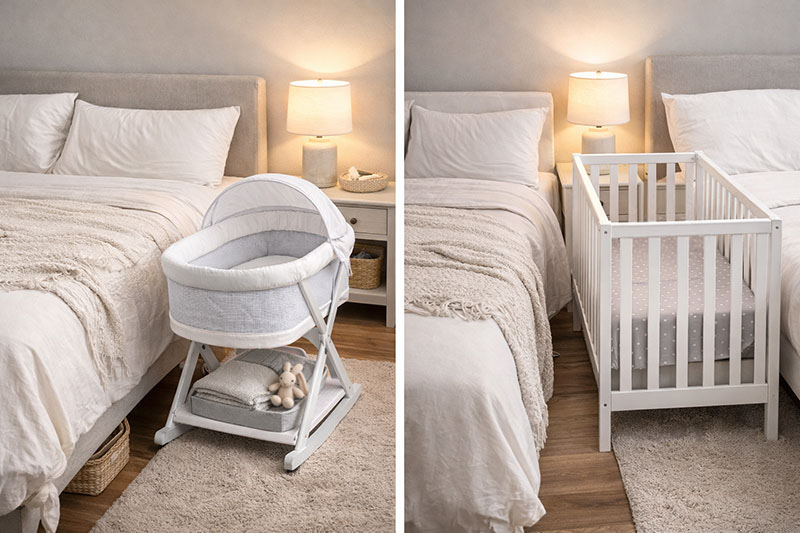
A bassinet is a smaller baby bed designed for the early months and close proximity. In the crib vs bassinet vs mini crib conversation, this is the shortest-term option, even though it often feels easiest at first.
It works early. Then it ends.
Mini crib
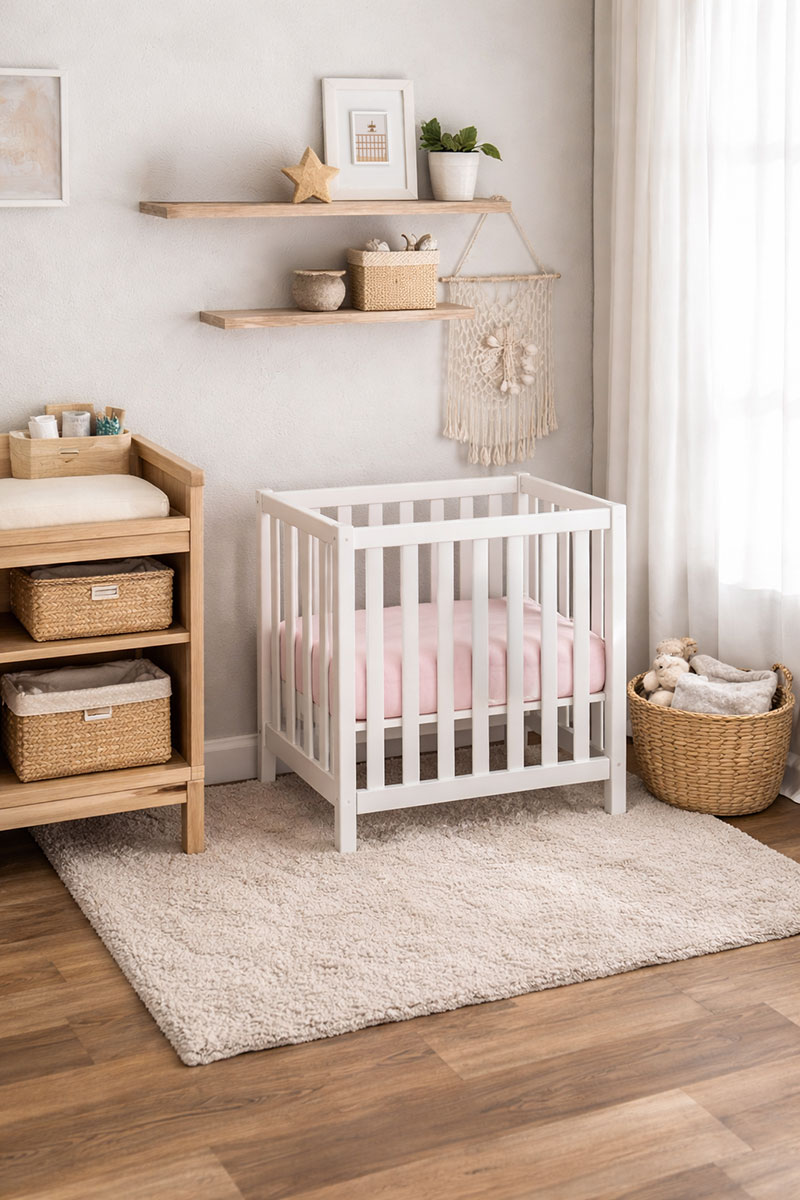
A mini crib is a compact crib with a true crib structure. In the crib vs bassinet vs mini crib comparison, it is the space-saving middle ground that fits smaller rooms better than a full-size crib.
Crib shape. Smaller footprint.
Why this choice affects daily life
This decision changes how nights feel. How often you walk across the room. How much furniture you work around. Crib vs bassinet vs mini crib is really about how your home functions at 2 a.m.
Space matters. Door swing. Drawer clearance. Where the light lands. These details quietly decide whether a sleep setup feels calm or cramped.
There is also a money rhythm to this choice. A bassinet often leads to a second purchase. A mini crib can feel just right or just a little short-lived. A full-size crib asks for commitment up front.
This is where most parents get confused.
If you only remember one thing
The best option in a crib vs bassinet vs mini crib choice is the one that fits your home without forcing constant adjustments.
Floor space plus time of use. Everything else is noise.
What goes wrong when the fit is off
Most problems are quiet. Babies outgrow bassinets faster than expected. Mini cribs feel perfect until storage becomes tight. Full-size cribs feel solid but overwhelm small nurseries.
Another issue is expectation drift. Sleep routines change. Room sharing lasts longer or ends early. A crib vs bassinet vs mini crib choice that made sense on paper can feel different in real life.
Each category has limits. A crib is built for longer use. A bassinet is not. A mini crib sits between them. Those boundaries exist for a reason.
Those structural boundaries are also tied to manufacturer-defined crib weight limits, which determine how long a crib can safely function as a regulated sleep space.
For foundational context, my main reference hub page has more information on the topic of baby crib types and standards.
Did I buy the right size crib?
Most parents want reassurance that they have spent their money wisely. The choice is right when it matches your room size, your sleep setup, and how long you need the sleep space to work.
No second guessing required.
Quick fit check
Can you move through the room without bumping furniture? Can doors and drawers open freely?
Does this still make sense three months from now?
Most parents choose
In a nursery, many parents choose a full-size crib for longevity.
In smaller homes or apartments, many choose a mini crib because it balances function and space.
To see which compact models actually perform best in tight layouts, this breakdown of top mini cribs for small spaces compares real-world fit, footprint, and usability.
For more ideas on choosing a crib that works in a tighter nursery, apartment, or shared room, see small-space crib options.
Room-sharing reality
A bassinet often works well early. The tradeoff is time.
If you want one purchase that carries you farther, a crib usually does that more cleanly.
Size comparisons are covered in detail on crib dimensions and standard sizes.
Situations worth noting
Older sleep spaces, secondhand items, and missing manuals are common.
Unknown models and missing parts complicate decisions.
This page explains crib vs bassinet vs mini crib at the category level only.
Words that cause confusion
I use one primary term here: sleep space. Other terms like baby bed or nursery crib get used interchangeably, but sleep space keeps things clear.
“Portable crib” is another fuzzy phrase. Some people mean a mini crib. Others mean something else entirely. This page stays focused.
To sort out what people usually mean by portable sleep setups, this breakdown of travel crib vs pack and play differences explains how those categories are defined and used in everyday situations.
Definitions are explained further in the crib terminology glossary.
Why US safety standards shape this decision
In the United States, crib and bassinet categories are regulated differently. That affects design, size, and expected use.
Understanding those boundaries keeps the crib vs bassinet vs mini crib choice grounded in reality.
For authoritative guidance, see the US Consumer Product Safety Commission safe sleep information.
What should I do now?
In most homes, a full-size crib works best unless space is tight.
In tighter spaces, a mini crib often keeps the room functional.
If a bassinet is already in place and working, it can be fine short term. Just recognize its limits.
What to do next
Decide how long you need the sleep space to last.
Let your floor plan settle the rest.
For what comes later, see when to switch from crib to toddler bed.
One clear decision. Then you move on.
When you click on links to various merchants on this site and make a purchase, this may result in this site earning a commission. This does not affect the price you pay.

UBGI Gold Standard 2026
Reviewed under the site's
editorial checklist.
Photos, decorating ideas, party setups and reader submissions are shared for inspiration unless a page is specifically presented as a pattern, tutorial, reference guide or step-by-step project. Follow the instructions, measurements, safety guidance and manufacturer directions provided for the particular project or product.
About Jan | Contact | Baby Nursery Ideas (Blog) | Site Map | Privacy Policy | Disclosure Policy | Disclaimer | Affiliate Disclosure | Earnings Disclosure | Facebook | Pinterest
I am a participant in the Amazon Services LLC Associates Program, an affiliate advertising program designed to provide a means for us to earn fees by linking to Amazon. As an Amazon Associate I earn from qualifying purchases.
Copyright © 2006-2026. All Rights Reserved.