Crib Mattress Height Adjustment Guide (When to Lower the Mattress)
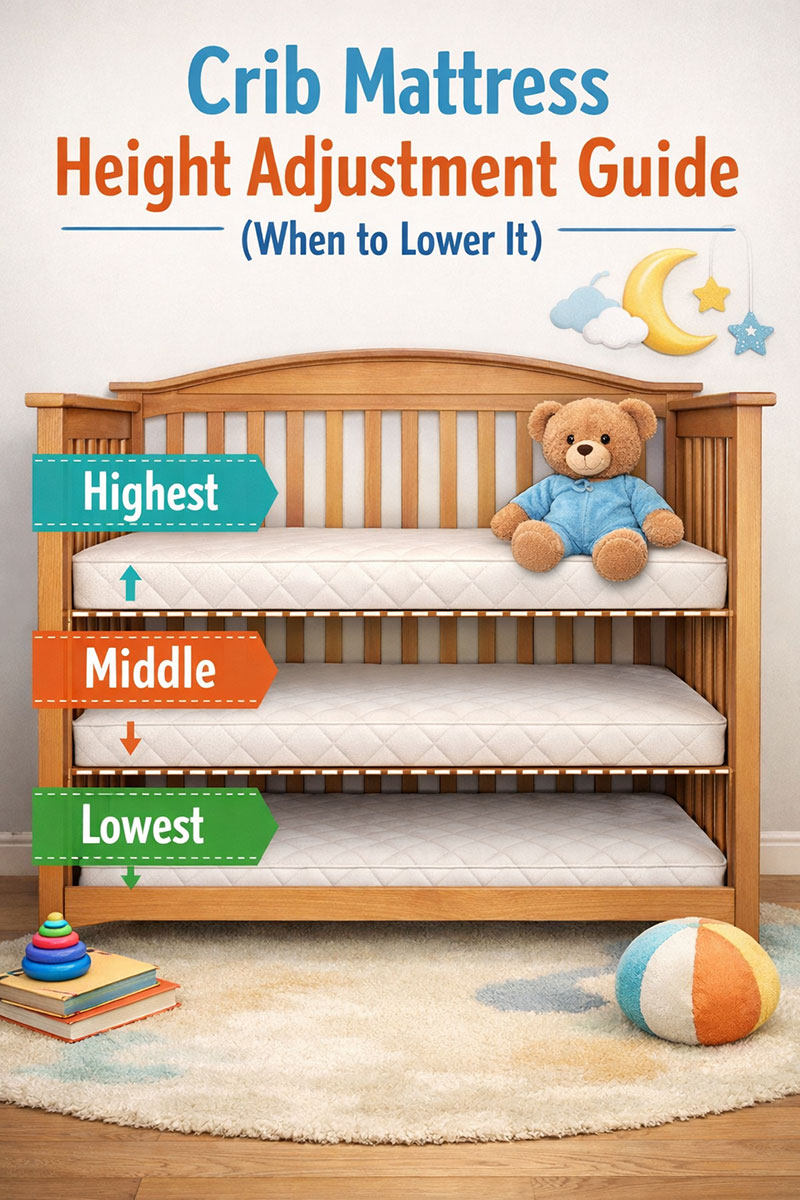
You should lower a crib mattress as soon as your baby starts pushing up on hands and knees, pulling to stand, or reaching the top rail, because higher mattress settings become unsafe once mobility increases.
Not sure when to lower the crib mattress before climbing starts? Check these first:
This page focuses on crib mattress height adjustment and how mattress support positions are commonly described for different crib setups. For more information on crib mattress fit, firmness, sizing, and safety basics, see my crib mattress guide.
This crib mattress height adjustment guide connects into the broader crib usage stages, standards, and selection context, which is organized on the baby cribs overview.
In most cribs, the mattress height is controlled by a mattress support frame, platform, or spring assembly that attaches to the crib at fixed bracket or bolt locations.
- Crib mattress height adjustment refers to changing the position of the mattress support frame within a crib.
- Most cribs include multiple height settings designed for different stages of infant movement.
- Height settings are typically labeled using levels or age-based terms rather than measurements.
- Adjustment guidance is defined by crib design and manufacturer documentation rather than universal timing.
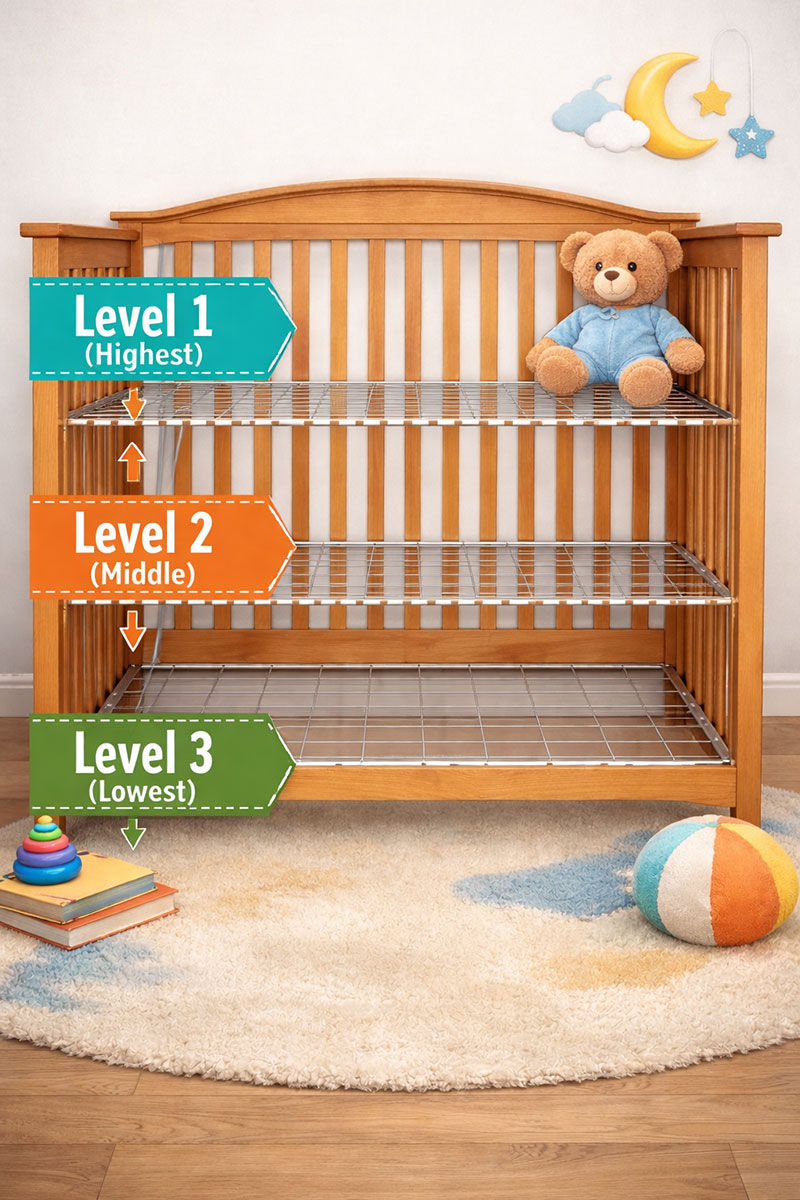
Height settings can be confusing because crib manuals, retailers, and manufacturers do not always describe them the same way. The real goal is to understand what the highest, middle, and lowest positions mean as your baby becomes more active.
Crib Mattress Height Adjustment Guide: what parents really want to know
Crib mattress height adjustment guide searches usually mean one thing: you want the crib to feel “right” again now that your baby is changing fast. You see the mattress sitting up high, then one day your baby looks taller, stronger, wigglier… and your brain goes, “Wait. Did I set this up wrong?”
Here’s what to do next, right now: take a quick look at where your mattress support is sitting (top, middle, or bottom), then find your crib’s manual so you can match the words to the actual holes and brackets on your crib. My crib instructions hub is the easiest starting point when the manual is missing or buried in a drawer, and it pairs naturally with any crib mattress height adjustment guide you’re using.
What “mattress height adjustment” means (in normal-people language)
Some older or discontinued cribs may use non-standard mattress support designs, spacing, or hardware that does not match current crib models. In those cases, published height guidelines may not align cleanly with the crib’s original configuration, and identifying the exact model becomes especially important.
Most cribs have a mattress support frame (sometimes metal, sometimes wood) that can sit at more than one level inside the crib. That support frame is what the mattress rests on. Adjusting the height simply means moving that support frame up or down to a different set of holes or brackets.
Some cribs call the settings “Level 1 / Level 2 / Level 3.” Others call them “newborn,” “infant,” and “toddler.” The names change, but the idea stays the same: higher is easier for parents to reach when baby is tiny, and lower gives more room as baby grows. Any solid crib mattress height adjustment guide is really just helping you translate those labels into real-life use.
When parents usually lower the mattress (without guessing)
When to lower the crib mattress (simple rules)
Lower the crib mattress when your baby:
- Pushes up on hands and knees
- Pulls up or tries to stand
- Can reach or lean toward the top rail
- Looks noticeably taller in the crib than before
Always follow your crib’s manual if it gives a specific instruction, because some crib models include their own height adjustment guidance.
I’m not going to pretend there’s one magic week where every baby changes overnight. What I can tell you is what parents notice right before they start thinking about lowering the mattress: baby is pushing up, pulling, scooting, or suddenly getting “tall” in the crib in a way that makes the rail feel closer than it used to.
The most reliable way to decide is this: use your crib’s own manual as your “rule book,” then line that up with what your baby is doing right now. When a crib brand gives a height-change cue, it’s usually based on movement (not just age), which is why a crib mattress height adjustment guide should always point you back to the specific crib model.
If your baby is also spending more time mouthing or chewing the top rail during this stage, this explains the common reasons behind that behavior: why babies chew crib rails.
Quick fit check
Stand next to the crib and look at the top rail compared to your baby’s chest and shoulders when they’re upright. This is not a math test. It’s a simple visual check that tells you whether the crib still feels like it has plenty of “room” above baby.
Then look at the mattress support itself. Make sure it’s sitting flat and even on all four corners, with no corner higher than the others. A crooked support frame can make everything feel off.
Did I buy the right crib and mattress for this stage?
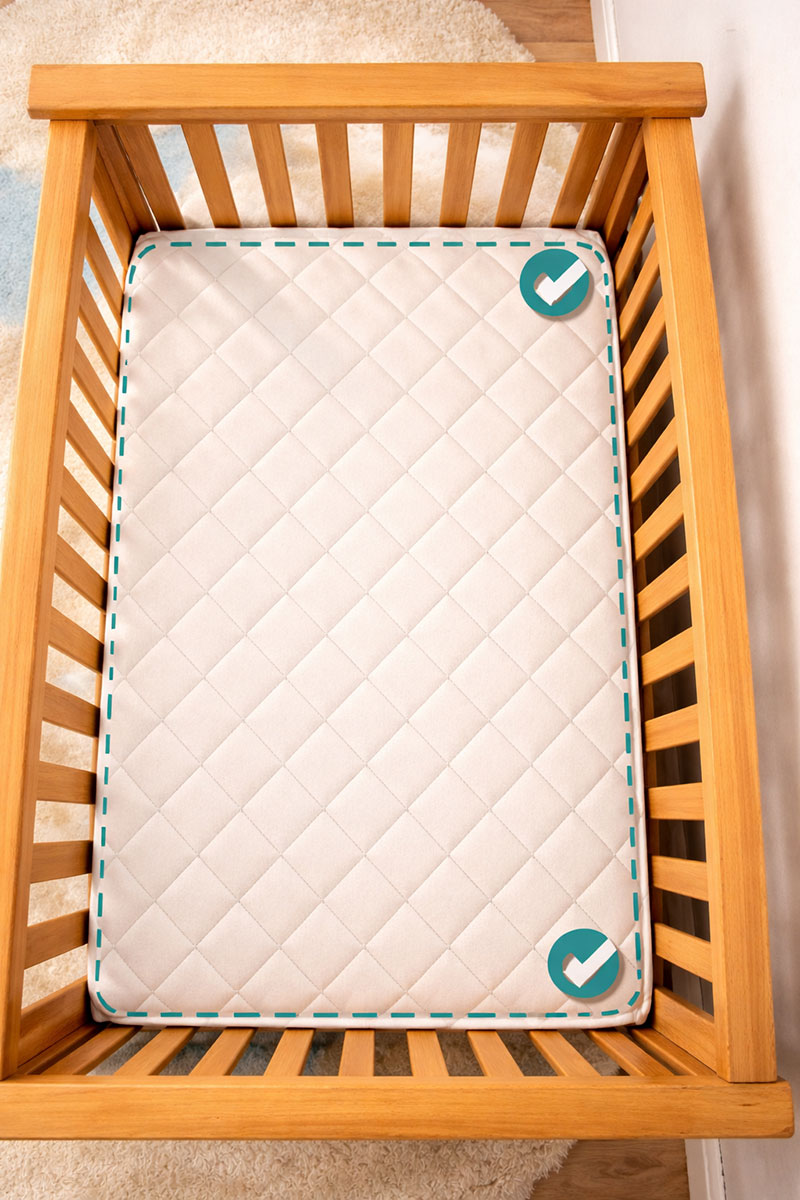
This question pops up a lot, and I get it. When you’re tired, you start second-guessing everything. A good “fit” usually comes down to the mattress size, how snug it sits inside the crib, and whether the support frame is the correct one for that crib model.
In crib discussions, fit refers to how securely the mattress sits in the crib, gap describes visible space between the mattress edge and crib sides, and tolerance refers to the small dimensional allowances permitted by safety standards.
On the mattress side, I keep a full guide here: crib mattress basics and sizing. For parents who want the quick version, the mattress should sit snug in the crib with no weird leaning, bowing, or shifting when you press down near the edges.
Most parents choose
Most parents keep the mattress at the highest setting only for the earliest stretch, then move it down once baby starts looking more “active” in the crib.
Movement changes are usually the real signal, not age alone, and this guide explains exactly how to spot that transition clearly: when to lower a crib mattress.
After that first drop, many families end up staying on the middle setting for a while, then move to the lowest when baby’s movement changes again.
That middle stage is when small details start to matter more, including mattress firmness, how the sheet fits, and whether the surface stays clean and protected from everyday messes. I break those out separately in my crib mattress firmness explained and crib mattress protector basics, while my best breathable crib mattress guide compares which airflow-focused designs still stay firm, fit correctly.
What the hardware should look like (so you can spot “not right” fast)
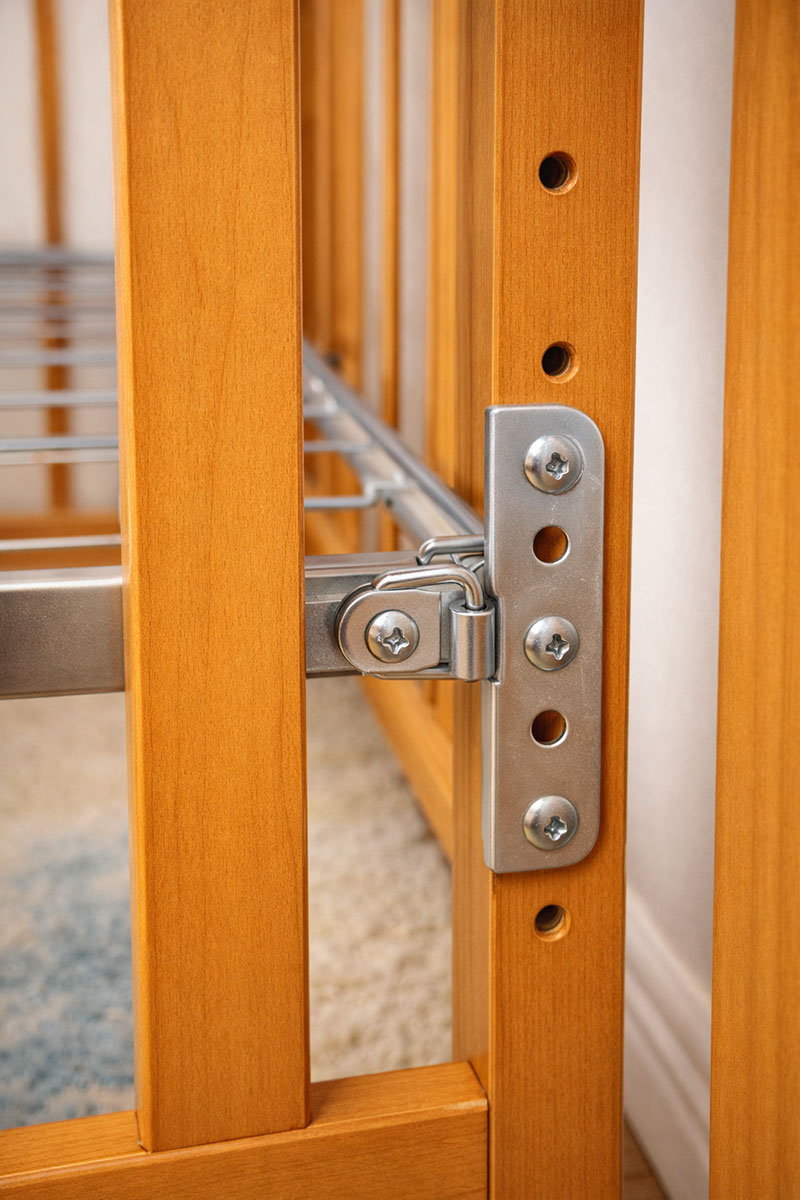
Crib mattress supports usually attach in one of a few ways: bolts into threaded inserts, hooks into brackets, or a frame that rests on fixed ledges with locking hardware. You don’t need to love tools to understand what you’re seeing—you just need to know what “matched corners” looks like.
All four corners should be using the same type of connection, at the same height, with the same hardware. A mixed set (one corner on a different hole, or one corner missing a fastener) is the kind of thing that makes parents feel uneasy, and for good reason: it can cause a tilt you notice when you change sheets.
If you only remember one thing
Match the manual to the crib you actually have. Brand names get reused, cribs get handed down, and photos online can be misleading. The manual (or the model number on the crib) is what keeps you from guessing.
When the manual is missing, the next best step is identifying the exact crib model and tracking down the official instructions. My manual lookup starting point is built for that exact moment.
What to do now (the simple, calm plan)
Here’s the practical next step: decide which setting you’re on today, then decide whether you’re moving down one level soon based on your crib’s manual and what you’re noticing in real life. Take five minutes to tighten and re-check the mattress support corners so you know everything is even.
After that, I like to do a quick “daily-life” check: can you reach baby comfortably for bedtime routines, and does the crib still feel roomy at the top rail? This is about confidence and clarity, not perfection, and it’s exactly how I personally use a crib mattress height adjustment guide.
When the crib is older, or the parts don’t look original
Older cribs can come with mysteries: missing bolts, swapped brackets, or a support frame that looks close-but-not-quite. This is where I slow down and get very picky about model numbers and correct parts. My parts reference pages exist to help you identify what you have, not to encourage repairs on recalled or outdated crib designs.
When you’re trying to figure out what a piece is called (especially that mattress support frame), this page helps: crib hardware and part names glossary. Having the right name makes searching and comparing much easier.
A single authoritative reference (for the rule-makers)
For parents who want to read the official language behind crib requirements in the U.S., the Consumer Product Safety Commission is the place I trust for standards and recall information.
CPSC crib standards and rulemaking overview
What to do next (near the finish line)
Next step: once your mattress support is on the right level, take one clear photo of the inside corners (one photo per corner). Save them in a folder named with your crib brand and model. That tiny habit makes future questions easier—especially when someone else helps with bedtime and asks, “Which level is this supposed to be?”
Then, keep your crib notes together: your manual (or the model number), your mattress brand and size, and any parts info. When something feels confusing later, you’ll have the exact details ready instead of relying on memory.
If you’re unsure about timing, it’s safer to lower the crib mattress earlier rather than later, because increased movement can make higher settings unsafe faster than expected.
When you click on links to various merchants on this site and make a purchase, this may result in this site earning a commission. This does not affect the price you pay.

UBGI Gold Standard 2026
Reviewed under the site's
editorial checklist.
Photos, decorating ideas, party setups and reader submissions are shared for inspiration unless a page is specifically presented as a pattern, tutorial, reference guide or step-by-step project. Follow the instructions, measurements, safety guidance and manufacturer directions provided for the particular project or product.
About Jan | Contact | Baby Nursery Ideas (Blog) | Site Map | Privacy Policy | Disclosure Policy | Disclaimer | Affiliate Disclosure | Earnings Disclosure | Facebook | Pinterest
I am a participant in the Amazon Services LLC Associates Program, an affiliate advertising program designed to provide a means for us to earn fees by linking to Amazon. As an Amazon Associate I earn from qualifying purchases.
Copyright © 2006-2026. All Rights Reserved.