Crochet Bee Lovey Pattern
This free crochet bee lovey pattern will show you how to make a baby security blanket that is both playful and practical. The design combines a cuddly honey bee with a comforting blanket, making it a thoughtful baby shower gift, nursery accessory, or handmade keepsake for little ones.
More Free Crochet Baby Patterns:
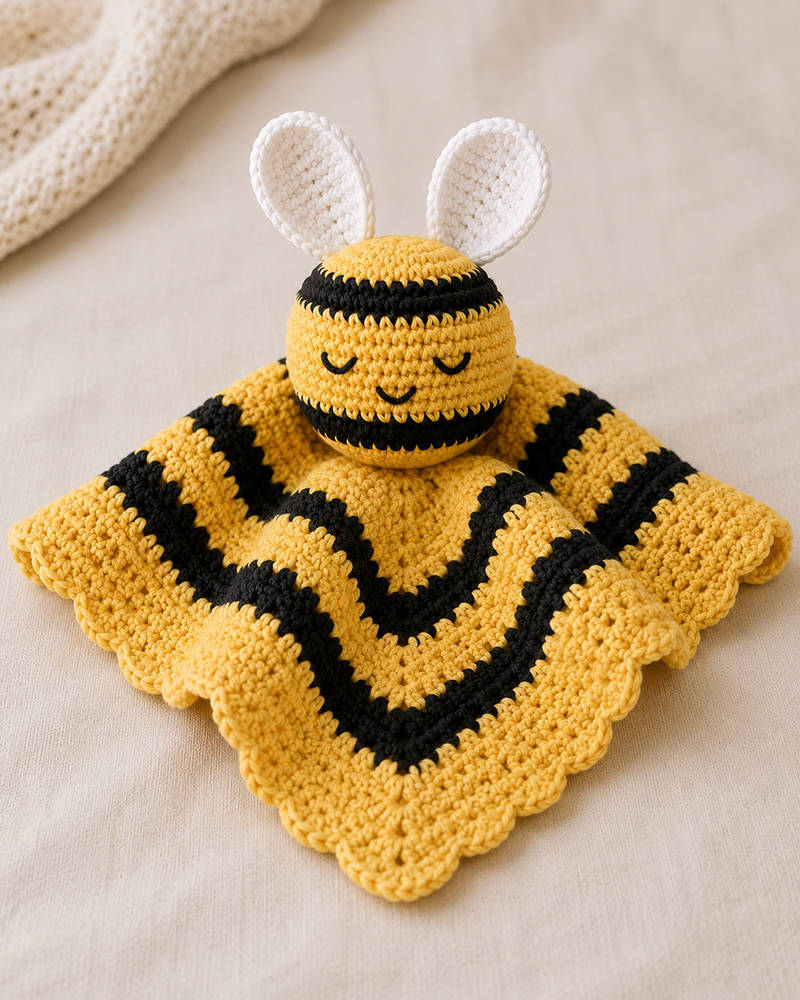
This crochet bee lovey pattern combines a cheerful bee design with a comforting baby security blanket.
Helpful Supplies for This Crochet Bee Lovey Pattern
A soft cotton yarn, this crochet bee lovey pattern and a quality crochet hook make this an easy project.
Pattern Note: This pattern is designed to produce a crochet bee lovey with the same general features and proportions shown in the page images. Finished measurements and appearance may vary slightly depending on yarn brand, hook size, stuffing, and individual crochet tension.
Safety Note: This pattern uses embroidered facial features. For baby projects, avoid buttons, beads, plastic eyes, or any other small attached parts that could become detached.
Infant Sleep Safety: Use this lovey only during supervised awake time. Do not place it in a crib, bassinet, play yard, bedside sleeper, or other infant sleep space, and remove it if the baby falls asleep. Infant sleep spaces should remain bare except for a properly fitted sheet. See the CPSC safe sleep guidance.
Jump To:
Looking for another nursery themed project? Browse these crochet animal lovey patterns for more handmade nursery gift ideas.
Materials For This Crochet Bee Lovey Pattern
This pattern creates a crochet bee lovey with a striped bee head, upright wings, embroidered sleepy eyes, and a 15 inch striped blanket matching the design shown in the page images.
- 200 to 225 yards yellow worsted weight yarn
- 125 to 150 yards black worsted weight yarn
- 25 to 35 yards white worsted weight yarn
- 4.0 mm crochet hook
- 25 to 35 grams washable polyfill stuffing
- Black embroidery floss
- Yarn needle
- Scissors
- Stitch marker
Abbreviations
This pattern uses US crochet terminology.
- ch = chain
- sc = single crochet
- hdc = half double crochet
- dc = double crochet
- sl st = slip stitch
- inc = increase, work 2 sc in the same stitch
- dec = decrease, single crochet the next 2 stitches together
Gauge
Bee Head Gauge: 16 single crochet stitches and 18 rounds = 4 inches in firm single crochet before stuffing.
Check that the stitches are dense enough to prevent the stuffing from showing. The head gauge does not determine the blanket size because the blanket is worked in double crochet clusters.
Measure the blanket after Round 14 and before adding the edging. The finished blanket should measure approximately 15 inches square after the edging is completed, although yarn and tension may cause a small variation.
Finished Measurements
- Bee head: approximately 4.75 to 5 inches wide after stuffing
- Wing height: approximately 3.25 to 3.75 inches
- Wing width: approximately 2 to 2.25 inches
- Finished blanket: approximately 15 inches square after edging
Skill Level: Advanced beginner
Bee Head Pattern
Work the bee head in continuous rounds. Do not join at the end of each round. Place a stitch marker in the first stitch and move it upward after every round.
Keep the stitch marker and all color-change jogs centered at the back of the head. When changing colors, complete the final yarn-over of the last single crochet in the previous round with the new color.
Head Color Changes: After each color change, cut the previous yarn, leaving approximately a 6 inch tail. Weave the tail securely through several stitches on the inside of the head before stuffing. Do not carry the unused yarn across the yellow or black sections.
Using yellow yarn:
Round 1: Magic ring, 6 sc. (6)
Round 2: Inc in each stitch around. (12)
Round 3: *Sc, inc* around. (18)
Round 4: *2 sc, inc* around. (24)
Round 5: *3 sc, inc* around. (30)
Round 6: *4 sc, inc* around. (36)
Round 7: *5 sc, inc* around. (42)
Round 8: *6 sc, inc* around. (48)
Round 9: *7 sc, inc* around. (54)
Round 10: *8 sc, inc* around. (60)
Change to black yarn.
Rounds 11 and 12: Sc around. (60)
Change to yellow yarn.
Rounds 13 through 18: Sc around. (60)
Change to black yarn.
Rounds 19 and 20: Sc around. (60)
Change to yellow yarn.
Round 21: Sc around. (60)
Round 22: *8 sc, dec* around. (54)
Round 23: *7 sc, dec* around. (48)
Round 24: *6 sc, dec* around. (42)
Round 25: *5 sc, dec* around. (36)
Add enough stuffing to establish the rounded shape, but leave the lower opening accessible while embroidering the face.
Face Placement:
Turn the head so the stitch marker and color-change jogs are centered at the back.
Embroider the sleepy eyes between rounds 15 and 16 on the front yellow section.
Each eye should be approximately four to five stitches wide.
Leave approximately six stitches between the inner ends of the eyes.
Embroider the smile between rounds 17 and 18, centered below the eyes.
Secure all embroidery ends inside the head before continuing the decreases.
Round 26: *4 sc, dec* around. (30)
Round 27: *3 sc, dec* around. (24)
Round 28: *2 sc, dec* around. (18)
Finish stuffing the head firmly and evenly. Do not pack it so tightly that the stitches stretch or the stuffing becomes visible.
Round 29: *Sc, dec* around. (12)
Round 30: Dec around. (6)
Fasten off, leaving a yarn tail. Thread the tail through the front loops of the remaining six stitches, pull the opening closed, secure it, and bury the tail inside the head.
Bee Wings Pattern
Make two using white yarn.
Work in joined rounds. The beginning chain 1 does not count as a stitch.
Ch 9.
Round 1: Starting in the second chain from the hook, work 2 sc in the first chain, sc in each of the next 6 chains, and 4 sc in the last chain. Rotate the foundation chain and work along the unused loops on the opposite side. Sc in each of the next 6 chains and work 2 sc in the same chain that holds the first 2 sc. Join with a sl st to the first sc. (20)
Round 2: Ch 1. Work 2 sc in each of the first 2 stitches, sc in each of the next 6 stitches, 2 sc in each of the next 4 stitches, sc in each of the next 6 stitches, and 2 sc in each of the last 2 stitches. Join with a sl st to the first sc. (28)
Round 3: Ch 1. Work the following sequence 2 times total: sc in the next stitch, inc in the next stitch. Sc in each of the next 6 stitches. Work the following sequence 4 times total: sc in the next stitch, inc in the next stitch. Sc in each of the next 6 stitches. Work the following sequence 2 times total: sc in the next stitch, inc in the next stitch. Join with a sl st to the first sc. (36)
Round 4: Ch 1. Sc in each stitch around. Join with a sl st to the first sc. (36)
Fasten off, leaving a 12 inch tail for sewing.
Each wing should measure approximately 3.25 to 3.75 inches tall and 2 to 2.25 inches wide. The final round should cause the wing to cup slightly. Do not block the wing completely flat.
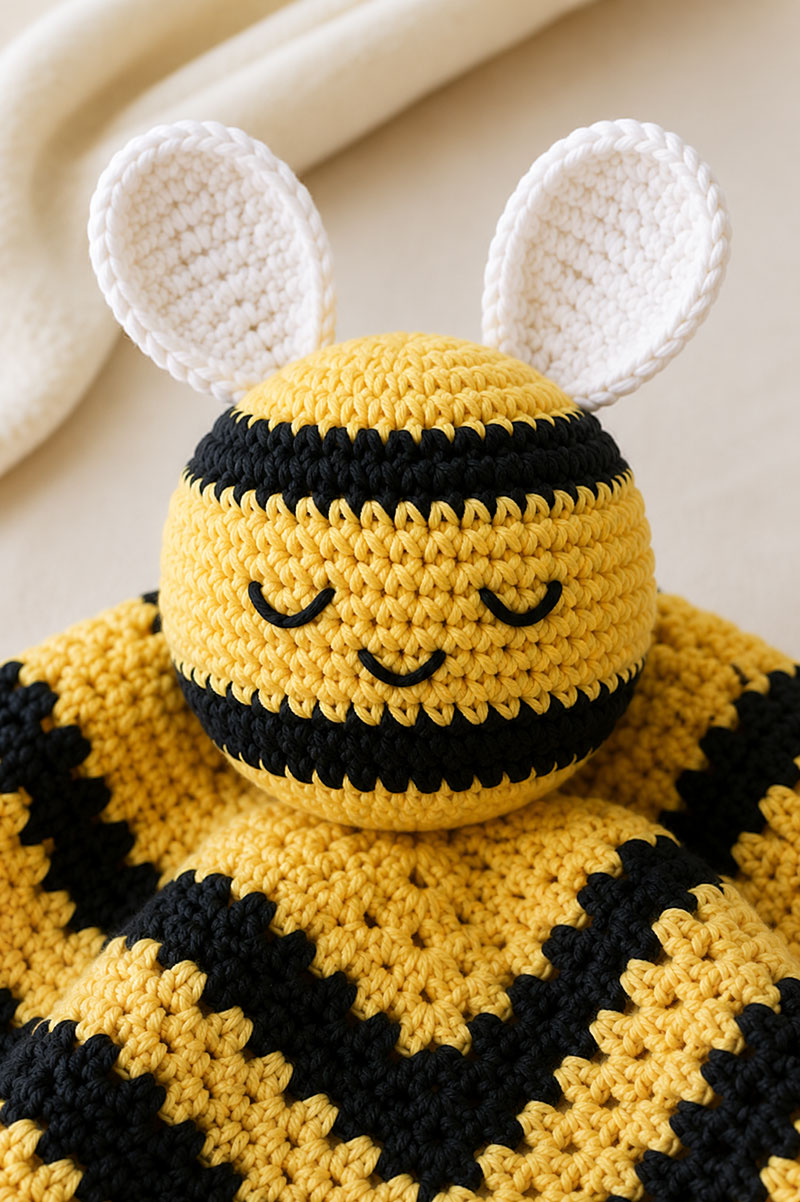
Close view showing the wing shape and the two black stripes used on the bee head.
15 Inch Bee Lovey Blanket Pattern
The blanket uses a traditional granny square construction worked in three-double-crochet clusters with chain-2 corner spaces. The alternating yellow and black rounds create the striped appearance shown in the page images.
Using yellow yarn:
Blanket Note: Chain 3 counts as the first double crochet at the beginning of each round. Join each round to the top of the beginning chain unless otherwise stated.
Right Side: Use the side with the cleaner round joins and fewer visible woven yarn tails as the right side of the blanket. Keep all fastened-off tails on the wrong side.
Blanket Color Changes: At each listed color change, complete the joining slip stitch with the new color. Cut the previous color, leaving approximately a 6 inch tail, and weave the tail securely into the wrong side. Do not carry the unused color up the outside edge across two complete rounds. After Round 14, fasten off the black yarn and weave in the tail before joining yellow yarn for the edging.
Round 1: Ch 4. Join with sl st to form a ring.
Ch 3. Work 2 dc into ring. Ch 2.
*Work 3 dc into ring. Ch 2.*
Repeat from * to * two more times.
Join to top of beginning chain.
You should now have 4 corner clusters and 4 corner spaces.
Round Check: 4 total clusters.
Beginning Each New Round: After joining the previous round, sl st in each of the next 2 dc and then sl st into the next corner ch-2 space. The beginning ch 3 counts as the first dc.
Round 2:
Sl st in each of the next 2 dc and into the first corner ch-2 space.
Ch 3. Work 2 dc, ch 2, 3 dc in the same corner space.
Work 3 dc, ch 2, 3 dc in each of the remaining 3 corner spaces.
Join with a sl st to the top of the beginning ch 3.
Round Check: 8 total clusters.
Round 3:
Sl st in each of the next 2 dc and into the first corner ch-2 space.
Ch 3. Work 2 dc, ch 2, 3 dc in the same corner space.
Work 3 dc in the space between the next 2 clusters.
*Work 3 dc, ch 2, 3 dc in the next corner ch-2 space. Work 3 dc in each space between clusters across the next side.*
Repeat from * to * around.
Join with a sl st to the top of the beginning ch 3.
Round Check: 12 total clusters.
Standard Round For Rounds 4 And Later:
Sl st in each of the next 2 dc and into the next corner ch-2 space.
Ch 3. Work 2 dc, ch 2, 3 dc in the same corner space.
Work 3 dc in every space between clusters across the side.
*In the next corner ch-2 space, work 3 dc, ch 2, 3 dc. Work 3 dc in every space between clusters across the next side.*
Repeat from * to * around.
Join with a sl st to the top of the beginning ch 3.
Each completed round adds 4 clusters.
Round 4, yellow: Work the standard round. (16 clusters)
Change to black yarn while completing the joining sl st.
Round 5, black: Work the standard round. (20 clusters)
Round 6, black: Work the standard round. (24 clusters)
Change to yellow yarn while completing the joining sl st.
Round 7, yellow: Work the standard round. (28 clusters)
Round 8, yellow: Work the standard round. (32 clusters)
Change to black yarn while completing the joining sl st.
Round 9, black: Work the standard round. (36 clusters)
Round 10, black: Work the standard round. (40 clusters)
Change to yellow yarn while completing the joining sl st.
Round 11, yellow: Work the standard round. (44 clusters)
Round 12, yellow: Work the standard round. (48 clusters)
Change to black yarn while completing the joining sl st.
Round 13, black: Work the standard round. (52 clusters)
Round 14, black: Work the standard round. (56 clusters)
Work through Round 14 for the stripe count shown in the page images, then measure the square before adding the edging.
If your yarn or tension requires a different round count, continue using the same standard round formula. Each additional round adds 4 clusters. The corrected edging below will fit any completed round count.
Stripe Sequence Used In The Page Images:
- Rounds 1 through 4: Yellow
- Rounds 5 and 6: Black
- Rounds 7 and 8: Yellow
- Rounds 9 and 10: Black
- Rounds 11 and 12: Yellow
- Rounds 13 and 14: Black
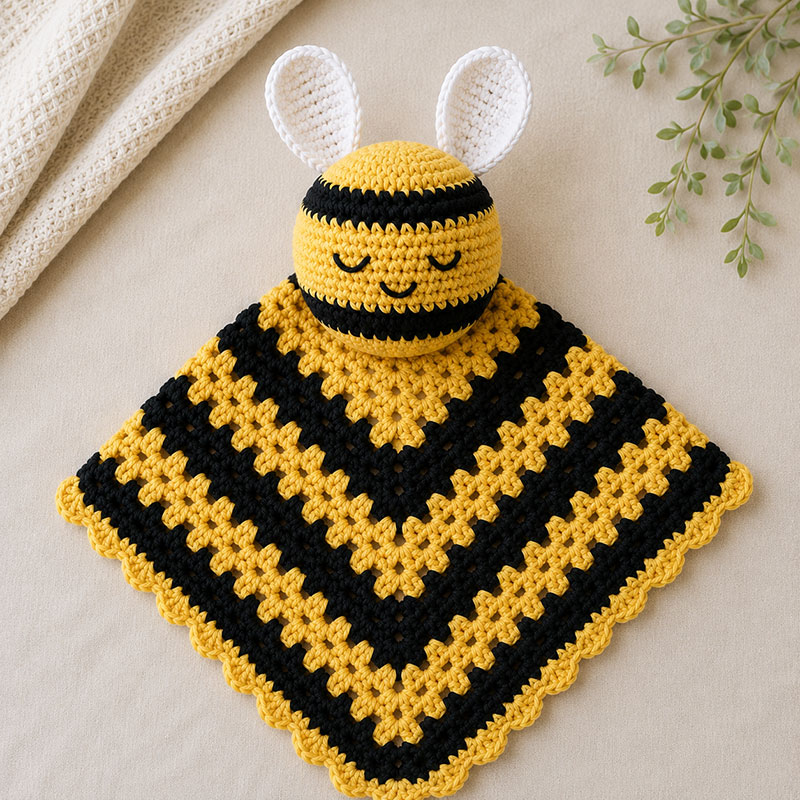
The completed blanket should display alternating yellow and black stripe sections similar to the page images.
Scalloped Border
The edging is worked in two rounds. The first round creates an even single crochet foundation. The second round creates the small scallops.
Edging Round 1:
Join yellow yarn in any corner ch-2 space.
Ch 1. Work sc, ch 2, sc in the same corner space.
*Sc in each dc across the side, working 1 additional sc in each space between the 3 dc clusters. In the next corner ch-2 space, work sc, ch 2, sc.*
Repeat from * to * 2 more times.
Sc in each dc across the final side, working 1 additional sc in each space between the 3 dc clusters.
Join with a sl st to the first sc. Do not work another corner group in the starting corner.
If the blanket has 14 completed granny rounds, Edging Round 1 will contain 228 sc and four ch-2 corner spaces.
Edging Round 2:
Sl st into the first corner ch-2 space.
Work 7 dc in the corner ch-2 space.
Sl st in the next sc.
*Skip the next sc, work 5 dc in the next sc, skip the next sc, and sl st in the next sc.*
Repeat from * to * across the first side until the final sl st is worked in the first sc of the next corner.
Work 7 dc in the next corner ch-2 space, then sl st in the next sc.
Repeat the side scallop sequence across the second side until the final sl st is worked in the first sc of the next corner.
Work 7 dc in the next corner ch-2 space, then sl st in the next sc.
Repeat the side scallop sequence across the third side until the final sl st is worked in the first sc of the next corner.
Work 7 dc in the next corner ch-2 space, then sl st in the next sc.
Repeat the side scallop sequence across the final side until the final sl st is worked in the first sc of the starting corner.
Join with a sl st to the first dc of the beginning corner shell.
Fasten off and weave in all yarn ends securely.
The finished border should lie flat and form small, evenly spaced scallops without gathering, flaring, or ruffling.
Blocking And Final Shaping: Before attaching the bee head, block the blanket only as permitted by the yarn care label. Shape it to approximately 15 inches square, straighten the four corners and scallops, and allow it to dry completely. Do not stretch the edging.
Assembly Instructions
Complete the embroidered face, stuffing, and head closure before beginning assembly.
Attach the Wings to the Head
Turn the head so the face is at the front and the stitch marker line and color-change jogs are at the back.
Position the lower edge of each wing across rounds 7 through 10 on the upper back portion of the head.
Place the wing bases approximately ¼ to ½ inch apart. The rounded upper ends should angle slightly outward.
Use the long white yarn tail to sew only the lower ¾ to 1 inch of each wing to the head.
Make at least two passes through the attached portion of each wing. Do not sew around the entire wing because the upper portion must remain free to stand upright.
Pass each remaining yarn tail through the stuffed head in two different directions, pull it snug without distorting the head, and trim it close to the surface so the end withdraws inside.
Check the wings from the front and adjust them until they are evenly spaced and stand at matching angles.
Attach the Head to the Blanket
Lay the blanket flat with the right side facing upward.
Locate the original center ring from Blanket Round 1.
Position the bee head directly over the center ring.
Turn the head so the face points toward one blanket corner rather than toward the middle of a side.
Thread a yarn needle with a long length of yellow yarn.
Sew around the lower portion of the head, catching head stitches from rounds 24 through 26 and secure blanket stitches surrounding the center ring.
Pass through both the blanket and the outer stitches of the head without pulling tightly enough to pucker the blanket.
Continue around the entire base of the head and make a second complete pass for added stability.
Secure the yarn, weave it through several nearby stitches, and bury the end inside the head or blanket.
Set the completed lovey on a flat surface and confirm that the blanket lies naturally, the head does not wobble, and the face remains directed toward the selected corner.
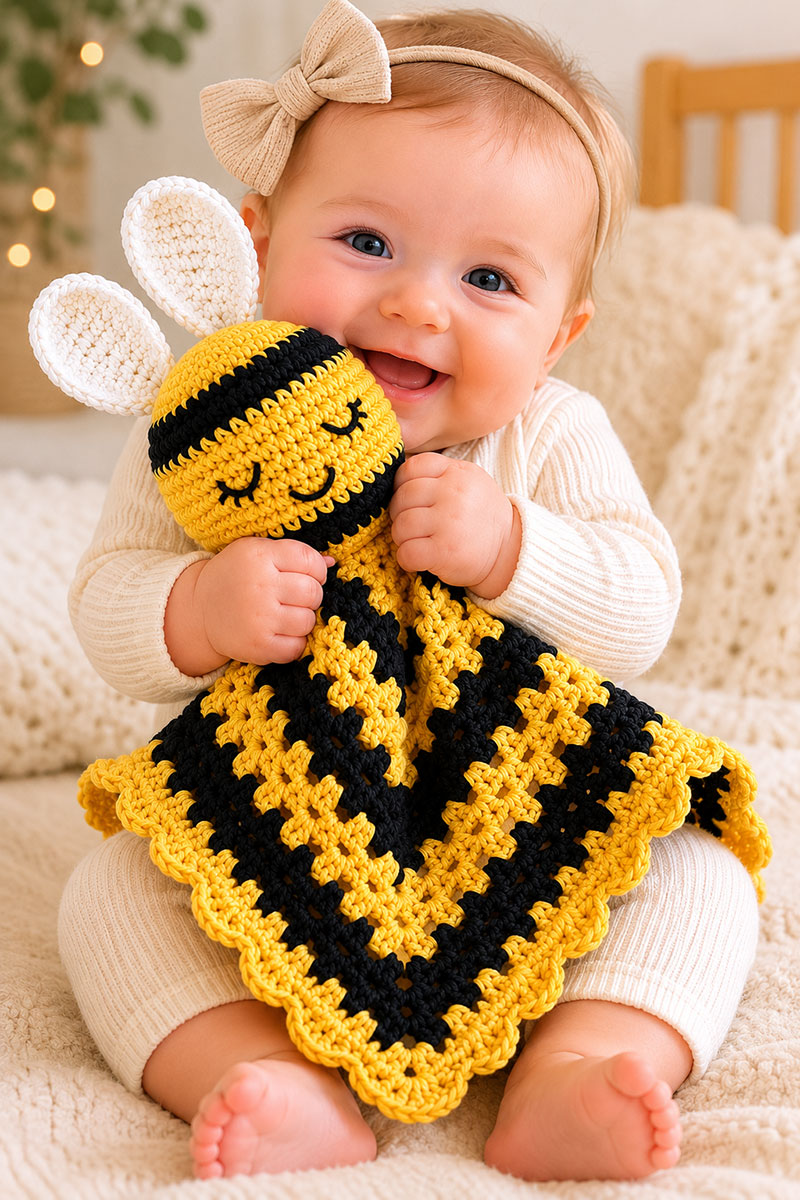
The completed bee lovey should have a centered head, upright wings, and evenly spaced stripes.
Final Size Verification Checklist
Before gifting or displaying the finished bee lovey, compare it to this checklist.
- Bee head measures approximately 4.75 to 5 inches wide after stuffing.
- Each wing measures approximately 3.25 to 3.75 inches tall.
- Each wing measures approximately 2 to 2.25 inches wide.
- Finished blanket measures approximately 15 inches square after edging.
- Two black stripes appear on the bee head.
- Color-change jogs are positioned at the back of the head.
- Sleepy eyes are embroidered between rounds 15 and 16.
- Smile is embroidered between rounds 17 and 18.
- Wing bases are securely attached across rounds 7 through 10 on the upper back of the head.
- Only the lower ¾ to 1 inch of each wing is sewn down.
- Bee head is centered directly over the blanket starting ring.
- Face points toward a blanket corner.
- Wings stand upright and appear balanced when viewed from the front.
- All yarn tails are securely buried.
- No stuffing is visible through the head stitches.
- The blanket and edging lie flat without gathering, flaring, or ruffling.
If your finished measurements are close to those listed above, your bee lovey should have the same general proportions, stripe placement, and wing arrangement shown in the page images.
Bee Lovey Gift Ideas
A crochet bee lovey works well as a baby shower gift because it combines a comfort blanket and character toy in a single project.
Many handmade gifts are admired for a few minutes and then placed on a shelf. A lovey tends to become part of everyday routines because it is easy to carry from room to room.
If you are creating a bee themed gift basket, you may also enjoy my bumble bee baby shower ideas. So, hurry and buzz over to that page to get some sweet inspiration.
If the lovey will be part of a handmade shower gift, these bee baby shower invitations can help you coordinate the gift table, invitation style, and bumble bee shower theme from the beginning.
If the lovey will be part of a bee themed nursery gift, these baby bumble bee nursery ideas can help you coordinate the handmade gift with the bedding, wall decor, and room theme.
For additional nursery themed crochet projects, visit these free baby patterns.
Many readers also enjoy browsing these crochet animal lovey patterns for coordinating nursery gifts.
Frequently Asked Questions
Can advanced beginners make this crochet bee lovey pattern?
Yes. The pattern uses basic stitches, simple shaping, color changes, sewn assembly, and embroidered facial details.
Can I use acrylic yarn?
Yes. Cotton blends and acrylic yarns both work, although finished measurements may vary slightly.
Should I use safety eyes?
No. Embroidered facial features are recommended for baby projects.
Can I make the blanket larger?
Yes. Continue adding traditional granny square rounds using the standard round instructions before working the border.
Will my finished bee look like the project shown in the page images?
The pattern is designed to produce the same general features, proportions, stripe placement, and wing arrangement shown in the page images. The finished appearance may vary slightly depending on yarn thickness, hook size, stuffing, and individual crochet tension.
How should the finished lovey be washed?
Follow the care instructions for both the yarn and the stuffing. Hand wash the lovey, or use a gentle machine cycle only if both materials permit machine washing. Reshape the head, wings, blanket, and scalloped edging, then dry the lovey flat.
Care And Safety Notes
Inspect all sewn areas periodically if the lovey will be used by a baby or toddler.
Check wing attachments, embroidered facial details, and woven yarn ends after repeated washing.
For general child product safety information in the United States, visit the Consumer Product Safety Commission.
This pattern is intended for personal use and handmade gift giving. Finished projects may vary slightly depending on materials and crochet tension.
When you click on links to various merchants on this site and make a purchase, this may result in this site earning a commission. This does not affect the price you pay.

UBGI Gold Standard 2026
Reviewed under the site's
editorial checklist.
Photos, decorating ideas, party setups and reader submissions are shared for inspiration unless a page is specifically presented as a pattern, tutorial, reference guide or step-by-step project. Follow the instructions, measurements, safety guidance and manufacturer directions provided for the particular project or product.
About Jan | Contact | Baby Nursery Ideas (Blog) | Site Map | Privacy Policy | Disclosure Policy | Disclaimer | Affiliate Disclosure | Earnings Disclosure | Facebook | Pinterest
I am a participant in the Amazon Services LLC Associates Program, an affiliate advertising program designed to provide a means for us to earn fees by linking to Amazon. As an Amazon Associate I earn from qualifying purchases.
Copyright © 2006-2026. All Rights Reserved.