How Much Weight Can a Crib Hold? Crib Weight Limits Explained
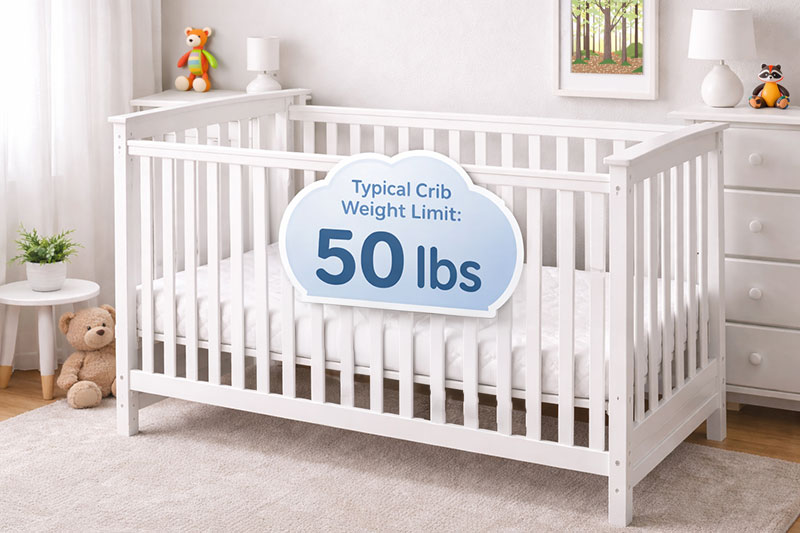
How much weight can a crib hold? Most standard baby cribs are designed to support a combined weight of the child and mattress up to about 50 pounds, but exact crib weight limits vary by manufacturer, crib design, and how the crib is being used.
Weight limits for cribs also vary by crib type. Standard full-size cribs, mini cribs, bassinets, travel cribs, and convertible cribs are built differently and may have very different maximum weight ratings, even though they are all commonly called “cribs.” Always check the manufacturer’s specifications for the specific crib style and model.
Not sure whether your child is outgrowing the crib? Check these first:
How Much Weight Can a Crib Hold?
In the United States, most standard full-size baby cribs are designed to hold a combined weight of about 50 pounds, including the crib mattress. That number comes up again and again because it reflects how cribs are tested and labeled under current US safety standards. Some cribs may be rated a little higher or lower depending on the design and materials, but manufacturers still set a specific stop-use limit that defines when crib use should end. This is a use limit, not a stress test number, and it’s meant to signal when crib use should stop rather than how much weight the crib can tolerate.
What “crib weight limit” really means
When people say “crib weight limits,” they usually mean one simple thing: the maximum weight a baby crib is rated to handle in normal, everyday use under US safety standards. That includes your child, plus anything that belongs in a crib (like the crib mattress). Some brands call it “crib weight capacity” or “maximum crib weight,” but I’m using one main term here: crib weight limit.
This page is about understanding the general idea, not chasing a perfect number for every brand and model. This page explains general US safety standards, not product-specific instructions.
This is where most parents get confused.
Crib weight limits (in plain English)
In most cases, the crib weight limit is the point where the crib is no longer meant to be used as a crib. Period. Not “maybe.” Not “close enough.” It’s a stop line that was set for a reason.
Here’s the part that surprises people: the limit is not just about a baby getting heavier. It’s also about the crib taking repeated stress over time—leaning, bouncing, pulling up, and all the normal toddler energy that shows up fast.
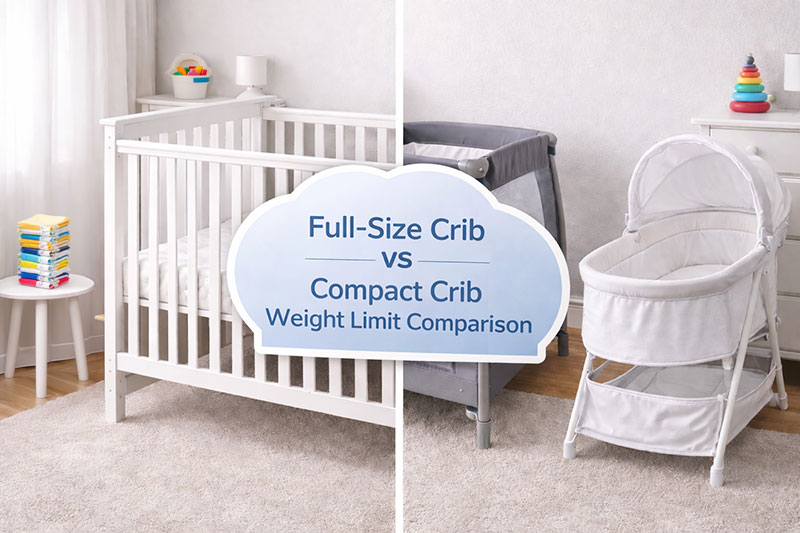
And yes, crib types matter. Full-size cribs, mini cribs, travel cribs, and bassinets can have very different maximum weight ratings because they’re built differently.
Parents comparing those crib types in tighter rooms may also want to look at crib options for small spaces.
If you’re comparing crib options more broadly, the baby cribs guide connects weight limits with crib types, sizes, and everyday use decisions.
If you only remember one thing
The crib weight limit is the stop line for crib use. Don’t treat it like a challenge.
What to do next: find the model label or manual for your crib, and use the stated limit as the deciding number.
Why it matters more than people think
A baby crib looks sturdy. Most of them are. But the crib weight limit is about more than “will it break right now.” It’s about what happens after months of pressure in the same joints and fasteners, and how a crib behaves when a child starts moving like a little gymnast.
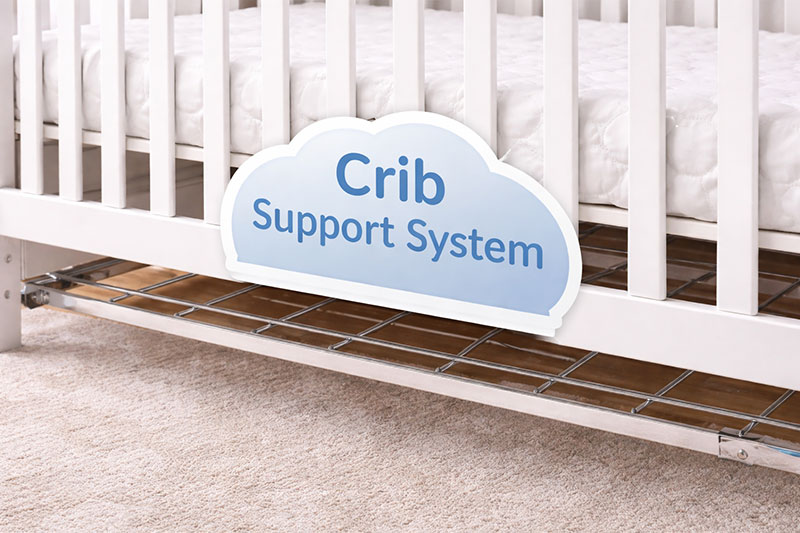
When a crib gets pushed past its crib weight limit, the risk isn’t just “damage.” It’s wobble. Flex. A mattress support that sits a little crooked. Hardware that loosens faster than it should. Tiny shifts that are easy to miss until the crib feels “off.”
I also think about sleep quality. A shaky crib makes parents nervous. A nervous parent checks more. More checking means less sleep. It snowballs.
If you’re also sorting out timing decisions, you might like the bigger picture on lifespan and transitions here: crib lifespan and when it’s time to replace a crib.
What goes wrong when the crib weight limit gets ignored
Most cribs don’t fail in a dramatic way. The usual story is quieter. Things slowly loosen. The crib starts to squeak. The mattress support feels less solid. A side rail has a tiny shift. Parents blame the floor. Or humidity. Or “kids are wild.” Sometimes that’s true. Sometimes it’s the crib taking more load than it was designed to take.
Another common issue is adults leaning into the crib. Not even climbing in. Just leaning. Reaching. Putting body weight on the rail for a few seconds. Over and over. That repeated load can matter, even when the child is well under the baby crib weight limit.
And then there’s the big question people search: “Can a crib hold adult weight?” A crib is not designed as adult furniture. Even if it doesn’t break, that’s not what the crib weight limit is for.
Related decision pages that connect here: crib vs bassinet vs mini crib and crib dimensions and standard sizes.
Quick fit check
Look at the crib as a whole, not just the number. A crib that feels solid, level, and tight is telling you something good. A crib that rocks, creaks, or looks slightly out of square is telling you something else.
That part matters more than people think.
Did I buy the right crib type for my life?
A lot of “crib weight limits” stress comes from buying the wrong crib type for the season you’re in. A travel crib is amazing for travel. It’s not built like a full-size crib. A mini crib can be perfect for a small room. It’s still a different build. A bassinet is short-term by design. That’s not a flaw. That’s the point.
So here’s the clean way I think about it: the crib weight limit is one clue, but the real question is whether the crib type matches your use. Daily sleep for a fast-growing baby? Full-size cribs usually make the most sense. Tight space, shorter stage, or a temporary setup? Mini and travel options can be a better match.
If you’re trying to figure out what “normal” looks like for sleep surfaces and upkeep, these pages can help you compare without drama: how to clean a crib mattress and crib mattress size vs twin.
Most parents choose
Most parents don’t need the “highest number.” They need the most stable match for everyday use: a solid full-size crib with a clear crib weight limit from the manufacturer, plus a crib mattress that fits properly.
When families are unsure, they usually feel better choosing the setup that stays sturdy as the baby turns into a toddler.
A calm word about secondhand and older cribs
Older cribs and secondhand finds can be beautiful. They can also be missing labels, missing manuals, or built under different rules than today’s US safety standards.
If the model info is missing, the crib weight limit is unknown, and that changes the decision.
For the bigger secondhand question, this page lays out what matters without panic: is it safe to use a used crib.
Where to find the number without turning this into a project
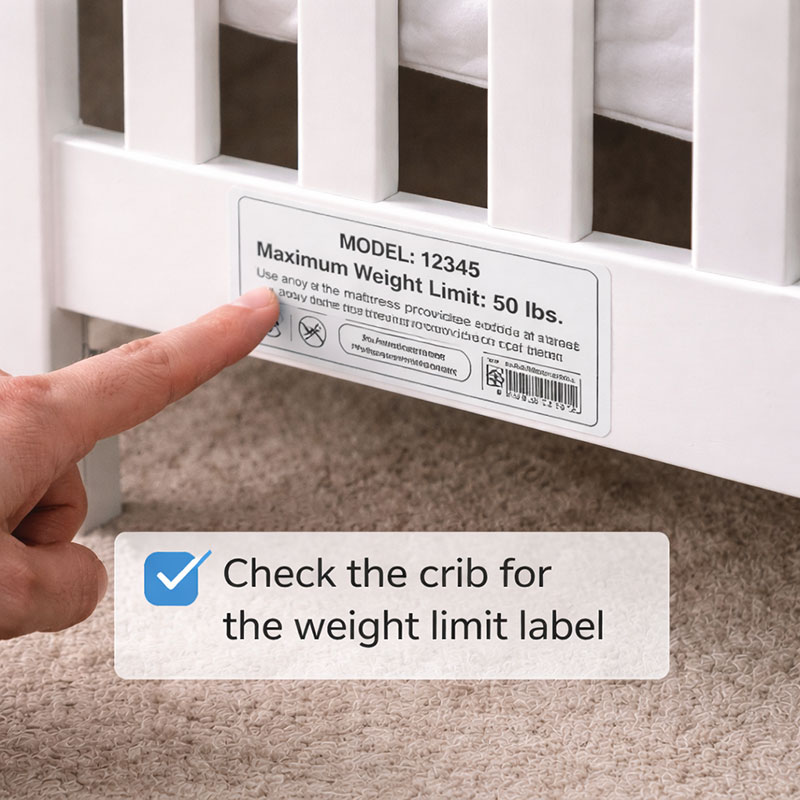
The crib weight limit usually shows up in one of a few places: the manual, the model label on the crib, or the manufacturer’s official listing for that model. Sometimes it’s tied to a stage, like “crib mode” vs “toddler bed mode” on convertible cribs.
If you’re in the annoying spot where the manual is gone and the label is unreadable, it’s okay to stop and call it what it is: unknown. Unknown doesn’t mean “bad.” It means you can’t make a clean decision from the number alone.
For basic standards and safety recalls in the United States, the most authoritative place to check is the US Consumer Product Safety Commission: CPSC crib safety information.
What should I do now?
Here’s the decision in one sentence: treat the crib weight limit as the stop line for crib use, and don’t push past it.
If your child is getting close to the limit, or the crib feels less solid than it used to, the next step is not “how do I squeeze more time out of it.” The next step is choosing the right transition for your home and your child’s stage.
Sometimes the simplest move is also the most peaceful one. A stable setup beats a stressed-out setup every time.
What to do next
Pick one thing to confirm today: the stated crib weight limit for your exact crib model. That single fact clears up a lot.
Then decide from there. Calmly. No guessing games.
One last note on parts, manuals, and “mystery cribs”
If your crib is missing parts, the manual, or a clear model ID, that’s a real limitation. Not a personal failure. It just means you can’t confidently “identify and understand” the crib weight limit for that specific product.
When you need model help or you’re sorting out what you even have, these hubs can be useful: crib instructions and baby crib parts.
If this sounds picky, it is—and for a reason.
When you click on links to various merchants on this site and make a purchase, this may result in this site earning a commission. This does not affect the price you pay.

UBGI Gold Standard 2026
Reviewed under the site's
editorial checklist.
Photos, decorating ideas, party setups and reader submissions are shared for inspiration unless a page is specifically presented as a pattern, tutorial, reference guide or step-by-step project. Follow the instructions, measurements, safety guidance and manufacturer directions provided for the particular project or product.
About Jan | Contact | Baby Nursery Ideas (Blog) | Site Map | Privacy Policy | Disclosure Policy | Disclaimer | Affiliate Disclosure | Earnings Disclosure | Facebook | Pinterest
I am a participant in the Amazon Services LLC Associates Program, an affiliate advertising program designed to provide a means for us to earn fees by linking to Amazon. As an Amazon Associate I earn from qualifying purchases.
Copyright © 2006-2026. All Rights Reserved.