Brown Bear Lovey Pattern (Faux Fur & Crochet Hybrid)
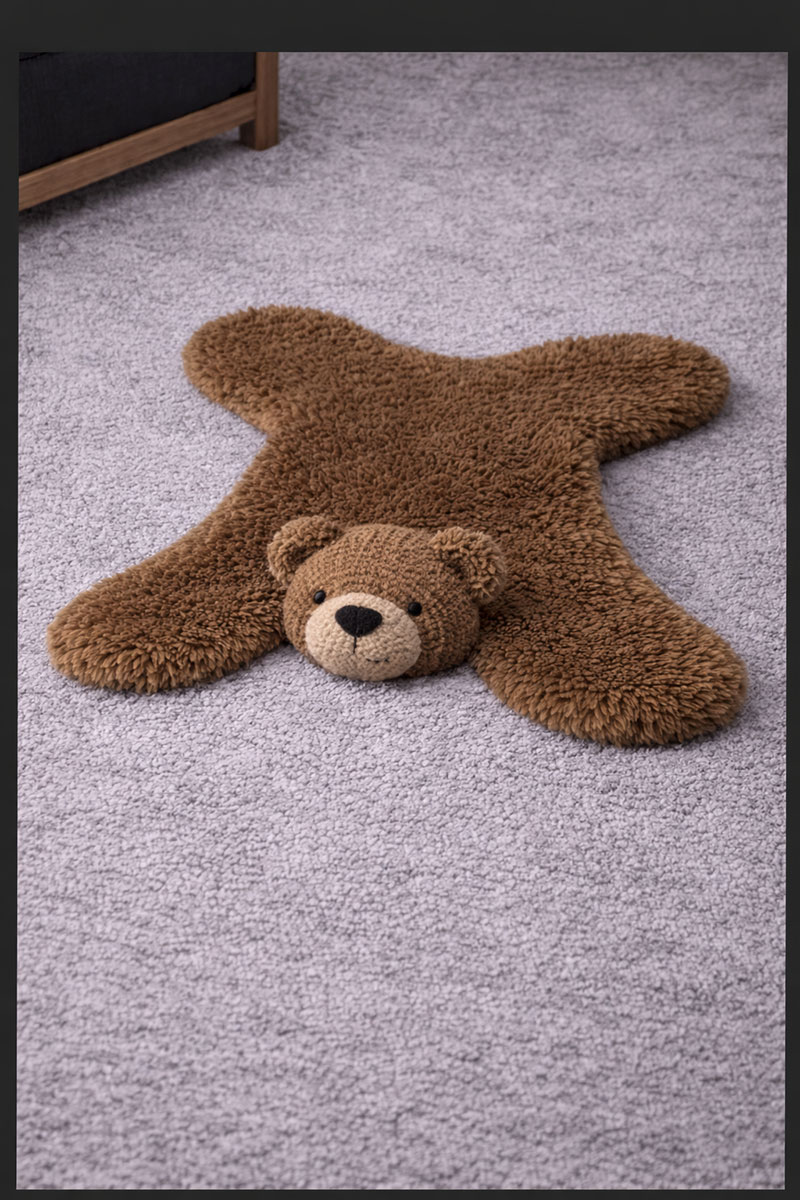
This brown bear lovey pattern combines a soft faux fur body with a crocheted bear head to create a cozy handmade comfort item for supervised awake use. Its bearskin-style silhouette fits beautifully in woodland nurseries and makes a memorable handmade gift.
Go here to see faux fur recommendations for this brown bear lovey pattern
If You’re Looking for a Woodland Creature Lovey, This Snuggly Bear Will Not Disappoint
If you enjoy handmade projects like this one, you can explore more ideas in my free baby patterns collection.
The highland cow crochet snuggler lovey pattern creates a shaggy rustic look, while my crochet cow pattern is more "domestic" and uses a flatter blanket body with simple spots that is easy for beginners to assemble.
For a water-oriented animal style, my ocean-inspired turtle crochet lovey pattern fits beautifully in a beach or coastal nursery theme, while my frog lovey crochet pattern adds a playful handmade baby gift option with a lighter, more whimsical feel than the bear.
For a broader mix of styles in one place, these crochet animal lovey patterns make it easier to compare different animals and pick the one that fits your project.
For quicker blanket-style projects with simpler shaping and lighter construction, these easy baby lovey crochet patterns work especially well for beginner baby gifts, nursery baskets, and fast handmade shower projects.
For cleaner nursery aesthetics and understated handmade baby gifts, this minimalist crochet lovey pattern uses a simpler modern style that fits beautifully into neutral nursery themes and contemporary baby rooms.
What to do next: start by reading the quick checks below, then draft and cut your faux fur body first. Once the silhouette is right, everything else falls into place (and you won’t waste time crocheting a head that doesn’t sit correctly). This early step matters more than anything else when you’re working through the Brown Bear Lovey Pattern, because the body shape sets the entire look.
See the kind of faux fur I prefer here
Quick fit check
Lay your paper pattern on the floor and step back — this quick check is essential when following the Brown Bear Lovey Pattern. You should see two front legs, two back legs, a narrower “waist,” and a shallow neckline that sits behind where the muzzle will land. If it reads like a bib, apron, or dress shape under the face, you’ve accidentally drifted into blanket territory.
I keep one rule in mind while I’m drafting the Brown Bear Lovey Pattern: the body begins behind the head, never beneath it. If you follow that, you won’t get that unwanted drape under the chin.
Brown bear lovey faux fur crochet pattern: the shape that makes it look a bit like a tiny bearskin rug
This brown bear lovey pattern combines faux fur, sewing, and crochet in a flat bear silhouette rather than a stuffed torso or square lovey. The body uses either two matching faux fur pieces or one faux fur front with one flannel or minky back. The two selected layers are sewn together and turned right side out. The center stays unstuffed, while the crocheted head and muzzle receive light stuffing.
If you prefer an all-crochet version with a soft, flat body, try my bear snuggler crochet pattern. It keeps the recognizable teddy bear shape while replacing the faux fur body with crocheted pieces.
For the fur, I go for a woodland brown that feels warm and natural (not reddish). The pile should be very soft and fuzzy, but not so long that it mats instantly. If you’ve ever bought faux fur that sheds all over your sewing room, you know why I’m picky here. I’d rather use a slightly denser “plush” fur that behaves and still looks luxurious once it’s stitched.
If you want it extra snuggly without getting bulky, let the fur do the work. A flat body with thick pile looks plush, but it stays easy for little hands.
Draft the faux fur body first
I always draft the Brown Bear Lovey Pattern at full size on paper before cutting into faux fur. The goal is a finished body that measures about 18 inches wide by 23 inches long after sewing and turning, so the paper pattern needs to be slightly larger to account for seam allowance.
If you’re using a standard ¼-inch seam allowance, draft your paper pattern to approximately 18½ inches wide by 23½ inches long. Faux fur pile compresses slightly when sewn, so this lands very close to the finished size once everything is turned and fluffed.
How I sketch the silhouette
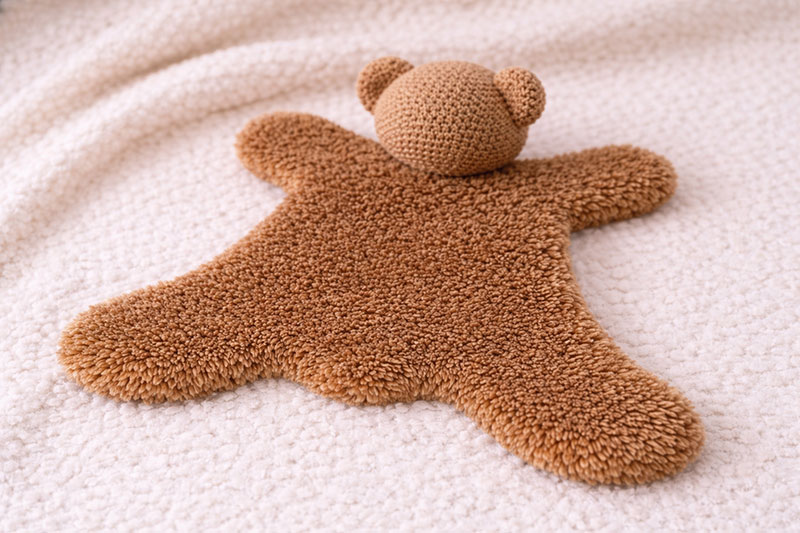
I start with a vertical center line and build the shape symmetrically. Think “bear shape,” not rectangle or square shaped blanket. Wide shoulders, rounded front legs, a gentle taper through the middle, and two distinct back legs with a slight dip between them.
The neckline is critical. Draw a shallow U-shaped curve that is just deep enough to seat the crocheted head. It should sit behind where the muzzle will land — not under it. If the neckline looks generous or scoop-shaped, it’s too deep.
When I step back from the paper pattern, it's easy to see four paws and a narrow midsection. If there is a bib, or apron shape beneath the neckline; you've drifted off track.
See a baby-soft plush faux fur option here
If you only remember one thing
Do not build a “chest panel” when working through the Brown Bear Lovey Pattern. If the faux fur body continues straight down from the neckline under the chin, it will drape there. The detailed look comes from a neckline that starts behind the head and a body that’s shaped like a teddy bear — not a bib.
Sew the faux fur body so it stays flat, fluffy, and cozy
Place the two selected body layers right sides together and sew around the outline with a consistent 1/4-inch seam allowance. Leave the turning opening along a relatively straight side section rather than at the neckline. Clip the inward curves, trim excess bulk from the outward curves, turn the body right side out, release trapped fur from the seams, and close the opening securely with a ladder stitch.
I do not stuff the torso when making this Brown Bear Lovey Pattern. That’s the secret sauce. A stuffed center turns this into a plush toy body. A flat center keeps the miniature-rug feel. If you want just a touch of structure, you can add a tiny pinch of stuffing in each paw tip—just enough to give the ends a little “plump”—and then stop. The minute you start filling the middle, you’ll lose the drape that makes this shape so charming.
Crochet the head and muzzle with a calm, classic bear face
I like a slightly lighter yarn for the muzzle (cream or tan), because it reads as “bear” instantly against the brown faux fur. A simple round head works beautifully here, especially when the muzzle has a little lift and the nose is centered cleanly. This is where you can make it feel handmade in the best way, and if you’d like to explore more projects like this, you’ll find them in my free baby crochet patterns collection.
For baby loveys, I strongly prefer embroidered features over buttons. A soft stitched mouth and sleepy eyes look sweet and hold up well through real-life use and washing. If you like having another example of how I finish and reinforce crochet details on baby items, my baby crown crochet pattern has some nice finishing ideas that translate well to this project.
Quick placement tip
Before you stitch the head on permanently, set it on the neckline and take a photo from above. The camera is honest. If the head looks too far back, it will read like a plush rug. If it’s too far forward, it can look detached. The sweet spot is forward enough that the muzzle clears the fur, but anchored at the neckline so there’s no fabric “apron” under the chin.
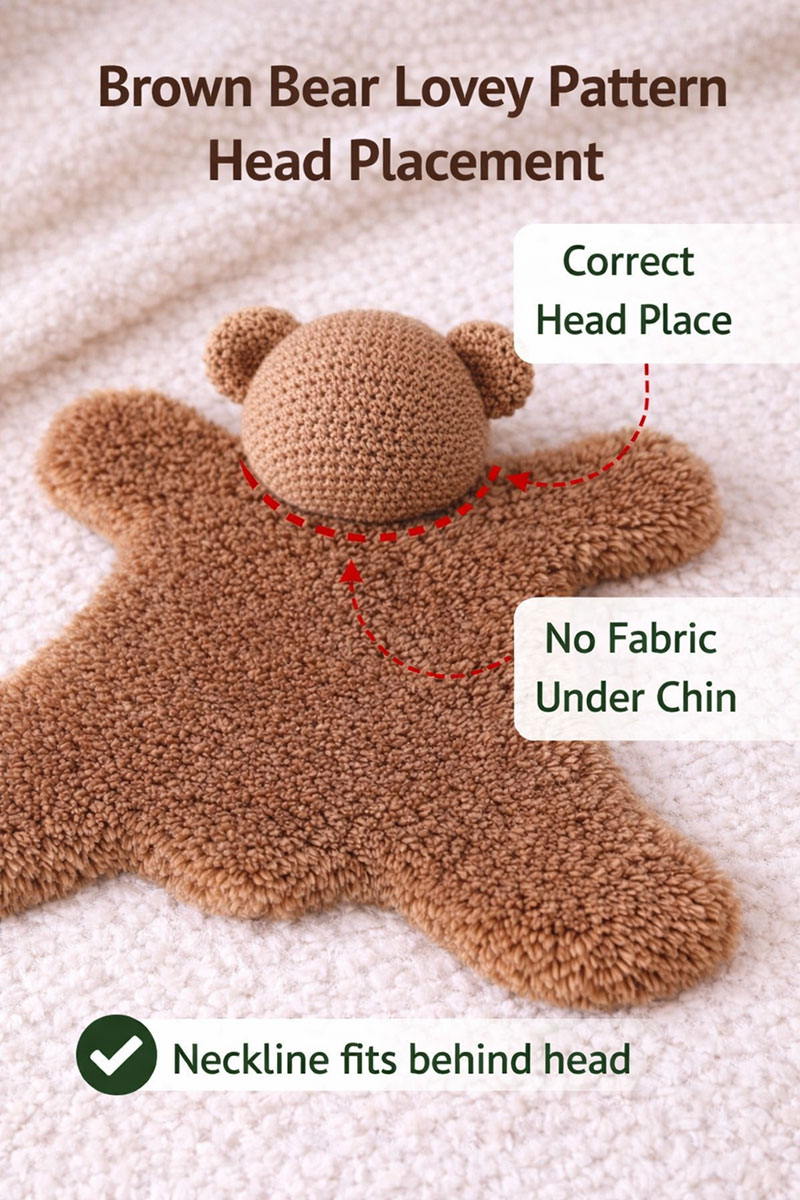
Attach the crocheted head at the neckline (so the muzzle stays clean)
This is the step that makes or breaks the look. Center the lower back of the crocheted head across the complete shallow neckline, making sure the muzzle remains in front of the faux fur. Sew through the crocheted fabric and the fabric backing beneath the fur pile. Work one secure pass across the neckline, then add a second offset reinforcement pass without pulling tightly enough to gather the body.
If you notice the faux fur creeping up toward the underside of the muzzle as you sew, pause and reposition. The fur should sit behind the head, not under it. When this is right, the face looks proud and forward—like a little bear shaped character—rather than a blanket with a face pasted on.
Make it nursery-friendly (and actually practical to live with)
I love how this unique lovey fits into woodland, rustic, and neutral nurseries without feeling theme-y or loud. It’s one of those pieces that looks sweet tossed over a chair, but it’s also genuinely useful for soothing.
That same relaxed woodland style shows up across these woodland nursery ideas, where simple forest details and soft textures create a space that feels warm and very woods-y.
The nursery usually feels more complete and polished once the smaller decorative elements start supporting the woodland atmosphere, and these woodland nursery decor ideas show how forest-inspired wall accents, rustic textures, shelving, and nature-themed details can help the room feel finished without looking overloaded.
And if you’re putting together a handmade gift bundle, this lovey pairs so nicely with a simple quilt or stroller blanket. I keep mine uncomplicated—nothing fussy—because the lovey already brings the “aww.” My baby quilt patterns collection is a good place to grab an easy companion project if you want a matching set.
For a more focused companion project, these bear baby quilt patterns include teddy bear, woodland bear, patchwork, and appliqué ideas that coordinate naturally with the brown bear lovey.
For forest-inspired sewing projects, woodland appliqué templates, rustic nursery crafts, and coordinated handmade décor ideas that pair naturally with bear and woodland animal themes, browse these woodland nursery patterns for cozy woodland baby rooms and handmade gift projects.
Important!
For baby loveys, I avoid using anything that can loosen over time (buttons, glued elements, loose embellishments). Embroidered facial features are usually the best choice. Reinforce your seams, double-check your head attachment stitches, and always supervise use—especially for younger babies.
If you want an authoritative safety refresher that’s non-competing and easy to skim, the U.S. Consumer Product Safety Commission has a solid overview here: toy safety guidance from the CPSC.
Care & washing note: This lovey holds up best with gentle care. I recommend hand washing or using a delicate machine cycle in cold water, then laying it flat to air dry so the faux fur keeps its softness and shape.
Skill level note: This project is best suited for a confident beginner to intermediate maker. You should be comfortable working in continuous crochet rounds, sewing curved faux fur pieces, clipping seam allowances, and attaching crocheted pieces securely by hand.
What to do next (so you finish it and love the result)
Here’s my simple finish order: draft and cut the bear silhouette, sew the flat faux fur body, crochet the head and muzzle, then attach the head at the neckline so the muzzle stays clean.
Once you’ve made one, you can repeat the same silhouette in other colors (polar bear, black bear, even a soft beige “teddy” version). The body shape stays the same, and you just swap fur and yarn shades. That’s my favorite kind of pattern—the kind you can come back to without reinventing it every time.
See how this same idea works as a soft elephant lovey design →
Brown Bear Lovey Pattern
This brown bear lovey combines a flat faux fur body with a crocheted bear head, ears, and muzzle. The body is shaped like a small bearskin-style rug rather than a square blanket or stuffed torso.
The faux fur body remains flat and flexible. Only the crocheted head and muzzle are lightly stuffed.
Finished Size
The finished faux fur body measures approximately 18 inches across the widest front-paw span by 23 inches from the top of the neckline to the lowest rear-paw tips.
The paper body pattern measures approximately 18 1/2 inches wide by 23 1/2 inches long before sewing. These paper-pattern measurements include the 1/4-inch seam allowance.
The crocheted head adds height above the neckline. The exact overall length will vary slightly depending on yarn thickness, crochet tension, stuffing, and head placement.
Skill Level
This project is suitable for a confident beginner to intermediate maker. The crochet stitches are basic, but cutting faux fur, sewing inward curves, placing the facial features, and securely attaching the head require careful finishing.
Materials
Faux Fur Body
- Approximately 3/4 yard of 54- to 60-inch-wide washable brown faux fur
- Optional: approximately 3/4 yard of cotton flannel or minky for a fabric-backed body
- Strong matching polyester sewing thread
Choose faux fur with a securely bonded pile and minimal shedding. A plush or medium-length pile is easier to cut, sew, inspect, and wash than very long shaggy fur.
Crocheted Head, Ears, and Muzzle
- Approximately 75 yards of brown worsted-weight yarn
- Approximately 15 yards of tan or cream worsted-weight yarn
- Small amount of black embroidery floss
- Small amount of washable polyester fiberfill
- 4.0 mm crochet hook, or the hook size needed to make a dense fabric
The crocheted fabric should be tight enough that the stuffing does not show through the stitches. Allow additional yarn for sewing, weaving in ends, and making a tension sample.
Other Tools
- Large paper for drafting the body pattern
- Ruler or measuring tape
- Pencil
- Paper scissors
- Fabric scissors or a craft knife suitable for cutting faux fur backing
- Sewing machine
- Hand-sewing needle
- Yarn or tapestry needle
- Stitch marker
- Fabric clips or pins
- Blunt turning tool
- Small comb or yarn needle for releasing fur from the seams
Crochet Abbreviations
This pattern uses U.S. crochet terminology.
- ch: chain
- sc: single crochet
- inc: work 2 single crochet in the same stitch
- dec: single crochet decrease over the next 2 stitches
- MR: magic ring
Important Crochet Construction Note
Work the head, ears, and muzzle in continuous spiral rounds. Do not join or turn at the end of a round, and do not add a beginning chain.
Place a stitch marker in the first stitch of each round and move it upward as the work progresses. Count every round before beginning the next round.
Part A: Draft the Faux Fur Body Pattern
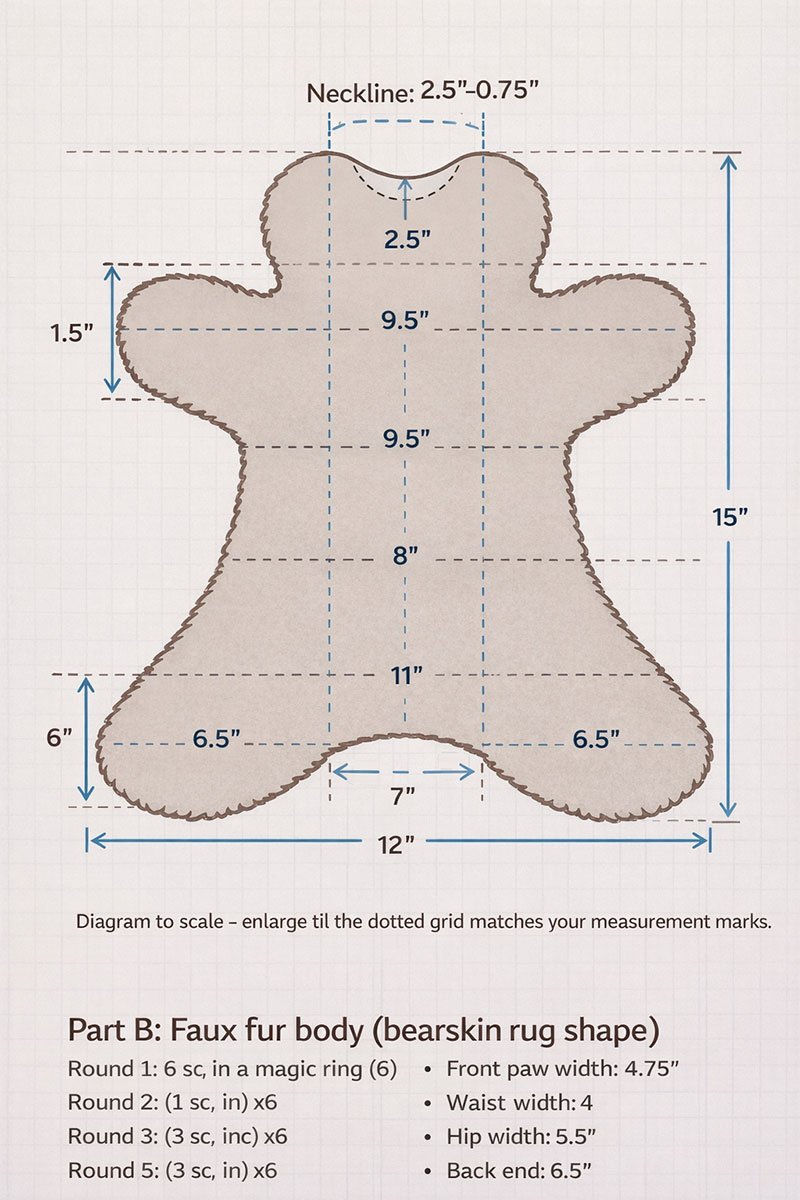
Important: The image above is a shape reference. It is not a full-size printable template. Do not print the web image at 100 percent and assume it will produce the required finished measurements.
Prepare the Paper
Tape together enough paper to create a piece at least 20 inches wide by 25 inches long.
Fold the paper vertically. The folded edge will become the center line of the bear body. Draft only one half of the silhouette, then cut through both paper layers and unfold the finished pattern.
Draw or measure a 23 1/2-inch center line along the folded edge. Mark the top and bottom clearly.
Mark the Neckline
At the top of the folded edge, measure down 3/4 inch and make a mark. This is the deepest center point of the shallow neckline.
Along the top edge of the paper, measure 1 1/4 inches outward from the fold. This is the outer neckline edge.
Draw a smooth, shallow curve between the center neckline mark and the outer neckline edge. When the paper is unfolded, the complete neckline will measure approximately 2 1/2 inches wide and 3/4 inch deep.
Mark the Outer Body Shape
Measure downward from the top of the paper along the folded center line. At each level, measure outward from the fold and make the corresponding mark:
- Shoulder transition: 2 1/2 inches down and 5 3/4 inches outward
- Widest front-paw point: 6 inches down and 9 1/4 inches outward
- Narrowest waist point: 11 inches down and 4 3/4 inches outward
- Hip point: 15 inches down and 6 1/4 inches outward
- Widest rear-paw point: 20 inches down and 8 1/4 inches outward
At the bottom line, 23 1/2 inches down from the top, make two additional marks:
- Outer bottom edge of the rear paw: 6 1/2 inches outward from the fold
- Inner bottom edge of the rear paw: 1 1/2 inches outward from the fold
On the folded center line, measure 3 inches upward from the bottom and make a mark. This point forms the top of the separation between the two rear legs.
Connect the Drafting Marks
Beginning at the outer neckline edge, draw a smooth curve through the shoulder mark and outward around the front-paw mark.
Curve inward toward the waist mark. This inward curve must be visible enough to separate the front leg from the hip and rear leg, but it should remain smooth rather than sharply pointed.
Continue the line outward through the hip and widest rear-paw marks. Curve downward to the outer bottom edge of the rear paw, across the rounded bottom of the paw, and then to the inner bottom edge.
From the inner bottom edge of the rear paw, curve upward to the mark on the folded center line. This creates one half of the central separation between the two rear legs.
Cut the paper along the neckline, outer silhouette, rear paw, and rear-leg separation. Unfold the paper.
Body Draft Checkpoint
Before cutting fabric, confirm all of the following:
- The widest front-paw span measures approximately 18 1/2 inches.
- The total length from the top neckline edge to the lowest rear-paw tips measures approximately 23 1/2 inches.
- The neckline measures approximately 2 1/2 inches wide and 3/4 inch deep.
- The two front legs match each other.
- The two rear legs match each other.
- The waist curves are symmetrical.
- The rear-leg separation is centered.
- The silhouette looks like a flat bear hide rather than a bib, dress, apron, or square blanket.
Correct the paper pattern before cutting the faux fur if any measurement or side does not match.
Part B: Cut the Body Pieces
Choose One Body Construction
Option 1, double-fur body: Cut two identical faux fur body pieces.
Option 2, fur front with fabric back: Cut one faux fur body piece and one matching flannel or minky body piece.
Do not cut two faux fur pieces plus two separate backing pieces. The body should contain only two primary fabric layers.
Check the Fur Direction
Before cutting, smooth the fur with your hand to identify the pile direction. Position the paper pattern so the fur runs from the neckline toward the rear paws.
When cutting two faux fur pieces, position both pieces with the top of the paper pattern facing the same direction on the fabric. This keeps the pile direction consistent on the front and back of the finished body.
Cut the Faux Fur
Place the paper pattern against the backing side of the faux fur and trace around it.
Cut from the backing side with short, controlled snips. Slide the lower blade of the scissors close to the fabric backing so the fur pile is separated rather than chopped.
After cutting, gently pull loose fibers from the cut edges and dispose of them before sewing.
Part C: Sew the Flat Body
Place the two selected body layers right sides together.
For the double-fur version, the fur piles should face each other inside the body. For the fabric-backed version, place the right side of the backing fabric against the fur pile.
Match and clip the following points before sewing:
- Both neckline edges
- Both shoulder points
- Both front-paw tips
- Both waist curves
- Both hip points
- Both rear-paw tips
- The center of the rear-leg separation
Sew around the entire body with a consistent 1/4-inch seam allowance. Leave a 4-inch turning opening along one of the relatively straight side sections between the waist and hip. Backstitch securely at both ends of the opening.
Clip and Trim the Seam Allowance
Carefully clip into the seam allowance around the shallow neckline, both inward waist curves, and the inward separation between the rear legs. Stop before reaching the stitching.
Trim small wedges from the seam allowance around the rounded front paws, hips, and rear paws. Do not cut through the sewn seam.
Reduce excess bulk where several curves meet, but leave enough seam allowance to protect the stitching.
Turn and Shape the Body
Turn the body right side out through the side opening. Work slowly so the opening does not stretch or tear.
Use a blunt turning tool to push out the front paws, waist curves, hips, rear paws, neckline, and rear-leg separation.
Use a yarn needle or small comb to release faux fur that is trapped in the seams. Work around the full outline until the edges look smooth and the four legs are clearly shaped.
Do not stuff the center of the body. The body must remain flat and flexible.
If a slightly rounded paw tip is desired, place an equal and very small pinch of stuffing in each of the four paw tips. Do not allow the stuffing to extend into the center body.
Turn the raw edges of the side opening inward by 1/4 inch. Close the opening securely with small ladder stitches. Knot the thread securely and bury the ends inside the body.
Finished Body Checkpoint
Lay the body flat without stretching it. It should measure approximately 18 inches across the widest front-paw span by 23 inches from the top neckline edge to the lowest rear-paw tips.
The exact measurement may vary slightly because of fur thickness and sewing tension. Both sides should remain symmetrical, and the center should lie flat without twisting, gathering, or ballooning.
Part D: Crochet the Bear Head
Head, Brown Yarn
The magic-ring end becomes the top of the head. The decrease and closing end becomes the bottom of the head.
Round 1: Work 6 sc in an MR. (6)
Round 2: Inc in each stitch around. (12)
Round 3: (Sc in the next stitch, inc in the next stitch) 6 times. (18)
Round 4: (Sc in the next 2 stitches, inc in the next stitch) 6 times. (24)
Round 5: (Sc in the next 3 stitches, inc in the next stitch) 6 times. (30)
Round 6: (Sc in the next 4 stitches, inc in the next stitch) 6 times. (36)
Rounds 7 through 10: Sc in each stitch around. (36)
Round 11: (Sc in the next 4 stitches, dec over the next 2 stitches) 6 times. (30)
Round 12: (Sc in the next 3 stitches, dec over the next 2 stitches) 6 times. (24)
Round 13: (Sc in the next 2 stitches, dec over the next 2 stitches) 6 times. (18)
Stuff the head evenly. The head should hold its round shape without becoming hard or stretched. Add small amounts of fiberfill at a time and keep the bottom area slightly softer for easier attachment.
Round 14: (Sc in the next stitch, dec over the next 2 stitches) 6 times. (12)
Round 15: Dec 6 times. (6)
Fasten off, leaving a 10-inch yarn tail. Thread the tail through the front loops of the remaining 6 stitches. Pull the opening closed, secure it, and weave the tail into the head.
Head Fit Checkpoint
Set the completed head above the 2 1/2-inch neckline before adding the muzzle. The head must cover the complete neckline and extend beyond both neckline corners.
The crocheted fabric should remain dense enough that the stuffing is not visible. If the head is too small to cover the neckline, remake it with a slightly larger hook or thicker worsted-weight yarn while keeping the fabric firm. If it is disproportionately large, use a slightly smaller hook.
Part E: Crochet the Ears
Ears, Make Two in Brown Yarn
Round 1: Work 6 sc in an MR. (6)
Round 2: (Sc in the next stitch, inc in the next stitch) 3 times. (9)
Rounds 3 and 4: Sc in each stitch around. (9)
Fasten off each ear, leaving an 8-inch yarn tail for sewing.
Do not stuff the ears. Flatten each ear so the final round forms a double-layered base.
Ear Placement
Place the ears on the upper sides of the head, approximately between Rounds 4 and 7. Angle them slightly forward.
Pin or hold both ears in place and inspect the head from the front, back, and top. Confirm that both ears are the same height and angle before sewing.
Using the yarn tail, sew through both layers of the flattened ear base and through the crocheted head fabric. Make a second pass through the attachment area. Knot securely and bury the tail inside the head.
Part F: Crochet the Muzzle
Muzzle, Tan or Cream Yarn
Chain 7.
Round 1: Sc in the second chain from the hook and in the next 4 chains. Work 3 sc in the last chain. Continue along the opposite side of the foundation chain and sc in the next 4 chains. Work 2 sc in the same foundation chain that contains the first sc of the round. (14)
Round 2: Inc in the first stitch, sc in the next 4 stitches, inc in each of the next 3 stitches, sc in the next 4 stitches, and inc in each of the final 2 stitches. (20)
Rounds 3 and 4: Sc in each stitch around. (20)
Fasten off, leaving a 16-inch yarn tail for sewing.
Attach the Muzzle
Position the muzzle horizontally on the lower front of the head. Center it from left to right, with its upper edge approximately near Round 8 and its lower edge approximately near Round 12.
Pin the muzzle in place and check that it is level. Use the long yarn tail to sew around the outer edge.
When approximately 1 inch remains open, add a small amount of fiberfill. The muzzle should be softly raised rather than firmly packed.
Finish sewing the opening. Make a second pass through the lower and side edges if needed. Knot securely and bury the yarn tail inside the head.
Part G: Embroider the Facial Features
Use black embroidery floss and a hand-sewing needle.
Nose and Mouth
Embroider a small horizontal oval or rounded triangle at the upper center of the muzzle. Build the nose with several closely placed stitches rather than one loose stitch.
For a mouth, make one short vertical stitch downward from the center of the nose. Add one short curved or diagonal stitch on each side if desired.
Eyes
Place the embroidered eyes above the muzzle at an equal height. Position them approximately between Rounds 7 and 8, adjusting slightly as needed for the finished muzzle size.
Use several short, closely placed stitches for each eye. Keep both eyes the same length and the same distance from the center of the face.
Do not use plastic safety eyes, buttons, beads, glued decorations, or other detachable facial pieces.
To begin each embroidered feature, tie a secure knot in the end of the floss. Insert the needle through the crocheted fabric from a nearby inconspicuous point, then gently pull the knot beneath the crochet surface so it rests inside the stuffed head.
After completing the feature, take two small securing stitches beneath the existing embroidery. Pass the needle through the stuffed head and bring it out approximately 1 inch away. Pull the floss gently and trim it close to the surface so the cut end retracts inside the head. No knot or loose thread should remain exposed.
Part H: Attach the Head to the Body
Position the Head
Lay the faux fur body flat with the intended front side facing upward.
Orient the crocheted head with the muzzle facing forward. The Round 15 closure should point downward and slightly toward the back of the head.
Center the lower back portion of the head over the complete shallow neckline. The head must cover both neckline corners, and the muzzle must remain completely in front of the fur body rather than resting on top of it.
Pin the head temporarily and inspect the lovey from the front, back, both sides, and above. Make sure:
- The head is centered between the front paws.
- The ears are level.
- The muzzle clears the faux fur.
- The head does not tilt sharply backward.
- No body fabric forms an apron beneath the chin.
Sew the Head Securely
Thread a sturdy hand-sewing needle with strong doubled polyester thread that matches the head or faux fur.
Beginning at one neckline corner, sew through the crocheted fabric on the lower back of the head and through both sewn fabric layers at the neckline. Push the needle through the fabric backing beneath the fur pile. Do not attach the head only to loose fur fibers.
Work small, closely spaced stitches across the complete neckline to the opposite corner. Pull each stitch firmly enough to hold the head in position, but do not pull so tightly that the neckline gathers.
Make a second reinforcement pass in the opposite direction. Offset the second row of stitches slightly so the attachment is supported across a wider section of the lower head.
After the second pass, gently move the head forward, backward, and from side to side. There should be no loose gap between the head and neckline.
Knot the thread securely and bury the ends inside the head or body.
If the head tilts backward or fur moves beneath the muzzle, remove the attachment stitches and reposition the head slightly farther forward. Do not try to correct poor placement by pulling the stitches tighter.
Part I: Final Shaping and Finishing
Lay the finished lovey flat and smooth the fur from the neckline toward the rear paws.
Use a small comb or yarn needle to release any remaining fur trapped along the outer seams, turning opening, neckline, and head attachment.
Shape the four paws with your fingers. Confirm that the two front paws match, the two rear paws match, and the waist curves remain visible.
Remove every fabric clip, pin, temporary marker, and loose fiber from the project.
Final Construction Checklist
- The finished body is approximately 18 inches wide by 23 inches long.
- The body lies flat without twisting, gathering, rippling, or ballooning.
- The center body contains no stuffing.
- Two front legs and two rear legs are clearly visible.
- The rear-leg separation is centered.
- The turning opening is fully closed.
- The head covers the complete neckline.
- The head is centered and does not tilt sharply backward.
- The muzzle sits forward and clears the faux fur beneath the chin.
- Both ears are firmly attached at matching heights and angles.
- The muzzle is firmly attached around its complete edge.
- All facial features are embroidered and secure.
- No plastic eyes, buttons, beads, glued pieces, or loose embellishments are present.
- All sewing thread, yarn tails, embroidery ends, knots, and stuffing are enclosed.
- No pins, clips, markers, or loose faux fur fibers remain.
Care Instructions
Confirm that all selected yarn, faux fur, backing fabric, thread, and stuffing are washable before beginning.
Hand wash or use a cold, gentle machine cycle inside a protective laundry bag. Do not use high heat. Reshape the body and head while damp, then lay the lovey flat to air dry completely.
After washing, inspect the ears, muzzle, embroidered face, head attachment, outer body seam, and turning opening before the item is used again.
Important Safety Information
This handmade lovey is not an infant sleep product. Keep it out of cribs, bassinets, play yards, and other infant sleep spaces during naps and nighttime sleep. Use it only during supervised awake interaction.
Current safe-sleep guidance recommends keeping soft objects and stuffed toys out of an infant’s sleep space. Review the CPSC safe sleep guidance for current information.
Inspect the lovey before each use. Discontinue use immediately if the faux fur sheds excessively or if any seam, yarn end, embroidery stitch, ear, muzzle, head attachment, or section of fabric begins to loosen or tear.
When you click on links to various merchants on this site and make a purchase, this may result in this site earning a commission. This does not affect the price you pay.

UBGI Gold Standard 2026
Reviewed under the site's
editorial checklist.
Photos, decorating ideas, party setups and reader submissions are shared for inspiration unless a page is specifically presented as a pattern, tutorial, reference guide or step-by-step project. Follow the instructions, measurements, safety guidance and manufacturer directions provided for the particular project or product.
About Jan | Contact | Baby Nursery Ideas (Blog) | Site Map | Privacy Policy | Disclosure Policy | Disclaimer | Affiliate Disclosure | Earnings Disclosure | Facebook | Pinterest
I am a participant in the Amazon Services LLC Associates Program, an affiliate advertising program designed to provide a means for us to earn fees by linking to Amazon. As an Amazon Associate I earn from qualifying purchases.
Copyright © 2006-2026. All Rights Reserved.