DIY Macrame Owl Wall Hanging for a Woodland Nursery (Step-by-Step Design Guide)
A DIY macrame owl wall hanging is one of those nursery projects that looks much more complicated than it actually is once you get started. The shape comes together slowly from a few simple knots, and somewhere in the middle it stops looking like loose cotton cord and starts looking like a perfect little woodland accent with real personality. What I like about this one is that it feels handmade in the best way. Soft, textured, a little imperfect, and warm enough to make a blank nursery wall look really special.
Try Another Nursery Wall Project

Go here to see more and the recommended cord for this project
DIY Macrame Owl Wall Hanging Pattern for the Owl Shown Here
This macramé owl pattern is for the chunky ivory owl shown in my example image, with the big round eyes, pointed brows, long layered wings, two wooden dowels and the little wrapped ring hanging in front of the fringe.
I wanted the written pattern to match that owl instead of giving you a generic macramé owl that only looks vaguely similar when you're finished. The eyes are built around covered rings, the wings use raised knotted ribs rather than brushed cord, and the body narrows before it reaches the lower dowel.
This is an engineered pattern based on the finished design shown here. The finished measurements are target measurements calculated from the proportions of the example owl. Because cord thickness and knot tension can change the exact number of wraps in a few places, I've given you both the expected knot count and the measurement that should control the finished size.
Macramé Owl Supplies
For this owl, I'd use 5 mm twisted cotton cord rather than thinner 3 mm cord. The thicker cord is a big part of the chunky texture around the eyes, body and wings.
- About 110 m or 120 yd of 5 mm natural ivory 3-ply twisted cotton cord
- 1 smooth wooden dowel, 10 inches long and about 5/8 inch thick
- 1 smooth wooden dowel, 9 inches long and about 5/8 inch thick
- 2 welded metal craft rings, 2 1/2 inches in diameter
- 1 welded metal craft ring, 1 1/2 inches in diameter
- 2 dark brown wooden round beads, about 28 to 30 mm
- 1 tapered or olive-shaped wooden bead, about 30 to 35 mm long, with the hole running lengthwise from top to bottom, for the beak
- About 8 yd or 7.5 m of 1 mm ivory waxed cotton cord for hidden joins, wing finishing and hanger attachments
- Tapestry needle
- Scissors
- Measuring tape
- Macramé board or cork board and pins
The fine waxed cord is used for hidden structural joins and finishing. It secures the eyes, beak, wing ribs, wing ends, decorative ring and hanger attachments without adding bulky 5 mm cord knots to those areas.
Cord Cut List
- Eye rings: 2 cords, each 1.6 m or 63 inches
- Upper brow panels: 8 cords, each 2.2 m or 87 inches
- Body: 12 cords, each 3 m or 118 inches
- Wings: 8 cords, each 3.2 m or 126 inches
- Lower decorative ring: 1 cord, 1.4 m or 55 inches
- Gathering wrap: 1 cord, 1 m or 39 inches
- Hanger: 1 cord, 1.2 m or 47 inches
The cut list totals about 86 m of cord before trimming and working allowance. Starting with about 110 m gives you room for differences in knot tension, the number of wraps needed to cover the rings and the cord used while shaping the wings.
Make the Two Round Macramé Owl Eyes
Start with the eyes because their finished diameter controls the proportions of the whole head.
Take one 2 1/2-inch metal ring and one 63-inch cord. Anchor the cord at the back of the ring. Work firm half-hitch wraps all the way around the ring, using the metal ring as the core.
Push every knot tightly against the previous one. Don't leave little flashes of metal between the knots.
With 5 mm cord, you'll probably need about 30 to 34 wraps to cover the ring, but don't force that number. Keep knotting until the ring is completely covered. The finished outside diameter should be about 3 to 3 1/4 inches.
Finish the cord ends at the back of the ring and weave them into the surrounding knots so they don't show from the front.
Make the second eye the same way and compare the two before moving on. They need to be very close to the same size or the difference will show once they're sitting side by side.
Add the Wooden Eye Beads
Cut a short piece of the 1 mm waxed cotton cord and pass it through the hole in one dark wooden bead.
Turn the bead so its hole runs horizontally from side to side. Center the bead inside the covered eye ring, then anchor one end of the fine cord to the back of the ring near the 3 o'clock position and the other near the 9 o'clock position.
Adjust the two sides until the bead sits in the center of the opening without sagging. Tie the fine-cord ends securely at the back and bury them beneath the wrapped ring.
From the front, you should see the wooden bead sitting in the center of the ivory eye with no obvious support cord around it.
Repeat with the second eye.
Make the Pointed Macramé Owl Brows
Place the 10-inch dowel horizontally on your work surface. Leave about 1 1/4 inches of bare dowel at each end.
Take four of the 87-inch brow cords and fold them in half. Attach all four to the left side of the dowel with lark's head knots.
Attach four more cords to the right side the same way.
You should now see four attachment loops on the left and four on the right, with about 1 1/2 inches of open dowel between the two groups.
Each side gives you eight working strands.
Left Brow
Number the eight strands from the outside edge toward the middle of the owl as L1 through L8. L1 is the strand closest to the left outer edge, and L8 is closest to the center of the owl.
Use L1 as the holding cord for Brow Ridge 1. Angle it diagonally down and inward toward the center of the owl. Tie one double half hitch onto L1 with each of these strands in order: L2, L3, L4, L5, L6, L7 and L8. Total: 7 double half hitch knots.
For Brow Ridge 2, use L2 as the new holding cord. Position it about 5 mm below and parallel to Ridge 1, then tie one double half hitch onto it with L3, L4, L5, L6, L7 and L8. Total: 6 double half hitch knots.
For Brow Ridge 3, use L3 as the holding cord. Position it about 5 mm below and parallel to Ridge 2, then tie one double half hitch onto it with L4, L5, L6, L7 and L8. Total: 5 double half hitch knots.
Keep all three ridges sloping from the outer upper attachment area down toward the center of the owl. Together they should form the left half of the strong V-shaped brow shown above the eyes.
Leave all remaining brow tails attached until the eye ring has been positioned. Don't trim them yet.
Right Brow
Make the right brow as a mirror image of the left. Number the strands R1 through R8 from the outside edge toward the center of the owl. R1 is closest to the right outer edge, and R8 is closest to the center.
Use R1 as the holding cord for Brow Ridge 1. Angle it diagonally down and inward toward the center of the owl. Tie one double half hitch onto R1 with R2, R3, R4, R5, R6, R7 and R8. Total: 7 double half hitch knots.
For Brow Ridge 2, use R2 as the holding cord. Position it about 5 mm below and parallel to Ridge 1, then tie one double half hitch onto it with R3, R4, R5, R6, R7 and R8. Total: 6 double half hitch knots.
For Brow Ridge 3, use R3 as the holding cord. Position it about 5 mm below and parallel to Ridge 2, then tie one double half hitch onto it with R4, R5, R6, R7 and R8. Total: 5 double half hitch knots.
The three ridges should slope from the right outer upper attachment area down toward the center. Compare both brows before attaching the eyes. Together they should form a balanced V above the two circular eye rings.
Attach the Eyes Beneath the Brows
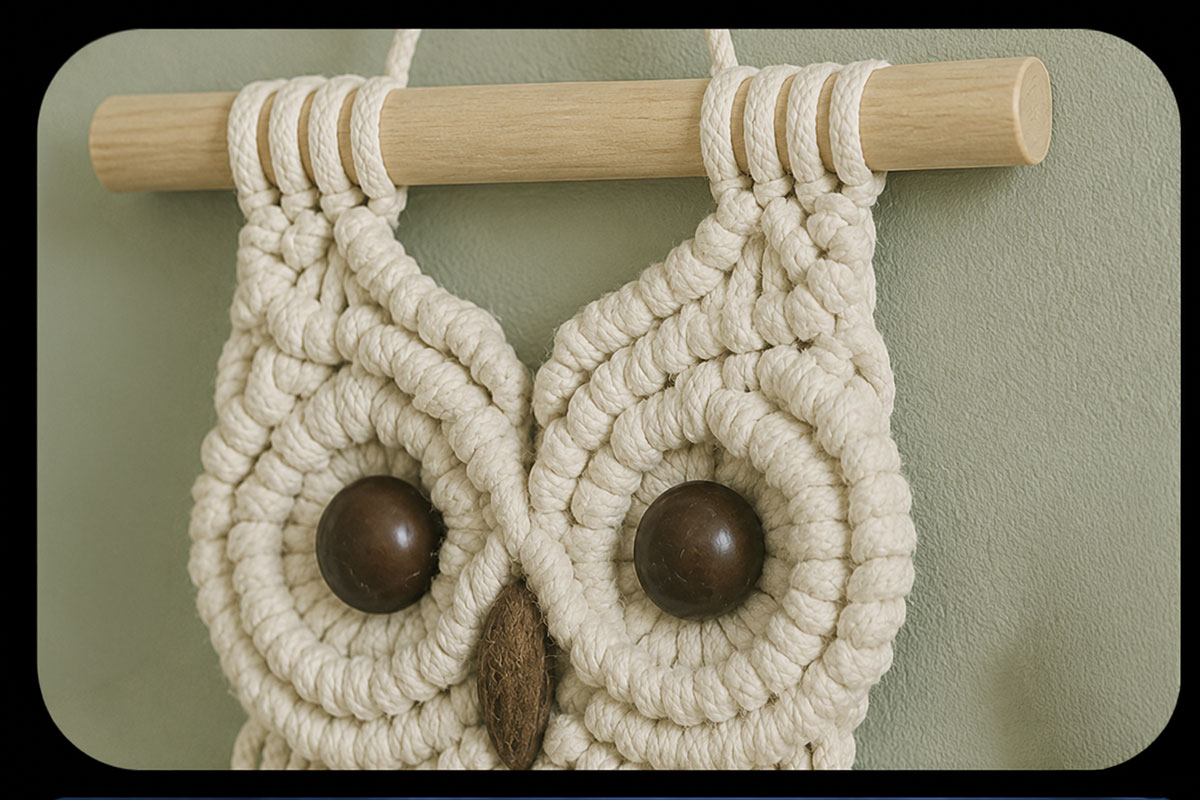
Pin the two covered eye rings beneath the upper dowel. Position them close together so their wrapped inner edges almost touch.
The eyes should be level, with roughly the upper third of each ring tucked behind its brow panel. Let the inner edges rise toward the center slightly. That's what gives this owl the sharp pointed expression shown in the finished design.
Use the fine waxed cord to stitch each brow panel to its eye ring from the back at three locations: near the outer upper edge, at the top of the ring and near the inner upper edge.
At each location, make 3 snug passes with the waxed cord. Pass each stitch beneath one or two adjacent cord wraps on the covered eye ring and through the back of the brow panel so the fine cord captures both pieces without showing from the front.
After the third pass at each attachment point, tie the waxed-cord ends together securely on the back with a square knot. Trim the fine ends only after tugging the join gently to confirm that the brow cannot separate from the eye ring.
Pull the brow snugly against the ring as you work so you don't end up with a visible gap between the two pieces.
Take the remaining brow tails to the back, weave them through at least three nearby knots and trim them. There shouldn't be any loose brow fringe on the finished owl.
Now use another short piece of waxed cord to join the two eye rings together from behind. Make one hidden join near the upper inner edges and another near the lower inner edges.
Keep the rings touching or separated by no more than about 1/8 inch.
Check the head now before you keep going. You should have four loops on each side of the upper dowel, two pointed brows, two large round ivory eyes and two centered dark wooden beads. If the two sides aren't sitting evenly, fix them here. The rest of the owl hangs from this structure.
Knot the Macramé Owl Body
Take six of the 118-inch body cords and fold each one exactly in half.
Before attaching them, leave about 1 3/4 inches of the wrapped ring clear along the outer lower edge of each eye. Measure this along the curve of the wrapped ring. This open section is reserved for the four 5 mm wing cords that will be added later.
Attach six body cords with lark's head knots across the remaining lower center of the left eye ring. Keep the six attachments close together and centered beneath the eye rather than allowing them to spread into the reserved outer section.
Attach the remaining six body cords across the lower center of the right eye ring the same way, again leaving the outer 1 3/4-inch section clear.
You now have 12 working strands hanging from the left eye and 12 from the right, for a total of 24 body strands.
With the front of the owl facing you, number the body strands 1 through 24 from left to right. Keep those numbers assigned to the same strands for the rest of the pattern, including the strands that later travel behind the tapered body and the 4 + 1 + 4 arrangement on the lower dowel.
Upper Body
Begin the first row about 1/4 inch below the eyes.
Row 1: Make six square knots using strands 1 to 4, 5 to 8, 9 to 12, 13 to 16, 17 to 20 and 21 to 24.
Row 2: Leave strands 1, 2, 23 and 24 idle. Make five offset square knots using strands 3 to 6, 7 to 10, 11 to 14, 15 to 18 and 19 to 22.
The square knot worked with strands 11 to 14 crosses the middle and joins the cords from the two eyes into one body.
Row 3: Repeat Row 1 for six square knots.
Row 4: Repeat Row 2 for five offset square knots.
Row 5: Repeat Row 1 for six square knots.
Row 6: Repeat Row 2 for five offset square knots.
Leave about 1/4 inch between these rows instead of packing every knot tightly against the row above it. You want the little open spaces that show through the body of the finished owl.
Taper the Lower Body
Now start narrowing the body. Any outside strands that aren't used in a row should travel straight down behind the work. Don't cut them. You'll need all 24 strands when you reach the lower dowel.
Row 7: Make five square knots with strands 3 to 6, 7 to 10, 11 to 14, 15 to 18 and 19 to 22. Strands 1, 2, 23 and 24 travel behind the body.
Row 8: Make four square knots with strands 5 to 8, 9 to 12, 13 to 16 and 17 to 20.
Row 9: Make three square knots with strands 7 to 10, 11 to 14 and 15 to 18.
Row 10: Make two square knots with strands 9 to 12 and 13 to 16.
Row 11: Make one square knot with strands 11 to 14.
Stop and count the cords before going any farther. You should still have all 24 body strands hanging below or traveling down the back of the owl.
Don't cut the unused outside strands. They haven't finished their job yet.
Make the Long Macramé Owl Wings
The wings on this owl are made as raised knotted ribs. They aren't square-knot strips, and they aren't brushed macramé feathers.
Use four of the 126-inch cords for the left wing and four for the right.
Each wing cord is folded unevenly. Leave about 28 inches on the short side and about 98 inches on the long side.
The short side becomes the core or holding cord. The long side does the knotting.
Attach the four unevenly folded wing cords to the 1 3/4-inch outer section of the eye ring that you reserved before adding the body cords. Use a reverse lark's head knot for each cord, keeping the four attachments side by side without overlapping the body-cord attachments.
Position the reverse lark's head loops primarily toward the back so the covered eye ring still looks round from the front.
You now have four core-and-working-cord pairs.
Knot the Four Wing Ribs
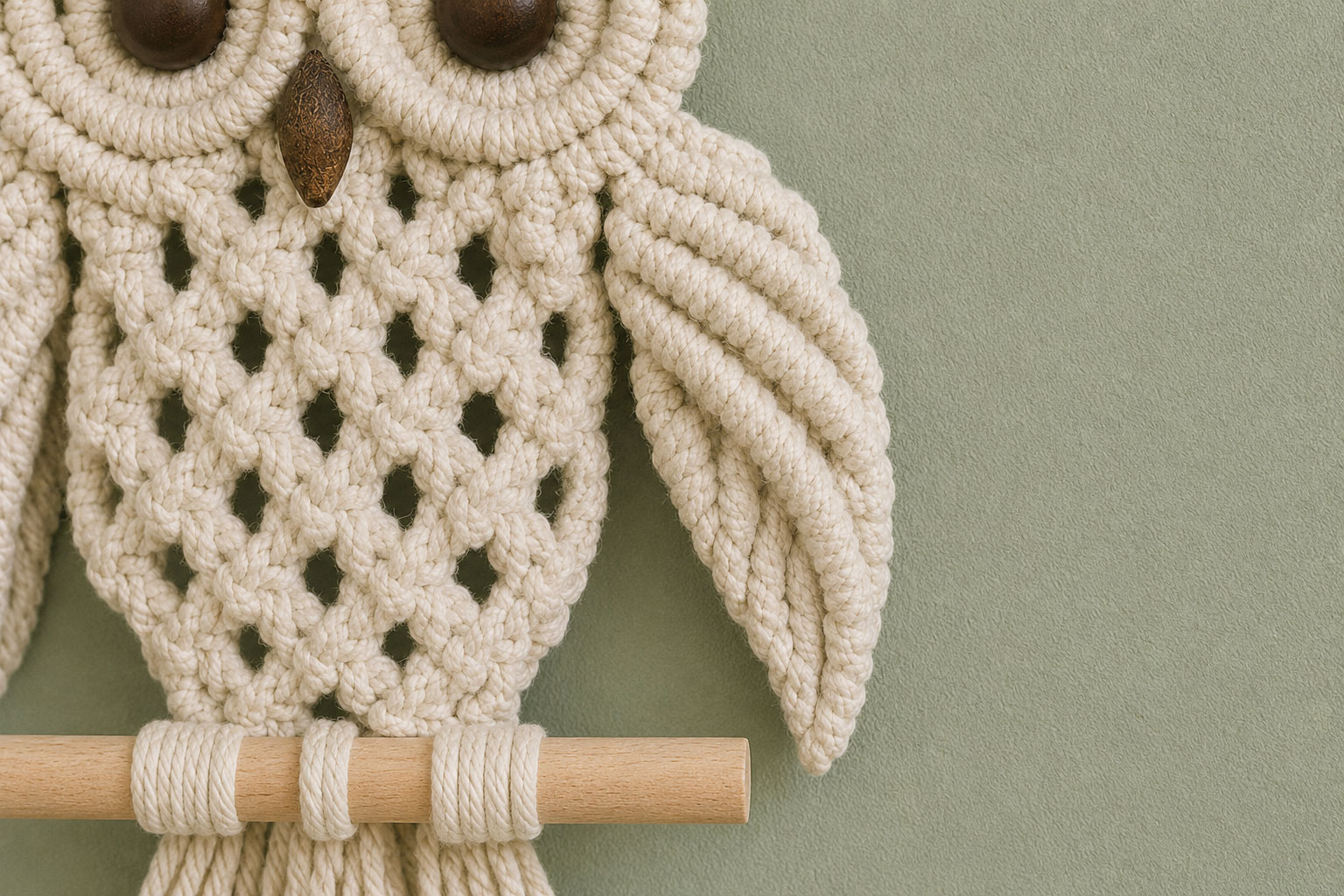
Start with the pair closest to the owl's body.
Hold the short core cord straight and use the long working cord to tie repeated double half hitches around it.
Inner rib: Continue until the knotted section measures about 3 3/4 inches. You'll probably make about 17 to 19 double half hitches.
Second rib: Knot the next pair until the raised section measures about 4 1/2 inches, or roughly 20 to 22 double half hitches.
Third rib: Continue the third pair to about 5 1/4 inches, or roughly 23 to 25 double half hitches.
Outer rib: Make the final raised rib about 6 to 6 1/2 inches long, or roughly 26 to 29 double half hitches.
Use the measurements as your guide. The exact knot count can shift with the cord you buy and how firmly you tighten each hitch.
After the final double half hitch on each rib, keep both remaining ends from that rib. Each wing still has 8 ends: 4 core-cord tails and 4 knotting-cord tails.
Take each long knotting-cord tail to the back of its own raised rib. Lay it upward along the back of the final 1 1/2 to 2 inches of that rib and secure it there with several firm stitches of the fine waxed cord. Keep these attachments on the back so they don't cross the raised rib on the front.
The four core-cord tails remain free and continue downward. These are the only four 5 mm tails that should travel toward the wing point.
Lay the four ribs side by side with the shortest rib next to the body and the longest rib along the outside edge. Curve the ribs gently downward.
Using the fine waxed cord on the back, tack neighboring ribs together about 1 1/2 inches below the eye, again near the middle and once more about 1 1/2 inches above the wing tip.
Don't pull the four ribs into one flat slab. Leave the narrow valleys between them so the four raised rows remain visible.
Guide the four core-cord tails downward through those valleys toward the lower point. Keep them lying flat instead of twisting them into one thick rope.
About 1/2 inch above the wing tip, use the fine waxed cord to bind the four core tails together with 6 tight wraps. Tie the waxed cord securely on the back.
Fold the remaining core tails upward against the back of the wing and secure them with several additional waxed-cord stitches. Once the wing has been compared with its mate and holds the intended tapered shape, trim the concealed excess and tuck the ends behind the raised knotting.
The finished wing should end in a narrow closed point with no loose fringe.
Make the second wing the same way in mirror image.
The wing tips should hang around the level of the lower body rows rather than reaching the second dowel. If a wing wants to twist forward, add one small hidden stitch from the back of the wing tip to the body.
Add the Wooden Beak
Place the tapered wooden bead vertically between the two eye rings with the wide end at the top and the point facing down.
The bead should overlap the inner edges of the eyes slightly and extend into the top of the body.
Pass a short piece of waxed cord through the bead. Anchor the upper end behind the eye-ring junction and the lower end behind the first body rows.
Tie everything on the back so no attachment cord shows from the front.
Attach the Lower Wooden Dowel
Place the 9-inch dowel horizontally about 1/2 to 3/4 inch below the final body knot.
Bring all 24 body strands down to the dowel.
The finished owl has four visible wraps on the left side of this dowel, one wrap in the center and four wraps on the right. Don't make three matching groups of four here. That changes the lower part of the design.
Four Left Wraps
Take body strands 1 through 8 to the left side of the dowel.
Use strands 1, 3, 5 and 7 for the four visible wraps. With each strand separately, bring the working end over the front of the dowel, around underneath it and back toward the rear. Pass the working end through the loop formed behind the dowel and pull snug to complete one half hitch around the dowel.
Keep the locking portion of each half hitch on the back. From the front, each strand should appear as one clean ivory wrap around the wood.
Strands 2, 4, 6 and 8 pass directly behind the dowel without making a hitch.
When all four hitches are complete, slide them together so the front shows four close wraps. All eight strands continue below the dowel.
One Center Wrap
Bring strands 9 through 16 behind the center of the dowel.
Use strand 12 to make one half hitch around the dowel in exactly the same way as the left-side wraps. Keep the locking portion on the back so the front shows one clean center wrap.
Strands 9, 10, 11, 13, 14, 15 and 16 pass directly behind the dowel. All eight center strands continue below it.
You should see one isolated center coil.
Four Right Wraps
Bring strands 17 through 24 to the right side.
Use strands 18, 20, 22 and 24 to make one half hitch each around the dowel, following the same path used for the left side. Keep every locking portion on the back.
Strands 17, 19, 21 and 23 pass directly behind the dowel. All eight strands continue below it.
Look at the lower dowel from the front before continuing. You should see four wraps on the left, one in the middle and four on the right.
All 24 body strands should still continue below the dowel.
Make the Wrapped Neck and Long Fringe
Bring all 24 body strands together beneath the center of the lower dowel.
Use the separate 39-inch gathering cord to make a standard gathering knot around the bundle.
Make about six or seven close wraps, or enough to create a wrapped neck approximately 1 1/4 inches long.
Finish the gathering cord inside the wrap and trim it.
Add the Small Wrapped Ring
Take the 1 1/2-inch metal ring and the 55-inch wrapping cord.
Cover the ring completely with tight half-hitch wraps just as you did with the two eye rings.
The finished outside diameter should be about 1 3/4 to 2 inches.
Finish the cord at the back of the ring.
Use fine waxed cord to attach the ring at its top immediately below the gathering wrap. The little ring sits in front of the fringe. It doesn't carry the weight of the tassel.
Separate and Trim the Fringe
Untwist the 24 body cords below the gathering knot into their individual plies.
Finger separate the strands or use a wide-tooth comb just enough to take out the obvious twists.
Don't brush them into fluffy cotton. The finished owl has long separated strands in the tassel rather than a soft brushed fringe.
Trim the fringe about 8 inches below the lower dowel, leaving the center slightly longer than the sides so the bottom has a shallow rounded shape.
Add the Hanging Cord
Use the 47-inch hanger cord. Center it above the owl and adjust the two sides until the top of the hanging loop sits about 6 to 7 inches above the upper dowel.
Hold one hanger end against the back of the dowel immediately outside each brow group. Check the owl from the front and make sure the hanging loop is centered.
Once the hanger height and position are correct, trim the excess so about 1 1/2 inches of each hanger end extends downward behind the dowel.
Cut two pieces of the 1 mm waxed cord about 30 inches long. At the left attachment point, hold the 1 1/2-inch hanger tail firmly against the back of the dowel. Wrap one waxed cord tightly around both the dowel and the hanger tail 8 times. Slide the wraps together immediately beside the brow group and tie the waxed-cord ends with a square knot on the back.
Repeat at the right attachment point. The fine binding wraps will circle the dowel; keep them close together and position them directly beside the brow group rather than claiming that a full wrap can remain only on the back half of the wood.
Tug firmly upward on the center of the hanger before trimming the waxed-cord ends. Neither hanger attachment should slide along the dowel, loosen or pull free.
Expected Finished Size
Your finished dimensions can shift a little with cord thickness and knot tension, but these are the target proportions for this macramé owl pattern:
- Upper dowel: 10 inches
- Lower dowel: 9 inches
- Covered eye diameter: about 3 to 3 1/4 inches each
- Combined head width: about 6 to 6 1/2 inches
- Upper body width: about 5 to 5 1/2 inches
- Body length below the eyes: about 7 inches
- Wing length: about 6 to 6 1/2 inches
- Wrapped neck: about 1 1/4 inches
- Wrapped decorative ring: about 1 3/4 to 2 inches across
- Fringe below the lower dowel: about 8 inches
Before displaying the owl, remove every pin, clip or temporary support used while positioning the eyes, brows or wings.
Hang the owl and check it from the front. The upper and lower dowels should sit level, the two eyes should be even, both wings should hang at matching heights and the decorative ring should sit centered in front of the fringe.
Gently tug the wooden eye beads, beak, brow-to-eye joins, wing attachments, lower-dowel hitches, gathering wrap, decorative ring and hanger attachments. Nothing should shift or pull free.
Once those checks pass, trim any concealed wing tails or other ends that the instructions deliberately left long. Make sure every trimmed end remains securely buried or stitched on the back before the owl is displayed.
Safe Nursery Placement for a Macramé Owl Wall Hanging
This owl is a decorative wall hanging, not a toy or crib mobile. I'd put it on a separate nursery wall where the long fringe, hanging cord, wooden beads and dowels stay completely beyond a child's reach.
Do not hang it above a crib, bassinet, play yard or changing table. Keep it away from furniture a growing child could eventually use to reach the cords.
Use wall hardware that's appropriate for both the wall surface and the finished weight of the hanging. Check the hanger, dowels, beads and mounting point occasionally and remove the owl if anything becomes loose.
The U.S. Consumer Product Safety Commission warns about the strangulation risk from accessible cords around children. That's reason enough to give a long-fringed macramé piece its own out-of-reach wall rather than treating it like decoration for the crib area.
You can find more general sleep-space information on my crib safety standards page.
Where I'd Use This Owl in a Woodland Nursery
This is already a fairly detailed wall hanging, so I'd give it some space. A plain painted wall lets the round eyes, layered wings and long ivory fringe show instead of competing with a lot of little decorations around it.
The natural cord and wood work especially well with forest colors, warm wood furniture and other simple woodland details. You don't need to repeat owls everywhere in the room.
If you do want to carry the theme farther, my owl baby nursery ideas have more ways to use the motif without making every accessory match. You can also mix the owl with deer, foxes, rabbits and bears using the ideas on my woodland nursery theme page.
I'd keep the space immediately below this hanging fairly simple. The wings and tassel already give you plenty of texture.
As your child grows, check the placement again. A wall decoration that was unreachable when the nursery was first set up may not stay that way once climbing and movable furniture enter the picture.
A Few Things That Matter With This Macramé Owl Pattern
The measurements are more important than forcing every repeated half hitch to match an exact count. Two 5 mm cotton cords can behave differently, and a very tight knotter can fit more knots into the same distance than someone using a looser tension.
That's especially true around the eye rings and along the four raised ribs in each wing. Use the knot-count ranges as checkpoints, then stop when the piece reaches the stated measurement.
Don't trim a cord while it is still needed for shaping, positioning or a later attachment. Once a component has reached its stated measurement, has been permanently secured and has passed the checkpoint given in that section, conceal and trim only the tails that the instructions specifically tell you to finish.
I also wouldn't substitute much thinner cord and expect the same owl. The chunky 5 mm cord is part of what gives the eyes, brows and wings their weight and shape.
Frequently Asked Questions About This Macramé Owl Pattern
Is this a beginner-friendly macramé owl pattern?
I'd call it a confident beginner to early-intermediate project rather than a first macramé project. The square-knot body is straightforward, but you'll also be working double half hitches, covered rings, unevenly folded wing cords and a few hidden joins.
If you already know how to make a lark's head knot, square knot and double half hitch without having to relearn each one as you go, the instructions should be much easier to follow.
How much cord do I need for this macramé owl?
I'd start with about 110 m or 120 yd of 5 mm natural ivory 3-ply cotton cord.
The planned cut list accounts for 86 m before trimming and working allowance. The extra cord gives you room for differences in knot tension, the number of wraps required to cover the rings and the amount needed to finish the wing ribs cleanly.
Why do some of the knot counts give a range?
Because the finished measurement is the part that needs to match. Cord diameter, twist and knot tension can change how many half hitches fit into 4 inches even when both makers are using cord sold as the same size.
For example, if a wing rib reaches its stated length after 18 double half hitches instead of 19, stop at the measurement. Don't add another knot just to hit the larger number and make the wing too long.
Can I make the owl larger or smaller?
You can, but I wouldn't resize it by simply adding or removing a couple of body rows. The round eyes, brow width, wing length, dowels and fringe all work together as one set of proportions.
For a different finished size, scale the eye rings and dowels first, then adjust the body width, wing-rib lengths and starting cord lengths to match. Changing only one section is likely to give you an owl with oversized eyes, short wings or a body that doesn't line up with the lower perch.
Do I have to use metal rings inside the eyes?
You need a firm circular core if you want the large round eyes to hold the shape shown here. Welded craft rings are useful because they stay round while you work the covering knots tightly around them.
I wouldn't replace the rings with loops made only from soft macramé cord. They won't give the eyes the same defined circular structure.
Can I use 3 mm cord instead of 5 mm cord?
You can make a macramé owl with 3 mm cord, but it won't automatically produce this one at the same measurements. The brows, eye surrounds and wing ribs will all come out finer, and you'll need more wraps to cover the rings.
If your goal is to reproduce the owl shown in the example image, I'd stay with the 5 mm cord.
Why are the wings made separately from the body?
Because the finished owl has long, raised wing ribs that sit over the sides of the knotted body. Making the wings as their own components gives you that layered shape without turning the outer body strands into loose fringe.
It also lets you curve and position each finished wing before the hidden attachment points are secured at the back.
Is the small wrapped ring below the lower dowel holding the fringe?
No. The body cords continue behind it and form the fringe. The small wrapped ring is attached separately in front of the tassel, so it doesn't carry the weight of the owl or replace the gathering wrap.
Can I hang this macramé owl above a crib?
No. This project has long cords, fringe, beads and wooden components. Hang it on a separate wall completely outside the child's reach rather than above a crib, bassinet, play yard or changing area.
More Handmade Woodland Projects
If this is the kind of nursery project you like making, browse my free baby patterns for more DIY nursery decor pattern ideas.
You can also carry the woodland look into nursery storage with my free crochet owl basket pattern, or mix in other forest animals with the projects in my free crochet basket patterns collection.
The owl has enough character to stand on its own, though. You don't have to turn the whole room into an owl theme just because you made one very good owl.
When you click on links to various merchants on this site and make a purchase, this may result in this site earning a commission. This does not affect the price you pay.

UBGI Gold Standard 2026
Reviewed under the site's
editorial checklist.
Photos, decorating ideas, party setups and reader submissions are shared for inspiration unless a page is specifically presented as a pattern, tutorial, reference guide or step-by-step project. Follow the instructions, measurements, safety guidance and manufacturer directions provided for the particular project or product.
About Jan | Contact | Baby Nursery Ideas (Blog) | Site Map | Privacy Policy | Disclosure Policy | Disclaimer | Affiliate Disclosure | Earnings Disclosure | Facebook | Pinterest
I am a participant in the Amazon Services LLC Associates Program, an affiliate advertising program designed to provide a means for us to earn fees by linking to Amazon. As an Amazon Associate I earn from qualifying purchases.
Copyright © 2006-2026. All Rights Reserved.