Woodland Nursery Crochet Mushroom Pattern for Baby Crib Mobile Decorations
This free woodland nursery crochet mushroom pattern is an easy project that adds hand stitched charm to a baby's room. The pattern collection includes several mushroom styles you can mix together to create a woodland crib mobile, nursery garland, shelf decorations, or hanging accents inspired by a forest nursery theme.Explore more woodland and crochet ideas:
Woodland Forest Animals Nursery Theme
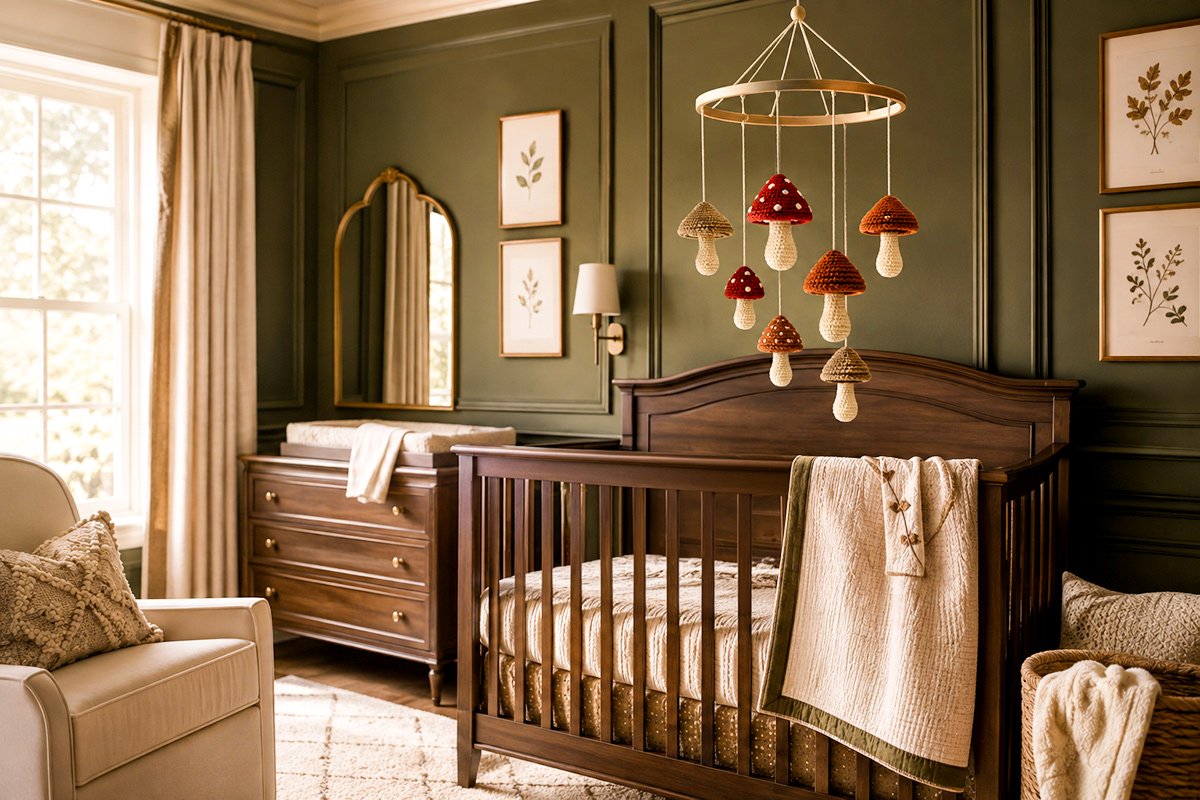
Supplies used for this woodland nursery crochet mushroom pattern:
Jump to a section:
Woodland Nursery Crochet Mushroom Pattern Quick Answer
A woodland nursery crochet mushroom pattern is a small stuffed mushroom worked in continuous rounds and suspended from a mobile hoop using cotton cord. Most mushrooms on this page take less than an hour to complete and can be mixed in different sizes to create a woodland crib mobile, nursery decorations, or hanging accents.
Use odd numbers of mushrooms.
Five or seven hanging pieces often balance better than six because the arrangement looks more natural from different viewpoints around the room.
This woodland nursery crochet mushroom pattern is designed for a seven piece mobile with varied finished sizes.
Skill Level and Supplies for This Crochet Mushroom Pattern
Small nursery decorations can look simple until the pieces start twisting, leaning, or hanging unevenly. That is why this woodland nursery crochet mushroom pattern includes exact stitch counts, finished sizes, stuffing notes, and hanging instructions instead of leaving the mobile assembly to guesswork.
This pattern is written for a confident beginner, not a first-day crocheter. You should already know how to make a magic ring, single crochet, increase, decrease, work in continuous rounds, and sew two crochet pieces together. If those skills are new, practice on one test mushroom before making the full mobile.
The woodland nursery crochet mushroom pattern below keeps the cap, stem, stuffing, and hanging loop steps separated so the project is easier to follow.
Pattern notes before you begin:
- Use US crochet terms.
- Work in continuous spiral rounds. Do not join at the end of each round unless a step says to do so.
- Place a stitch marker in the first stitch of every round and move it up as you work.
- Keep your stitches snug so the stuffing does not show through.
- Gauge is not critical, but your finished mushrooms should match the size chart below if you want the same mobile proportions.
- After fastening off a stem, thread its remaining tail onto the yarn needle, secure it through several stitches on the inside of the stem, and hide the end in the stuffing. Do not pull the final stem round closed because that opening will be fitted inside the mushroom cap.
Yarn and supplies for seven mushrooms:
- Worsted weight number 4 cotton yarn, red, about 25 yards
- Worsted weight number 4 cotton yarn, rust, about 25 yards
- Worsted weight number 4 cotton yarn, light brown, about 30 yards
- Worsted weight number 4 cotton yarn, cream, about 50 yards
- Small amount of white or cream yarn for cap dots
- 3.5 mm crochet hook
- Polyfill stuffing
- Yarn needle
- Stitch marker
- Scissors
- At least 10 yards of strong cotton hanging cord, plus additional cord if a longer upper suspension is needed
- 9 to 12 inch wooden mobile hoop
- Closed hanging ring for the upper suspension cords
Abbreviations:
- MR means magic ring
- ch means chain
- sc means single crochet
- inc means 2 single crochet in the same stitch
- dec means single crochet 2 stitches together
- sl st means slip stitch
- st means stitch
If you are making this for a full forest themed room, the handmade look pairs naturally with the ideas on DIY Woodland Crib Mobile and Woodland Nursery Ideas.
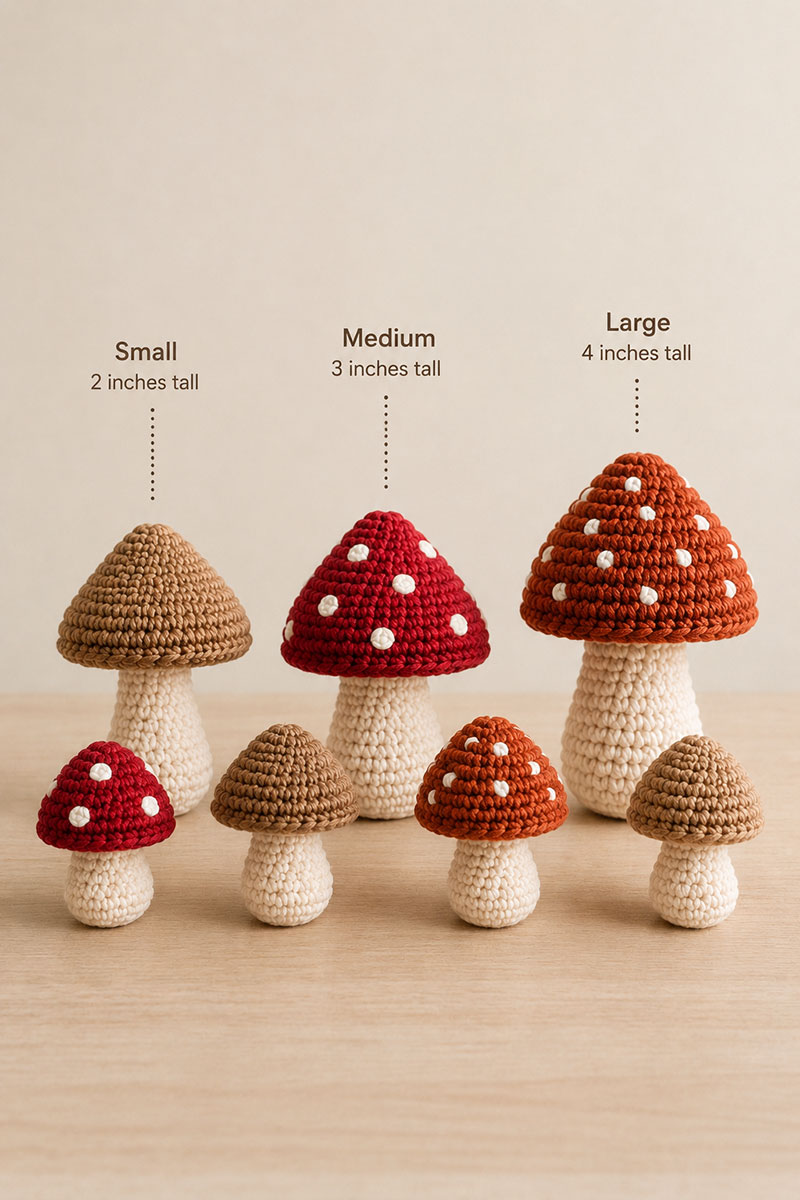
Finished Size Chart for a Crochet Mushroom Mobile
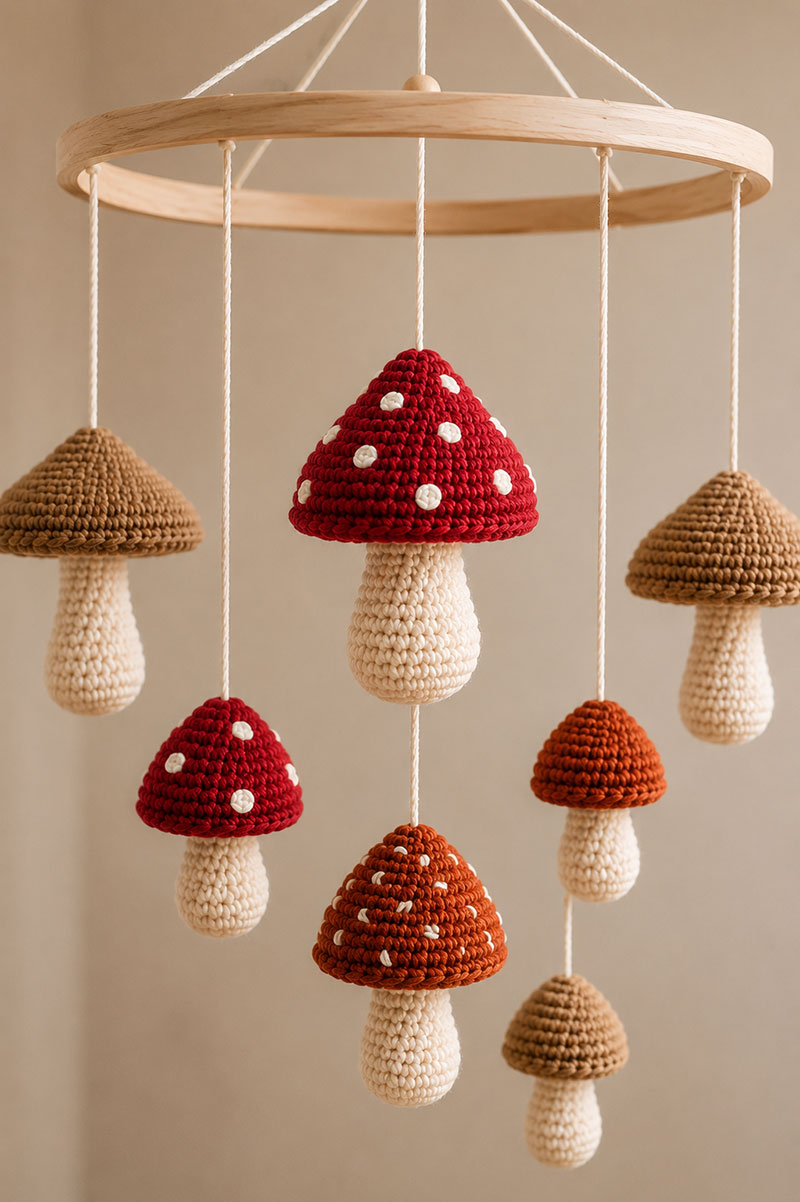
The mobile in the main page image combines mushrooms with several finished measurements. Real nursery mobiles look better when every piece is not lined up like a row of matching ornaments.
- Small mushroom: about 2 inches tall, 1 1/2 inch cap width
- Medium forest mushroom: about 3 inches tall, 2 inch cap width
- Medium speckled mushroom: about 3 1/2 inches tall
- Large toadstool: about 4 inches tall, 2 1/2 inch cap width
Suggested seven piece mobile layout:
- 2 large toadstools
- 2 medium forest mushrooms
- 1 medium speckled mushroom
- 2 small mushrooms
Use odd numbers of mushrooms.
Five or seven hanging pieces balance better visually because the eye does not split the mobile into two equal halves. I believe that is why some handmade nursery mobiles look finished while others look a little stiff, even when the crochet work is neat.
Install the Hanging Cords Before Stuffing
Add the hanging cord to each cap while the wrong side is still accessible. Do this after completing any dots or speckles but before stuffing the cap or sewing it to the stem.
For each mushroom cap:
- Cut a 30 inch length of cotton hanging cord. The extra length allows room for balancing and tying; it will be trimmed after the mobile is assembled.
- Thread one end of the cord onto a yarn needle.
- From the wrong side of the cap, insert the needle through the exact center of the starting magic ring and pull the cord to the outside.
- Leave about 3 inches of cord inside the cap.
- Tie several firm overhand knots in the short inside end to form a stopper that cannot pass through the center of the crochet.
- Pull gently on the outside cord to seat the knot against the wrong side of the cap.
- If the knot begins to pull through the center, add another knot before continuing.
- Leave the long outside cord untrimmed until the mushroom has been positioned and balanced on the mobile.
The hanging cord should rise from the exact center of the cap. A cord placed even one or two stitches off center can cause the finished mushroom to tilt.
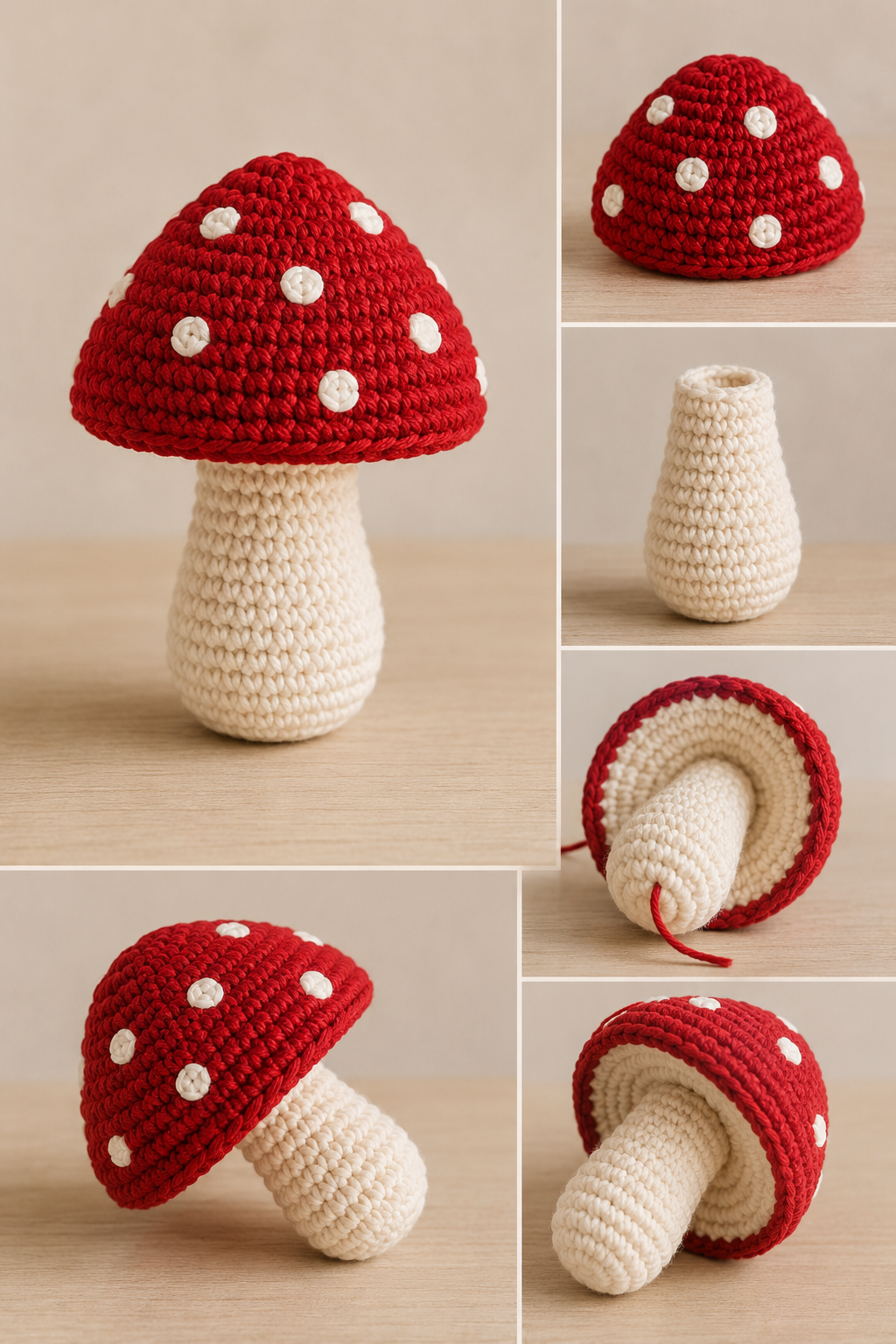
Classic Toadstool Crochet Mushroom Pattern
The classic toadstool is the easiest mushroom to recognize from across a nursery. It gives the mobile a clear woodland look without needing extra decorations.
This woodland nursery crochet mushroom pattern starts with the toadstool because it becomes the main visual piece in the mobile.
Finished size: about 4 inches tall.
Make 2 large toadstools for the mobile.
Cap, using red yarn:
Round 1: Make a MR. Work 6 sc into the ring. Pull the ring closed. (6)
Round 2: Work 2 sc in each stitch around. (12)
Round 3: Work 1 sc in the next stitch, then 2 sc in the next stitch. Repeat around. (18)
Round 4: Work 1 sc in each of the next 2 stitches, then 2 sc in the next stitch. Repeat around. (24)
Round 5: Work 1 sc in each of the next 3 stitches, then 2 sc in the next stitch. Repeat around. (30)
Round 6: Work 1 sc in each of the next 4 stitches, then 2 sc in the next stitch. Repeat around. (36)
Rounds 7 through 10: Work 1 sc in each stitch around. (36)
Round 11: Work 1 sc in each of the next 4 stitches, then dec. Repeat around. (30)
Fasten off, leaving a 20 inch tail for gathering and sewing. Do not close the opening yet.
Stem, using cream yarn:
Round 1: Make a MR. Work 6 sc into the ring. Pull the ring closed. (6)
Round 2: Work 2 sc in each stitch around. (12)
Round 3: Work 1 sc in the next stitch, then 2 sc in the next stitch. Repeat around. (18)
Rounds 4 through 6: Work 1 sc in each stitch around. (18)
Round 7: Work 1 sc in each of the next 4 stitches, then dec. Repeat around. (15)
Rounds 8 through 12: Work 1 sc in each stitch around. (15)
Stuff the stem until it stands upright when placed on the table. It should press back slightly when squeezed, but it should not bend in the middle.
Round 13: Work 1 sc in the next stitch, then dec. Repeat around. (10)
Fasten off, leaving a 12 inch tail for securing inside the stem.
Add the cap dots:
- Thread a yarn needle with cream yarn.
- Bring the needle up through the inside of the cap to the outside.
- Make one short straight stitch on the cap surface.
- Bring the needle back inside the cap.
- Repeat 8 to 12 times, spacing the dots unevenly so they do not look like a grid.
- Knot the yarn inside the cap and trim the end.
Assemble the toadstool:
- Install the hanging cord through the center of the cap before adding stuffing.
- Add stuffing until the cap looks rounded and does not cave in when held from the sides.
- Using the cap sewing tail, run a gathering stitch through all 30 stitches around the cap opening.
- Place the narrow final 10 stitch round of the stem inside the center of the cap opening. The wider magic-ring end of the stem is the bottom of the mushroom.
- Pull the gathering thread gradually until the cap opening fits evenly around the final stem round.
- Check that the stem is centered and that the hanging cord rises straight from the center of the cap.
- Whipstitch the gathered cap edge securely to the top of the stem.
- Sew around the join a second time, then knot securely and hide the yarn tail inside the mushroom.
A small lean may not show on the table, but it becomes obvious once the mushroom is hanging. Hold the finished piece by the top of the cap before tying it to the mobile hoop.
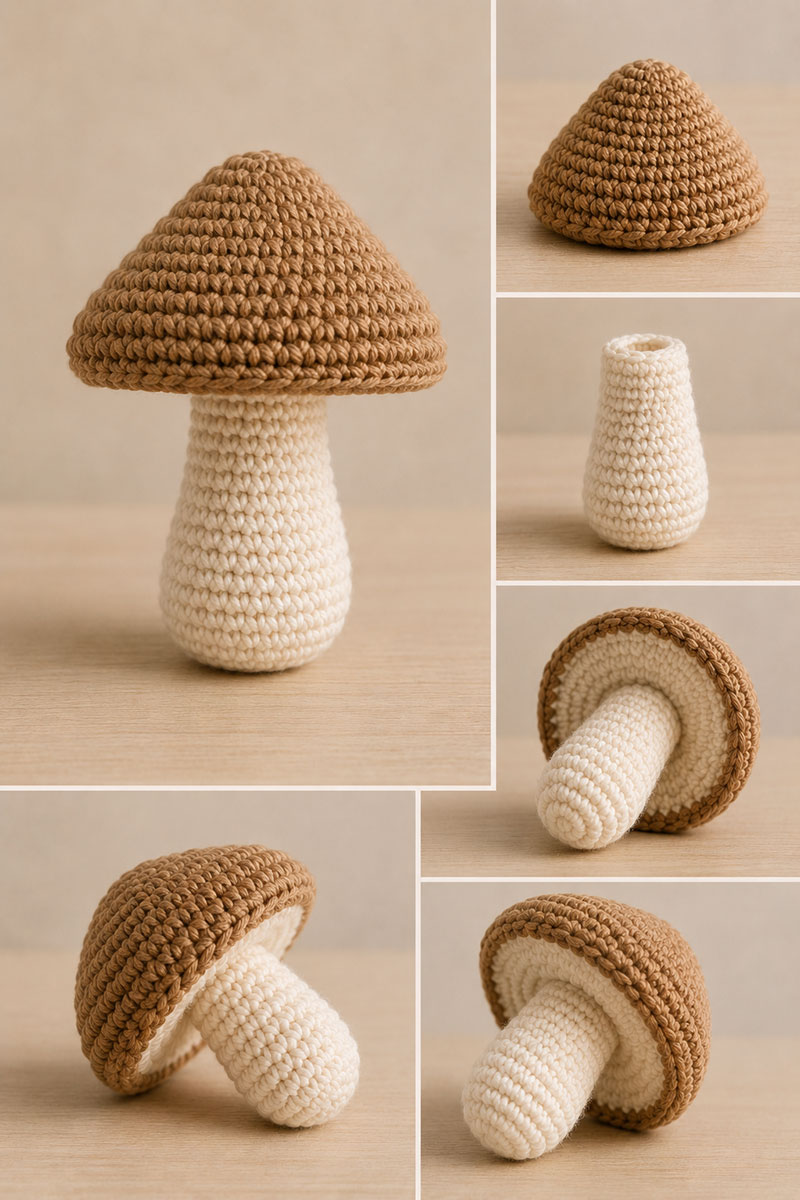
Tall Forest Woodland Nursery Crochet Mushroom Pattern
The tall forest mushroom adds height variation to the mobile. In a real nursery, that little change matters because the mobile is seen from the doorway, the crib side, and the rocking chair, not just straight on.
Finished size: about 3 inches tall.
Make 2 medium forest mushrooms for the mobile.
Cap, using light brown yarn:
Round 1: Make a MR. Work 6 sc into the ring. Pull closed. (6)
Round 2: Work 2 sc in each stitch around. (12)
Round 3: Work 1 sc in the next stitch, then 2 sc in the next stitch. Repeat around. (18)
Round 4: Work 1 sc in each of the next 2 stitches, then 2 sc in the next stitch. Repeat around. (24)
Round 5: Work 1 sc in each of the next 3 stitches, then 2 sc in the next stitch. Repeat around. (30)
Rounds 6 through 8: Work 1 sc in each stitch around. (30)
Round 9: Work 1 sc in each of the next 3 stitches, then dec. Repeat around. (24)
Fasten off, leaving a 12 inch sewing tail.
Stem, using cream yarn:
Round 1: Make a MR. Work 6 sc into the ring. Pull closed. (6)
Round 2: Work 2 sc in each stitch around. (12)
Rounds 3 through 10: Work 1 sc in each stitch around. (12)
Stuff the stem in small pinches. Push the filling down with the blunt end of the hook after every few rounds so the stem does not collapse.
Round 11: Work 1 sc in each of the next 2 stitches, then dec. Repeat around. (9)
Fasten off, leaving a 12 inch tail for securing inside the stem.
Assemble the forest mushroom:
- Install the hanging cord through the center of the cap before adding stuffing.
- Stuff the cap until the top keeps a rounded shape.
- Using the cap sewing tail, run a gathering stitch through all 24 stitches around the cap opening.
- Place the narrow final 9 stitch round of the stem inside the center of the cap opening. The wider magic-ring end of the stem is the bottom of the mushroom.
- Pull the gathering thread gradually until the cap opening fits evenly around the final stem round.
- Check that the stem is centered and that the hanging cord rises straight from the center of the cap.
- Add a little more stuffing before closing the seam if the cap looks flat.
- Whipstitch the gathered cap edge securely to the stem, knot the yarn, and hide the tail inside the mushroom.
Use this taller mushroom near the outside edge of the hoop. It creates movement without making the center of the mobile look heavy.
Speckled Crochet Mushroom Pattern for Nursery Decor
The speckled mushroom gives the mobile a handmade collected look. The cap is made almost the same way as the toadstool, but the color and stitched markings keep it from looking copied.
Finished size: about 3 1/2 inches tall.
Make 1 speckled mushroom for the mobile.
Cap, using rust yarn:
Round 1: Make a MR. Work 6 sc into the ring. Pull closed. (6)
Round 2: Work 2 sc in each stitch around. (12)
Round 3: Work 1 sc in the next stitch, then 2 sc in the next stitch. Repeat around. (18)
Round 4: Work 1 sc in each of the next 2 stitches, then 2 sc in the next stitch. Repeat around. (24)
Round 5: Work 1 sc in each of the next 3 stitches, then 2 sc in the next stitch. Repeat around. (30)
Round 6: Work 1 sc in each of the next 4 stitches, then 2 sc in the next stitch. Repeat around. (36)
Rounds 7 through 9: Work 1 sc in each stitch around. (36)
Round 10: Work 1 sc in each of the next 4 stitches, then dec. Repeat around. (30)
Fasten off, leaving a 14 inch sewing tail.
Stem, using cream yarn:
Round 1: Make a MR. Work 6 sc into the ring. Pull closed. (6)
Round 2: Work 2 sc in each stitch around. (12)
Rounds 3 through 9: Work 1 sc in each stitch around. (12)
Stuff the stem so it is firm enough to stand, but do not pack it so tightly that the stitches stretch open.
Round 10: Work 1 sc in each of the next 2 stitches, then dec. Repeat around. (9)
Fasten off, leaving a 12 inch tail for securing inside the stem.
Add speckles:
- Cut an 18 inch strand of cream yarn.
- Thread the yarn needle.
- Bring the yarn up through the inside of the cap.
- Make a short straight stitch across one crochet stitch.
- Move to another spot on the cap and repeat.
- Add 10 to 14 speckles total.
- Keep the spacing uneven so the cap looks handmade rather than dotted in rows.
- Knot the yarn inside the cap.
Assemble the speckled mushroom:
- Install the hanging cord through the center of the cap after adding the speckles but before adding stuffing.
- Stuff the cap in small amounts until it holds a rounded shape.
- Using the cap sewing tail, run a gathering stitch through all 30 stitches around the cap opening.
- Place the narrow final 9 stitch round of the stem inside the center of the cap opening. The wider magic-ring end of the stem is the bottom of the mushroom.
- Pull the gathering thread gradually until the cap opening fits evenly around the final stem round.
- Check that the stem is centered and that the hanging cord rises straight from the center of the cap.
- Whipstitch the gathered cap edge securely to the stem, knot the yarn, and hide the tail inside the mushroom.
I notice speckles show up best when they are not too tiny. If the dots disappear from arm's length away, make them slightly longer on the next mushroom.
Small Crochet Mushroom Pattern for Filling Gaps
The small mushrooms keep the mobile from looking too heavy. They are also helpful when one side needs a little visual weight without adding another large piece.
Finished size: about 2 inches tall.
Make 2 small mushrooms for the mobile.
Cap, using red, rust, or brown yarn:
Round 1: Make a MR. Work 6 sc into the ring. Pull closed. (6)
Round 2: Work 2 sc in each stitch around. (12)
Round 3: Work 1 sc in the next stitch, then 2 sc in the next stitch. Repeat around. (18)
Round 4: Work 1 sc in each of the next 2 stitches, then 2 sc in the next stitch. Repeat around. (24)
Rounds 5 through 7: Work 1 sc in each stitch around. (24)
Round 8: Work 1 sc in each of the next 2 stitches, then dec. Repeat around. (18)
Fasten off, leaving a 10 inch sewing tail.
Stem, using cream yarn:
Round 1: Make a MR. Work 6 sc into the ring. Pull closed. (6)
Round 2: Work 2 sc in each stitch around. (12)
Rounds 3 through 6: Work 1 sc in each stitch around. (12)
Stuff lightly but evenly.
Round 7: Work 1 sc in each of the next 2 stitches, then dec. Repeat around. (9)
Fasten off, leaving a tail for securing inside the stem.
Assemble the small mushroom:
- Install the hanging cord through the center of the cap before adding stuffing.
- Stuff the cap until rounded.
- Using the cap sewing tail, run a gathering stitch through all 18 stitches around the cap opening.
- Place the narrow final 9 stitch round of the stem inside the center of the cap opening. The wider magic-ring end of the stem is the bottom of the mushroom.
- Pull the gathering thread gradually until the cap opening fits evenly around the final stem round.
- Check that the stem is centered and that the hanging cord rises straight from the center of the cap.
- Whipstitch the gathered cap edge securely to the stem, knot the yarn, and hide the tail inside the mushroom.
Check the Hanging Position of Each Crochet Mushroom
The hanging cords should already be anchored inside the caps before the mushrooms are stuffed and assembled.
Hold each mushroom by its cord and check its position before attaching it to the hoop. The stem should point downward without leaning sharply to the front, back, left, or right.
If a mushroom tilts, do not try to correct it by pulling the cord sideways through the stuffing. Reopen a small section of the cap-to-stem seam, reposition the stuffing around the center anchor, and close the seam again.
Small mushrooms are the pieces I would check twice before hanging. Because they weigh less, they can turn more easily once the air moves around the room.
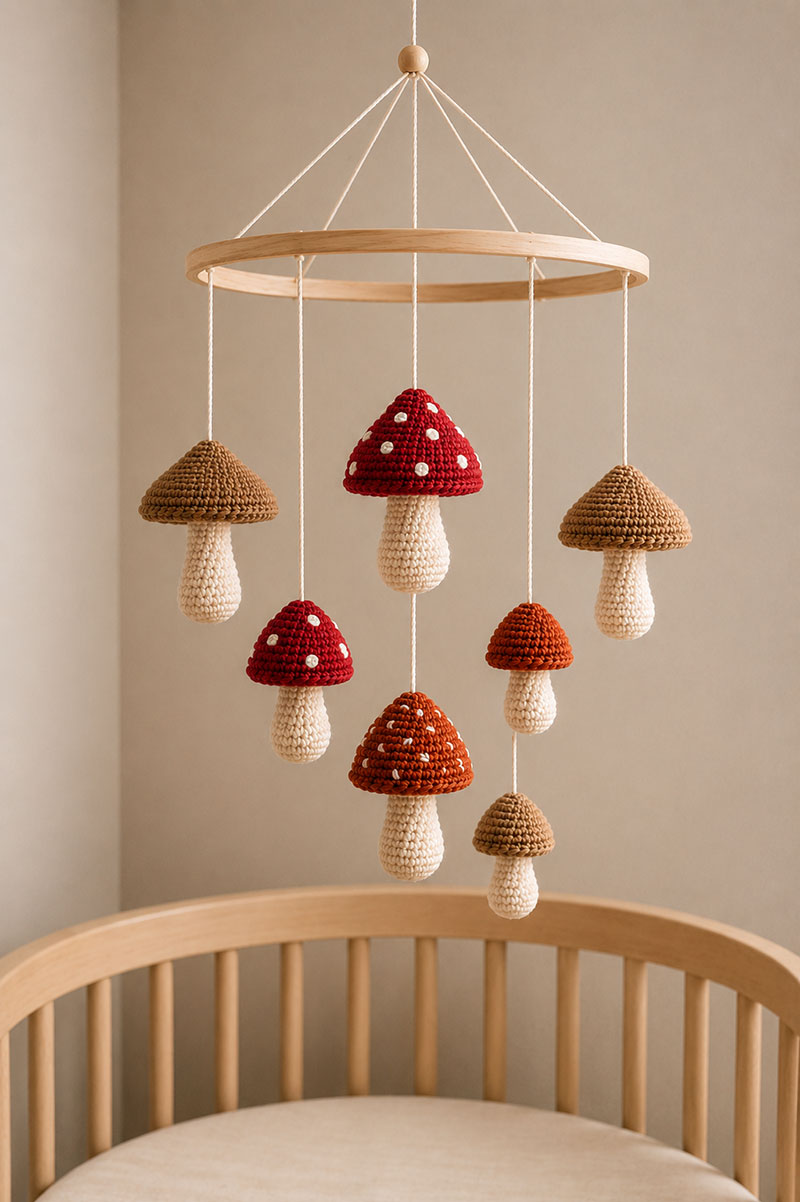
How to Assemble the Woodland Mushroom Crib Mobile
Lay every mushroom on a table before tying anything to the hoop. Keep the 30 inch mushroom cords untrimmed until the completed mobile hangs level.
Add supports for the center mushroom:
- Cut two lengths of cotton cord several inches longer than the diameter of the wooden hoop.
- Tie the first cord tightly across the center of the hoop.
- Tie the second cord across the hoop at a right angle to the first so the two cords cross at the exact center.
- Knot the two support cords together where they cross.
- Check that both cords remain taut and that their intersection stays centered inside the hoop.
Arrange the seven mushrooms:
- Tie one large toadstool to the center intersection of the support cords.
- Arrange the remaining large toadstool, two medium forest mushrooms, one speckled mushroom, and two small mushrooms at roughly even intervals around the hoop.
- Begin with about 16 inches between the hoop and the top of the center mushroom.
- Begin with about 12 inches for the remaining large toadstool and the speckled mushroom.
- Begin with about 14 inches for the two medium forest mushrooms.
- Begin with about 10 inches for the two small mushrooms.
- Tie each cord temporarily so its length can still be adjusted.
Add the upper suspension:
- Cut three equal lengths of strong cotton cord.
- Tie the cords securely to three evenly spaced points around the wooden hoop.
- Bring the three upper ends together above the exact center of the hoop.
- Tie all three cords securely to a closed hanging ring.
- Lift the mobile by the hanging ring and check that the hoop remains level.
- If the hoop tilts, adjust an upper suspension cord before tightening the final knots.
- If the decorations make one side dip, move one of the perimeter mushrooms slightly around the hoop or adjust its hanging length.
- When the mobile is level, tighten every knot and test each connection with a firm pull.
- Trim the cord ends only after the mobile has been balanced and fully checked.
Use properly rated ceiling hardware that is suitable for the ceiling material and follow the hardware manufacturer's installation directions. Never attach this handmade mobile directly to the crib.
Safety: These handmade mushrooms are decorations, not baby toys or crib toys. Never place them inside the crib or attach the mobile directly to the crib. Install the mobile with properly rated ceiling hardware and position every mushroom, cord, hoop, knot, and hanging component completely beyond the baby's reach. Shelf decorations and garlands must also remain out of reach. Check the knots, cords, crochet fabric, stuffing seams, hanging ring, and ceiling attachment regularly. Remove the mobile when the baby begins pushing up on hands and knees or by about 5 months old, whichever comes first. Keep the crib sleep space bare with only a fitted sheet, as recommended in the CPSC Safe Sleep guidance.
Woodland Nursery Decorating Ideas With Crochet Mushrooms
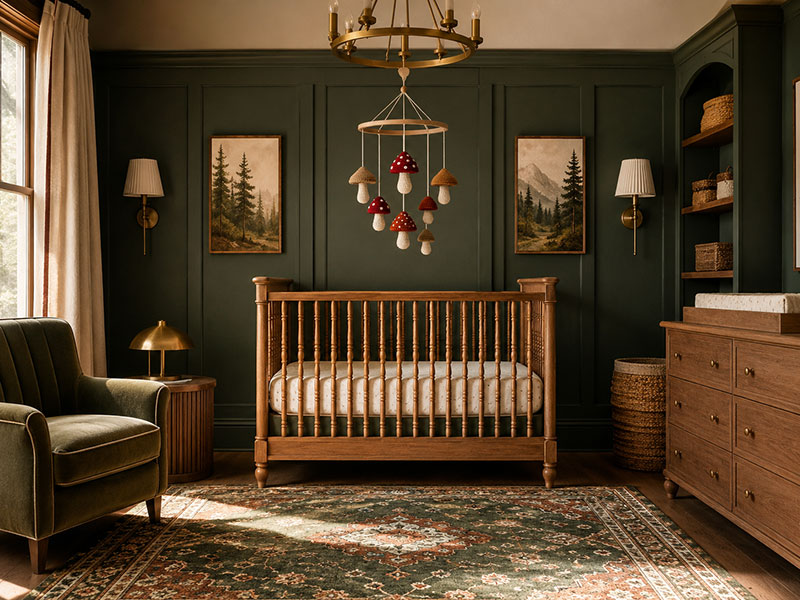
A crochet mushroom mobile does not need the whole room to match it. In a real nursery, a few repeated forest details usually look more intentional than covering every wall and shelf with the same theme.
This woodland nursery crochet mushroom pattern can also be used for shelf accents, nursery garlands, or small handmade decorations.
Try pairing the mobile with one woodland print, one crib sheet, and one wall detail. That gives the room a clear direction without making the crib area look busy.
The crochet mushrooms also fit naturally with Woodland Nursery Decor Ideas and Woodland Nursery Wallpaper, especially when the room already uses forest colors or animal artwork.
If you want more projects with the same theme, Crochet Animal Lovey Patterns can help connect this mushroom mobile to fox, deer lovey patterns, owl, and other woodland animal projects without drifting away from the nursery look.
Two smaller handmade animals that also suit this forest floor style are the crochet otter lovey pattern and the crochet hedgehog lovey pattern.
Woodland Nursery Crochet Mushroom Pattern FAQ
Can these mushrooms be used as nursery shelf decorations?
Yes. Simply omit the hanging cords and place the finished mushrooms directly on a shelf or dresser.
What yarn works best?
Cotton yarn tends to hold its shape well and provides consistent stitch definition for smaller decorative pieces.
Can I make the mushrooms larger?
Yes. For a simple proportional increase, use thicker yarn with a hook size suitable for that yarn while keeping the written stitch counts unchanged. Make one test mushroom before completing the full set because the finished measurements and weight will change.
Are crochet mobiles safe above a crib?
Mobiles should always remain completely out of a child's reach and should be removed when a child begins pushing up on hands and knees. For current nursery safety guidance, see the Consumer Product Safety Commission Safe Sleep recommendations.
Can these mushrooms be used in a garland?
Yes. String the mushrooms onto a length of cotton cord instead of attaching them to a mobile hoop.
Can beginners make this pattern?
Yes. Anyone comfortable with single crochet, increasing, decreasing, and working in the round should be able to complete the mushrooms by following the stitch counts provided above.
When you click on links to various merchants on this site and make a purchase, this may result in this site earning a commission. This does not affect the price you pay.

UBGI Gold Standard 2026
Reviewed under the site's
editorial checklist.
Photos, decorating ideas, party setups and reader submissions are shared for inspiration unless a page is specifically presented as a pattern, tutorial, reference guide or step-by-step project. Follow the instructions, measurements, safety guidance and manufacturer directions provided for the particular project or product.
About Jan | Contact | Baby Nursery Ideas (Blog) | Site Map | Privacy Policy | Disclosure Policy | Disclaimer | Affiliate Disclosure | Earnings Disclosure | Facebook | Pinterest
I am a participant in the Amazon Services LLC Associates Program, an affiliate advertising program designed to provide a means for us to earn fees by linking to Amazon. As an Amazon Associate I earn from qualifying purchases.
Copyright © 2006-2026. All Rights Reserved.