Free Ocean Baby Quilt Pattern (Easy Patchwork Appliqué Crib-Size Design)
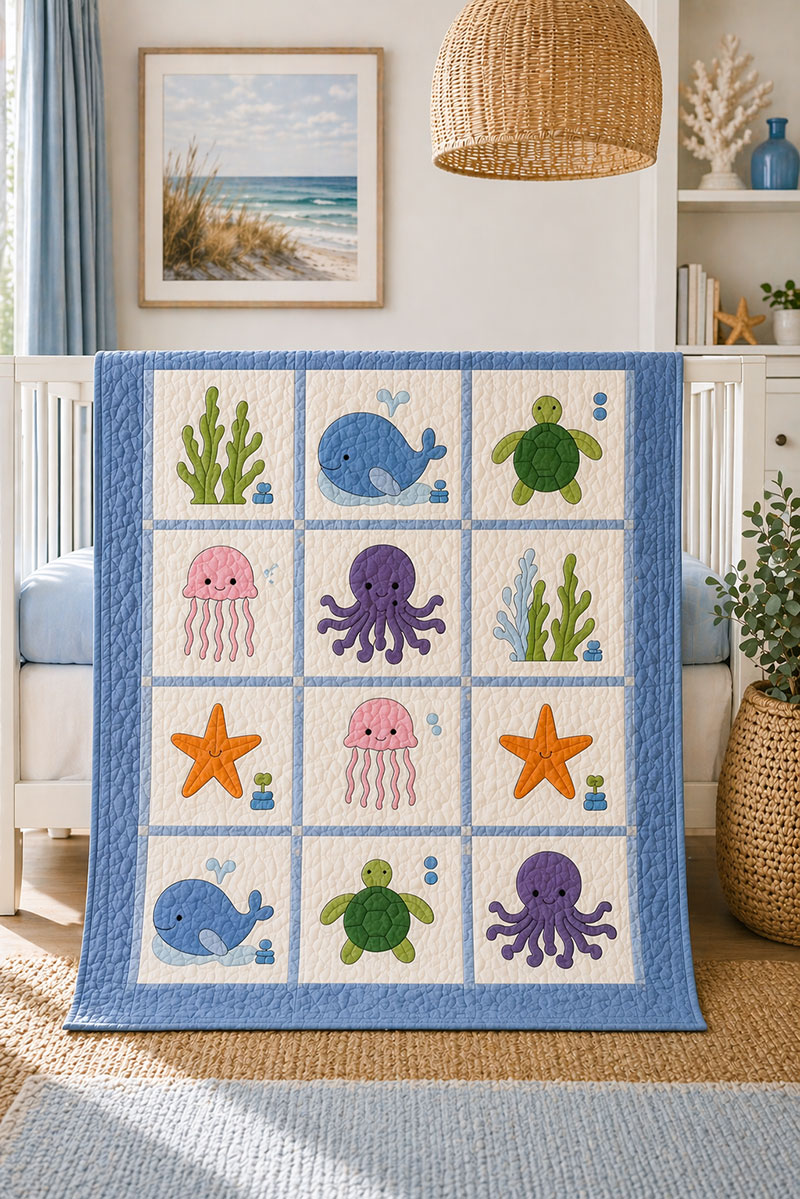
Ocean baby quilt pattern designs like this are what quilters are making right now for a soft, modern under the sea nursery, especially when they want something that looks custom without being complicated to sew. This one uses simple appliqué shapes for a whale, sea turtle, octopus, and jellyfish so you can get that high-end watercolor look using fabric instead of prints, and it’s sized to fit a crib featuring a timeless patchwork style.
Looking for more baby quilt ideas?
Ocean fabric bundle that works perfectly for this quilt
Shop ocean theme fat quarter bundle (coordinated blues, aqua, and sea life prints)
Jump to what you need
Ocean baby quilt pattern finished size, layout, and exact build overview
It usually starts with a few fabrics on the table and a quick moment where something feels slightly off even though the colors looked right in the store. This ocean baby quilt pattern is set up so once everything is placed using the guides below, the quilt holds together without shifting pieces or redoing blocks.
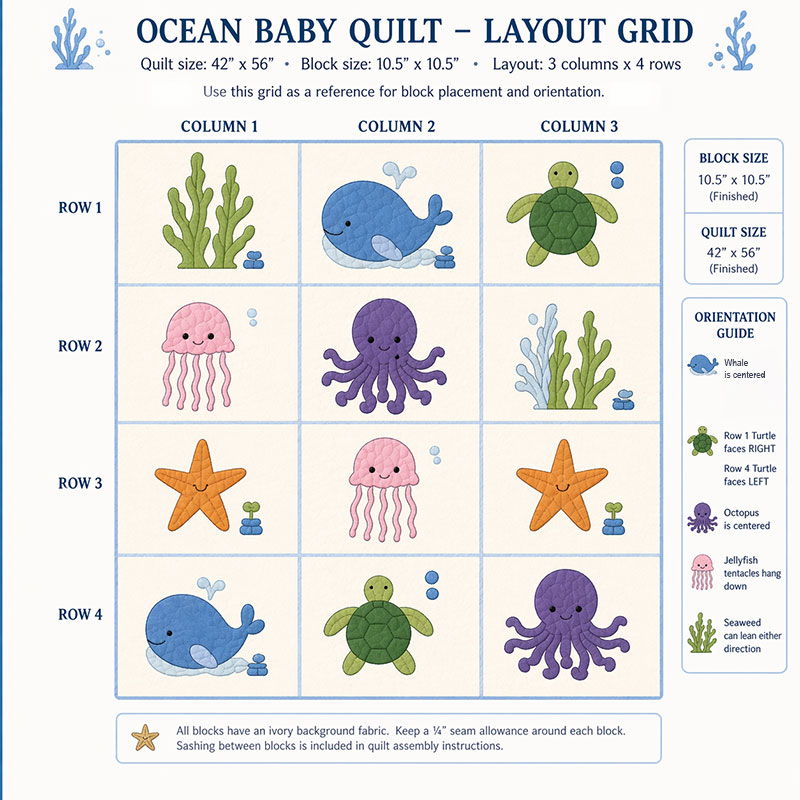
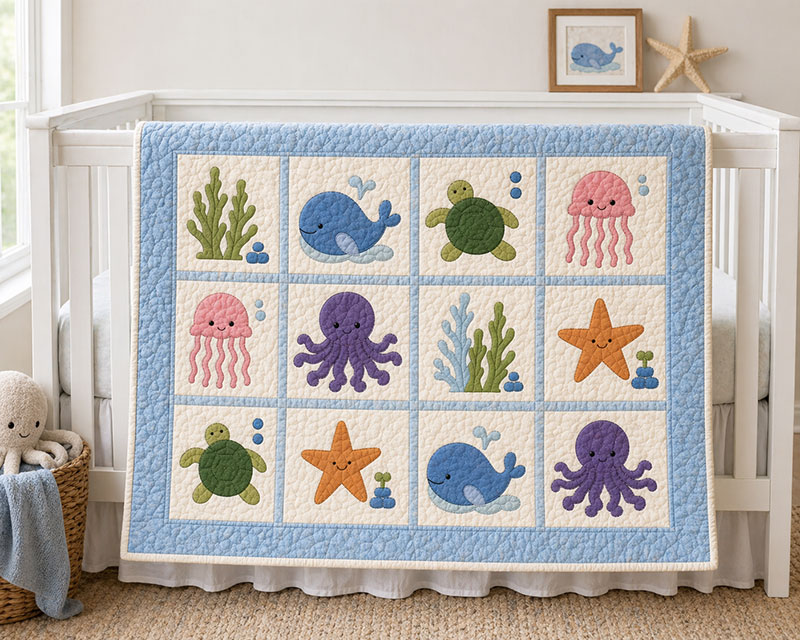
Quick answer: This ocean baby quilt pattern is a 42 by 54 inch crib-size quilt made from twelve 10 inch finished blocks arranged in a 3 by 4 layout with two seaweed blocks, two whale blocks, two turtle blocks, two jellyfish blocks, two octopus blocks, and two starfish blocks placed in a fixed arrangement so the finished quilt matches the design shown.
If you follow the measurements, placement, orientation, and order exactly, your finished quilt will match the design shown.
Final quilt size: 42 inches wide by 54 inches long
- Blocks: 12 total
- Layout: 3 across by 4 down
- Finished block: 10 inches
- Cut size: 10.5 inches
- All seams: 1/4 inch seam allowance
Exact layout and orientation:
- Row 1: seaweed, whale facing right, turtle facing right
- Row 2: jellyfish, octopus centered, seaweed
- Row 3: starfish, jellyfish, starfish
- Row 4: whale facing left, turtle facing left, octopus centered
This reversal in the bottom row is what keeps the quilt from feeling repetitive.
The same under-the-sea animal mix can be extended into handmade nursery accents with my sea creature crochet patterns, especially when you want matching whale, turtle, octopus, jellyfish, and fish projects beyond the quilt blocks. A handmade seahorse crochet lovey pattern adds another sea creature accent for a baby gift basket, shelf display, or under the sea room theme, while a small crochet starfish lovey pattern is an easy way to repeat the starfish shape from this quilt in a handmade nursery piece.
The same technique is effective with a collection of coastal artwork as you will see in my nautical nursery picture ideas showing various arrangements of sailboat prints, maritime gallery walls, and polished seaside nursery decor.
That’s the beauty of ocean themed nursery ideas, there are endless possibilities that prevent the room from feeling repetitive.
For a wall-focused version of the same under-the-sea look, these coastal nursery wallpaper ideas show how wave prints, sea-glass colors, sandy neutrals, and ocean-inspired patterns can set the room’s mood before the quilt, crib textiles, and handmade sea-creature details are added.
A more fish-focused version of that same coastal look appears in my fish theme baby bedding ideas, where koi-inspired accents, fish crib sheets, and fishing nursery decor create a cleaner underwater nursery direction.
Sea turtle details can also guide the crib area itself, especially in these turtle baby bedding ideas that pair coastal quilt colors, crib textiles, and ocean-inspired nursery accents in one clear direction.
baby quilt ideas and layout styles
Materials, fabric amounts, and exact cutting instructions
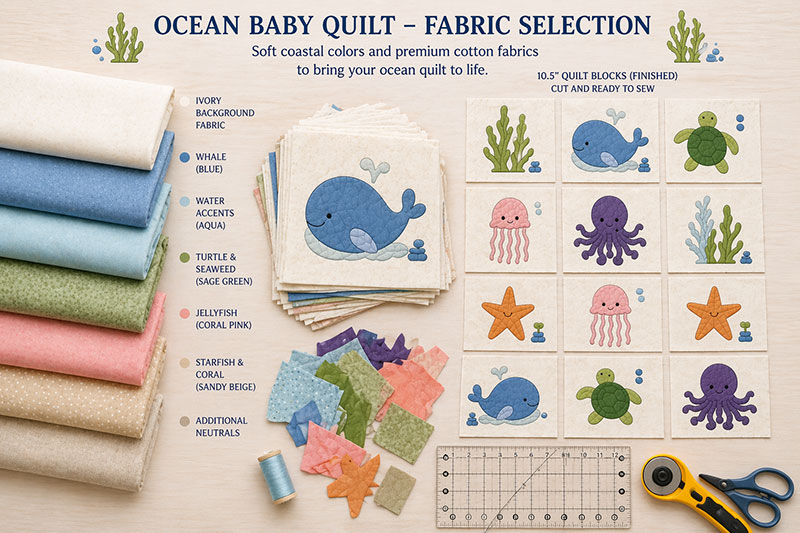
When the fabrics stay within a close tone range, the appliqué shapes become the focus without needing strong contrast. That balance shows up clearly once the blocks are placed side by side.
If you're choosing fabrics for an ocean-themed quilt, my baby fabrics guide explains how to combine nursery cotton prints, blender fabrics, watercolor-style coordinates, and backing materials to create a more polished finished quilt.
- Background fabric: 1 yard
- Whale fabric: 1/4 yard
- Turtle fabric: 1/4 yard
- Octopus fabric: 1/4 yard
- Jellyfish fabric: 1/4 yard
- Accent fabrics: 2 to 3 fat quarters
- Backing fabric: 1.5 yards
- Binding fabric: 1/2 yard
- Batting: crib size
- Fusible web
- Thread
Cutting:
- 12 background squares at 10.5" x 10.5"
- Vertical sashing: 8 pieces at 2.5" x 10.5"
- Horizontal sashing: 3 strips at 2.5" x 34.5"
- Side borders: 2 pieces at 3.5" x 54.5"
- Top and bottom borders: 2 pieces at 3.5" x 42.5"
Appliqué templates, print check, and mirroring requirement
This step prevents nearly all sizing and orientation problems.
- Print templates at 100 percent scale
- Do not select “fit to page”
- After printing, measure the 1 inch test square to confirm accuracy
- Trace shapes onto fusible web in reverse
- All shapes must be mirrored before cutting
If the shapes are not reversed, the whale and turtle will face the wrong direction in the final quilt.
Printable appliqué templates and how to use them correctly
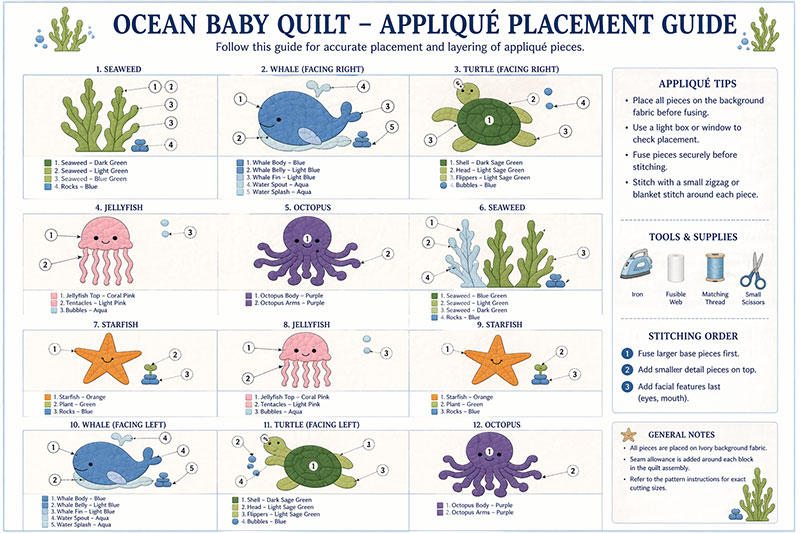
The appliqué templates for this ocean baby quilt pattern are designed to match the block size and layout exactly, so it’s important to use them as-is without resizing.
Template download and print setup:
- Templates are provided as individual JPG files
- Each page is sized to standard 8.5" x 11"
- Print at 100 percent scale (do not select “fit to page”)
- After printing, measure the 1 inch test square to confirm accuracy
Before cutting any fabric:
- Trace all shapes onto the paper side of fusible web
- All shapes must be traced in reverse (mirror image)
- Cut rough shapes, fuse to fabric, then cut clean edges
Important placement rule:
- Do not fuse pieces immediately after placing them
- Lay out all appliqué pieces on the block first
- Step back and compare to the finished quilt layout image
- Make adjustments before fusing anything in place
If something looks off:
- Gently lift and reposition pieces before applying full heat
- Check that shapes are centered and evenly spaced
- Confirm orientation (left/right facing animals) matches the layout guide
This step is what ensures your finished quilt matches the design and prevents sizing or placement issues later.
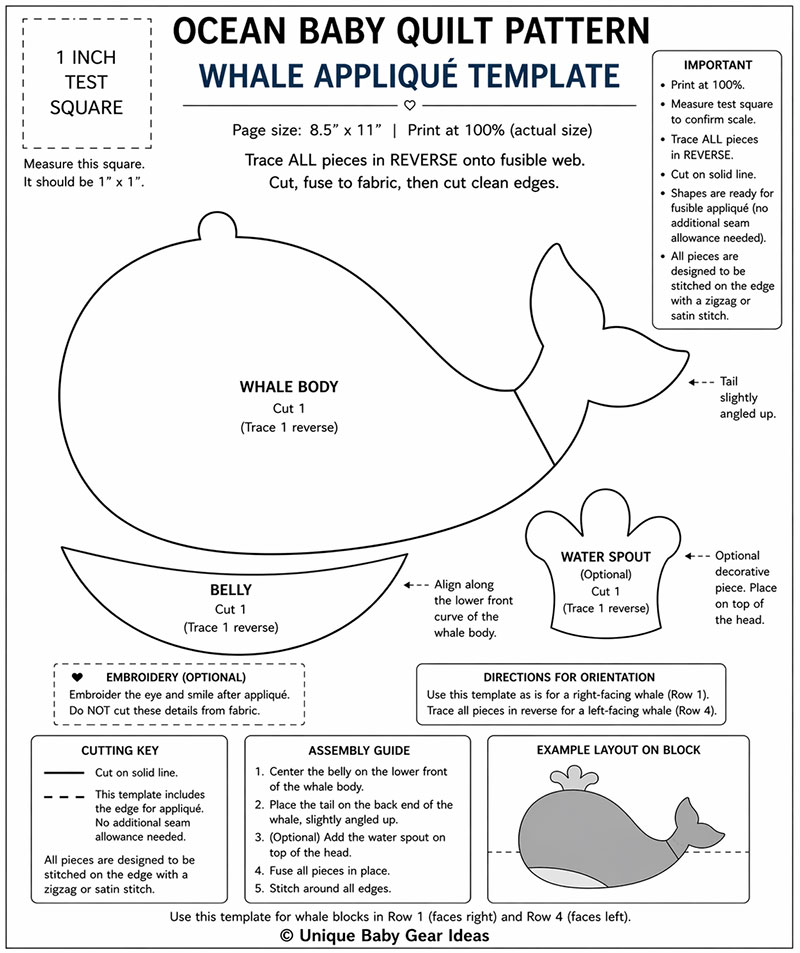
Printable whale appliqué template
Use this whale appliqué template for the whale blocks in Row 1 and Row 4. Print at 100 percent scale, trace in reverse onto fusible web, and check the 1 inch test square before cutting fabric.
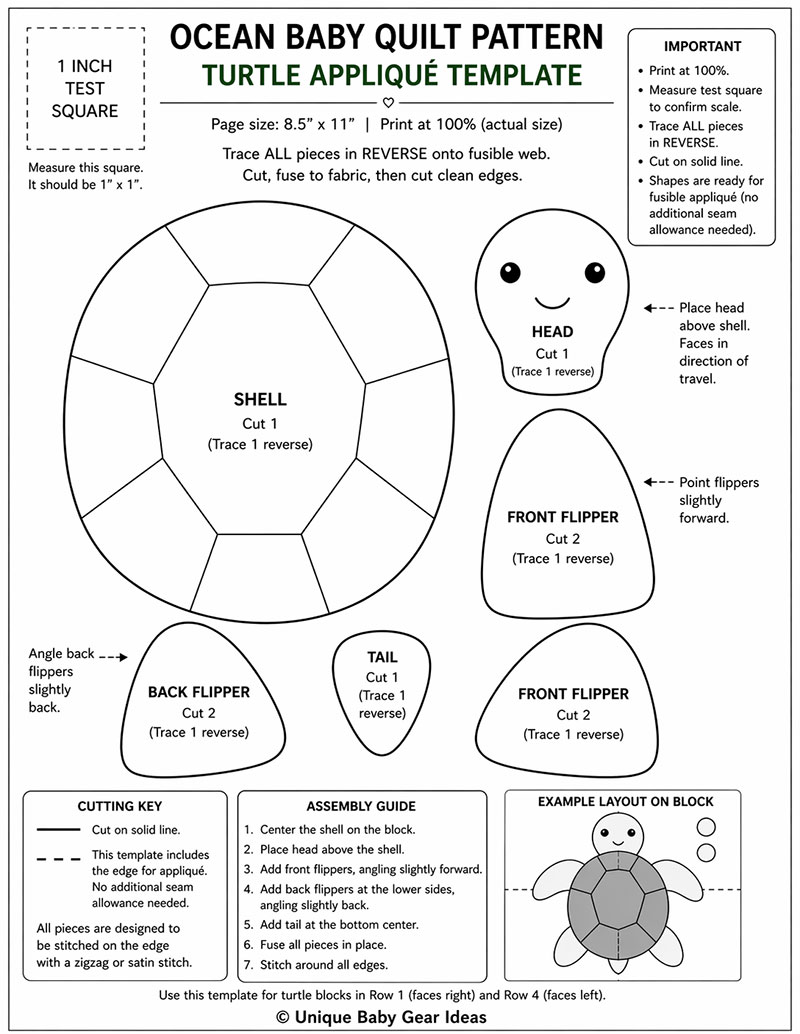
Printable turtle appliqué template
Use this turtle appliqué template for the turtle blocks in Row 1 and Row 4. Print at full size, trace the pieces in reverse, and keep the shell and head aligned with the direction of travel shown in the layout guide.
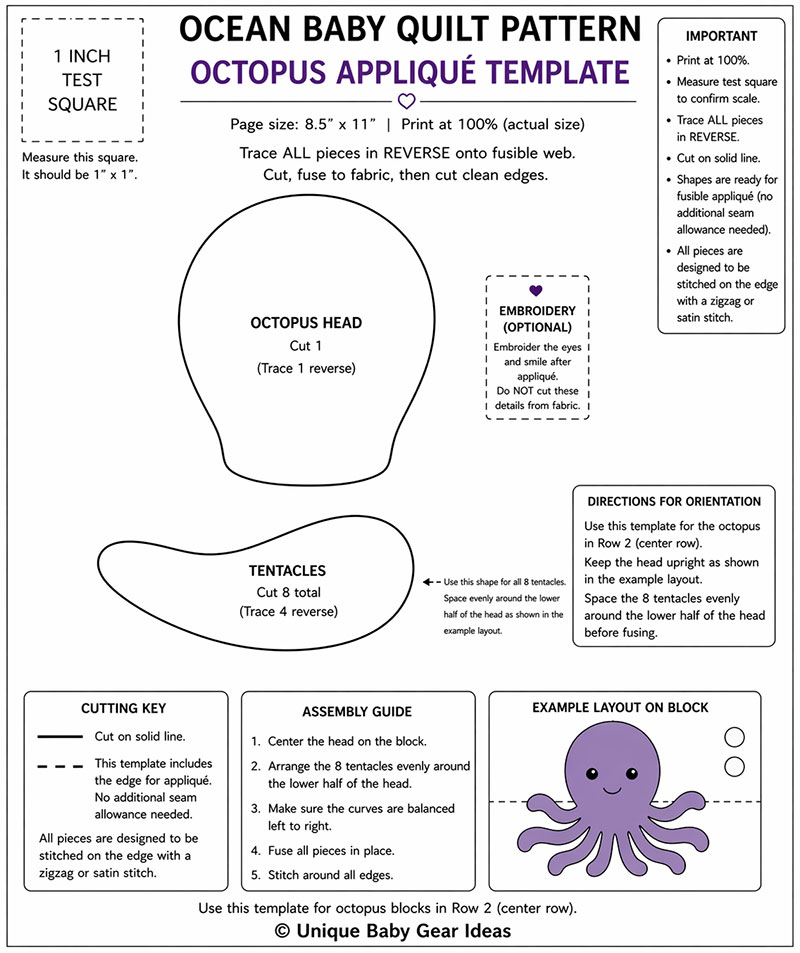
Printable octopus appliqué template
Use this octopus appliqué template for the center block in Row 2 and the final block in Row 4. Print at 100 percent scale, trace in reverse, and spread the tentacles evenly before fusing so the block matches the finished quilt.
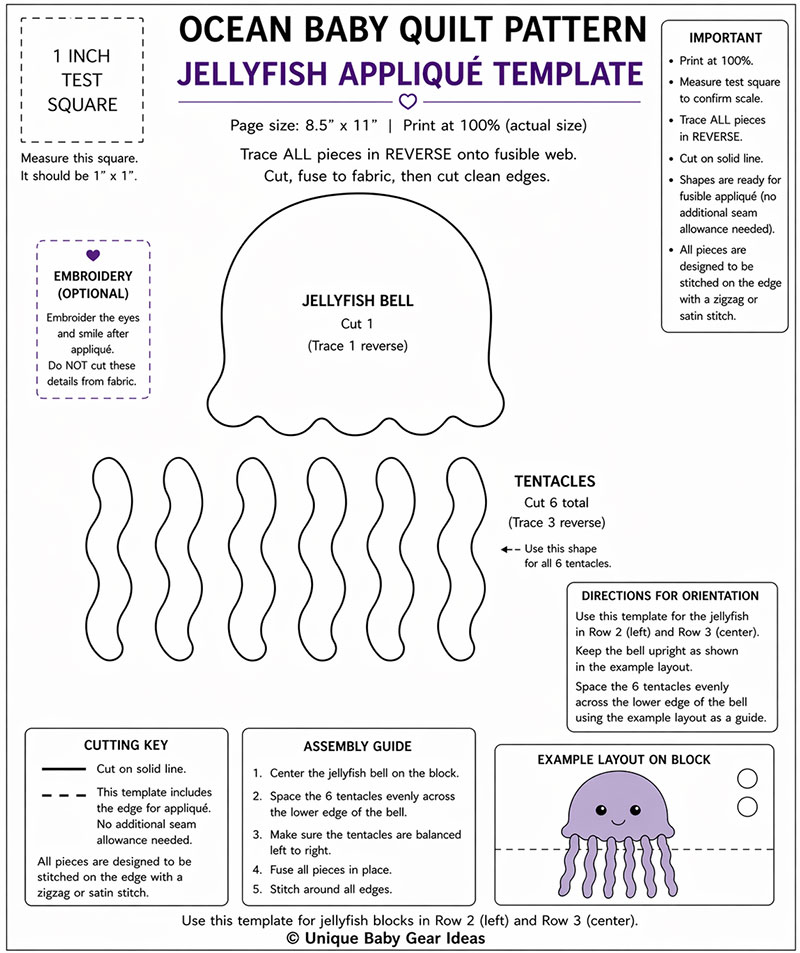
Printable jellyfish appliqué template
Use this jellyfish appliqué template for the jellyfish blocks in Row 2 (left) and Row 3 (center). Print at full size, trace in reverse, and keep the strands spaced evenly so the block reads clearly once quilted.
Printable seaweed and starfish appliqué template
Use these seaweed and starfish appliqué templates to create the ocean floor accent blocks in your quilt. Print at 100 percent scale, trace all shapes in reverse onto fusible web, and check the 1 inch test square before cutting fabric so your finished blocks match the layout exactly.
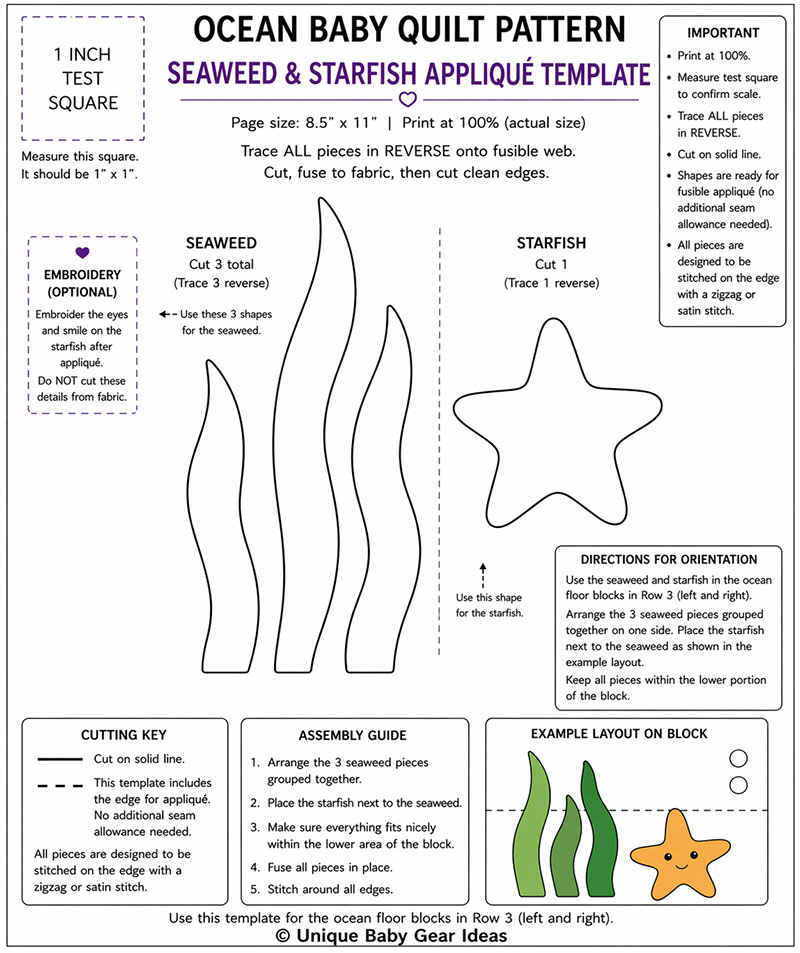
Use this template for seaweed blocks in Row 1 (left) and Row 2 (right), and starfish blocks in Row 3 (left and right).
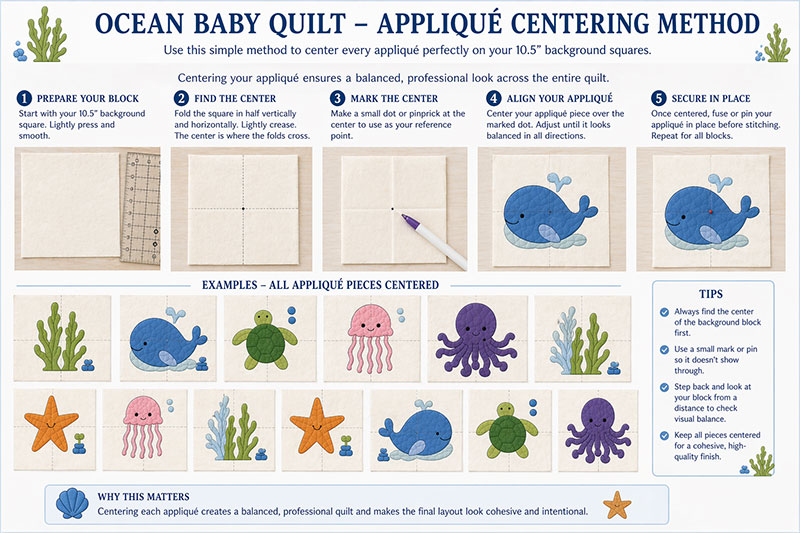
Centering method and exact placement coordinates for each block
This is the step that keeps every block consistent across the quilt.
- Fold block vertically and press lightly
- Fold horizontally and press
- Mark the center intersection
- Main appliqué aligns to that center point
Placement rule:
- Main shape centered horizontally
- Top of main shape sits 2 inches below top edge of block
- Keep at least 1.5 inches from all edges
Many nurseries run into this issue when shapes are placed too low. That small vertical shift upward keeps the design balanced.
Exact appliqué shape construction and orientation per animal
Before fusing:
- Place all pieces on the block first
- Step back and compare to layout image
- Adjust spacing before fusing
If a piece is misplaced, lift it gently before fully pressing the fusible web.
Whale:
- Centered horizontally
- Faces right in top rows, left in bottom row
- Tail angled slightly upward
Turtle:
- Shell centered
- Head extends forward in direction of travel
- Flippers evenly spaced
Octopus:
- Centered in middle block
- Tentacles spread evenly left and right
- Outer tentacles stop 1 inch from block edges
Jellyfish:
- Dome centered
- Top of dome 2 inches from top edge
- Strands spaced 0.5 inches apart
- Strands extend about 3 inches downward
This is usually where the design starts to look correct before stitching begins.
For more ocean creatures and nursery animals that can be mixed into custom appliqué quilts, these animal quilt block patterns include simple blocks for ocean, woodland, farm, safari, and classic baby quilt projects.
animal crib quilt pattern inspiration
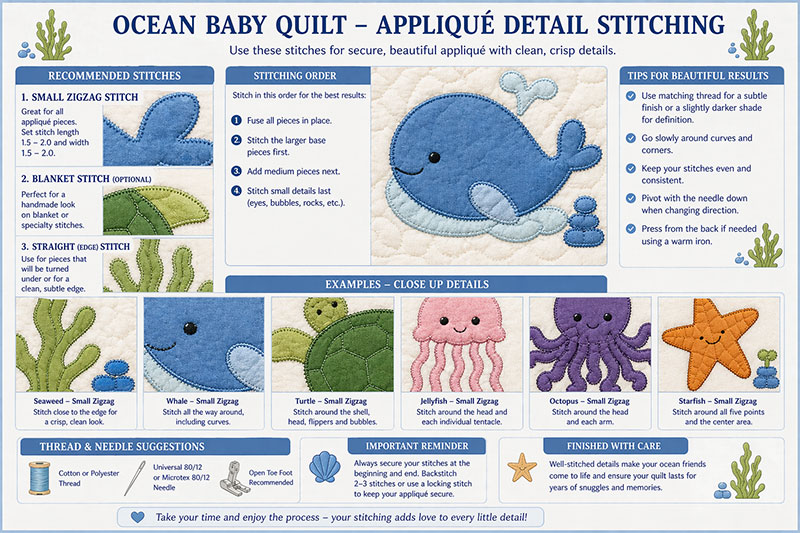
Step by step appliqué process and stitching settings
The first block takes the longest. After that, the process becomes consistent.
- Trace mirrored templates
- Cut rough shapes
- Fuse to fabric
- Cut final shapes
- Place all pieces on block
- Adjust placement
- Fuse pieces
- Stitch edges
Stitch settings:
- Zigzag width: 2.5 to 3.0
- Zigzag length: 0.8 to 1.2
Cut appliqué pieces following the grain of the fabric to reduce stretching during stitching.
Avoid thick fabrics. They do not lay flat and can shift while sewing.
easy baby quilt patterns for beginners
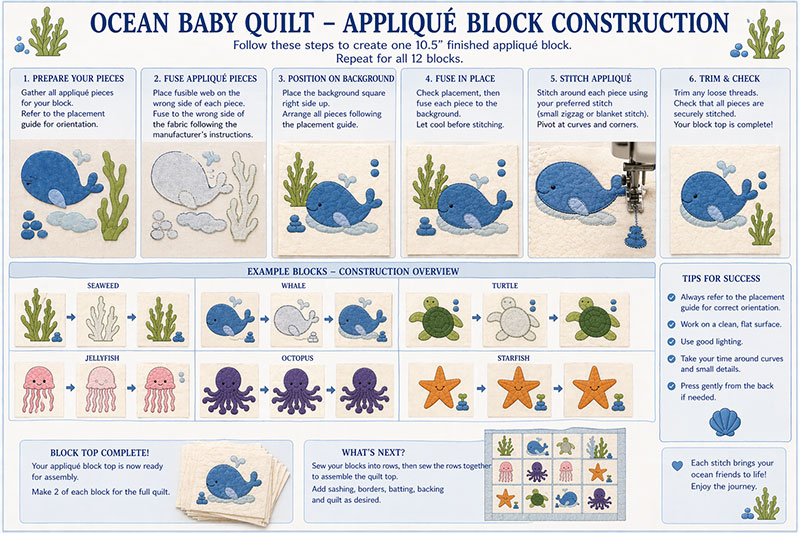
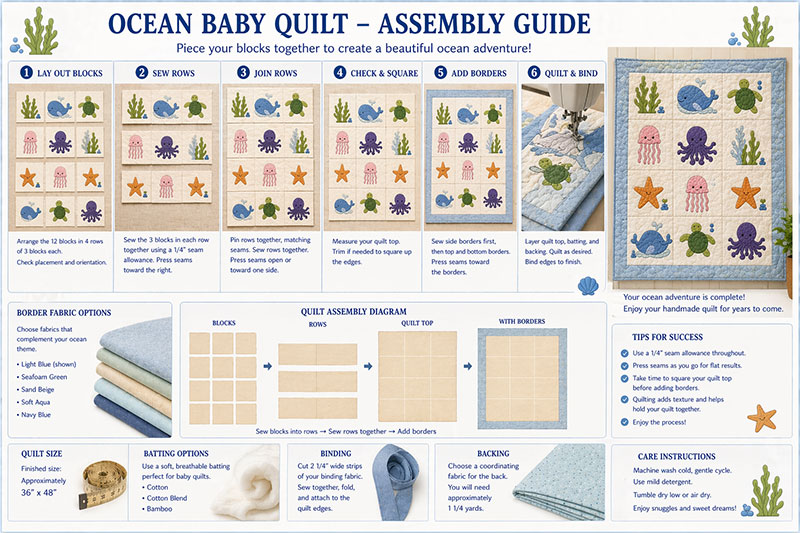
Quilt assembly order and seam alignment method
Following the correct order prevents alignment issues later.
- Cut all pieces
- Complete all appliqué blocks
- Sew blocks into rows
- Add vertical sashing
- Join rows with horizontal sashing
- Add borders
- Layer quilt
- Quilt and bind
Press seams toward sashing. Alternate pressing direction between rows to keep seams aligned.
This is where the quilt finally starts to look finished.
Time expectations, quilting, and long term care
Each appliqué block typically takes 30 to 45 minutes. The full quilt usually takes 6 to 10 hours depending on pace.
- Layer quilt top, batting, backing
- Secure layers
- Quilt with straight or wave lines
- Trim edges
- Attach binding
I’ve learned that simple quilting lines hold up better over time and keep the shapes clear.
FAQ ocean baby quilt pattern
Will my quilt match the design exactly?
Yes. If templates are printed at correct scale and placement steps are followed, the result will match.
Is this beginner friendly?
Yes. The block size and simplified shapes are designed for basic sewing skills.
Can I adjust colors?
Yes. Keep tones consistent for best results.
Does it fit a standard crib?
Yes. The finished size is designed for standard crib use.
When you click on links to various merchants on this site and make a purchase, this may result in this site earning a commission. This does not affect the price you pay.

UBGI Gold Standard 2026
Reviewed under the site's
editorial checklist.
Photos, decorating ideas, party setups and reader submissions are shared for inspiration unless a page is specifically presented as a pattern, tutorial, reference guide or step-by-step project. Follow the instructions, measurements, safety guidance and manufacturer directions provided for the particular project or product.
About Jan | Contact | Baby Nursery Ideas (Blog) | Site Map | Privacy Policy | Disclosure Policy | Disclaimer | Affiliate Disclosure | Earnings Disclosure | Facebook | Pinterest
I am a participant in the Amazon Services LLC Associates Program, an affiliate advertising program designed to provide a means for us to earn fees by linking to Amazon. As an Amazon Associate I earn from qualifying purchases.
Copyright © 2006-2026. All Rights Reserved.