Free Daisy Garden Crib Quilt Pattern
By Jan Bay
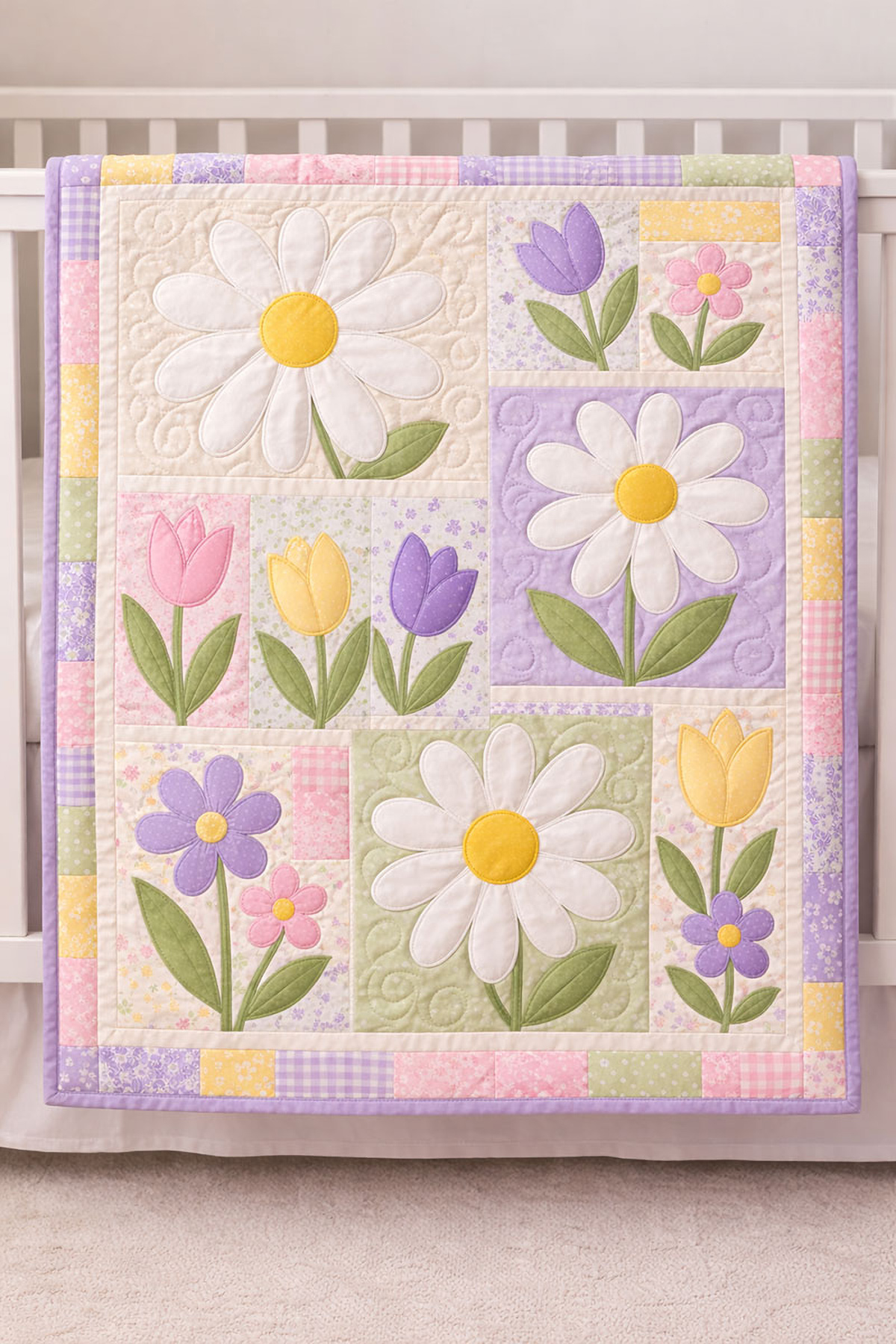
This free Daisy Garden crib quilt pattern features all that we love about spring with a combination of three large white daisies, colorful tulips and smaller flowers with soft pastel patchwork for a finished quilt that measures 40 x 47 inches.
Browse More Baby Quilt Patterns
See the basic quilting tools used for simple crib quilt projects.
Jump to a Section
Download the Daisy Garden Quilt Pattern
Finished Size and Quilt Details
Piece the Patchwork Background
Quick Answer: The Daisy Garden quilt finishes at 40 x 47 inches and combines pieced pastel background sections with raw-edge fusible flower appliqué. The design includes three white daisies, five tulips and four smaller flowers, all arranged asymmetrically across the quilt top.
This is not a repeated-block daisy quilt. Each flower group has its own size, shape and placement, with the largest white daisy in the upper-left corner and smaller flower groups moving across the lavender, cream, pink and pale green patchwork.
The downloadable pattern includes the cutting chart, construction instructions, full-size placement guides, normal cutting templates and reversed fusible-web tracing templates.
Pattern note: This pattern was digitally checked for measurements, template scale and placement. It has not been physically sewn or tested from the final pattern package.
For more seasonal quilt ideas, visit spring crib quilt patterns. You can also browse the main baby quilt patterns collection or compare this finished size with my crib quilt size guide.
Download the Free Daisy Garden Quilt Pattern
The complete printable pattern includes the patchwork cutting chart, appliqué instructions, full-size placement guides and full-size flower templates needed to make the Daisy Garden quilt.
Free Daisy Garden Quilt Pattern PDF
Download the Complete Daisy Garden Quilt Pattern
The PDF contains full construction instructions plus normal and reversed full-size appliqué templates. Print template pages at Actual Size / 100% and check the 1-inch calibration square before cutting fabric.
Finished quilt: 40 x 47 inches
Finished center panel: 36 x 43 inches
Appliqué method: Raw-edge fusible appliqué with no seam allowance added to the flower templates.
Patchwork: Cutting dimensions in the pattern already include the 1/4-inch seam allowance.
Daisy Garden Quilt Design
The Daisy Garden quilt uses an asymmetrical floral layout rather than repeated identical blocks. Three large white daisies anchor the design while five tulips and four smaller flowers fill the surrounding patchwork.
The upper-left daisy is the largest flower. A purple tulip and small pink flower sit in the upper-right area. Pink, yellow and purple tulips form the middle-left group, while another white daisy fills the lavender panel on the right.
The lower section includes a purple flower and smaller pink flower, a white daisy on pale green, and a yellow tulip above a small purple flower.
What I wanted to prevent in this design was a cookie cutter look. I wanted the quilt to have the random feel of a natural flower garden. The three daisies are not copies of one another, the tulips do not line up like stiff little soldiers in a row, and the leaves change direction from flower to flower. That little bit of asymmetry is what keeps the quilt from looking like a sheet of repeated flower blocks.
How the Flower Appliqué Is Built
The flowers are made with raw-edge fusible appliqué. Each white daisy uses separately shaped petals so the finished flowers keep the soft, uneven character of the design rather than looking like identical radial flower discs.
The three daisies use 10, 9 and 9 petals. Each daisy also has a separate golden yellow center, stem and leaf pieces.
Each tulip uses three overlapping flower pieces. Place the rear petal first, then the front-left petal and finally the front-right petal. The stem extends behind the flower cup so no gap shows between the stem and petals.
The four smaller flowers use connected flower silhouettes with separate yellow centers. Leaf veins shown in the pattern are stitching lines only and should not be cut from separate slivers of fabric.
Fabric and Materials
The quilt uses quilting cotton for the pieced background and appliqué, plus lightweight fusible web and coordinating thread.
Background fabrics: cream 1 yard, lavender 3/4 yard, pale pink 1/4 yard, pale green 1/2 yard and pale yellow 1/8 yard or scraps. Allow another 1/2 yard for the pale framing and about 3/4 yard total of assorted pastels for the scrappy outer border.
Appliqué fabrics: white 3/4 yard, green 3/4 yard, golden yellow 1/2 yard, purple 1/2 yard and pink 1/4 yard. The pattern also calls for about 3 yards of 20-inch-wide fusible web, or an equivalent amount.
Finishing: allow 1/2 yard of lavender for binding, 3 yards of 44-inch-wide backing fabric and batting at least 48 x 55 inches.
The upper-right purple tulip is placed on a light cream or off-white background rather than lavender. That small color break matters because it keeps the purple flower from disappearing into its block.
If you are choosing cotton prints or solids for the quilt, my baby fabrics guide can help you compare fabrics for baby quilts and handmade nursery projects.
You do not need to reproduce the exact floral prints shown in the inspiration quilt. Keep the same light spring balance so the white daisies and colorful tulips remain easy to see.
For another light floral nursery project, see the butterfly crib quilt pattern.
Piece the Pastel Patchwork Background
The patchwork background is assembled from cream, lavender, pink, green and yellow rectangles separated in several places by narrow pale framing strips.
Follow the cutting chart and seam map in the downloadable PDF rather than trying to convert the design into equal blocks. The finished interior measures 34 1/2 x 41 1/2 inches before the pale frame is added.
After the pale frame is attached, the center panel measures 36 x 43 inches. The 2-inch scrappy pastel outer border brings the finished quilt to 40 x 47 inches.
For another soft nursery quilt project, see my bunny baby quilt pattern.
Printing the Full-Size Appliqué Templates
The PDF includes normal front-view templates for fabric-side cutting and reversed templates for tracing onto the paper side of fusible web.
Print the full-size pages on US Letter paper at Actual Size / 100%. Do not use Fit, Shrink, Scale to Fit or automatic resizing.
Measure the 1-inch calibration square both horizontally and vertically before cutting any fabric.
The larger placement guides are tiled with a 1/2-inch overlap and registration marks. Match the duplicated overlap area and registration crosses before taping the sheets together.
The full center placement guide covers the complete 36 x 43 inch center panel. Smaller flower-group guides are also included so you do not have to assemble the entire center guide when working on only one section.
The pattern contains 86 unique appliqué templates for 86 fabric appliqué pieces. Each template is used once. The three daisies use 10, 9 and 9 individually shaped petals rather than one repeated petal shape.
Finished Daisy Garden Quilt Size
This pattern finishes at 40 x 47 inches.
The finished center panel measures 36 x 43 inches, including the narrow pale frame. A 2-inch scrappy pastel border surrounds the center before the lavender binding is added.
The pattern was drafted from the natural proportions of the finished design rather than forcing the quilt into a predetermined 40 x 50 inch rectangle.
If you want to compare this measurement with other common baby quilt dimensions, see my crib quilt size guide.
Safe Ways to Use a Crib Quilt in a Nursery
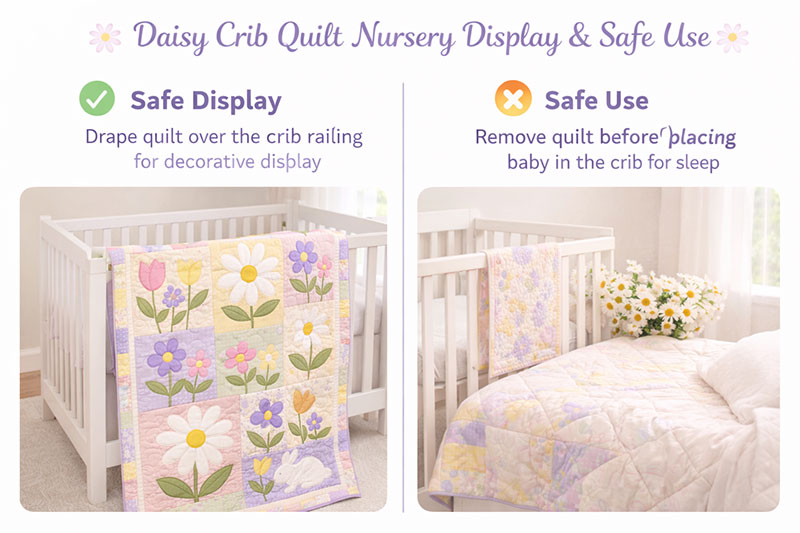
Daisy crib quilt displayed outside the crib as nursery decor rather than loose bedding for infant sleep.
In the United States, safe sleep guidance recommends keeping an infant's sleep space bare except for a fitted sheet, with no loose quilts, blankets or other soft bedding. For that reason, use this quilt for nursery display or supervised time rather than as infant sleep bedding. See the U.S. Consumer Product Safety Commission safe sleep guidance.
Crib quilts should not be placed inside the crib during infant sleep.
Crib quilts can still be displayed elsewhere in the nursery. They may be folded over a chair, displayed on a quilt ladder or used during supervised floor time. Keep the quilt out of the crib whenever an infant is sleeping.
This is an important distinction and worth stating clearly. A crib quilt can absolutely belong in a nursery design, but it should not be used as loose bedding for a sleeping infant.
Daisy Garden Quilt Pattern FAQ
What size is the finished Daisy Garden quilt?
The finished quilt measures 40 x 47 inches.
How many flowers are in the quilt?
The design includes three large white daisies, five tulips and four smaller flowers.
Are the appliqué templates full size?
Yes. The PDF includes full-size normal templates and reversed fusible-web tracing templates. Print them at Actual Size / 100% and check the 1-inch calibration square before cutting.
Do I add seam allowance to the appliqué pieces?
No. The flower, stem and leaf templates are for raw-edge fusible appliqué and do not include or require an appliqué seam allowance.
Are seam allowances included in the patchwork cutting chart?
Yes. The patchwork cutting dimensions already include the 1/4-inch seam allowance.
Can the quilt be used as loose bedding during infant sleep?
No. Use the quilt for nursery display or supervised use and keep loose quilts and blankets out of the crib during infant sleep.
When you click on links to various merchants on this site and make a purchase, this may result in this site earning a commission. This does not affect the price you pay.

UBGI Gold Standard 2026
Reviewed under the site's
editorial checklist.
Photos, decorating ideas, party setups and reader submissions are shared for inspiration unless a page is specifically presented as a pattern, tutorial, reference guide or step-by-step project. Follow the instructions, measurements, safety guidance and manufacturer directions provided for the particular project or product.
About Jan | Contact | Baby Nursery Ideas (Blog) | Site Map | Privacy Policy | Disclosure Policy | Disclaimer | Affiliate Disclosure | Earnings Disclosure | Facebook | Pinterest
I am a participant in the Amazon Services LLC Associates Program, an affiliate advertising program designed to provide a means for us to earn fees by linking to Amazon. As an Amazon Associate I earn from qualifying purchases.
Copyright © 2006-2026. All Rights Reserved.