Nursery Layout for Bedroom Sharing With Baby
When you need a nursery layout for bedroom sharing, the goal is simple: create a calm, safe baby zone inside an already functional adult bedroom. You are not designing a full nursery. You are carving out a smart, intentional space that works day and night without feeling crowded.
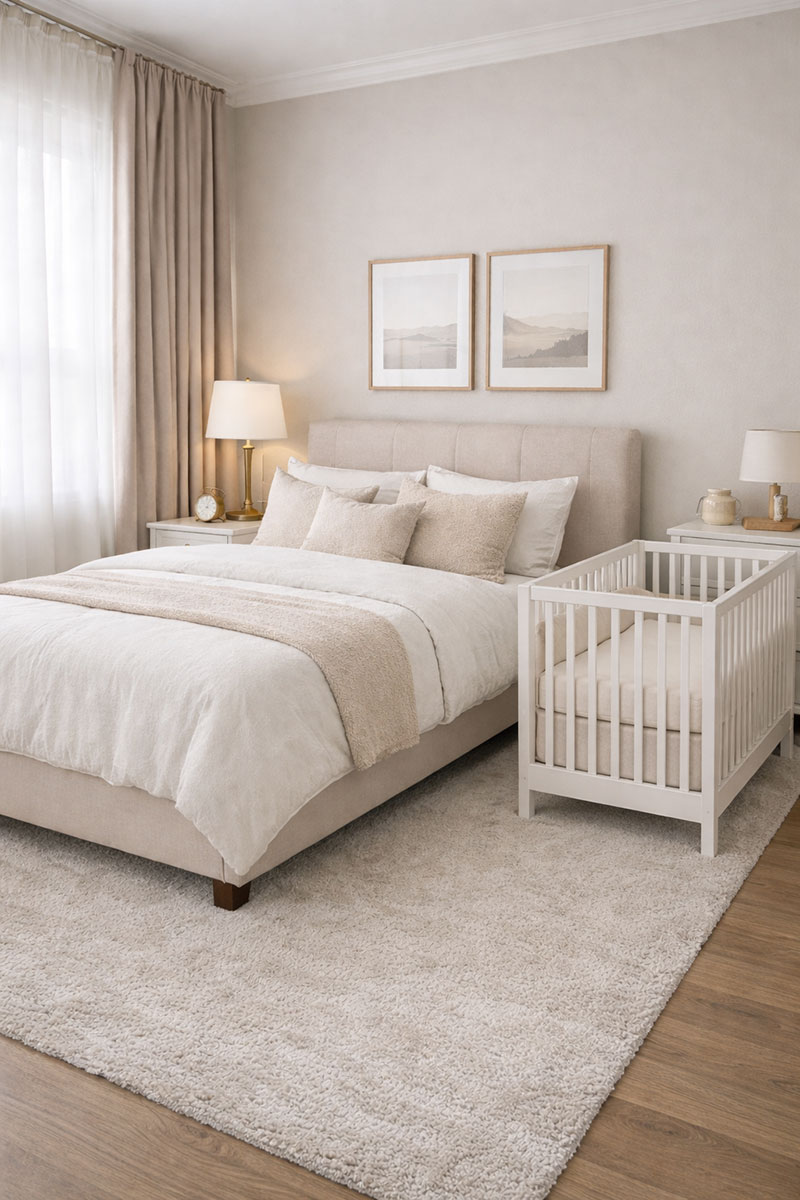
Here’s what that looks like in a real bedroom:
On this page
What a bedroom-sharing layout really looks like
Which two bedroom layouts actually last?
Which bedroom layouts fall apart
What a Nursery Layout for Bedroom Sharing Really Looks Like
In real life, this simply means placing a full-size crib inside your bedroom in a way that feels deliberate and workable. The room still functions for adult sleep, and the baby has a clearly defined space. One room. Two purposes. No confusion about who sleeps where.
For a simple example of how the crib and dresser can work together inside a practical baby zone, see this nursery layout with crib and dresser guide.
When people search for a nursery layout for bedroom sharing, they are usually trying to answer one quiet question: can this room hold both of us without feeling chaotic? The answer is yes — but only if the layout supports movement first and decoration second.
In the United States, where many families live in apartments, townhomes, or shared spaces, room sharing during the early months is common. This is not about squeezing a crib into leftover space. It’s about identifying a crib zone, preserving a real walking lane, and understanding how ordinary bedroom elements — lamps, drapes, charging cords — interact with that new sleep space.
This page explains general layout structure and safety considerations, not product-specific assembly or furniture modification instructions.
Definition: A bedroom-sharing layout keeps the crib inside the parents’ room while maintaining visible walking space, separation from cords and fabric, and full adult access to the bed.
The two layouts most parents settle on
Layout A: The crib sits beside the adult bed with a clear lane between them. The bed remains fully usable, and the crib does not block drawers, closets, or pathways.
Layout B: The crib is placed across the room with a straight path from bed to crib. This often works better in narrow rooms where side placement feels cramped.
Both arrangements hold up because they respect how adults actually move at night. They are not styled for photographs. They are structured for 2 a.m.
For more examples of what works in shared rooms, square rooms, and other real-life setups, browse these nursery layout ideas for small rooms to compare different ways to make a baby space feel calm and workable.
When the room you are sharing has four fairly even walls instead of a long narrow shape, these nursery layout ideas for square rooms can help you balance the crib, dresser, and walking lane with less stress.
Families planning for two babies in one room often need a different approach to spacing, crib placement, and walking lanes, so see these twin nursery layout ideas for examples that work better for shared twin setups.
For a wider look at how the crib, dresser, and other main pieces should work together, see my nursery furniture layout guide for simple placement ideas that keep the room functional.
Some families experiment with angled placement or corner tucking. Occasionally that works. More often, it narrows the walking path and reduces flexibility. The two straightforward layouts above tend to age better as routines become predictable.
Why layout matters more than decor
It’s easy to focus on bedding, paint color, and framed art. Those details matter visually. But movement determines whether the room functions.
A layout that works during night wakes will also work during daytime routines. If the path between bed and crib is clear, you move confidently. If it’s tight or cluttered, even small interruptions feel bigger than they need to be.
When the crib drifts too close to the bed, walking turns sideways. Sideways walking leads to objects collecting nearby. And once items begin to accumulate in that zone, the room slowly loses its sense of order.
This is where most parents get confused.
The room can look beautiful and still feel awkward. A nursery layout for bedroom sharing succeeds when it feels open and predictable, not decorative and delicate.
In most shared bedrooms, storage decisions determine whether the space feels calm or crowded, so explore nursery storage ideas for small rooms that use vertical shelving, drawer systems, and closet organization to protect your walking lanes.
One simple rule: Protect the walking lane as if it were permanent floor space. That part matters more than people think.
Where bedroom-sharing layouts fall apart
Most layout problems do not appear overnight. They build quietly.
The crib inches closer to the bed to “save space.” A laundry basket lands near the footboard. A phone charger stretches across the walking path. The room still technically works, but it no longer feels stable.
Bedrooms also contain features traditional nurseries do not. Long drapes. Bedside lamps. Device cords. Decorative throw blankets. In a shared bedroom, those items do not disappear just because a crib moves in.
If fabric brushes the crib area or cords hang within reach, the layout needs adjusting. Those are layout signals, not minor decor details.
For a broader safety overview, see my crib safety checklist page for common bedroom hazards that are easy to overlook.
Lighting can also affect how the room feels at night. A lamp placed directly beside the crib may cast shadows or create glare during late checks. Subtle repositioning can improve flow without changing the overall design.
Does the furniture actually fit this room?
In a nursery layout for bedroom sharing, simpler furniture usually performs better over time. A stable crib. A compact dresser. Storage that closes cleanly instead of spilling outward.
Before rearranging again, pause and evaluate the mechanics of the room. Can drawers open fully without hitting the crib? Can closet doors swing freely? Can both adults access their side of the bed without navigating around furniture?
If any of those answers are unclear, the layout deserves reconsideration.
A simple nursery floor plan layout can help you map the crib zone, adult bed clearance, and walking lanes before you shift furniture again.
For tighter spaces, my small nursery layout ideas page looks at room dimensions that still feel workable and balanced.
Even in larger bedrooms, oversized dressers can shrink usable space quickly. Choosing proportional pieces often improves flow more than pushing walls outward ever could.
Older gear and secondhand pieces
Older furniture and secondhand items can absolutely be part of a shared bedroom. What matters is how they integrate into the current space. Older pieces may have deeper profiles, thicker legs, or hardware that extends slightly beyond the frame.
Take a careful look at how those details affect walking clearance and crib positioning. A layout works best when every piece feels stable and properly scaled to the room it’s in now, not the room it originally came from.
What to do now
Stand at the bedroom door. Look at the path to your bed. Then look at the path from your bed to the crib. Those two lanes reveal whether the layout will remain functional long term.
Design the room so it stays clear without effort. Do not rely on willpower to keep pathways open.
In most cases, a nursery layout for bedroom sharing works best when the crib has visible space around it and the adult bedroom still functions as an adult bedroom.
Near the end of your setup, step back and ask whether the space feels usable during a late-night wake-up. That simple check reduces clutter, lowers stress, and keeps the layout steady once daily life with a baby settles into rhythm.
When you click on links to various merchants on this site and make a purchase, this may result in this site earning a commission. This does not affect the price you pay.

UBGI Gold Standard 2026
Reviewed under the site's
editorial checklist.
Photos, decorating ideas, party setups and reader submissions are shared for inspiration unless a page is specifically presented as a pattern, tutorial, reference guide or step-by-step project. Follow the instructions, measurements, safety guidance and manufacturer directions provided for the particular project or product.
About Jan | Contact | Baby Nursery Ideas (Blog) | Site Map | Privacy Policy | Disclosure Policy | Disclaimer | Affiliate Disclosure | Earnings Disclosure | Facebook | Pinterest
I am a participant in the Amazon Services LLC Associates Program, an affiliate advertising program designed to provide a means for us to earn fees by linking to Amazon. As an Amazon Associate I earn from qualifying purchases.
Copyright © 2006-2026. All Rights Reserved.