Free Fish Knitting Pattern for Toys, Loveys, and Blanket Tiles
This free fish knitting pattern shows you how to knit a simple fish motif step by step, using basic stitches that are easy to follow and repeat.
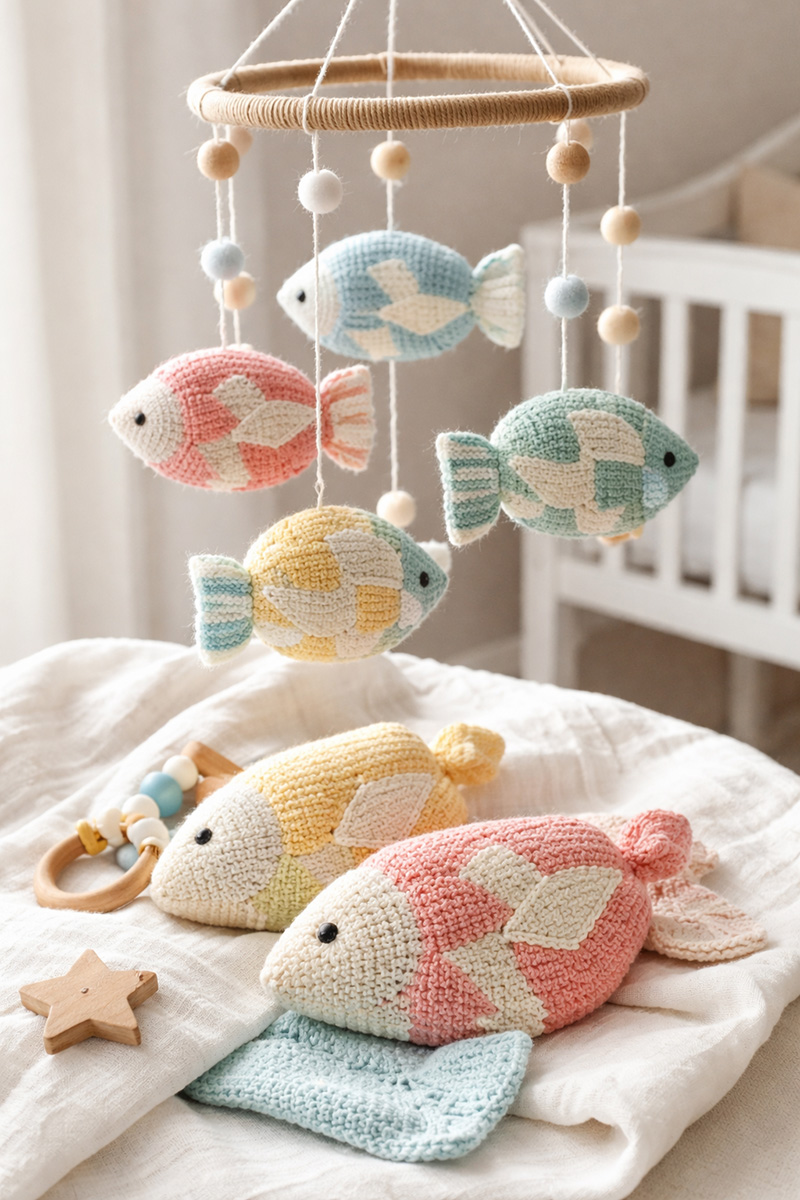
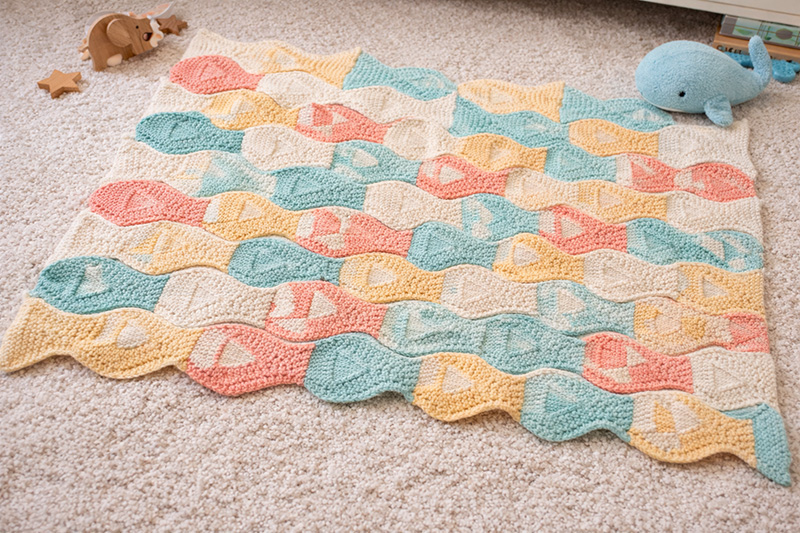
This pattern is built around one repeating “fish tile” that naturally lines up with the next tile, so your blanket forms a gentle, wavy tessellation. If you’re making a crib mobile, the exact same fish tiles can be knit as single motifs (or lightly stuffed) and hung safely out of reach for a soft, handmade ocean vibe.
Free Fish Knitting Pattern: Tessellated Fish Tile
This free fish knitting pattern is designed so each tile stands on its own while also locking neatly into the next, making it easy to scale from a single fish motif to a full baby blanket without complicated shaping or math.
Each fish “tile” is worked flat and then repeated. You can make a full baby blanket by knitting many tiles and joining them, or knit a smaller set of tiles for a stroller blanket. For a truly calm nursery look, stick with ocean pastels (seafoam, pale aqua, sand, shell pink, buttery yellow) and keep the contrast soft.
Skill level + techniques
- Advanced beginner to intermediate
- You’ll use knit, purl, simple decreases (k2tog/ssk), and optional color changes (intarsia-style).
Materials
- Worsted yarn (or DK for a lighter blanket) in 2 colors: MC (background) + CC (fish), or multiple pastels for a “school of fish” look
- Needles: size that gives you a soft but sturdy fabric (many knitters like US 7–8 / 4.5–5 mm for worsted)
- Tapestry needle for weaving ends + joining tiles
Gauge + sizing (easy to adjust)
Your tile size depends on yarn + needle choice. If your tiles feel too floppy, go down one needle size. If you want a more drapey blanket, go up one size. For a baby blanket, you’ll typically want a fabric that feels cozy but not holey.
How the Tessellation Works
The fish shape is designed so it “reads” clearly inside each tile, but still connects visually when repeated. The most charming effect happens when you alternate tile colors (or flip which color is the fish versus the background) so the blanket looks like a gentle, rhythmic swim pattern.
If you’re in “crib mobile mode,” you can stop at a single fish tile, add a soft backing, and hang three to five fish in a staggered row (again: always out of reach). If you’re in “blanket mode,” keep going—because once you see the tessellation appear, it’s hard to stop.
Fish Tile Pattern (Original, Site-Safe)
This is an original tile concept written specifically for your site. You can knit it in two colors (fish pops) or in one color with texture contrast (fish in stockinette, background in reverse stockinette).
Tile setup
- Cast on: 33 sts
- Border: 4 rows garter stitch (knit every row)
- Then work the charted center while keeping a garter border: k3 at the beginning and end of every row
- Chart width (center): 27 sts (because 33 total minus 6 border stitches)
Chart key
- . = background (MC)
- F = fish (CC)
Read RS rows (odd-numbered) right-to-left. Read WS rows (even-numbered) left-to-right. Keep the border as garter: knit the first 3 and last 3 stitches on every row.
Tessellated Fish Tile Chart (27 sts wide x 27 rows tall)

Row 27: ...........................
Row 26: ............FFF............
Row 25: ..........FFFFF............
Row 24: ........FFFF.FFF...........
Row 23: ......FFFF...FFFF..........
Row 22: .....FFFF.....FFFF.........
Row 21: ....FFFF.......FFFF........
Row 20: ...FFFF.........FFFF.......
Row 19: ..FFFF....FFF....FFFF......
Row 18: .FFFF....FFFFF....FFFF.....
Row 17: FFFF....FFFFFFF....FFFF....
Row 16: FFF.....FFFFFFFF.....FFF....
Row 15: FFF.....FFFFFFFF.....FFF....
Row 14: FFFF....FFFFFFF....FFFF....
Row 13: .FFFF....FFFFF....FFFF.....
Row 12: ..FFFF....FFF....FFFF......
Row 11: ...FFFF.........FFFF.......
Row 10: ....FFFF.......FFFF........
Row  9: .....FFFF.....FFFF.........
Row  8: ......FFFF...FFFF..........
Row  7: ........FFFF.FFF...........
Row  6: ..........FFFFF............
Row  5: ............FFF............
Row  4: ...........................
Row  3: ...........................
Row  2: ...........................
Row  1: ...........................
Finishing the tile
- After Row 27, work 4 rows garter stitch across all stitches.
- Bind off knitwise.
Connecting Tiles Into a Baby Blanket
Because this free fish knitting pattern uses repeatable tiles, you can adjust the finished size at any point—stop early for a stroller blanket or keep going for a generously sized crib or tummy-time blanket.
For a baby blanket, a simple layout is to knit 30–48 tiles (depending on your tile size and your target blanket size), then join them in a grid. If you want the tessellation to feel extra “locked in,” alternate which color is the fish versus the background every other tile.
Joining options
- Mattress stitch for a clean seam
- Whip stitch for a slightly more textured seam
- Knit-on garter seam: pick up stitches along one edge and knit 2–3 stitches garter as a joining strip
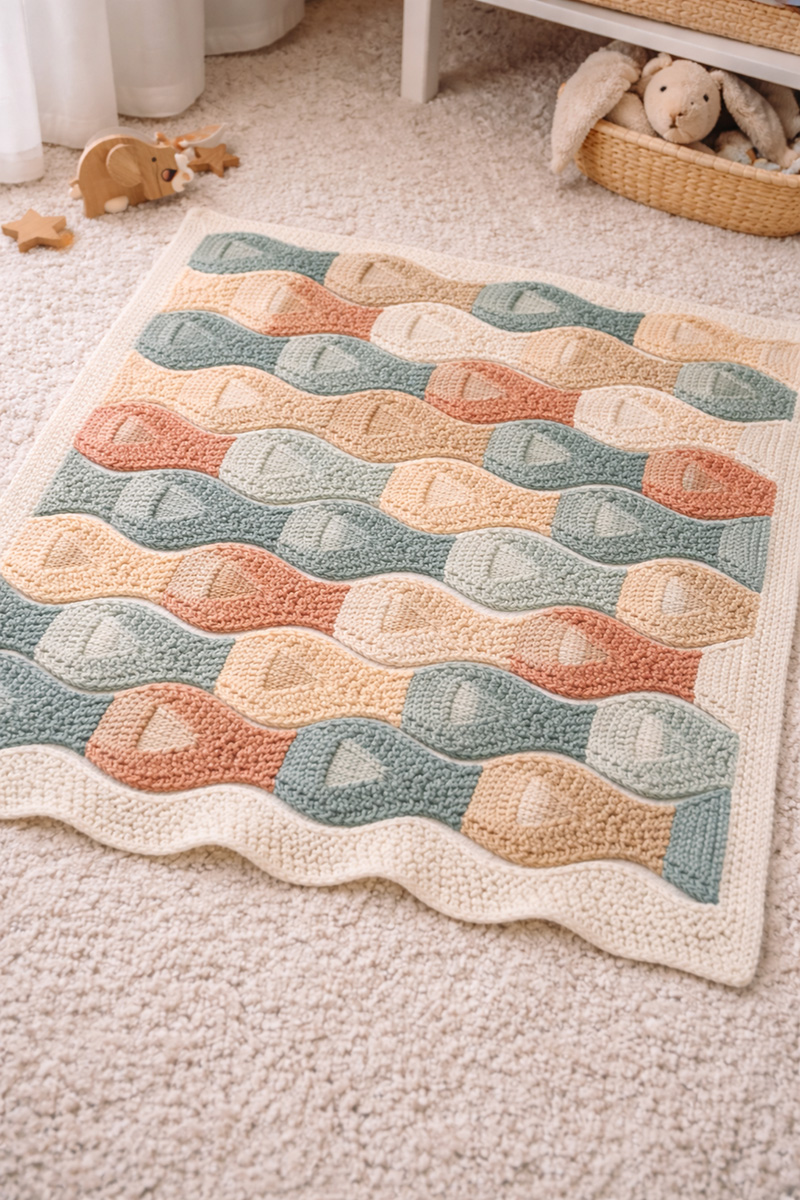
If you like the look of a framed finish, add a garter border around the finished blanket by picking up stitches and knitting 6–10 rows garter on each side.
DIY Crib Mobile Notes (Safety First)
If you’re making a crib mobile with your fish tiles, prioritize safety over style: keep the mobile securely attached, use strong cord, stitch through attachment points multiple times, and hang it out of baby’s reach. For safe sleep guidance and current best practices, I recommend reviewing the American Academy of Pediatrics safe sleep information here: https://www.aap.org/en/patient-care/safe-sleep/
If you’re looking for more nursery inspiration that pairs beautifully with ocean themes, you may also enjoy browsing: baby nursery ideas.
And if you’d like to keep your handmade gifts practical and parent-friendly, my guide on whether it’s safe to buy a used baby crib walks through the safety checks that matter most when you’re decorating on a budget.
For more theme browsing, you can also explore: baby boy nursery themes and baby girl nursery themes.
Color Ideas for an Ocean-Themed Nursery Blanket
If you want that “calm coastal nursery” feel, choose two to four pastels and repeat them consistently. A simple combination that photographs well (and feels soothing in real life) is seafoam + pale aqua + warm cream + shell pink. If you want more nautical energy, swap shell pink for a soft navy accent—but keep it minimal so the blanket still feels airy.
When you’re ready, you can also add a few matching fish tiles to a nursery corner as soft decor (hung safely out of reach), and let the blanket echo the same palette. That repetition is what makes the whole room feel intentional.
If you knit this fish tile blanket, you’ll end up with one of those keepsakes that feels both playful and timeless—something you’ll reach for in photos, stroller walks, and sleepy contact-nap moments.
When you click on links to various merchants on this site and make a purchase, this may result in this site earning a commission. This does not affect the price you pay.

UBGI Gold Standard 2026
Reviewed under the site's
editorial checklist.
Photos, decorating ideas, party setups and reader submissions are shared for inspiration unless a page is specifically presented as a pattern, tutorial, reference guide or step-by-step project. Follow the instructions, measurements, safety guidance and manufacturer directions provided for the particular project or product.
About Jan | Contact | Baby Nursery Ideas (Blog) | Site Map | Privacy Policy | Disclosure Policy | Disclaimer | Affiliate Disclosure | Earnings Disclosure | Facebook | Pinterest
I am a participant in the Amazon Services LLC Associates Program, an affiliate advertising program designed to provide a means for us to earn fees by linking to Amazon. As an Amazon Associate I earn from qualifying purchases.
Copyright © 2006-2026. All Rights Reserved.