Crib Parts Identification Across Manufacturers and Brands
Crib parts identification across manufacturers and brands follows consistent reference patterns used in manuals, labels, hardware diagrams, and archived brand documentation rather than interchangeable part systems. This page explains how crib parts are identified for reference and documentation purposes only, using manufacturer model numbers, component naming conventions, and visual comparison methods commonly found across U.S. crib brands.
Trying to identify crib parts across different brands and models? These pages explain why similar-looking parts are often completely different:
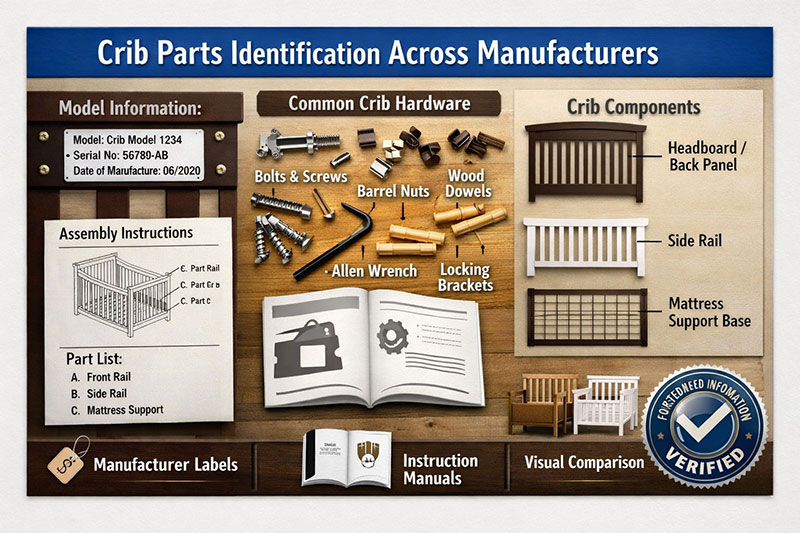
Crib parts identification across manufacturers and brands in the United States
What this actually means is to figure out which specific part belongs to which specific crib model, using the way the original company labeled and documented it in the United States.
This is about understanding names, numbers, and diagrams. Not swapping parts. Not making things fit.
In most cases, you cannot identify a crib part correctly without the crib’s model label and a matching manual diagram from the same manufacturer.
I use one main term here: crib parts identification across manufacturers and brands. You may see people say “hardware lookup” or “model reference,” but I keep one term so the meaning stays clear.
This page explains how identification works, not product-specific instructions.
Why crib parts identification matters
Cribs look simple. That’s the trap.
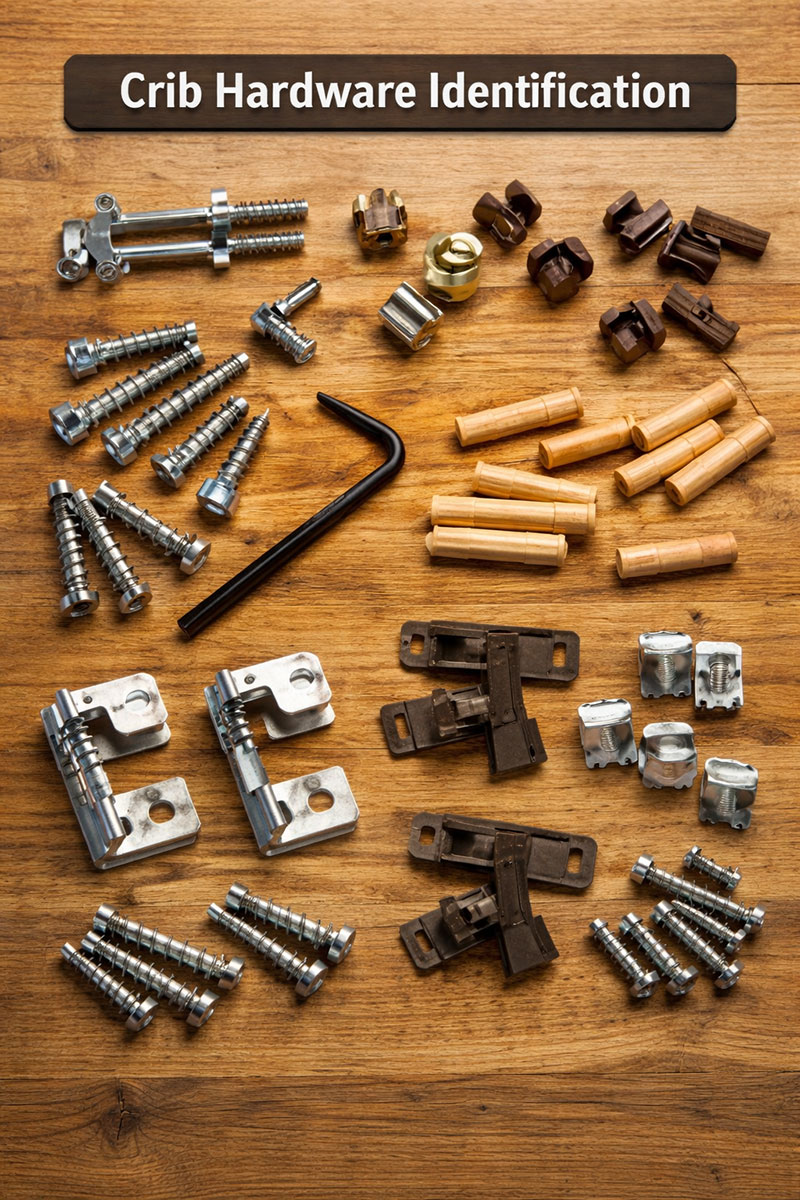
Across brands, two bolts can look the same and still behave very differently once they’re under weight. Length, thread, and how the force travels through the frame all matter.
For a more focused explanation of common fastener types, thread differences, and model-specific screw naming, see this crib screws reference page.
For fastener-specific questions, see crib screws missing.
That part matters more than people think.
Most confusion starts when someone skips the model and jumps straight to the loose piece in their hand. I see it all the time.
What to do next: treat this like a paperwork problem first, not a hardware problem.
How manufacturers and brands actually identify crib parts
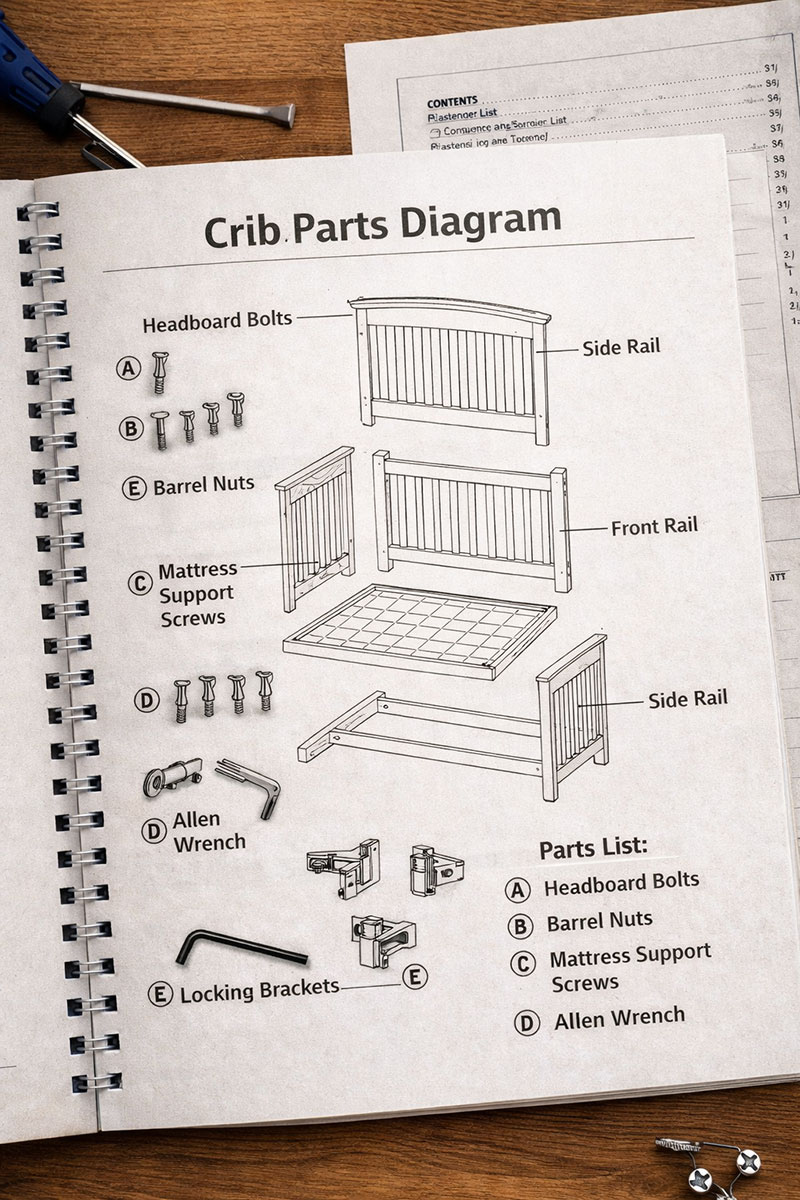
In the US, crib parts are identified by the manufacturer’s own system. That usually means a model number, a part name used in the manual, and a diagram that shows where that part belongs.
There is no universal naming system across brands. One company’s “mattress support” is another company’s “spring frame.” Same category. Different part.
That’s why identification works best when you stay inside one brand’s language instead of translating everything into generic terms.
For an additional reference page that discusses crib hardware categories more broadly, see crib parts.
If you’re starting from scratch, the cleanest routing point is the main hub: crib parts and hardware reference hub.
Where crib parts identification goes wrong
This is where most parents get confused.
The most common issue is brand changes. Companies merge. Names shift. Support moves to a different owner. The crib didn’t change, but the paperwork did.
Private labeling causes problems too. A crib sold under a store name may have been manufactured by a different company entirely. The model label tells the real story, not the marketing name.
Photos can also mislead. Angle hides thickness. Lighting hides thread detail. Size looks right until it isn’t.
Quick clarity check
Identification is not about whether something might fit. It’s about whether the part name and number match the documentation for that exact crib model.
If you can’t tie the part back to a model label and a diagram, you don’t have confirmation. You have a guess.
When missing components are part of the problem, see can you use a crib with missing parts for the core safety baseline.
What information actually identifies a crib part
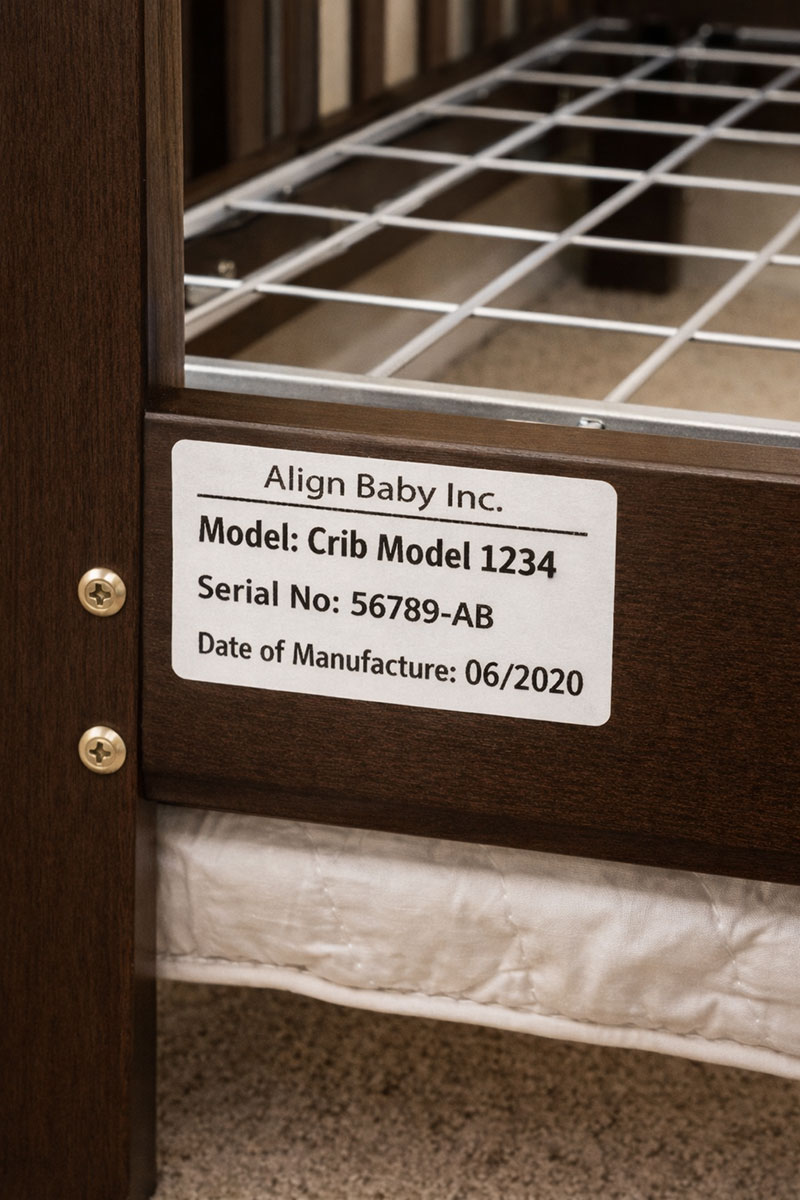
In most US cribs, the strongest identifiers live on the model label attached to the crib itself. That label usually includes a model number, manufacturer name, and production date or code.
Those details matter more than color, style, or where the crib was bought.
When you’re reading manuals or diagrams, consistent wording helps. The crib terminology glossary keeps part names aligned with how manufacturers use them.
Did I buy the right crib
This question sits underneath almost every parts search.
A crib with a readable model label and a matching manual is usually identifiable, even if parts are missing.
A crib with no label, no manual, and only a store name is much harder to confirm. That doesn’t mean it was unsafe when sold. It means documentation may no longer exist.
For broader structure and crib category context, see the baby crib documentation hub.
Most parents choose
Most parents choose the path that reduces uncertainty fastest: confirm the model first, then decide what documentation exists for that brand.
That usually answers more questions than staring at a bolt ever will.
How the same crib part category differs by brand
Mattress supports are a good example. Some use metal spring frames. Others use solid platforms. Others use hybrid systems with clip-in height settings.
They may all be called “mattress support,” but they are not interchangeable.
The same thing happens with side hardware, corner brackets, and rail connectors. Similar shapes. Different functions.
If you’re trying to match manuals to models, the crib instructions and manual lookup hub is the best place to start.
Edge cases that change identification
Older cribs, secondhand cribs, and cribs missing labels are harder to identify.
Some brands no longer support documentation for discontinued models.
When original parts or documentation cannot be located at all, this guide on what to do if you can't find crib replacement parts explains the safest next steps.
And a manual found online doesn’t always mean the model can still be verified with confidence.
What should I do now
Start by deciding what you’re trying to identify: the crib model, a major component, or a single hardware piece. Identification gets clearer once the model is confirmed.
If you only remember one thing: the model label matters more than the loose part.
What to do next: route through the crib parts and hardware reference hub, stay within one brand’s language, and compare documentation carefully.
For official US recall and safety context, the authoritative source is the U.S. Consumer Product Safety Commission recall database.
When you click on links to various merchants on this site and make a purchase, this may result in this site earning a commission. This does not affect the price you pay.

UBGI Gold Standard 2026
Reviewed under the site's
editorial checklist.
Photos, decorating ideas, party setups and reader submissions are shared for inspiration unless a page is specifically presented as a pattern, tutorial, reference guide or step-by-step project. Follow the instructions, measurements, safety guidance and manufacturer directions provided for the particular project or product.
About Jan | Contact | Baby Nursery Ideas (Blog) | Site Map | Privacy Policy | Disclosure Policy | Disclaimer | Affiliate Disclosure | Earnings Disclosure | Facebook | Pinterest
I am a participant in the Amazon Services LLC Associates Program, an affiliate advertising program designed to provide a means for us to earn fees by linking to Amazon. As an Amazon Associate I earn from qualifying purchases.
Copyright © 2006-2026. All Rights Reserved.