DIY Macrame Toy Hammock Pattern- How to Make Your Own Toy Organizer
By Jan Bay
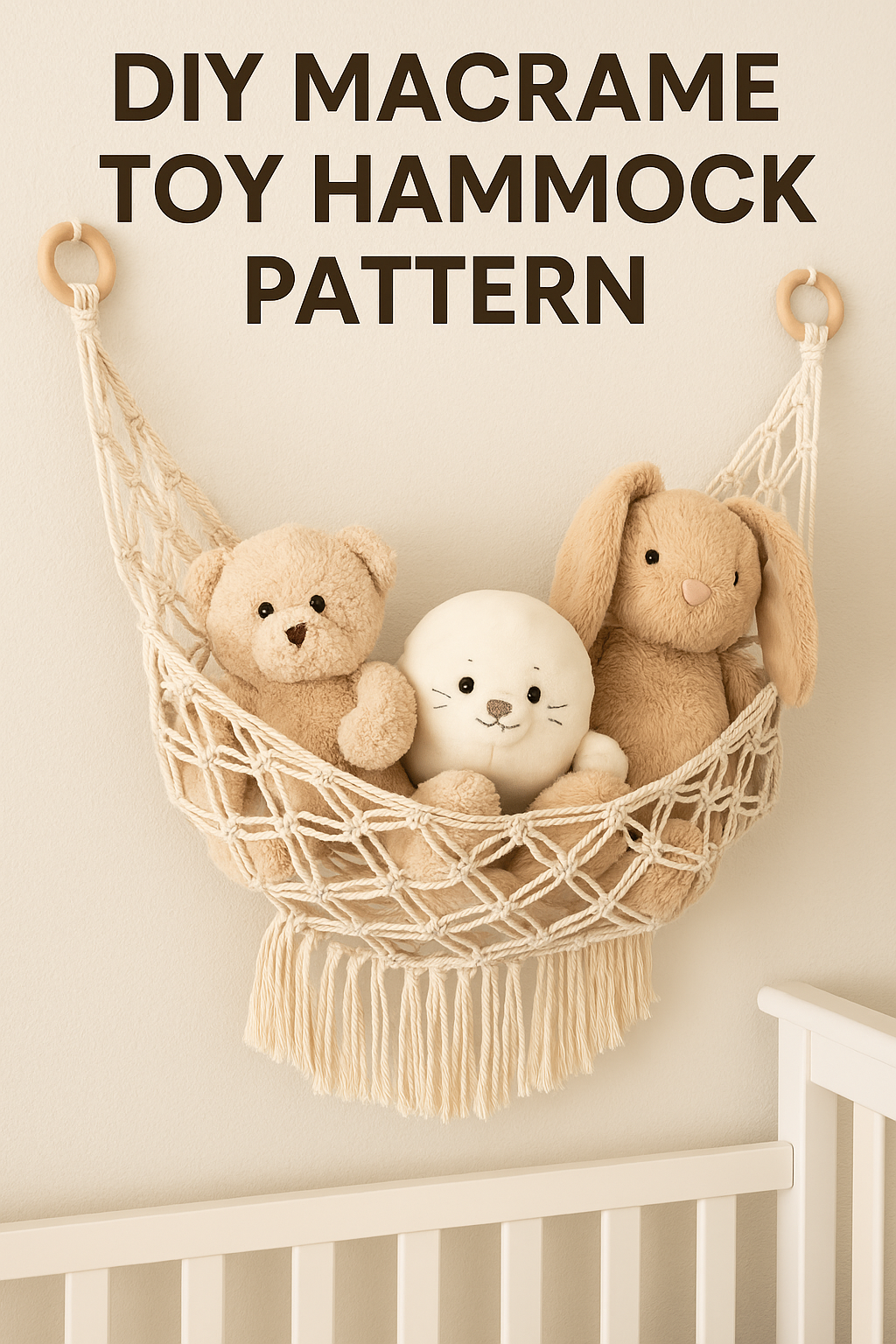
This DIY macrame toy hammock pattern shows you how to make the two-ring wall hammock in the example image, with a diamond-knot pouch, curved lower edge and short fringe for lightweight plush toy storage.
Start here:
Get the exact supplies for this toy hammock →
Jump to the step-by-step pattern →
The construction below starts at both upper rings, joins the two sides into one diamond net and finishes with a separate curved lower edge so the written pattern matches the hammock shown in the example image.
Supplies for This DIY Macrame Toy Hammock Pattern
This pattern is built for the hammock shown in the example image: two wooden rings at the upper corners, an ivory diamond-knot pouch, a thick curved lower edge and a short row of fringe across the bottom. There isn't a second finishing ring at the bottom, and I'm not adding beads because they aren't part of this design.
This is an engineered pattern based on the finished example image. The measurements below are calculated targets rather than measurements taken from a physically test-made hammock, so keep the checkpoints in the instructions instead of relying on knot counts alone.
- About 230 ft or 70 m of 4 mm natural ivory 3-ply twisted cotton macramé cord
- 2 unfinished wooden rings, about 3 inches in outside diameter
- Measuring tape
- Sharp scissors
- Macramé board, cork board or another large work surface where you can pin the cords temporarily
- Strong pins or clips for holding the rings and lower edge in position while you work
- Wall hooks and anchors appropriate for your wall surface and the finished hanging
Cord Cut List
- Main hammock: 12 cords, each 16 ft long
- Curved lower edge: 2 cords, each 8 ft long
The cut list uses 208 ft of cord. Starting with about 230 ft gives you some working room for knot tension and trimming.
Six of the 16-foot cords will hang from the left wooden ring and six from the right. Each cord is folded in half, so you'll begin with 12 working strands on each side and 24 strands altogether.
Expected Finished Size
- Ring spacing: about 24 inches center to center
- Knotwork depth: about 17 to 18 inches from the bottom of the wooden rings to Row 10
- Depth to the center of the curved lower edge: about 21 to 22 inches from the bottom of the wooden rings
- Lower pouch width: about 22 to 24 inches
- Fringe: about 5 to 6 inches
- Overall hanging length: about 29 to 31 inches from the top of the wooden rings to the trimmed fringe, depending on knot tension
If you want to change the size later, I would change the ring spacing, cord lengths and number of net rows together. Simply adding rows to this version changes the proportions of the pouch.
Step-by-Step DIY Macrame Toy Hammock Pattern
The easiest way to keep this hammock symmetrical is to work it with both wooden rings pinned in their finished positions from the beginning. That lets you build the two upper sides first and then join them into one net instead of trying to gather a finished strip into a second ring.
Step 1: Position the Two Wooden Rings
Pin the two 3-inch wooden rings to your work surface with their centers about 24 inches apart and their tops level.
This spacing becomes the finished width between the two wall supports, so measure it now rather than trying to stretch the hammock wider after the knotting is finished.
Step 2: Attach Six Cords to Each Ring
Take six 16-foot cords for the left side. Fold each one exactly in half and attach all six to the lower half of the left wooden ring with lark's head knots.
Repeat with the remaining six cords on the right ring.
You now have:
- 6 folded cords on the left = 12 strands
- 6 folded cords on the right = 12 strands
- 24 working strands altogether
Let the strands hang toward the center and bottom of the work.
For the rest of the pattern, number all 24 strands from left to right. Strands 1 through 12 come from the left ring. Strands 13 through 24 come from the right ring.
Step 3: Make the Upper Left and Right Net Sections
Work the first two rows separately beneath the two rings. These short sections create the sloping sides that you can see coming down from each wooden ring in the finished hammock.
Pin the strands so they fan gradually wider as they move away from each ring. Don't pull them straight down into a narrow column.
Position Upper Row 1 about 1 inch below the bottom of the wooden rings. From this point on, measure the row spacing from the center of one square-knot row to the center of the next and keep it at about 1 1/2 inches.
Upper Row 1, left side: Leave strands 1, 2, 11 and 12 idle. Make 2 square knots using strands 3 to 6 and 7 to 10.
Upper Row 1, right side: Leave strands 13, 14, 23 and 24 idle. Make 2 square knots using strands 15 to 18 and 19 to 22.
You now have 4 square knots altogether, with two separate upper sections beneath the wooden rings.
Place Upper Row 2 about 1 1/2 inches below Upper Row 1.
Upper Row 2, left side: Make 3 offset square knots using strands 1 to 4, 5 to 8 and 9 to 12.
Upper Row 2, right side: Make 3 offset square knots using strands 13 to 16, 17 to 20 and 21 to 24.
You now have 6 square knots in Upper Row 2. The two sides should be wider here than at Upper Row 1, creating the gradual fan from each wooden ring.
You should still have two separate triangular net sections hanging from the wooden rings. That's correct. Don't join them yet.
Step 4: Join the Two Sides Into One Hammock Net
About 1 1/2 inches below Upper Row 2, bring the two sections toward one another.
The first joining row is an offset row.
Joining Row 1: Leave strands 1, 2, 23 and 24 idle. Make 5 square knots using strands 3 to 6, 7 to 10, 11 to 14, 15 to 18 and 19 to 22.
The square knot made with strands 11 to 14 is important. It uses two strands from the left half and two from the right half, so this is the knot that physically joins the two ring-supported sections into one net.
Check the shape before continuing. The center joining knot should sit midway between the wooden rings. If it is pulling toward one side, correct your ring position or cord tension now.
Joining Row 2: About 1 1/2 inches below Row 1, make 6 square knots using strands 1 to 4, 5 to 8, 9 to 12, 13 to 16, 17 to 20 and 21 to 24.
All 24 strands are now part of one hammock panel.
Step 5: Continue the Diamond Net
Keep about 1 1/2 inches between knot rows. The open spacing matters because this hammock is supposed to look like a net, not a solid panel of square knots.
Row 3: Leave strands 1, 2, 23 and 24 idle. Make 5 offset square knots with strands 3 to 6, 7 to 10, 11 to 14, 15 to 18 and 19 to 22.
Row 4: Make 6 square knots with strands 1 to 4, 5 to 8, 9 to 12, 13 to 16, 17 to 20 and 21 to 24.
Row 5: Repeat Row 3 for 5 offset square knots.
Row 6: Repeat Row 4 for 6 square knots.
Row 7: Repeat Row 3 for 5 offset square knots.
Row 8: Repeat Row 4 for 6 square knots.
Row 9: Repeat Row 3 for 5 offset square knots.
Row 10: Repeat Row 4 for 6 square knots.
Including the first two joining rows, the main joined net contains five 5-knot rows and five 6-knot rows.
That's:
- 5 rows × 5 square knots = 25 square knots
- 5 rows × 6 square knots = 30 square knots
- 55 square knots in the joined pouch
The two upper side sections add another 10 square knots before the join.
The whole hammock therefore uses 65 square knots before the lower edging is added.
Stop here and measure from the bottom edge of either wooden ring to Row 10. There are eleven spaces between Upper Row 1 and Row 10, so with the rows about 1 1/2 inches apart, the finished knotwork should land at roughly 17 to 18 inches before the curved lower edge is added.
If you're noticeably outside that range, adjust the spacing before you add the lower edge. Don't add or remove a row unless you intentionally want to change the proportions of the hammock.
Step 6: Form the Deep Curved Lower Edge
This lower edge is what turns the straight net into the deep sling shape shown in the example image.
Take the two 8-foot cords and hold them together as one thick paired core. Position the paired core beneath the final knot row and pin it loosely in place so you can shape it into the curve below.
Before tying the lower edge, spread the bottom of the net so strand 1 and strand 24 are about 22 to 24 inches apart. Pin the left end of the paired core directly below strand 1 and the right end directly below strand 24, keeping that 22-to-24-inch horizontal span while you form the curve.
Make a shallow U shape:
- position each end about 2 to 2 1/2 inches below the last net row
- drop the center of the paired cords about 4 inches below the last row
- keep the left and right sides even
That extra drop at the center gives the front edge of the hammock its curved pouch shape.
Starting at the far left, take each of the 24 hanging strands in order and tie one double half hitch around both core cords held together.
Space the 24 attachment points evenly along the curved core instead of pushing all the hitches tightly together. The first strand anchors the far left side, strand 12 finishes the left half, strand 13 starts the right half and strand 24 anchors the far right side.
Keep checking the curve while you work. The two sides should rise equally and the lowest point should remain centered.
When all 24 strands are attached, finish the paired core cords at the back of the hammock. At the left end, use the two core-cord tails as the working cords and strands 1 and 2 as the filler cords. Tie one snug square knot directly behind the outermost double half hitch. At the right end, repeat with the two core-cord tails around strands 23 and 24. Take the four core tails to the back and weave each tail upward through at least two neighboring knots before trimming. Do not trim strands 1, 2, 23 or 24 because they continue into the fringe.
Step 7: Trim the Bottom Fringe
Leave the 24 hanging strands below the curved edge intact. The example hammock has simple cord fringe, not heavily brushed fiber.
Comb the cords with your fingers only enough to straighten them.
Trim the fringe to about 5 to 6 inches below the curved edge. Follow the same shallow curve as the pouch rather than cutting a sharp V.
Hang the empty hammock temporarily before making your last trim. Gravity will settle the cords differently than they sit on a work board.
Step 8: Check the Finished Shape
Hang the two wooden rings at the same height with their centers about 24 inches apart.
The finished hammock should have:
- one wooden ring at each upper corner
- two sloping upper net sections
- a center join between those sections
- a broad diamond-knot pouch
- a thick curved lower edge
- short fringe running across the bottom
Put a few lightweight plush toys into the pouch while you check its shape. Their weight should let the net bow forward into the sling shape shown in the example image.
If the hammock leans, remove the toys and compare the ring height, center joining knot and lower-edge curve. Don't compensate by trimming one side of the fringe shorter.
How I'd Use and Customize This Macrame Toy Hammock
I wouldn't add much to this one. The wide diamond net and curved fringe edge already give it plenty of texture.
If you want a different look, changing the cord color is the easiest option because it doesn't change the construction. Natural ivory works with the unfinished wooden rings in the example image, but a muted nursery color would work with the same pattern.
I would skip loose beads, bells, ribbons and dangling decorations. They aren't part of the finished design we're making here, and they add more small or hanging pieces without improving the hammock.
You can also shorten the fringe if you prefer. Keep enough length to make a clean finished edge, then trim both sides evenly after the hammock has been hung.
Where to Hang a Macrame Toy Hammock Safely
This is decorative storage for lightweight plush toys. It isn't a seat, swing, climbing hammock or weight-bearing piece.
Keep the entire hammock, including the rings, net and fringe, completely out of a baby's or young child's reach. I would not mount it above a crib, bassinet, play yard or changing table, and I would keep climbable furniture away from the wall beneath it.
The U.S. Consumer Product Safety Commission warns that strings and cords can pose strangulation hazards to infants. Keep this handmade cord storage piece on a separate wall, completely out of reach and away from cribs, bassinets, play yards and climbable furniture.
Use wall anchors and hooks made for your particular wall surface. Because this engineered pattern has not been load-tested, I'm not giving it a weight rating. Use it only for lightweight plush storage and check the rings, hooks and knots regularly.
For other ways to handle toys without filling the floor, my baby room organization ideas have more storage options. You can also browse my DIY nursery decor ideas if you want another handmade project for a separate wall.
Before You Call the Toy Hammock Finished
Remove every pin or temporary clip from the net and check both wooden rings before the hammock goes on the wall.
Run your hands along the outside edges and the curved lower border. No cord end should be pulling free, and the center of the lower edge should hang lower than the two sides.
Then hang it empty and step back. The wooden rings should be level, the center joining knot should sit in the middle and the fringe should follow the curve of the pouch.
Once those three things line up, add only a few lightweight plush toys and let the net settle. That's the finished shape we're after.
If you'd like another handmade wall project, the DIY macrame owl wall hanging uses a very different macramé construction with wrapped eye rings and raised wing ribs.
When you click on links to various merchants on this site and make a purchase, this may result in this site earning a commission. This does not affect the price you pay.

UBGI Gold Standard 2026
Reviewed under the site's
editorial checklist.
Photos, decorating ideas, party setups and reader submissions are shared for inspiration unless a page is specifically presented as a pattern, tutorial, reference guide or step-by-step project. Follow the instructions, measurements, safety guidance and manufacturer directions provided for the particular project or product.
About Jan | Contact | Baby Nursery Ideas (Blog) | Site Map | Privacy Policy | Disclosure Policy | Disclaimer | Affiliate Disclosure | Earnings Disclosure | Facebook | Pinterest
I am a participant in the Amazon Services LLC Associates Program, an affiliate advertising program designed to provide a means for us to earn fees by linking to Amazon. As an Amazon Associate I earn from qualifying purchases.
Copyright © 2006-2026. All Rights Reserved.